Power networks/Philippines
| Philippines (PH) | |
|---|---|
 .svg.png) | |
| References | |
| OpenStreetMap | 443174 443174 443174 |
| Wikidata | Q928 |
| Wikipédia | Philippines |
| Country characteristics | |
| Continent | Asia |
| Population | 112,729,484 |
| Area | 343,448 km2 |
| GDP | 404.3 B$ |
| Language(s) | English, Filipino, Taglish |
| Electrical Network | |
| Generation capacity | 26,067 MW (OSM) |
| Power line length | 15,974 km (OSM) |
| Frequency | 60 Hz |
| Transmission lines voltages (kV) | 500 kV, 230 kV, 138 kV, 115 kV, 69 kV |
| Data from Wikidata (last update 2025-09-13) and OpenInfraMap (last update 2025-09-13) | |
This page aims to coordinate the efforts of mapping electricity-related objects in the Philippines. It is intended to be a guide for mapping power lines from aerial imagery and on-the-ground observation.
For a visualization of all power lines mapped in OSM, see Open Infrastructure Map.
Network details
The Philippine power grid is divided into transmission, sub-transmission, and distribution sectors. The grid frequency is at 60 Hz, the same as with North America, Taiwan and west Japan, but different from most of Southeast Asia which uses 50 Hz.
The transmission grid consists of 500 kV, 230 kV, 138 kV, 115 kV and some 69 kV power lines and associated substations, for a total of over 13,000 km (8,100 mi) of power lines. There are three separate wide-area grids: Luzon, Visayas and Mindanao grids. The Luzon grid operates at 69 kV to 500 kV, while the Visayas and Mindanao grids operate mostly at 138 kV, with a growing network of 230 kV power lines for bulk transmission. The grids and subgrids are interconnected by high-voltage direct current lines and submarine cables. 115 kV is used for transmission in Ilocos and 69 kV in poorer areas. Majority of these lines are operated by the National Grid Corporation of the Philippines (NGCP). Under certain conditions, some transmission lines are operated by power generating companies, distribution utilities, and electric cooperatives.
The sub-transmission networks operate with voltages of 69 kV and 115 kV. Lines are operated by NGCP, distribution utilities, and power generating companies.
The distribution networks generally operate at 7.62/13.2 kV, 8/13.8 kV or 20/34.5 kV, which is then downstepped to 230 V or 254/440 V for consumption. These are operated by electric cooperatives, investor-owned distribution utilities, and municipal power companies. The majority of power distribution networks in the Philippines fall under electric cooperatives.
Power lines and voltages
Standard voltages for power lines, from highest to lowest, are as follows. Unless otherwise marked, voltages are for three-phase systems, measured between each live wire. Distribution lines have a fourth neutral wire connected to ground, and both line-to-neutral (for single-wire lines) and line-to-line (for two or three-wire lines) voltages are listed. Frequency is 60 Hz unless otherwise indicated.
| Voltage | Standard voltage code | Network | Comments | Appearance | Images |
|---|---|---|---|---|---|
| 500 kV | 9 | Transmission | Extra-high-voltage line voltage in Luzon and the highest operating voltage of the Philippine power grid since 1994. | Large to very tall lattice towers and steel poles (with the latter are rarely used) ranging from a height of 27–60 meters (89–197 ft). Lines use quadruple-bundle conductors. | %252C_San_Manuel_jf673.jpg) 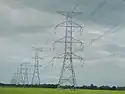 |
| 230 kV | 8 | Used on most transmission lines in Luzon, and as bulk transmission in Visayas and Mindanao. | Small to very tall double-circuit towers or poles, or single delta towers. Lines that run roadside or along railroads use steel poles. Structures usually 15–45 meters (49–148 ft)) high. |  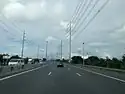    | |
| 138 kV | 7 | Used on the Visayas and Mindanao grids. | |||
| 115 kV | 6 | Transmission/sub-transmission | Medium to tall poles, and H-frame towers. Lines in Ilocos primarily use conventional towers. Meralco primarily uses double-bundle conductor for upgrades and new lines. Few lines branching. |  | |
| 69 kV | 5 | Used for sub-transmission in the majority of the country. | Medium to tall poles, and H-frame towers. Lines may branch off to supply a large industrial customer or a distribution substation. Typical height and size of structures from 15–21 meters (49–69 ft) tall. |  | |
| 20/34.5 kV | 4 | Distribution | Mostly used for distribution by Meralco in most of its coverage area. Other distributors operating lines with this voltage are CEPALCO (in Cagayan de Oro), and LIMA Enerzone (at LIMA Technology Center in Lipa and Malvar, Batangas) | Medium-size poles, usually placed roadside. Multiple wires and circuits may not be obvious from imagery. Networks form large webs of lines with many branches that may carry one or two wires. Step-down transformers normally mounted on poles. Structures typically from 12–18 meters (39–59 ft), with taller poles used in major river crossings and smaller poles in narrow streets | |
| 25 kV single-phase | none | Railway electrification | International AC railway electrification voltage. No installations yet (proposed for Mindanao Railway and PNR South Long Haul upgrades). | ||
| 7.62/13.2 kV or 8/13.8 kV | 3 | Distribution | Predominant distribution voltage supplied by the majority of electric cooperatives. 8/13.8 kV is used by Meralco (in Northern Bulacan, southern Cavite, Batangas City and San Pascual) and most other private power utilities. | Medium-size poles, usually placed roadside. Multiple wires and circuits may not be obvious from imagery. Networks form large webs of lines with many branches ("laterals") that may carry one or two wires. Step-down transformers normally mounted on poles. | |
| 3.4/4.16 kV | 2 | Used by Meralco on older inner-city distribution networks in Manila. Most systems are being replaced by 34.5 kV facilities. | |||
| 1,500 V DC | Railway electrification | Railway electrification voltage, used on LRT Line 2. Future usage on North-South Commuter Railway (NSCR) and Metro Manila Subway. Used with overhead lines supported by poles. | 6–9-meter (20–30 ft) poles. Most existing installations do not use separate feeder wire. | ||
| 750 V DC | Railway electrification voltage, either used with overhead lines or third rail. Utilized by LRT Line 1, MRT Line 3 and the future MRT Line 7. | For overhead contact systems only: 6–7-meter (20–23 ft) poles or gantries. Most existing installations use separate feeder wire, except the LRT Line 1 from Baclaran to Monumento. | |||
| 127/220, 400, and 254/440 V | none | Distribution | Voltage supplied to large commercial/industrial consumers, and high-rise buildings. Supplied through a three-phase transformer (usually a set of two or three single-phase ones), a large ground-mounted transformer, or an indoor substation. | Wires usually connect directly to a single building. Rarely used for wide-area distribution. | |
| 230 V single-phase | none | Standard supply voltage for homes and small businesses and industries. Supplied from a single transformer connected to 1 or 2 wires of a primary distribution line. | 9–9.5-meter (30–31 ft) poles. Lines either use two wires (most common) or three (American-style split-phase, with 115/230 kV. Example would be those by Meralco). |
Some nonstandard voltages are 13.2/23 kV for the Visayas Electric (VECO) distribution network in Cebu and 350 kV for HVDC Leyte–Luzon and the Visayas-Mindanao Interconnection.
Most transmission lines have two circuits (6 wires), though there are also those with only one circuit (3 wires). Sub-transmission lines are often single-circuit, while distribution lines may have more that 2 circuits carried by the same poles or structures. This do not include the ground wire used for lightning protection.
Part of a distribution circuit can be fed from another substation, where one substation has to be shut down, or a line segment is being repaired. Transmission and sub-transmission lines are usually looped in most places.
Railway traction systems are fed from the distribution or sub-transmission grids. Overhead line systems may use feeders for more efficient power transmission, but this system is only used with the LRT Line 1 Roosevelt extension and the whole MRT Line 3. LRT Line 2 and the NSCR use a feeder system that combines the feeder wire with the messenger wire (the wire where the contact wire where trains collect power hangs from); the upper arm on the poles used with this system carrying lightning protection wires instead of the feeder.
Substations
Substation names are generally prefixed with "Substation". substation=* depends on the voltages. If the higher voltage is 500 kV, 230 kV, or 138 kV, it's most likely to be substation=transmission. substation=distribution usually have an input voltage of 69 kV or 115 kV. No-name substation=minor_distribution fed by either 34.5, 23, 13.8, or 13.2 kV lines are commonly found in large buildings (e.g. malls, high-rises, college/university campuses) and supply 127/220 V or 254/440 V three-phase; otherwise, these are generally pole-mounted transformers.
Operators
| Operator | Network | Wikidata | Website | Wikipedia | Operating area | Information | Label | Taginfo |
|---|---|---|---|---|---|---|---|---|
| National Grid Corporation of the Philippines | Transmission | Q28197109 WhatLinksHere |
https://www.ngcp.ph | National Grid Corporation of the Philippines | nationwide | operator=National Grid Corporation of the Philippinesoperator:wikidata=Q28197109
|
operator=National Grid Corporation of the Philippines |
See WikiProject Power networks/Philippines/Operators for a full list of operators, particularly for distribution networks.
Data sources
Tagging examples
| Image | Tags | Notes |
|---|---|---|
 |
Transmission tower |
|
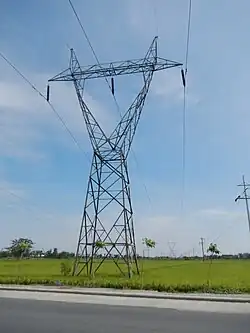 |
Transmission tower |
|
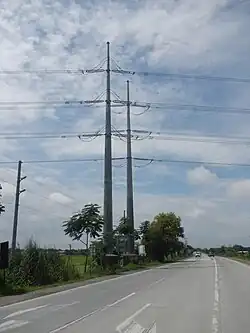 |
Transmission tower |
|
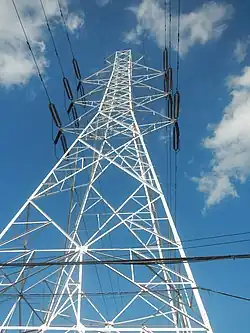 |
Transmission tower |
|
 |
Transmission tower
Transmission line |
Statistics and mapping details
- Power networks/Philippines/Power lines mapped
- Power networks/Philippines/Components of power lines
- Power networks/Philippines/Number of towers that were painted with aluminum or zinc paint
- Power networks/Philippines/Number of retired structures
- Power networks/Philippines/Power line references
- Power networks/Philippines/Power line structures references
- Power networks/Philippines/Abbreviation of substations and power plants
- Power networks/Philippines/Mapped transmission and subtransmission lines constructed by each companies
- Power networks/Philippines/Power stations/substations mapped
- Power networks/Philippines/List of relocated or reused and retired structures
Statistics
Structures
- Amount of painted structures: 581 (steel poles), 259 (lattice towers), 2 (portal towers). Total: 842
- Amount of reused structures: 18
Power lines
| Power Lines Voltage | Length |
|---|---|
| < 10 kV | 103 km |
| 10 kV - 25 kV | 244 km |
| 25 kV - 52 kV | 306 km |
| 52 kV - 132 kV | 3,671 km |
| 132 kV - 220 kV | 4,446 km |
| 220 kV - 330 kV | 4,586 km |
| 330 kV - 550 kV | 1,705 km |
| > 550 kV | 0 km |
| No voltage tagged | 909 km |
| Total | 15,974 km |
- Mapped power lines: 30 (NGCP), 1 (Meralco), 2 (BATELEC-I), 5 (BATELEC-II, including lines or line section divested from NGCP in 2011), 1 (LIMA Enerzone (LIMA Utilities), all from NGCP, originally commissioned by NAPOCOR). Total: 39