304

| Years |
|---|
| Millennium |
| 1st millennium |
| Centuries |
| Decades |
| Years |
| 304 by topic |
|---|
| Leaders |
|
| Categories |
|
| Gregorian calendar | 304 CCCIV |
| Ab urbe condita | 1057 |
| Assyrian calendar | 5054 |
| Balinese saka calendar | 225–226 |
| Bengali calendar | −290 – −289 |
| Berber calendar | 1254 |
| Buddhist calendar | 848 |
| Burmese calendar | −334 |
| Byzantine calendar | 5812–5813 |
| Chinese calendar | 癸亥年 (Water Pig) 3001 or 2794 — to — 甲子年 (Wood Rat) 3002 or 2795 |
| Coptic calendar | 20–21 |
| Discordian calendar | 1470 |
| Ethiopian calendar | 296–297 |
| Hebrew calendar | 4064–4065 |
| Hindu calendars | |
| - Vikram Samvat | 360–361 |
| - Shaka Samvat | 225–226 |
| - Kali Yuga | 3404–3405 |
| Holocene calendar | 10304 |
| Iranian calendar | 318 BP – 317 BP |
| Islamic calendar | 328 BH – 327 BH |
| Javanese calendar | 184–185 |
| Julian calendar | 304 CCCIV |
| Korean calendar | 2637 |
| Minguo calendar | 1608 before ROC 民前1608年 |
| Nanakshahi calendar | −1164 |
| Seleucid era | 615/616 AG |
| Thai solar calendar | 846–847 |
| Tibetan calendar | ཆུ་མོ་ཕག་ལོ་ (female Water-Boar) 430 or 49 or −723 — to — ཤིང་ཕོ་བྱི་བ་ལོ་ (male Wood-Rat) 431 or 50 or −722 |
Year 304 (CCCIV) was a leap year starting on Saturday of the Julian calendar. It was known in the Roman Empire as the Year of the Consulship of Diocletian and Maximian (or, less frequently, year 1057 Ab urbe condita). The denomination 304 for this year has been used since the early medieval period, when the Anno Domini calendar era became the prevalent method in Europe for naming years.
Events
By place
Roman Empire
- Caesar Galerius, perhaps accompanied by Emperor Diocletian, wins his fourth and final victory over the Carpi. Many of the surviving Carpi and Bastarnae are resettled in the Roman Empire, where they are split up. The Bastarnae are not attested after this time, and the Carpi are attested only once more in the 310s.
- Diocletian, while inspecting the Danube border, becomes seriously ill.
- Caesar Constantius I besieges a Germanic raiding force on an island in the Rhine and forces their surrender.
Asia
- Sixteen Kingdoms: The Xiongnu establishes the Han-Zhao state under Liu Yuan, often seen as the start of the Upheaval of the Five Barbarians.
- Cheng-Han earns its independence from Jin dynasty.
- Biryu becomes king of the Korean kingdom of Baekje.[1]
By topic
Religion
- October 25 – Pope Marcellinus dies at Rome after an 8-year reign. The papal throne will remain vacant until 308.
Deaths

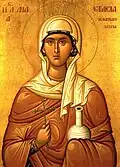
Note: Not all particulars of the Christian martyrs are supported by reliable historical evidence.
- January 21 – Saint Agnes of Rome (martyred by fire) (b. c. 291)
- March 19/20 – Sima Ai, Chinese prince of the Jin dynasty (executed) (b. 277)[2]
- May 12 (or 303?) – Saint Pancras of Rome (martyred by beheading) (b. c. 289)
- c. October? – Bunseo of Baekje, king of Baekje (Korea) (assassinated)[3]
- c. August 10 – Saint Philomena (martyred by beheading)
- October 25 – Pope Marcellinus
- December 25 – Saint Anastasia of Sirmium (martyred by beheading)
- Date unknown
- Saint Afra (martyred by fire)
- Saints Agape, Chionia, and Irene (martyred by fire and sword)
- Saint Alban (martyred by beheading) (possibly 309)
- Saint Florian (martyred by drowning)
- Saint Gorgonius of Nicomedia (martyred)
- Saint Juliana of Nicomedia (martyred)
- Saint Lucy of Syracuse (martyred by fire and sword)
- Saint Margaret the Virgin (martyred by beheading)
- Saints Theodora and Didymus (martyred by beheading)
- Saint Vincent of Saragossa (martyred)
References
- ^ "List of Rulers of Korea". www.metmuseum.org. Archived from the original on December 15, 2010. Retrieved April 20, 2019.
- ^ Knechtges, David R.; Chang, Taiping (2010). Ancient and Early Medieval Chinese Literature (vol.I): A Reference Guide, Part One. BRILL. p. 542. ISBN 9789004191273.
- ^ "List of Rulers of Korea". www.metmuseum.org. Retrieved April 20, 2019.