306

| Years |
|---|
| Millennium |
| 1st millennium |
| Centuries |
| Decades |
| Years |
| 306 by topic |
|---|
| Leaders |
|
| Categories |
|
| Gregorian calendar | 306 CCCVI |
| Ab urbe condita | 1059 |
| Assyrian calendar | 5056 |
| Balinese saka calendar | 227–228 |
| Bengali calendar | −288 – −287 |
| Berber calendar | 1256 |
| Buddhist calendar | 850 |
| Burmese calendar | −332 |
| Byzantine calendar | 5814–5815 |
| Chinese calendar | 乙丑年 (Wood Ox) 3003 or 2796 — to — 丙寅年 (Fire Tiger) 3004 or 2797 |
| Coptic calendar | 22–23 |
| Discordian calendar | 1472 |
| Ethiopian calendar | 298–299 |
| Hebrew calendar | 4066–4067 |
| Hindu calendars | |
| - Vikram Samvat | 362–363 |
| - Shaka Samvat | 227–228 |
| - Kali Yuga | 3406–3407 |
| Holocene calendar | 10306 |
| Iranian calendar | 316 BP – 315 BP |
| Islamic calendar | 326 BH – 325 BH |
| Javanese calendar | 186–187 |
| Julian calendar | 306 CCCVI |
| Korean calendar | 2639 |
| Minguo calendar | 1606 before ROC 民前1606年 |
| Nanakshahi calendar | −1162 |
| Seleucid era | 617/618 AG |
| Thai solar calendar | 848–849 |
| Tibetan calendar | ཤིང་མོ་གླང་ལོ་ (female Wood-Ox) 432 or 51 or −721 — to — མེ་ཕོ་སྟག་ལོ་ (male Fire-Tiger) 433 or 52 or −720 |
Year 306 (CCCVI) was a common year starting on Tuesday of the Julian calendar. At the time, it was known as the Year of the Consulship of Constantius and Valerius (or, less frequently, year 1059 Ab urbe condita). The denomination 306 for this year has been used since the early medieval period, when the Anno Domini calendar era became the prevalent method in Europe for naming years.
Events
By place
Roman Empire
- July 25 – Constantius I dies outside Eboracum (modern-day York). Constantine, aged 23 or 24, is declared emperor by his troops.[1] Emperor Galerius grants Constantine the title of Caesar, and elevates Flavius Valerius Severus to emperor in the Western part of the Roman Empire.[2]
- Constantine institutes toleration of the Christians in his territories.
- Constantine establishes his capital in Augusta Treverorum (Trier). He begins a major expansion of the city, strengthening the walls, expanding the palace complex and building the Imperial Baths.
- Building on the efforts of Diocletian, Galerius introduces the poll tax to central and southern Italy and truncates the size of the Praetorian Guard, with plans to disband the Guard altogether.
- October 28 – Maxentius, son of former Western Emperor Maximian, leads a revolt by the Praetorian Guard and members of the Senate in Rome, and is proclaimed Emperor. Southern Italy supports Maxentius, as do Africa, Corsica, Sardinia and Sicily. Maxentius recalls Maximian from retirement, who joins his son in Rome.
- Winter: Constantine fights with success against the Franks.
- Galerius has the Rotunda of Galerius built in Thessaloniki (Macedonia).
Asia
- The War of the Eight Princes ends in China.
By topic
Religion
- The Synod of Elvira concludes with the issue of various canons, including one declaring that killing through a magic spell is a sin and the work of the devil.
- Metrophanes becomes bishop of Byzantium.
- The Patriarchate of Lisbon is established.
- Christianity is established in Roman Britain. British bishops participate in the councils of Arles (314), Nicaea (325) and Arminum (349).
Births
- Ephrem the Syrian, Syriac theologian and hymnodist (d. 373)
Deaths
_-_Santa_Maria_del_Mar_-_Barcelona_2014.jpg)
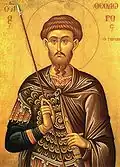
- February 17 – Theodore of Amasea, Roman soldier and martyr
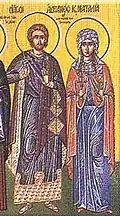
- March 4 – Adrian and Natalia of Nicomedia, Christian martyrs
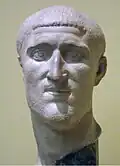
- July 25 – Constantius Chlorus, Roman emperor (b. c. 250)
- August 25 – Maginus, Christian hermit and martyr
- Demetrius of Thessaloniki, Roman soldier and martyr
- Sima Ying, Chinese prince of the Jin Dynasty (b. 279)
- Sima Yong (or Wenzai), Chinese prince and regent
References
- ^ Eutropius, Breviarum 10.1–2
- ^ Consularia Constantinopolitana 306, in Monumenta Germaniae Historica ant. 11: Chronica Minora Vol. 1 (Theodor Mommsen ed., 1892) p. 231. ISBN 978-0656631308