687
| Years |
|---|
| Millennium |
| 1st millennium |
| Centuries |
| Decades |
| Years |
| 687 by topic |
|---|
| Leaders |
|
| Categories |
|
| Gregorian calendar | 687 DCLXXXVII |
| Ab urbe condita | 1440 |
| Armenian calendar | 136 ԹՎ ՃԼԶ |
| Assyrian calendar | 5437 |
| Balinese saka calendar | 608–609 |
| Bengali calendar | 93–94 |
| Berber calendar | 1637 |
| Buddhist calendar | 1231 |
| Burmese calendar | 49 |
| Byzantine calendar | 6195–6196 |
| Chinese calendar | 丙戌年 (Fire Dog) 3384 or 3177 — to — 丁亥年 (Fire Pig) 3385 or 3178 |
| Coptic calendar | 403–404 |
| Discordian calendar | 1853 |
| Ethiopian calendar | 679–680 |
| Hebrew calendar | 4447–4448 |
| Hindu calendars | |
| - Vikram Samvat | 743–744 |
| - Shaka Samvat | 608–609 |
| - Kali Yuga | 3787–3788 |
| Holocene calendar | 10687 |
| Iranian calendar | 65–66 |
| Islamic calendar | 67–68 |
| Japanese calendar | Shuchō 2 (朱鳥2年) |
| Javanese calendar | 579–580 |
| Julian calendar | 687 DCLXXXVII |
| Korean calendar | 3020 |
| Minguo calendar | 1225 before ROC 民前1225年 |
| Nanakshahi calendar | −781 |
| Seleucid era | 998/999 AG |
| Thai solar calendar | 1229–1230 |
| Tibetan calendar | མེ་ཕོ་ཁྱི་ལོ་ (male Fire-Dog) 813 or 432 or −340 — to — མེ་མོ་ཕག་ལོ་ (female Fire-Boar) 814 or 433 or −339 |
Year 687 (DCLXXXVII) was a common year starting on Tuesday of the Julian calendar. The denomination 687 for this year has been used since the early medieval period, when the Anno Domini calendar era became the prevalent method in Europe for naming years.
Events
By place
East Asia
- Ilterish Qaghan leads the Göktürks northward from Inner Mongolia and occupies the Mongolian Plateau, marking the restoration of the Turkic Khaganate.
Byzantine Empire
- Emperor Justinian II negotiates a peace treaty with the Umayyad Caliphate (resulting in caliph Abd al-Malik paying tribute). He removes 12,000 Christian Maronites, who continually resist the Arabs, from Lebanon.[1] Justinian reinforces the Byzantine navy on Cyprus, and transfers cavalry troops from the Thracesian Theme in Anatolia to the Theme of Thrace in the Balkan Peninsula.
Europe
- Battle of Tertry: King Theuderic III of Neustria is defeated by Pepin of Herstal, mayor of the palace of Austrasia, near Péronne (modern France), at the River Somme. Theuderic withdraws to Paris and is forced to sign a peace treaty. Pepin becomes "de facto" ruler of the Frankish Kingdom, and begins calling himself Duke of the Franks. He establishes a base for the future rise of the Pippinids and the Carolingians. Pepin appoints Nordebert as Duke of Burgundy, and puts him in charge of Neustria and Burgundy (as a sort of regent).
- King Erwig dies after a 7-year reign, and is succeeded by his son-in-law Ergica as ruler of the Visigothic Kingdom.
Britain
- King Mul of Kent and 12 companions are burnt to death, during a Kentish uprising. His brother, King Cædwalla of Wessex, ravages the kingdom in revenge.
- Adomnán, Irish abbot of Iona, visits the court of King Ecgfrith, to ransom Irish captives (60 Gaels who had been captured in a Northumbrian raid).
By topic
Religion
- Cuthbert, bishop of Lindisfarne, resigns his office and retires to his hermitage on Inner Farne (Northumberland) where he dies, after a painful illness.[2]
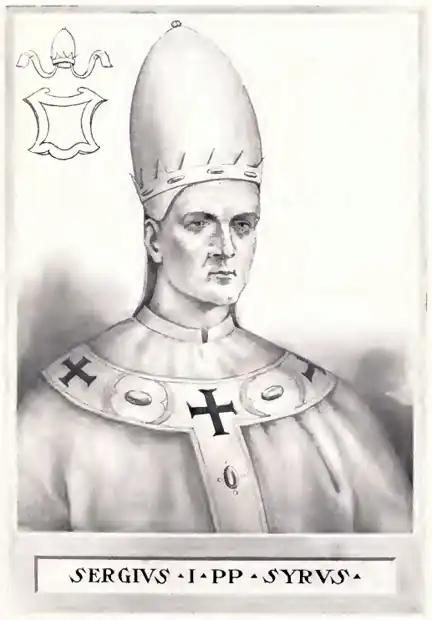
- September 21 – Pope Conon I dies at Rome after a 1-year reign, and is succeeded by Sergius I as the 84th pope of the Catholic Church.
- Construction of the Dome of the Rock, located on the Temple Mount, is started in Jerusalem (approximate date).
Births
- Eucherius, Frankish bishop (d. 743)
- Wei Jiansu, chancellor of the Tang dynasty (d. 763)
- Wittiza, king of the Visigoths (approximate date)
Deaths
- March 20 – Cuthbert, Anglo-Saxon bishop
- September 21 – Pope Conon I
- Abd Allah ibn Abbas, cousin of Muhammad
- Erwig, king of the Visigoths
- Mul, king of Kent (England)
- Romuald I
- Wamba, king of the Visigoths
References
Sources
- Bury, John Bagnall (1889). A History of the Later Roman Empire from Arcadius to Irene. Vol. II. London: Macmillan.