719
| Years |
|---|
| Millennium |
| 1st millennium |
| Centuries |
| Decades |
| Years |
| 719 by topic |
|---|
| Leaders |
|
| Categories |
|
| Gregorian calendar | 719 DCCXIX |
| Ab urbe condita | 1472 |
| Armenian calendar | 168 ԹՎ ՃԿԸ |
| Assyrian calendar | 5469 |
| Balinese saka calendar | 640–641 |
| Bengali calendar | 125–126 |
| Berber calendar | 1669 |
| Buddhist calendar | 1263 |
| Burmese calendar | 81 |
| Byzantine calendar | 6227–6228 |
| Chinese calendar | 戊午年 (Earth Horse) 3416 or 3209 — to — 己未年 (Earth Goat) 3417 or 3210 |
| Coptic calendar | 435–436 |
| Discordian calendar | 1885 |
| Ethiopian calendar | 711–712 |
| Hebrew calendar | 4479–4480 |
| Hindu calendars | |
| - Vikram Samvat | 775–776 |
| - Shaka Samvat | 640–641 |
| - Kali Yuga | 3819–3820 |
| Holocene calendar | 10719 |
| Iranian calendar | 97–98 |
| Islamic calendar | 100–101 |
| Japanese calendar | Yōrō 3 (養老3年) |
| Javanese calendar | 612–613 |
| Julian calendar | 719 DCCXIX |
| Korean calendar | 3052 |
| Minguo calendar | 1193 before ROC 民前1193年 |
| Nanakshahi calendar | −749 |
| Seleucid era | 1030/1031 AG |
| Thai solar calendar | 1261–1262 |
| Tibetan calendar | ས་ཕོ་རྟ་ལོ་ (male Earth-Horse) 845 or 464 or −308 — to — ས་མོ་ལུག་ལོ་ (female Earth-Sheep) 846 or 465 or −307 |
Year 719 (DCCXIX) was a common year starting on Sunday of the Julian calendar, the 719th year of the Common Era (CE) and Anno Domini (AD) designations, the 719th year of the 1st millennium, the 19th year of the 8th century, and the 10th and last year of the 710s decade. The denomination 719 for this year has been used since the early medieval period, when the Anno Domini calendar era became the prevalent method in Europe for naming years.
Events
By place
Byzantine Empire
- Ex-Emperor Anastasios II starts a revolt against Leo III with considerable support, including auxiliaries provided by Tervel, emperor (khagan) of the Bulgarian Empire. His attack on Constantinople fails; Anastasios is captured and is put to death (by beheading), on the orders of Leo.
Europe
- Umayyad conquest of Gaul (first major Muslim attack upon Visigothic Septimania, in southern France): Governor Al-Samh takes or re-takes Narbonne (Arbouna for the Arabs), before raiding the Toulouse area. Many town defenders and inhabitants are killed in the aftermath by the Umayyad forces.[1]
- Frisian–Frankish War: Charles Martel defeats Redbad, King of the Frisians. He easily invades Frisia (modern Netherlands) and subjugates the territory. Charles also crosses the Rhine and annexes "farther" Frisia, to the banks of the River Vlie.[2]: 795
- Duke Grimoald becomes sole ruler of Bavaria, after the deaths of his brothers Theodbert, Theobald, and Tassilo II. He reunites the duchy after a civil war, and makes his capital Salzburg (approximate date).
- May – Chilperic II is raised on the shield after the death of Chlothar IV, and recognized by Charles Martel as king (roi fainéant) of the Franks. Charles, however, gains a monopoly on power and royal offices.
By topic
Religion
- The Church of Nubia transfers its allegiance, from the Eastern Orthodox Church to the Coptic Church (approximate date).
Births
- Guan Bo, chancellor of the Tang Dynasty (d. 797)[3]
- Isma'il ibn Jafar, Shī‘ah Imām and scholar (or 722)[4][5]
- Yang Guifei, concubine of Xuan Zong (d. 756)[6][7][8]
Deaths
- Anastasios II, Byzantine emperor[9]
- Chlothar IV, king of Austrasia (approximate date)[10]
- Dae Jo-yeong, king of Balhae[11]
- Muhammad ibn Marwan, Arab general (or 720)[12][13]
- Pega, Anglo-Saxon anchoress[14]
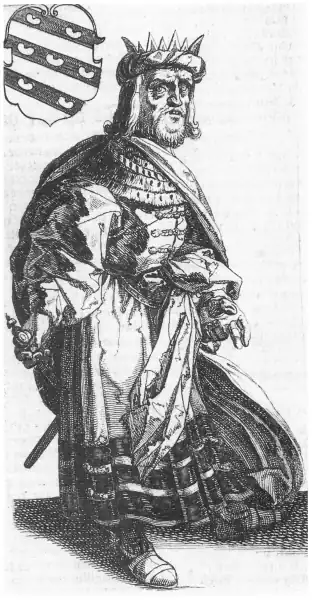
- Radbod, king of the Frisians[15]
- Tassilo II, duke of Bavaria (approximate date)[16]
- Theobald, duke of Bavaria (or 717)[17]
- Theodbert, duke of Bavaria (approximate date)[18]
References
- ^ David Nicolle (2008). Poitiers AD 732, Charles Martel turns the Islamic tide (p. 17). ISBN 978-184603-230-1
- ^ Halbertsma, Herrius (1982). "Summary". Frieslands Oudheid (PDF) (Thesis) (in Dutch). Groningen: Rijksuniversiteit Groningen. pp. 791–798. OCLC 746889526. Archived from the original (PDF) on October 1, 2013. Retrieved April 17, 2010.
- ^ "中央研究院".
- ^ Daftary, Farhad (2007). The Ismāʿı̄lı̄s: Their History and Doctrines. Cambridge University Press. p. 91. ISBN 978-0-521-61636-2. Retrieved June 14, 2024.
- ^ Ivanow, Vladimir (1942). Ismaili Tradition Concerning the Rise of the Fatimids. Islamic Research Association. p. 306. ISBN 978-0-598-52924-4. Retrieved June 14, 2024.
{{cite book}}: ISBN / Date incompatibility (help) - ^ Yang's biography in vol.76 of New Book of Tang recorded that she was 38 (by East Asian reckoning) when she died.
- ^ "Yang Guifei". www.princeton.edu. Retrieved January 16, 2025.
- ^ "Yang Guifei - A Beautiful and Talented Consort and Her Tragic Fate | ChinaFetching". ChinaFetching.com. Retrieved January 16, 2025.
- ^ "Anastasius II". De Imperatoribus Romanis. Australian Catholic University. November 25, 2000. Archived from the original on December 24, 2021. Retrieved June 14, 2024.
- ^ "Chlotar IV | Merovingian king | Britannica". Encyclopedia Britannica. Retrieved November 11, 2023.
- ^ Hollym (2004). Korean History: Discovery of Its Characteristics and Developments. Universidad de Michigan. p. 142. ISBN 9781565911772. Retrieved June 14, 2024.
- ^ Lilie, Ralph-Johannes; Ludwig, Claudia; Pratsch, Thomas; Zielke, Beate (2000). "Muḥammad ibn Marwān (# 5189)". Prosopographie der mittelbyzantinischen Zeit: 1. Abteilung (641–867), Band 3: Leon (# 4271) – Placentius (# 6265) (in German). Berlin and Boston: De Gruyter. pp. 322–323. ISBN 978-3-11-016673-6.
- ^ Zetterstéen, K. V. (1993). "Muḥammad b. Marwān". In Bosworth, C. E.; van Donzel, E.; Heinrichs, W. P. & Pellat, Ch. (eds.). The Encyclopaedia of Islam, Second Edition. Volume VII: Mif–Naz. Leiden: E. J. Brill. p. 408. doi:10.1163/1573-3912_islam_SIM_5363. ISBN 978-90-04-09419-2.
- ^ Owen, Weldon (2012). The Book of Saints: A Day-By-Day Illustrated Encyclopedia. Weldon Owen International. p. 17. ISBN 9781681887197. Retrieved June 14, 2024.
- ^ Halbertsma, Herrius (2000). Frieslands oudheid: het rijk van de Friese koningen, opkomst en ondergang (in Dutch and English). Utrecht: Matrijs. p. 90. ISBN 9789053451670.
- ^ "Thessalonus II, Duke of Bavaria". The British Museum.
- ^ "Family tree of Duke Theobald Of Bavaria". Geneanet. Retrieved January 16, 2025.
- ^ "Family tree of Duke Theodbert Of Bavaria". Geneanet. Retrieved January 16, 2025.