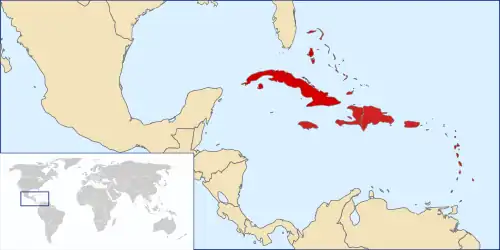
Geographically, the Antillean islands are generally considered a subregion of North America. Culturally speaking, Cuba, the Dominican Republic, and Puerto Rico – and sometimes the whole of the Antilles – are included in Latin America, although some sources use the phrase "Latin America and the Caribbean" instead.[3]
In terms of geology, the Greater Antilles are mostly made up of continental rock accreted on the North American Plate from relative movement of the Caribbean Plate. The Lesser Antilles are mostly young volcanic islands created by the Lesser Antilles subduction zone.
Background
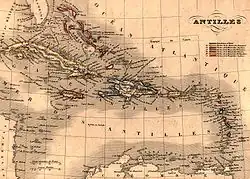
Map of Antilles / Caribbean in 1843
The word Antilles originated in the period before the European colonization of the Americas, Antilia being one of those mysterious lands which figured on the medieval charts, sometimes as an archipelago, sometimes as continuous land of greater or lesser extent, its location fluctuating in mid-ocean between the Canary Islands and India.[4]
After the 1492 arrival of Christopher Columbus's expedition in what was later called the West Indies, the European powers realized that the dispersed lands constituted an extensive archipelago in the Caribbean Sea and the Gulf of Mexico. The Antilles were called multiple names before their current name became the norm. Early Spanish visitors called them the Windward Islands (today having a narrower definition). They were also called the Forward Islands by 18th-century British.[5] Thereafter, the term Antilles was commonly assigned to the formation, and "Sea of the Antilles" became a common alternative name for the Caribbean Sea in various European languages.
Countries and territories by subregion and archipelago
^Some sources, such as Encarta in Spanish, include the Bahamas in the Antilles. [1]Archived 2009-10-04 at the Wayback Machine (in Spanish). Archived 2009-10-31.
^One or more of the preceding sentences incorporates text from a publication now in the public domain: Chisholm, Hugh, ed. (1911). "Antilles". Encyclopædia Britannica. Vol. 2 (11th ed.). Cambridge University Press. p. 126.
N.B.: Territories in italics are parts of transregional sovereign states or non-sovereign dependencies.
^These three form the SSS islands that with the ABC islands comprise the Dutch Caribbean, of which *the BES islands are not direct Kingdom constituents but subsumed with the country of the Netherlands.
†Physiographically, these continental islands are not part of the volcanic Windward Islands arc, although sometimes grouped with them culturally and politically.
ǂDisputed territories administered by Guyana. ~Disputed territories administered by Colombia.
#Bermuda is an isolated North Atlanticoceanic island, physiographically not part of the Lucayan Archipelago, Antilles, Caribbean Sea nor North American continental nor South American continental islands. It is grouped with the Northern American region, but occasionally also with the Caribbean region culturally.


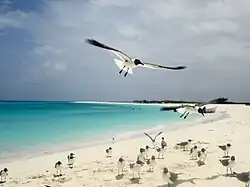
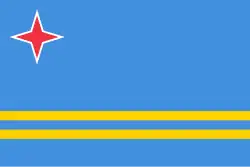 Aruba (Kingdom of the Netherlands)
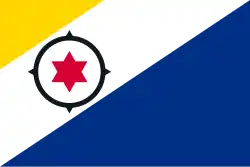 Bonaire (Netherlands)
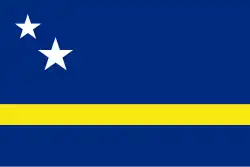 Curaçao (Kingdom of the Netherlands)
 Federal Dependencies of Venezuela
 Nueva Esparta (Venezuela)
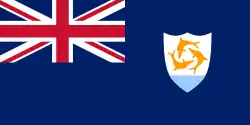 Anguilla (United Kingdom)
 Antigua and Barbuda
 British Virgin Islands (United Kingdom)
.svg.png) Guadeloupe (France)
Guadeloupe (France)

 Montserrat (United Kingdom)
 Saba (Netherlands)
.svg.png) Saint Barthélemy (France)
Saint Barthélemy (France) Saint Kitts and Nevis
 Sint Eustatius (Netherlands)
 Spanish Virgin Islands (Puerto Rico)
 United States Virgin Islands (United States)