Fra Angelico
Fra Angelico | |
|---|---|
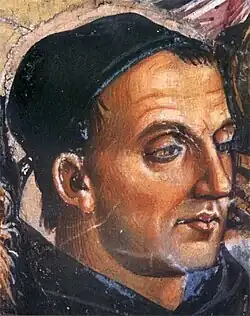 Posthumous portrait from The Preaching of the Antichrist by Luca Signorelli (c. 1501) in Orvieto Cathedral, Italy | |
| Born | Guido di Pietro c. 1395 Vicchio, Mugello, Republic of Florence |
| Died | 5 March 1455 (aged about 60) |
| Resting place | Church of Santa Maria sopra Minerva, Rome |
| Known for | Painting, Fresco |
| Notable work | Annunciation of Cortona Fiesole Altarpiece San Marco Altarpiece Deposition of Christ Niccoline Chapel |
| Movement | Early Renaissance |
| Patrons | Cosimo de' Medici Pope Eugene IV Pope Nicholas V |
John of Fiesole | |
|---|---|
| Venerated in | Catholic Church (Dominican Order) |
| Beatified | 3 October 1982, Vatican City, by Pope John Paul II |
| Major shrine | Santa Maria sopra Minerva, Rome |
| Feast | 18 February |
Fra Giovanni da Fiesole (Vicchio, c. 1395 – Rome, 18 February 1455), known posthumously as Fra Angelico (/ˌfrɑː ænˈdʒɛlɪkoʊ/ FRAH an-JEL-ik-oh, Italian: [ˈfra anˈdʒɛːliko], was a Dominican friar and painter active during the early Florentine Renaissance during the 15th century.
Angelico created a series of frescoes for the Dominican convent of San Marco in Florence, where he received the patronage of Cosimo de' Medici. His works include the San Marco Altarpiece and the Deposition of Christ, both made for the convent of San Marco. Painting exclusively religious subjects throughout his career, Angelico completed commissions in Rome under the patronage of two popes. Angelico was a pioneer of the artistic trends that came to distinguish the early Renaissance, namely linear perspective and a greater attention to depth and form than had been practised in the late Medieval period.[1]
Angelico was beatified by Pope John Paul II in 1982. In 1984, John Paul II declared him the patron of Catholic artists.
Biography
He was known to his contemporaries as Fra Giovanni da Fiesole ("Friar John of Fiesole"), reflecting the town where he joined the Dominican order, and Fra Giovanni Angelico ("Angelic Brother John"). In modern Italian, he is called Beato Angelico ("Blessed Angelic One") following his beatification by Pope John Paul II.
Early life, 1395–1436
Fra Angelico was born around 1395[2] in Mugello, near Fiesole in Tuscany. He was baptised Guido di Pietro and had a younger brother named Benedetto. The earliest known record of him is dated 17 October 1417, when he joined a religious confraternity or guild at the Carmine Church under the name Guido di Pietro. Payments made to Guido di Pietro in January and February 1418 for work at the church of Santo Stefano del Ponte in Florence indicate that he was already working as a painter.[3]
By 1423, Angelico had joined the convent of San Domenico in Fiesole. Following the custom of adopting a new name upon entering a religious order, he took the name Fra Giovanni (Friar John).[4] As a Dominican, he relied on alms and donations rather than working for profit. Angelico initially trained as a manuscript illuminator and may have collaborated with his brother Benedetto, who also joined the Dominican Order. Several manuscripts with illuminations attributed to him are preserved at the former Dominican convent of San Marco, now a state museum.[5] His artistic training may have included instruction from Lorenzo Monaco, and influences from the Sienese school are evident in his work.[6] Angelico trained also with Master Varricho in Milan.[7] According to Giorgio Vasari, Angelico's first major works were an altarpiece and a painted screen for the Charterhouse (Carthusian monastery) of Florence, though nothing remains of these today.[5]
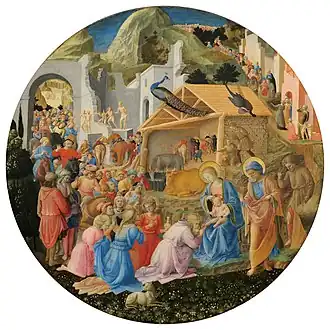
From 1408 to 1418 Angelico painted frescoes, many of which have now been lost, at the Dominican friary of Cortona as an assistant to Gherardo Starnina or one of his followers.[8] By 1418 he had returned in Fiesole, where he executed a number of works for the monastery, including the Fiesole Altarpiece. A predella of the altarpiece depicting Christ in Glory alongside over 250 figures, including beatified Dominicans, is conserved in the National Gallery.[9] Around 1427, Angelico produced an altarpiece depicting the Coronation of the Virgin, which remained at San Domenico until 1812 when artist and collector Vivant Denon acquired it for the Louvre.[10] Angelico also produced a Madonna of Humility now in the Thyssen-Bornemisza Museum. Also completed at this time were an Annunciation and a Madonna of the Pomegranate, both of which are now in the Prado Museum.
San Marco, Florence, 1436–1445
In 1436, Angelico was one of a number of friars from Fiesole who moved to the newly built convent of San Marco in Florence. This move that placed him at the heart of artistic life of the region. During these years in Florence, he was certainly in contact with the three artistic circles in city in the early 15th century: the school of miniaturists, the workshops of the last Giottesque students (followers of Giotto), and the group of young sculptors and architects destined for great fame: Jacopo della Quercia, Lorenzo Ghiberti, Filippo Brunelleschi and Donatello.[11]
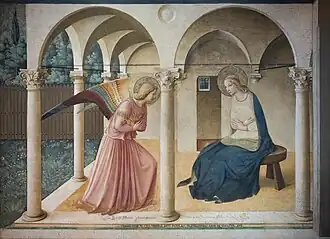
Angelico soon attracted the patronage of Cosimo de' Medici, one of the wealthiest and most powerful members of the city's governing authority (or "Signoria"), and founder of the Medici Dynasty that was set to dominate Florentine politics for much of the Renaissance. Cosimo had a cell reserved for himself at the friary so that he might "retreat from the world". Vasari reports that Cosimo commissioned Angelico to decorate the convent with frescoes, which were greatly admired at the time.[12] They include the magnificent fresco of the Chapter House, the much-reproduced Annunciation at the top of the stairs leading to the cells, the Maesta (or Coronation of the Madonna) with Saints (cell 9), and many other smaller devotional frescoes in the cells depicting stories of the Nativity and Passion of Jesus.[5]
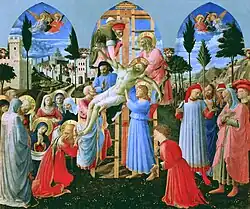
In his early works, Angelico retained a Gothic style. In the small tabernacles in San Marco, however, the adroit simplicity of his compositions and colour begin to demonstrate his mature style that would remain characteristic of his works. In his Deposition of Christ, produced for the Strozzi Chapel in Santa Trinita, he reached the full expression of his style. In this painting, the naturalistic spirit of the 15th century is affirmed by the lifelike figures, who possess a variety of expressions and gestures, as well as in the representation of a naturalistic landscape, which replaced the traditional gold ground typical of the Gothic period.
In 1439 Angelico completed one of his most famous and influential works: the San Marco Altarpiece. It created a new religious genre, Sacra Conversazione (Sacred Conversation), later used by artists including Giovanni Bellini, Titian, Perugino and Raphael.[13] Although representations of the enthroned Madonna and Child surrounded by saints were common, they were depicted in a heavenly-like setting, hovering as ethereal presences rather than with earthly substance. In the San Marco Altarpiece, the saints stand squarely within the space, grouped in a natural way as if conversing about their shared witness of the Virgin in glory.

The Vatican, 1445–1455
In 1445 Pope Eugene IV summoned Angelico to Rome to paint the frescoes of the Chapel of the Holy Sacrament at St Peter's, later demolished by Pope Paul III. Vasari suggests that at this time Angelico was offered the Archbishopric of Florence by Pope Nicholas V, which he rejected, recommending another friar in his place. However, the story runs against the historical facts. In 1445 the Pope was Eugene IV and Nicholas was not to be elected until two years later in March of 1447. The archbishop in question during 1446–1459 was the Dominican Antoninus of Florence (Antonio Pierozzi), who was canonised by Pope Adrian VI in 1523.
In 1447 Angelico was in Orvieto with his pupil, Benozzo Gozzoli, executing works for the Cathedral. Among his other pupils were Zanobi Strozzi.[14]
From 1447 to 1449 Angelico was back at the Vatican, designing the frescoes for the Niccoline Chapel for Nicholas V. The scenes from the lives of the two martyred deacons of the Early Christian Church, St. Stephen and St. Lawrence may have been executed wholly or in part by assistants. The small chapel, with its brightly frescoed walls and gold leaf decorations, gives the impression of a jewel box. From 1449 until 1452, Angelico was back at his old convent of Fiesole, where he became the Prior.[5][15]
Death and beatification

Fra Angelico died in 1455 while staying at a Dominican convent in Rome, perhaps on an order to work on Pope Nicholas' chapel. He was buried in the church of Santa Maria sopra Minerva, in Rome.[5][15][16] Angelico was interred in a niche near the altar in a marble tomb, an honour for an artist of the period. The tombstone is an effigy carved in relief depicting Angelico in a Dominican habit. Above the tomb are two epitaphs, probably by Lorenzo Valla. The first depicts Angelico in relief with the epitaph:
Give me not praise for being another Apelles,
But say, rather, that in the name of Christ, that I gave all I had to the poor.
The deeds that count on Earth are not the ones that count in Heaven.
That city which is the flower of Etruria bore me, Giovanni.[5]
Below this is inscribed:
In this place is enshrined the glory, the mirror, and the ornament of painters, John the Florentine. A religious and a true servant of God, he was a brother of the holy Order of Saint Dominic. His disciples mourn the death of such a great master, for who will find another brush like his? His homeland and his order mourn the death of a distinguished painter, who had no equal in his art.
The English writer and critic William Michael Rossetti wrote of the friar:
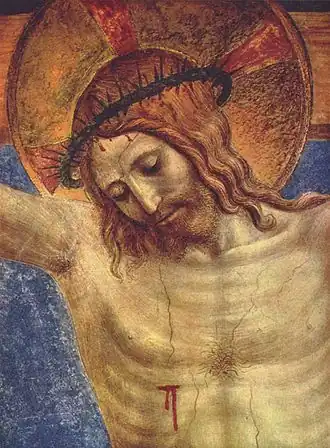
From various accounts of Fra Angelico's life, it is possible to gain some sense of why he was deserving of canonization. He led the devout and ascetic life of a Dominican friar, and never rose above that rank; he followed the dictates of the order in caring for the poor; he was always good-humored. All of his many paintings were of divine subjects, and it seems that he never altered or retouched them, perhaps from a religious conviction that, because his paintings were divinely inspired, they should retain their original form. He was wont to say that he who illustrates the acts of Christ should be with Christ. It is averred that he never handled a brush without fervent prayer and he wept when he painted a Crucifixion. The Last Judgment and the Annunciation were two of the subjects he most frequently treated.[17][15]
Pope John Paul II beatified Angelico on 3 October 1982 and in 1984 he declared him patron of Catholic artists.[18] John Paul II noted that:
Angelico was reported to say "He who does Christ's work must stay with Christ always". This motto earned him the epithet "Blessed Angelico", because of the perfect integrity of his life and the almost divine beauty of the images he painted, to a superlative extent those of the Blessed Virgin Mary.
He is commemorated by the current Roman Martyrology on 18 February,[19] the date of his death in 1455. There the Latin text reads Beatus Ioannes Faesulanus, cognomento Angelicus ("Blessed John of Fiesole, known as the Angelic").
Evaluation

Background
Angelico worked during a period where artistic style and taste changed dramatically. The development from Medieval to Early Renaissance had begun in the late fourteenth century with the works of Giotto and his contemporaries, namely Giusto de' Menabuoi. Both artists had produced their major works in Padua, though Giotto had been trained in Florence by the Gothic artist Cimabue. Giotto had painted a fresco cycle of St Francis in the Bardi Chapel in Santa Croce, Florence, and had many enthusiastic followers who imitated his frescoes. Some of them, notably Pietro and Ambrogio Lorenzetti, achieved great success.[13]
Altarpieces
The works of Angelico are both conservatively Gothic and progressively Renaissance. In the altarpiece of the Coronation of the Virgin, painted for the Florentine church of Santa Maria Novella, are all the elements that a very expensive altarpiece of the 14th century was expected to provide; a precisely tooled gold ground, much azure, and much vermilion. The workmanship of the gilded haloes and gold-edged robes is exquisite and all very Gothic. What makes this a Renaissance painting, as against Gentile da Fabriano's masterpiece, is the solidity, three-dimensionality and naturalism of the figures and the realistic way in which their garments hang or drape around them. Even though it is clouds these figures stand upon, and not the earth, they do so with weight.
Frescoes
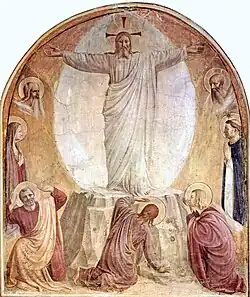
The series of frescoes that Fra Angelico painted for the Dominican friars at San Marco realise the advancements made by Masaccio and carry them further. Away from the constraints of wealthy clients and the limitations of panel painting, Angelico was able to express his deep reverence for his God and his knowledge and love of humanity. The meditational frescoes in the cells of the convent have a quieting quality about them. They are humble works in simple colours. There is more mauvish pink than there is red, and the brilliant and expensive blue is almost totally lacking. In its place is dull green and the black and white of Dominican robes. There is nothing lavish, nothing to distract from the spiritual experiences of the humble people who are depicted within the frescoes. Each one has the effect of bringing an incident of the life of Christ into the presence of the viewer. They are like windows into a parallel world. These frescoes remain a powerful witness to the piety of the man who created them.[13] Vasari relates that Cosimo de' Medici seeing these works, inspired Angelico to create a large Crucifixion scene with many saints for the Chapter House. As with the other frescoes, the wealthy patronage did not influence the Friar's artistic expression with displays of wealth.[5]
Masaccio ventured into perspective with his creation of a realistically painted niche at Santa Maria Novella. Subsequently, Angelico demonstrated an understanding of linear perspective particularly in his Annunciation paintings set inside the sort of arcades that Michelozzo and Brunelleschi created at San Marco and the square in front of it.[13]
Lives of the Saints
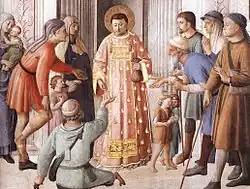
When Fra Angelico and his assistants went to the Vatican to decorate the chapel of Pope Nicholas, the artist was again confronted with the need to please the very wealthiest of clients. In consequence, walking into the small chapel is like stepping into a jewel box. The walls are decked with the brilliance of colour and gold that one sees in the most lavish creations of the Gothic painter Simone Martini at the Lower Church of St Francis of Assisi, a hundred years earlier. Yet Angelico has succeeded in creating designs which continue to reveal his own preoccupation with humanity, with humility and with piety. The figures, in their lavish gilded robes, have the sweetness and gentleness for which his works are famous. According to Vasari, "in their bearing and expression, the saints painted by Angelico come nearer to the truth than the figures done by any other artist."[21]
It is probable that much of the actual painting was done by his assistants to his design. Both Benozzo Gozzoli and Gentile da Fabriano were highly accomplished painters. Benozzo took his art further towards the fully developed Renaissance style with his expressive and lifelike portraits in his masterpiece depicting the Journey of the Magi, painted in the Medici's private chapel at their palazzo.[22]
%253B_Fra_Angelico1.jpg)
Artistic legacy
Through Fra Angelico's pupil Benozzo Gozzoli's careful portraiture and technical expertise in the art of fresco we see a link to Domenico Ghirlandaio, who in turn painted extensive schemes for the wealthy patrons of Florence, and through Ghirlandaio to his pupil Michelangelo and the High Renaissance.
When Michelangelo took up the Sistine Chapel commission, he was working within a space that had already been extensively decorated by other artists. Around the walls the Life of Christ and Life of Moses were depicted by a range of artists including his teacher Ghirlandaio, Raphael's teacher Perugino and Botticelli. They were works of large scale and exactly the sort of lavish treatment to be expected in a Vatican commission, vying with each other in the complexity of design, number of figures, elaboration of detail and skilful use of gold leaf. Above these works stood a row of painted Popes in brilliant brocades and gold tiaras. None of these splendours have any place in the work which Michelangelo created. Michelangelo, when asked by Pope Julius II to ornament the robes of the Apostles in the usual way, responded that they were very poor men.[13]
Within the cells of San'Marco, Fra Angelico had demonstrated that painterly skill and the artist's personal interpretation were sufficient to create memorable works of art, without the expensive trappings of blue and gold. In the use of the unadorned fresco technique, the clear bright pastel colours, the careful arrangement of a few significant figures and the skillful use of expression, motion and gesture, Michelangelo showed himself to be the artistic descendant of Fra Angelico. Frederick Hartt describes Fra Angelico as "prophetic of the mysticism" of painters such as Rembrandt, El Greco and Zurbarán.[13]
Vasari praised Fra Angelico: "it is impossible to bestow too much praise on this holy father, who was so humble and modest in all that he did and said and whose pictures were painted with such facility and piety." [5]
Works


Early works, 1408–1436
Unknown
- Saint James and Saint Lucy Predella, five panels, tempera, c. 1426 to 1428
Rome
- The Crucifixion, panel, c. 1420–1423, Metropolitan Museum, New York.[23] Possibly Fra Angelico's only signed work.[24]
Cortona
- Annunciation, c. 1430, Diocesan Museum, Cortona
Fiesole
- Coronation of the Virgin, altarpiece with predellas of Miracles of St Dominic, Church of San Domenico, Louvre, Paris
- Virgin and Child between Saints Thomas Aquinas, Barnabas, Dominic and Peter Martyr, altarpiece, San Domenico, 1424
- Christ in Majesty, predella, National Gallery, London.
Florence, Basilica di San Marco
- Dormition of the Virgin, 1431[25]
Florence, Santa Trinita
- Deposition of Christ, altarpiece, National Museum of San Marco, Florence.
- Coronation of the Virgin, c. 1432, Uffizi, Florence
- Coronation of the Virgin, c. 1434–1435, Louvre, Paris
Florence, Santa Maria degli Angeli
- Last Judgement, Accademia, Florence
Florence, Santa Maria Novella
- Coronation of the Virgin, altarpiece, Uffizi.
San Marco, Florence, 1436–1445
- Altarpiece for chancel – Virgin with Saints Cosmas and Damian, attended by Saints Dominic, Peter, Francis, Mark, John Evangelist and Stephen. Cosmas and Damian were patrons of the Medici. The altarpiece was commissioned in 1438 by Cosimo de' Medici. It was removed and disassembled during the renovation of the convent church in the seventeenth century. Two of the nine predella panels remain at the convent; seven are in Washington, Munich, Dublin and Paris. Unexpectedly, in 2006 the last two missing panels, Dominican saints from the side panels, turned up in the estate of a modest collector in Oxfordshire, who had bought them in California in the 1960s.[26]

- Altarpiece ? – Madonna and Child with Twelve Angels (life sized); Uffizi.
- Altarpiece – The Annunciation
- San Marco Altarpiece
- Two versions of the Crucifixion with St Dominic; in the Cloister
- Very large Crucifixion with Virgin and 20 Saints; in the Chapter House
- The Annunciation; at the top of the Dormitory stairs. This is probably the most reproduced of all Fra Angelico's paintings.
- Virgin Enthroned with Four Saints; in the Dormitory passage

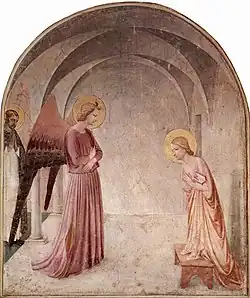
Each cell is decorated with a fresco which matches in size and shape of the single round-headed window beside it. The frescoes are apparently for contemplative purposes. They have a pale, serene, unearthly beauty. Many of Fra Angelico's finest and most reproduced works are among them. There are, particularly in the inner row of cells, some of the less inspiring quality and of the more repetitive subject, perhaps completed by assistants.[13] Many pictures include Dominican saints as witnesses of the scene each in one of the nine traditional prayer postures depicted in De Modo Orandi. The friar using the cell could place himself in the scene.
- The Adoration of the Magi
- The Transfiguration
- Noli me tangere
- The Three Marys at the Tomb.
- The Road to Emmaus, with two Dominicans as the disciples
- The Mocking of Christ
- There are many versions of the Crucifixion
Late works, 1445–1455
Orvieto Cathedral
Three segments of the ceiling in the Cappella Nuova, with the assistance of Benozzo Gozzoli.
- Christ in Glory
- The Virgin Mary
- The Apostles
Niccoline Chapel
The Chapel of Pope Nicholas V, at the Vatican, was probably painted with much assistance from Benozzo Gozzoli and Gentile da Fabriano. The entire surface of the wall and ceiling is sumptuously painted. There is much gold leaf for borders and decoration, and a great use of brilliant blue made from lapis lazuli.
- The Life of St Stephen
- The Life of St Lawrence
- The Four Evangelists.
Discovery of lost works
In September 2006 two works by Angelico were identified in a private collection in Oxford. The owner, Jean Preston, had inherited them from her father, who had bought them for £100 in the 1960s.[27] Preston had recognised them as high-quality Florentine renaissance, but did not realize that they were works by Angelico until they were identified in 2005 by Michael Liversidge of Bristol University.[28] The works are two of eight side panels of the San Marco Altarpiece, produced in 1439 and later separated by Napoleon's army. While the centre section is still held in San Marco, the other six side panels are in German and US museums. The Italian Government had hoped to purchase them but they were outbid at auction on 20 April 2007 by a private collector for £1.7M.[27] Both panels are now restored and exhibited in the San Marco Museum in Florence.
See also
- List of Italian painters
- List of famous Italians
- Early Renaissance painting
- Poor Man's Bible
- Fray Angelico Chavez – Franciscan friar, historian and artist who was named after Fra Angelico due to his interest in painting
- Western painting
Footnotes
- ^ Finocchio, Ross (2006-10-01). "Fra Angelico (ca. 1395–1455) - The Metropolitan Museum of Art". www.metmuseum.org. Retrieved 2026-01-08.
- ^ "Metropolitan Museum of Art".
- ^ Werner Cohn, Il Beato Angelico e Battista di Biagio Sanguigni. Revista d'Arte, V, (1955): 207–221.
- ^ Stefano Orlandi, Beato Angelico; Monographia Storica della Vita e delle Opere con Un'Appendice di Nuovi Documenti Inediti. Florence: Leo S. Olschki Editore, 1964.
- ^ a b c d e f g h Giorgio Vasari, Lives of the Artists. Penguin Classics, 1965.
- ^ Williamson, Beth (2018). Fra Angelico: Heaven On Earth. Boston: Isabella Stewart Gardner Museum, Paul Holberton Publishing. p. 41. ISBN 978-1-911300-39-7.
{{cite book}}: CS1 maint: date and year (link) - ^ Rossetti 1911, pp. 6–7.
- ^ "Gherardo Starnina". Artists. Getty Center. Archived from the original on 2007-09-26. Retrieved 2007-09-28.Getty Education[]
- ^ Gordon, Dillian; Wyld, Martin; Roy, Ashok (2002). "Fra Angelico's Predella for the High Altarpiece of San Domenico, Fiesole" (PDF). National Gallery Technical Bulletin. London: National Gallery Company. ISBN 1-85709-941-9. ISSN 0140-7430. Retrieved 9 December 2025N.
{{cite web}}: CS1 maint: url-status (link) - ^ Rubin, Patricia (2004). "Hierarchies of Vision: Fra Angelico's "Coronation of the Virgin" from San Domenico, Fiesole". Oxford Art Journal. 27 (2): 137–153. ISSN 0142-6540.
- ^ Papini, Roberto. "ANGELICO, il Beato (Enciclopedia Italiana – 1929)" [Angelico, The Blessed]. Trecannioo (in Italian). Retrieved 9 December 2025.
- ^ Norwich, John Julius (1990). Oxford Illustrated Encyclopedia Of The Arts. USA: Oxford University Press. pp. 16. ISBN 978-0-19-869137-2.
- ^ a b c d e f g Frederick Hartt, A History of Italian Renaissance Art, (1970) Thames & Hudson, ISBN 0-500-23136-2
- ^ "Strozzi, Zanobi". The National Gallery, London. Archived from the original on 2007-10-14. Retrieved 2007-09-28.
- ^ a b c Rossetti, William Michael (as attributed) (18 March 2016). "Fra Angelico". orderofpreachersindependent.org. Retrieved 1 May 2016.
- ^ The tomb has been given greater visibility since the beatification.
- ^ Rossetti 1911, p. 7.
- ^ Bunson, Matthew; Bunson, Margaret (1999). John Paul II's Book of Saints. Our Sunday Visitor. p. 156. ISBN 0-87973-934-7.
- ^ Martyrologium Romanum, ex decreto sacrosancti oecumenici Concilii Vaticani II instauratum auctoritate Ioannis Pauli Pp. II promulgatum, editio [typica] altera, Typis Vaticanis, A.D. MMIV (2004), p. 155 ISBN 88-209-7210-7
- ^ Zuffi, Stefano; Hyams, Jay; Seppi, Giorgio; Pauli, Tatjana; Scardoni, Sergio (2003). The Renaissance: 1401-1610: the splendor of European art. New York: Barnes & Noble Books. ISBN 978-0-7607-4200-6. OCLC 53441832.
- ^ Cite error: The named reference
Vasari2was invoked but never defined (see the help page). - ^ Paolo Morachiello, Fra Angelico: The San Marco Frescoes. Thames and Hudson, 1990. ISBN 0-500-23729-8
- ^ The Crucifixion in the online databank of the MET.
- ^ Ross Finocchio in an essay on Fra Angelico at The Met's Heilbrunn Timeline of Art History in 2006.
- ^ "Dormition of the Virgin". on WikiArt.org
- ^ "San Marco Altarpiece". Web Gallery of Art. Retrieved 2014-05-29.
- ^ a b Morris, Steven (20 April 2007). "Lost altar masterpieces found in spare bedroom fetch £1.7m". The Guardian. Retrieved 2007-09-28.
- ^ Morris, Steven (14 November 2006). "A £1m art find behind the spare room door". The Guardian. Retrieved 2007-09-28.
References
- This article incorporates text from a publication now in the public domain: Rossetti, William Michael (1911). "Angelico, Fra". In Chisholm, Hugh (ed.). Encyclopædia Britannica. Vol. 2 (11th ed.). Cambridge University Press. pp. 6–8. Rossetti's article includes an assessment of the body of work, from the pre-Raphaelite viewpoint.
- Hood, William. Fra Angelico at San Marco. Yale University Press, 1993. ISBN 978-0-300-05734-8
- Morachiello, Paolo. Fra Angelico: The San Marco Frescoes. Thames and Hudson, 1990. ISBN 0-500-23729-8
- Frederick Hartt. A History of Italian Renaissance Art, Thames & Hudson, 1970. ISBN 0-500-23136-2
- Giorgio Vasari. Lives of the Artists. first published 1568. Penguin Classics, 1965.
- Donald Attwater. The Penguin Dictionary of Saints. Penguin Reference Books, 1965.
- Luciano Berti. Florence, the city and its Art. Bercocci, 1979.
- Werner Cohn. Il Beato Angelico e Battista di Biagio Sanguigni. Revista d'Arte, V, (1955): 207–221.
- Stefano Orlandi. Beato Angelico; Monographia Storica della Vita e delle Opere con Un'Appendice di Nuovi Documenti Inediti. Florence: Leo S. Olschki Editore, 1964.
Further reading
- Nathaniel Silver (ed.), Fra Angelico: Heaven on Earth, Isabella Stewart Gardner Museum, Boston 2018
- Gerardo de Simone, Il Beato Angelico a Roma. Rinascita delle arti e Umanesimo cristiano nell'Urbe di Niccolò V e Leon Battista Alberti, Fondazione Carlo Marchi, Studi, vol. 34, Olschki, Firenze 2017
- Cyril Gerbron, Fra Angelico. Liturgie et mémoire (= Études Renaissantes, 18), Brepols Publishers, Turnhout 2016. ISBN 978-2-503-56769-3;
- Gerardo de Simone, "La bottega di un frate pittore: il Beato Angelico tra Fiesole, Firenze e Roma", in Revista Diálogos Mediterrânicos, n. 8, Curitiba (Brasil) 2015, ISSN 2237-6585, pp. 48–85 – http://www.dialogosmediterranicos.com.br/index.php/RevistaDM
- Gerardo de Simone, "Fra Angelico: perspectives de recherche, passées et futures", in Perspective, la revue de l'INHA. Actualités de la recherche en histoire de l'art, 1/2013, pp. 25–42
- Gerardo de Simone, "Velut alter Iottus. Il Beato Angelico e i suoi 'profeti trecenteschi'", in 1492. Rivista della Fondazione Piero della Francesca, 2, 2009 (2010), pp. 41–66
- Gerardo de Simone, "L'Angelico di Pisa. Ricerche e ipotesi intorno al Redentore benedicente del Museo Nazionale di San Matteo", in Polittico, Edizioni Plus – Pisa University Press, 5, Pisa 2008, pp. 5–35
- Gerardo de Simone, "L'ultimo Angelico. Le "Meditationes" del cardinal Torquemada e il ciclo perduto nel chiostro di S. Maria sopra Minerva", in Ricerche di Storia dell'Arte, Carocci Editore, Roma 2002, pp. 41–87
- Creighton Gilbert, How Fra Angelico and Signorelli Saw the End of the World, Penn State Press, 2002 ISBN 0-271-02140-3
- John T. Spike, Angelico, New York 1997.
- Georges Didi-Huberman, Fra Angelico: Dissemblance and Figuration. University of Chicago Press, Chicago 1995. ISBN 0-226-14813-0 Discussion of how Fra Angelico challenged Renaissance naturalism and developed a technique to portray "unfigurable" theological ideas.
- J. B. Supino, Fra Angelico, Alinari Brothers, Florence, undated, from Project Gutenberg
- Povoledo, Elisabetta, "Reuniting the Great Works of the Patron Saint of Artists: A new exhibition in Italy puts the spotlight on Fra Angelico, whose reputation for piety vied with his undeniable artistic talents." The New York Times, September 22, 2025. Article about Fondazione Palazzo Strozzi and the Museo di San Marco exhibit.
- Farago, Jason, "Fra Angelico and the Miracle of Faith Made Visible" The New York Times, October 8, 2025. Article about Fondazione Palazzo Strozzi and the Museo di San Marco exhibit.
External links


- Fra Angelico – Painter of the Early Renaissance
- Fra Angelico in the "History of Art" Archived 2012-02-25 at the Wayback Machine
- Ross Finocchio, Robert Lehman Collection, The Metropolitan Museum of Art
- Fra Angelico Exhibition at the Metropolitan Museum of Art, (October 26, 2005 – January 29, 2006).
- "Soul Eyes" Archived 2008-12-03 at the Wayback Machine Review of the Fra Angelico show at the Met, by Arthur C. Danto in The Nation, (January 19, 2006).
- Fra Angelico, Catherine Mary Phillimore, (Sampson Low, Marston & Co., 1892)
- Frescoes and paintings gallery Archived 2016-03-04 at the Wayback Machine
- Italian Paintings: Florentine School, a collection catalog containing information about the artist and his works (see pages 77–82).
- "From September 26, 2025, to January 25, 2026, the Fondazione Palazzo Strozzi and the Museo di San Marco present Fra Angelico...."
A list of all the congregations, notable members, priories, churches, and convents of the Order of Preachers (Dominicans) | |||||||||||||||||||||||||||||||||||
| |||||||||||||||||||||||||||||||||||
| |||||||||||||||||||||||||||||||||||
| |||||||||||||||||||||||||||||||||||
 Catholicism portal Catholicism portal | |||||||||||||||||||||||||||||||||||