Colombia national football team
 | |||||||||||||||||||||||||||||||||||||||||||||
| Nickname(s) | Los Cafeteros (The Coffee Growers) La Tricolor (The Tricolour) La Sele (The Sele) | ||||||||||||||||||||||||||||||||||||||||||||
|---|---|---|---|---|---|---|---|---|---|---|---|---|---|---|---|---|---|---|---|---|---|---|---|---|---|---|---|---|---|---|---|---|---|---|---|---|---|---|---|---|---|---|---|---|---|
| Association | Federación Colombiana de Fútbol (FCF) | ||||||||||||||||||||||||||||||||||||||||||||
| Confederation | CONMEBOL (South America) | ||||||||||||||||||||||||||||||||||||||||||||
| Head coach | Néstor Lorenzo | ||||||||||||||||||||||||||||||||||||||||||||
| Captain | James Rodríguez | ||||||||||||||||||||||||||||||||||||||||||||
| Most caps | David Ospina (129) | ||||||||||||||||||||||||||||||||||||||||||||
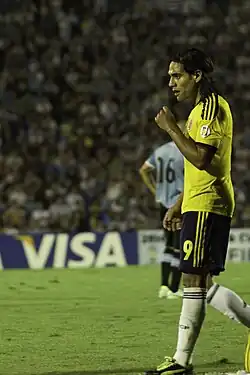
| Top scorer | Radamel Falcao (36) | ||||||||||||||||||||||||||||||||||||||||||||
| Home stadium | Estadio Metropolitano Roberto Meléndez[1] | ||||||||||||||||||||||||||||||||||||||||||||
| FIFA code | COL | ||||||||||||||||||||||||||||||||||||||||||||
| |||||||||||||||||||||||||||||||||||||||||||||
| FIFA ranking | |||||||||||||||||||||||||||||||||||||||||||||
| Current | 13  (22 December 2025)[2] (22 December 2025)[2] | ||||||||||||||||||||||||||||||||||||||||||||
| Highest | 3 (July–August 2013, September 2014 – March 2015, June–August 2016) | ||||||||||||||||||||||||||||||||||||||||||||
| Lowest | 54 (June 2011) | ||||||||||||||||||||||||||||||||||||||||||||
| First international | |||||||||||||||||||||||||||||||||||||||||||||
 Colombia 4–1 Costa Rica Colombia 4–1 Costa Rica  (Barranquilla, Colombia; 17 February 1926)[3][4] | |||||||||||||||||||||||||||||||||||||||||||||
| Biggest win | |||||||||||||||||||||||||||||||||||||||||||||
 Bahrain 0–6 Colombia Bahrain 0–6 Colombia (Riffa, Bahrain; 26 March 2015)[5] | |||||||||||||||||||||||||||||||||||||||||||||
| Biggest defeat | |||||||||||||||||||||||||||||||||||||||||||||
.svg.png) Brazil 9–0 Colombia Brazil 9–0 Colombia (Lima, Peru; 24 March 1957)[6] | |||||||||||||||||||||||||||||||||||||||||||||
| World Cup | |||||||||||||||||||||||||||||||||||||||||||||
| Appearances | 7 (first in 1962) | ||||||||||||||||||||||||||||||||||||||||||||
| Best result | Quarter-finals (2014) | ||||||||||||||||||||||||||||||||||||||||||||
| Copa América | |||||||||||||||||||||||||||||||||||||||||||||
| Appearances | 24 (first in 1945) | ||||||||||||||||||||||||||||||||||||||||||||
| Best result | Champions (2001) | ||||||||||||||||||||||||||||||||||||||||||||
| CONCACAF Gold Cup | |||||||||||||||||||||||||||||||||||||||||||||
| Appearances | 3 (first in 2000) | ||||||||||||||||||||||||||||||||||||||||||||
| Best result | Runners-up (2000) | ||||||||||||||||||||||||||||||||||||||||||||
| Confederations Cup | |||||||||||||||||||||||||||||||||||||||||||||
| Appearances | 1 (first in 2003) | ||||||||||||||||||||||||||||||||||||||||||||
| Best result | Fourth place (2003) | ||||||||||||||||||||||||||||||||||||||||||||
Medal record
| |||||||||||||||||||||||||||||||||||||||||||||









.svg.png)
.svg.png)
.svg.png)
The Colombia national football team (Spanish: Selección de fútbol de Colombia), nicknamed Los Cafeteros, represents Colombia in men's international football and is managed by the Federación Colombiana de Fútbol (English: Colombian Football Federation), the governing body for football in Colombia. They are a member of CONMEBOL and are ranked 13th in the FIFA World Rankings as of April 2025.[8] The team are nicknamed Los Cafeteros due to the coffee production in the country. The national team has been a symbol of nationalism, pride and passion for many Colombians worldwide. Colombia is known for having a passionate fan base, and the team's dances during goal celebrations have been symbolic.[9][10]
The Colombian team has participated in six FIFA World Cups: 1962, 1990, 1994, 1998, 2014 and 2018. It has also qualified for the upcoming 2026 World Cup.[11]
In the 2014 edition held in Brazil, the team achieved its best World Cup performance, reaching the quarter-finals and placing fifth in the final standings.[12] Its greatest international achievement is winning the Copa América in 2001 as hosts, during which the team set a record by winning every match without conceding a single goal. Colombia also finished runner-up in 1975 and 2024 and finished third five times: in 1987, 1993, 1995, 2016, and 2021.
Furthermore, the team managed to make outstanding appearances at the continental level, obtaining from the Central American and Caribbean Games the gold and bronze medals in 1946 and 1938 respectively,[13]
History
Early years and World Cup debut
The development of football in Colombia has long been the subject of scholarly debate. Most historians concur that the Caribbean Region served as the primary gateway through which the sport took root in the country. Its introduction is widely believed to date back to around 1900, when English railway engineers employed by The Colombia Railways Company brought the game with them.[14][15] The Colombian Football Federation was formed in 1924, initially under the name Liga de Fútbol, and became affiliated with FIFA and CONMEBOL in 1936.[14] Colombia played its first international match on 17 February 1926 against Costa Rica at the Julio Torres Stadium in Barranquilla, achieving a 4–1 victory with a team that competed under the name Selección Atlántico.[3][4]
In 1937, Colombia formed a national team for the Juegos del IV Centenario de Cali (Games of the IV Centenary of Cali).[16] Colombia contested four international fixtures at the newly inaugurated Estadio Olímpico Pascual Guerrero, facing the Mexico (3–1), Argentina (1–3), Ecuador (5–0), and Cuba (1–3). Despite securing FIFA membership in 1936, Colombia withdrew from the 1938 FIFA World Cup in France, opting instead to participate in the 1938 Central American and Caribbean Games. During this period, the Colombia national football team was composed predominantly of players from ‘‘Club Juventud Bogotana’’ (now Millonarios), reflecting the club’s central role in the early development of the national side.[17] Alfonso Novoa served as Colombia’s manager until 23 February. The national team played its first match on 10 February 1938, suffering a 3–1 defeat to Mexico, with goals from Luis Argüelles, Luis de la Fuente and Horacio Casarín for Mexico, while Marcos Mejía netted Colombia’s lone goal. Despite the opening setback, Colombia went on to secure the bronze medal, finishing the tournament with two victories and three defeats. Later that year, Colombia competed at the I Bolivarian Games in Bogotá, where they placed fourth after recording one win and three losses. During this period, Fernando Paternoster took charge of the national team, becoming Colombia’s first foreign manager.
.jpg)
Colombia would not take the field again until 1945, when the nation at last entered the South American Championship for the first time, concluding the tournament in fifth place. On this occasion, the Colombian side was drawn almost entirely from the ranks of Junior de Barranquilla, with only two exceptions: Antonio de la Hoz, then of Sporting de Barranquilla, and Pedro Ricardo López, who plied his trade with Boca Juniors de Cali.[18] Roberto Meléndez bore the dual mantle of player and coach for Colombia throughout the tournament. Though the nation withdrew from the 1946 edition, it turned its ambitions to the 1946 Central American and Caribbean Games in Barranquilla. There, Colombia emerged triumphant, vanquishing all six opponents, amassing twenty goals while conceding seven, and claiming the gold medal. At the helm of this victorious side stood the Peruvian strategist José Arana Cruz, whose guidance steered the team to its shining achievement.[19]
Under the stewardship of the Argentine manager Lino Taioli, Colombia entered the 1947 South American Championship in Ecuador, yet fortune proved unkind. The team languished in eighth place, the lowest of all competitors, achieving only two draws—against Ecuador and Bolivia—while suffering five defeats and scoring a mere two goals throughout the tournament. These solitary strikes were delivered by Carlos Arango, who scored in the 1–5 loss to Peru, and Rafael Granados, who found the net in the 1–4 defeat to Chile in Colombia’s final fixture. In the aftermath of this disappointing campaign, Taioli’s tenure came to an end.
Colombia’s inaugural match in the professional era was contested on 6 April during the 1949 South American Championship, a contest that ended in a 3–0 defeat at the hands of Paraguay. At the helm stood the Austrian tactician Friedrich Donenfeld, who had relocated to Colombia with his family in the wake of World War II. Donenfeld’s first foray into Colombian football as a coach came with Atlético Junior, marking the beginning of his influential, if challenging, tenure with the national side.[20] As Junior was chosen to represent Colombia in the tournament, he became the first European manager of the Colombia national team. The team, however, repeated their losing streak since, as in the previous tournament, by ending up eighth with two draws and five losses, scoring four goals.
Colombia chose to not enter the qualification process for the 1950 FIFA World Cup held in Brazil and also withdrew from the South American Championship in 1953. For the following World Cup in 1954, Colombia was banned from participating due to the controversial El Dorado era which witnessed the Colombian football league's breakaway from FIFA. Colombia also withdrew from the 1955 and 1956 editions of the South American Championship. Colombia returned to the 1957 South American Championship in Peru, finishing fifth with two wins and four losses. In this tournament, the team endured the heaviest defeat in its history, a 9–0 loss to Brazil. Colombia also made its first appearance in World Cup qualifying for the 1958 tournament in Sweden, opening with a 1–1 draw against Uruguay in Bogotá on 16 June 1957. Subsequent defeats left the team at the bottom of the group, preventing qualification.
Argentine Adolfo Pedernera orchestrated Colombia’s historic breakthrough as the team secured its first-ever qualification for the 1962 FIFA World Cup by overcoming Peru. The opening encounter in Bogotá concluded 1–0 in Colombia’s favor, with Eusebio Escobar converting the decisive goal. In the return fixture in Lima, Peru struck first with a third-minute penalty, yet Héctor González restored Colombia’s edge in the 68th minute, cementing a 2–1 aggregate triumph and the nation’s debut on football’s greatest stage.
Placed in a formidable group with Uruguay, UEFA Euro 1960 champions Soviet Union, and Yugoslavia, Colombia opened with a 2–1 loss to Uruguay, despite Francisco Zuluaga’s 19th-minute penalty—the nation’s first-ever goal at a World Cup. The following match produced an unforgettable spectacle: a 4–4 draw against the USSR, defined by América de Cali midfielder Marcos Coll’s Olympic goal, still the only direct corner goal in World Cup history.[21] Colombia’s tournament concluded with a 5–0 defeat to Yugoslavia, who would ultimately finish fourth, leaving behind a series of historic milestones and indelible moments that would echo through Colombian football for generations.
First Copa América final and unsuccessful World Cup qualification campaigns (1963–1979)
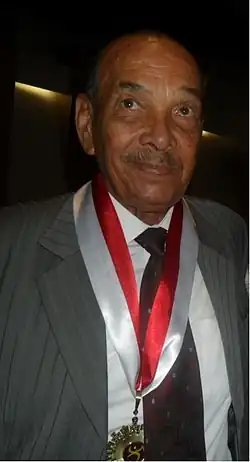
After withdrawing from the two editions of the 1959 South American Championship in Argentina and Ecuador, Colombia participated in the 1963 South American Championship in Bolivia. Colombia finished last in the tournament with a draw and five defeats. For the 1966 FIFA World Cup qualifiers, Colombia was placed in a group against Ecuador and Chile. The team finished in the bottom of their group with two points, with their only win being a 2–0 victory over Chile in Bogotá. The following year, Colombia had to qualify for the 1967 South American Championship by playing the same opponent, but was eliminated with a 5–2 defeat in Santiago and a goalless draw in Bogotá.
Colombia entered qualifying for the 1970 World Cup in Group 2, drawn alongside heavyweights Brazil, Paraguay and Venezuela. Despite spirited efforts, Colombia finished third in the group with one win, one draw and four defeats, falling short of a place at the finals. In the build‑up to the tournament, Colombia faced an illustrious England in a pre‑World Cup friendly, a match that ended in a 4–0 victory for the visitors. The result, however, was eclipsed by the infamous Bogotá Bracelet incident, in which Bobby Moore was briefly detained on allegations of theft during the team’s stay in Bogotá, a story that sparked international headlines and diplomatic attention.[22][23][24]
At the 1975 Copa America, Colombia was placed in Group C with Paraguay and Ecuador. Colombia won all four games to advance to the semifinals against Uruguay. Colombia won 3–0 at home and lost 1–0 away, but the aggregate score allowed them to advance to the final for the first time in their history, where they faced Peru. Colombia won at home 1–0, but lost 2–0 away, so the champion was decided on neutral ground (in Caracas) where Peru beat Colombia with a 25th-minute goal from Hugo Sotil.
1980s: dawn of the Golden Generation and World Cup qualification
Prior to the 1980s, the Colombia national team was widely perceived as a struggling side, hampered by limited investment from the Colombian Football Federation, a scarcity of devoted supporters, and the broader social turmoil that plagued the nation. Periods of national crisis, including ‘’La Violencia’’ and pervasive criminal activity, further undermined the development of football infrastructure and the cultivation of a footballing culture. Sporadic international participation compounded these challenges: although Colombia qualified for the 1962 FIFA World Cup, the team consistently fell short of expectations, earning a reputation as perennial underachievers on the global stage.[25]
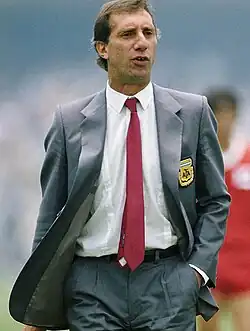
In the early 1980s, under the watchful eye of manager Carlos Bilardo, the Colombia national team sought to establish itself on the South American stage. Colombia entered the 1982 World Cup qualifiers with high hopes, yet the campaign ended in disappointment as the team failed to reach the World Cup and subsequently exited in the first round of the 1983 Copa América.
Undeterred, Colombia turned its attention to the Group 1 for the 1986 World Cup qualifiers, facing formidable opponents including Argentina, Peru, and Venezuela. The campaign began with promise: a hard-fought 1–0 victory over Peru, secured by Miguel Prince, seemed to signal a new era of competitiveness. Yet challenges loomed, highlighted by a 3–1 home defeat to Argentina and a narrow 1–0 loss in Buenos Aires. Colombia rebounded with resilience, drawing 2–2 and claiming a 2–0 win over Venezuela, efforts that earned them a spot in the play-offs against Paraguay. There, hopes of World Cup qualification were dashed: a heavy 3–0 defeat in Asunción proved decisive, and despite a 2–1 victory at home, Colombia fell 4–2 on aggregate, narrowly missing out on the tournament.
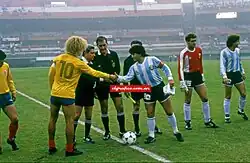
In the 1987 Copa América, Colombia were drawn into Group C alongside Bolivia and Paraguay. Demonstrating determination and growing tactical maturity, Colombia advanced from the group stage to face Chile in the semi-finals. The match reached dramatic heights when Bernardo Redín converted a 103rd-minute penalty to give Colombia a fleeting lead, only for Chile to respond with two decisive goals, eliminating the team in heartbreaking fashion.
As the continent prepared for the 1990 World Cup in Italy, South America was allocated three-and-a-half spots. With Argentina automatically qualifying as 1986 champions, the remaining nine teams were divided into three groups, with the two best group winners earning direct qualification. The group winner with the weakest record was required to contest the CONMEBOL–OFC play-off, where Colombia faced the Oceania winners, Israel, who had finished ahead of Australia and New Zealand. Displaying resilience and composure over two legs, Colombia triumphed 1–0 on aggregate, securing their first FIFA World Cup appearance since 1962 and marking a historic return to football’s grandest stage.[26]
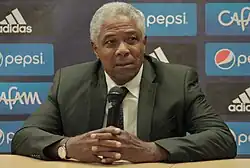
1990s: World Cup return, and the first Colombian Golden Era
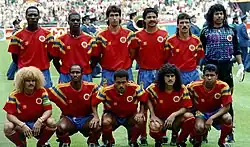
At the 1990 World Cup, Colombia was once again drawn with the Yugoslavs, alongside United Arab Emirates and powerhouse West Germany. Colombia faced the United Arab Emirates at the Stadio Renato Dall'Ara in Bologna, where they won 2–0 with goals from Bernardo Redín and Carlos Valderrama to achieve Colombia's first-ever win at the World Cup finals. Although losing their second game against Yugoslavia 1–0, Colombia achieved qualification to the round of 16 after a historic 1–1 draw with eventual champions West Germany, where Freddy Rincón equalized the game for Colombia in the 93rd minute after West Germany's initial goal five minutes earlier.[27][28] Colombia finished the group stage in third place with three points, and placing as the second-best third-placed teams. However, Colombia would be eliminated in their next match against Cameroon with a 2–1 defeat in extra time, after a mistake from Colombian goalkeeper René Higuita.[29][30] Shortly after the defeat, Maturana left his post as Colombia manager. However, this World Cup appearance marked the rise of a generation known as the first Colombian golden generation.[31]
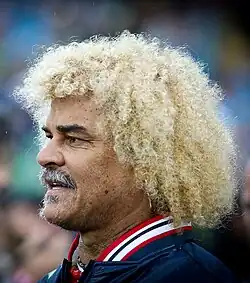
With Carlos Valderrama as captain during the 1993 Copa América, Colombia reached the semifinals, where they lost to Argentina on penalties. They won the third place match against Ecuador to finish third for the second time in their history.
Colombia finished first in their 1994 World Cup qualifying group without having lost a match, which included a historic 5–0 victory over Argentina in Buenos Aires.[32] A few days before the match, Diego Maradona launched a phrase during a television interview, while putting palms of the hands parallel to the ground at chest height, one above the other, said "You can't change history, history shouldn't be changed: Argentina up, Colombia down."[33]
Expectations of the team were high, some even naming them as favorites to win the tournament, as they had only lost one official match over a two-year period from July 1992 going into the World Cup. Colombia was drawn in Group A with the hosts United States, Romania, and Switzerland. Colombia only earned one win over Switzerland and suffered two losses, which would eliminate them in the group stage. The first match against Romania ended with a 3–1 defeat which notoriously angered Colombian drug cartels who had previously bet money on Colombia to win the match, which resulted in various death threats made to relatives of the Colombian players and manager Maturana.[34][35] During the match against the United States, Andrés Escobar scored an own goal, leading to Colombia's elimination as they lost 2–1. Escobar was later murdered in Colombia a few days after the own goal, and this incident would lead to the demise of Colombia's first golden generation.[36][37][38]
_(cropped)_2.jpg)
At the 1995 Copa América, the team achieved a third-place finish after winning a rematch against the United States, 4–1, in the third-place match. Two years later, in Bolivia, the Colombians lost to the hosts in the quarterfinals.[39]
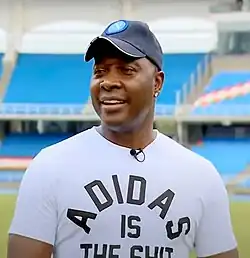
Colombia finished third in 1998 World Cup qualifying with 28 points to qualify for the finals in France. They would eventually be placed into Group G with Tunisia, England, Romania. Romania won the opening game 1–0, while Colombia sealed a 1–0 victory over Tunisia in the second game. In order to advance to the next round, Colombia needed to win their last game against England, however, The Three Lions defeated Colombia 2–0 with goals from midfielder Darren Anderton, and a young David Beckham, who scored his first goal for England from a free kick, thus ending Colombia's tournament hopes.[40][41]
Colombia finished first in their group at the 1999 Copa América after winning all of their matches; however, the team's tournament fell short after a 3–2 loss against Chile in the quarter-finals.[42]
2000s: First Copa América title and temporary decline
In 2000, Colombia participated in their first CONCACAF Gold Cup,[43] hosted in the United States. Achieving a 1–0 win against Jamaica, Colombia lost their next match against Honduras 2–0. They then played the hosts, who scored first with a 20th-minute goal from Brian McBride, but Colombia equalized four minutes later. Colombia eliminated the U.S. on penalties 2–1. In the semi-finals, the team beat Peru 2–1. Colombia faced Canada in the final, and lost 2–0.
.jpg)
Colombia hosted their first Copa América in 2001. Prior to the tournament, meetings were held by CONMEBOL authorities who were concerned about potential security issues, and the tournament was canceled on 1 July, just ten days before the opening match.[44] On 6 July, CONMEBOL decided to reinstate the tournament. Canada had already disbanded its training camp and released its players, so Costa Rica (a CONCACAF invitee) was invited to the tournament. Argentina decided to withdraw from the competition on 10 July despite the Colombian authorities' proposal to take additional safety precautions,[44] as the Argentine Football Association had complained about the abrupt change and claimed that Argentine players had received death threats from terrorist groups.

On 11 July, Colombia began the tournament with a 2–0 victory against Venezuela in at the Estadio Metropolitano of Barranquilla, a location that would serve as Colombia's home field throughout the group stage. The following match against Ecuador ended in a 1–0 victory for Colombia, who then defeated Chile in their last match 2–0 with goals from Aristizábal, and Eudalio Arriaga. The hosts eliminated Peru in the quarter-finals, and defeated Honduras 2–0 in the semi-finals. Colombia won their first Copa América title by defeating Mexico, another CONCACAF invitee, in the final with a goal from captain Iván Córdoba in the second half. The team became the first to not concede a goal at the Copa América.[45][46] The team won the fair play award as well. Goalkeeper Óscar Córdoba was awarded best goalkeeper.[47]
For the 2002 World Cup, Colombia only managed to place sixth in the qualification round, tied with Uruguay but failing to qualify due to goal difference. This was the first time that Colombia had failed to qualify for a World Cup since 1986.
However, as the team won the 2001 Copa América, Colombia played in the 2003 FIFA Confederations Cup, in Group A alongside Euro 2000 champions and hosts France, Japan, and New Zealand. In their opening game against France, Colombia lost 1–0 following a sole goal product of a penalty scored by Thierry Henry. Colombia then defeated New Zealand and Japan to reach the semi-finals, where they lost 1–0 against Cameroon. The team eventually finished fourth after losing to Turkey.
The 2004 Copa América saw Colombia lose to Argentina in the semi-finals, finishing fourth. Colombia also participated in the 2005 CONCACAF Gold Cup, with high expectations.[48] They defeated Mexico in the quarter-finals,[49] and lost to Panama in a semi-final that was a group stage rematch.[50]
For the 2006 World Cup, Colombia was ultimately unsuccessful in their qualifying campaign, missing out by a single point due to Uruguay's win over Argentina in the final fixture. Had Uruguay and Argentina drawn, Colombia would have qualified to the playoff spot with their 1–0 away win over Paraguay, as they had superior goal difference to Uruguay as well.
Colombia had one of their worst Copa América performances in 2007. The team finished third in the group with just one win against the United States and two losses, including a 5–0 loss to Paraguay, which wasn't enough to qualify for the knockout stages.[51][52] Colombia ended the decade with an unsuccessful 2010 World Cup qualifying campaign, mainly as a result of constantly changing formations and a dysfunctional rotation of managers which saw Pinto replaced by Eduardo Lara after a 4–0 loss to Chile in September 2008,[53] combined with the struggle to score in the last games of qualification.[54][55]
The Pékerman Era: revival and a new Golden Generation (2011–2018)
In the 2011 Copa América, Colombia topped their group and were eliminated in a 2–0 loss against Peru in extra time in the quarterfinals. Los Cafeteros ended 2011 at 36th in the FIFA rankings, up from 54th earlier in the year.
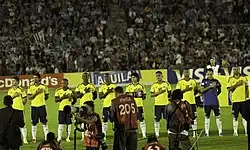
In October 2012, Colombia moved back into the top 10 of the FIFA Rankings for the first time since July 2002, after wins against Mexico in Miami, Chile (3–1) and Uruguay (4–0). The team climbed to 9th place,[56] and were 5th at the end of the year.[57]
Since hiring José Pékerman in January 2012,[58] the squad would break a personal qualifying best record by finishing in second with 30 points, appearing in the World Cup for the first time since 1998. Many neutrals hailed Colombia as a dark horse World Cup contender,[59][60][61] with players such as Carlos Valderrama stating that the team that could become the most successful Colombian squad in history.[60][61] Throughout the qualification process, Colombia only conceded 12 goals, which was the second-best defensive record behind Argentina.[59]
.jpg)
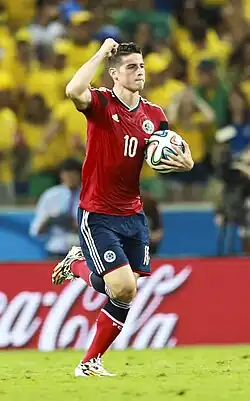
Even though the team's record goalscorer Radamel Falcao missed the tournament through injury, Colombia topped off their return in the 2014 World Cup after a 16-year absence by defeating Greece 3–0.[62] Colombia then sealed a 2–1 victory over the Ivory Coast to clinch Group C's top spot days later.[63] On the same day, Japan and Greece drew 0–0 and automatically qualified Colombia to the round of 16 for the first time in 24 years.[64] In its final group stage game, Colombia defeated Japan 4–1 to win Group C and become the third South American team (following Brazil and Argentina) to win all three group stage games in World Cup history. Colombia went on to defeat Uruguay 2–0 on 28 June in the round of 16, securing a spot in the quarter-finals for the first time in their history.[65] They then fell to hosts Brazil 2–1 in the quarter-finals.[66] James Rodríguez became the first Colombian player to win the Golden Boot award at a FIFA World Cup tournament with six goals.[67] He later won the FIFA Puskás Award for the best goal of the year for his second goal against Uruguay in the round of 16.[68]
Colombia had a disappointing 2015 Copa América, having won only a single game during the group stage match against Brazil, with their only goal of the tournament. Colombia would be eliminated by Argentina in the next round via a penalty shootout, ending their campaign with one win, two draws, and one loss. The following year, Colombia began their 2016 Copa América Centenario campaign with a 2–0 victory against hosts United States.[69] They then sealed their qualification to the quarter-finals with a 2–1 victory against Paraguay, but finished their group campaign with a defeat to Costa Rica.[70][71] On 17 June, they advanced to the semi-finals with a win against Peru on penalties.[72] Colombia would then lose to eventual tournament winners Chile before winning the third place match against the hosts United States to seal their best result since winning the 2001 edition.[73]

.jpg)
Colombia qualified for the 2018 FIFA World Cup by finishing fourth in CONMEBOL.[74] The team began their campaign with a 2–1 defeat to Japan.[75][76][77] Colombia resurrected their hopes of advancing from the group with a 3–0 win over Poland.[78] On 28 June, Colombia beat Senegal by a scoreline of 1–0, topping their group and advancing into the round of 16.[79] On 3 July in Moscow, Colombia were knocked out by England in the round of 16; the game finished 1–1 after extra time, with England winning 4–3 on penalties.[80]
2022 World Cup cycle (2019–2022)
Following the federation's choice to not renew Pekerman's contract, former Iran manager Carlos Queiroz was hired to coach the national team.
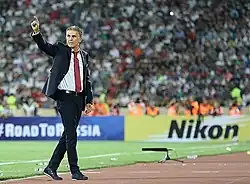
Starting off their 2019 Copa América campaign, Colombia defeated Argentina in a 2–0 win, marking their first victory over the La Albiceleste since 2007.[81] Days later, they would face Asian Cup champions Qatar, and would beat them 1–0 to advance to the next round before finishing the group with a 1–0 victory over Paraguay, finishing with nine points with four goals scored and none conceded throughout the group stage.[82][83][84] Colombia also became the only team since the 2001 edition to advance out of the group stage with a 100% record.[85] Despite this, Colombia were then eliminated by Chile in a penalty shootout in the quarter-finals.[86]
Colombia opened the 2022 World Cup qualifiers with victories over Venezuela and Chile. However, following the resumption of matches after the COVID-19 pandemic, the team’s form deteriorated markedly, culminating in their heaviest home defeat in 82 years against Uruguay and a humiliating 6–1 loss to Ecuador. The downturn brought an end to Carlos Queiroz’s tenure as head coach in December 2020. On 14 January 2021, the Colombian Football Federation announced the return of Reinaldo Rueda to lead the national team.[87][88]
In the 2021 Copa América, Colombia won their opening match against Ecuador, before playing out a goalless draw with Venezuela.[89][90] In their third match gainst Peru, Colombia lost 2–1.[91] Next, Colombia lost to Brazil, leaving them in third position but meant they had qualified for the quarter-finals. They progressed to the semi-finals after a penalty shootout victory against Uruguay following a goalless draw.[92] In the semi-finals, Colombia contested with Argentina, where they drew 1–1 before losing on penalties.[93] Colombia managed to win the match for third place against Peru, with the score 3–2,[94] where the last two goals that Luis Díaz scored along with one in the final 93rd minute of the game made him the top scorer of the Copa América, along with Lionel Messi. The third-place victory for Colombia marked their best result since winning bronze at the Copa América Centenario in 2016.
After the Copa América, Colombia resumed their 2022 qualification campaign. During qualification, Colombia went seven matches without scoring, harming their chances of qualifying. They defeated Venezuela 1–0 in their last match, but results elsewhere left Colombia in sixth position, missing out on the World Cup finals. Rueda left his post as the Colombian team manager shortly after.[95]
Néstor Lorenzo era (2022–present)
The Colombian Football Federation announced on 2 June 2022, that it had picked Néstor Lorenzo to replace Rueda as coach of the men's national team for the next four years.[96] On 28 February 2023, the federation launched an innovative project called "Futbol con Futuro" (Football with a Future) with the support of FIFA. The plan covers 2022 to 2025 and aims to innovate as well as reinforce the modus operandi of all the country's national teams so they can achieve success. "To achieve results on the pitch and enable Colombia to win trophies," said Colombian Football Association (FCF) Development Director Ivan Novella, setting out the ambitious objectives of Futbol con Futuro.[97]
Up until the Copa América final loss in extra time to Argentina on 14 July 2024, Colombia had compiled a 28-match unbeaten run under Lorenzo, a stretch that featured victories over Germany, Brazil and Spain.[98] In September 2025, Colombia qualified for the 2026 FIFA World Cup, their seventh World Cup appearance, after finishing third in CONMEBOL qualifying.[99]
Rivalries
Venezuela
Colombia's main geopolitical rival has always been Venezuela. However, the rivalry is historically very one-sided for Colombia. This state of affairs started to change from the late 1990s, when football slowly began replacing baseball as Venezuela's main sport.[100]
In 2001, coach Luis Garcia was sacked for only managing a draw in an away game in San Cristóbal which ended 2–2. Four years later in the 2006 World Cup qualifiers, Venezuela stunned the continent by defeating Colombia in Barranquilla 0–1. Former captain Valderrama called the match a "classic" and stated "Venezuela kill themselves [do their best] playing against us."[101]
Argentina
.jpg)
The Colombian–Argentine rivalry is more based on "respect" than a "hated" relationship, always attracting great interest between both nations.[102]
The 5–0 win against Argentina in the 1994 World Cup qualifiers was the first time Argentina lost in its home stadium Estadio Monumental during a World Cup qualifier. In the group stage of the 1999 Copa América, Colombia won 3–0 with Argentine striker Martin Palermo missing three penalty kicks.[103]
Tensions flourished again in 2021 after the semi-finals of the Copa América, a match which ended in a defeat for Colombia after the penalty shootout when Emiliano Martínez, the Argentine goalkeeper, utilized provocative gestures and phrases to distract the Colombian players, which were broadcast on live television. In 2024, the two nations met in the final of the Copa América which resulted in a 1–0 extra-time win for Argentina.
Ecuador
Although the head-to-head record showcases a one-sided advantage for Colombia, the increase of the footballing level in the neighboring nation of Ecuador during recent years has ended in close matches between the two teams. After Colombia was unable to obtain more than one point from six possible during the 2022 qualifiers (when the side often obtained four or six points from the encounters), including a historic 6–1 defeat against Ecuador in 2020, media began calling the match the new classic of the region, citing its potential for continuing to bring close matches with no clear favorites added to a new competitive atmosphere between both teams.
Home stadium
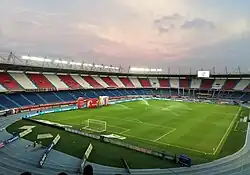
Colombia plays their qualifying matches and friendlies at the Estadio Metropolitano Roberto Meléndez in Barranquilla, which is the home stadium of the local football team Atlético Junior. The stadium is named after former Colombia national team player Roberto Meléndez, who is widely considered to be Colombia's best player during Colombia's amateur era in the 1930s and 1940s. The stadium was used for all of Colombia's successful World Cup qualifying campaigns since 1990.
The Estadio Nemesio Camacho El Campín in the capital city of Bogotá acts as the national team's alternative stadium. The stadium is the playing ground of local clubs Millonarios and Santa Fe, and hosted Colombia's 2001 Copa América final win against Mexico.
Team image

Traditionally, Colombia's home colours are yellow shirts with navy trim and navy or white shorts and socks, with their away colours being normally navy shirts. They wore their first ever red kit at the 2014 FIFA World Cup. Colombia used red as their home colours in the 20th century, although in Copa América Centenario the team played in an all-white kit for the first time in their history, before reverting to the yellow and navy kit thereafter.
Kit sponsorship
| Kit supplier | Period |
|---|---|
 Adidas Adidas
|
1980–1987 |
| Puma
|
1987 |
| Adidas
|
1988–1990 |
 Kelme Kelme
|
1991 |
| Comba
|
1992 |
 Umbro Umbro
|
1992–1998 |
| Reebok
|
1998–2002 |
 Lotto Lotto
|
2002–2010 |
| Adidas
|
2011–present |
Results and fixtures
The following is a list of match results in the last 12 months, as well as any future matches that have been scheduled.
Win Draw Loss Fixture
2025
| 20 March 2026 FIFA World Cup qualification | Brazil  | 2–1 | Colombia | Brasília, Brazil |
| 21:45 UTC−3 |
|
Report |
|
Stadium: Estádio Nacional Mané Garrincha Attendance: 70,027 Referee: Alexis Herrera (Venezuela) |

| 25 March 2026 FIFA World Cup qualification | Colombia | 2–2 |  Paraguay Paraguay | Barranquilla, Colombia |
| 19:00 UTC−5 |
|
Report |
|
Stadium: Estadio Metropolitano Roberto Meléndez Attendance: 42,262 Referee: Facundo Tello (Argentina) |
| 6 June 2026 FIFA World Cup qualification | Colombia | 0–0 | .svg.png) Peru Peru | Barranquilla, Colombia |
| 15:30 UTC−5 | Report | Stadium: Estadio Metropolitano Roberto Meléndez Attendance: 43,933 Referee: Wilton Sampaio (Brazil) |
| 10 June 2026 FIFA World Cup qualification | Argentina  | 1–1 | Colombia | Buenos Aires, Argentina |
| 21:00 UTC−3 |
|
Report |
|
Stadium: Estadio Monumental Attendance: 77,791 Referee: Juan Gabriel Benítez (Paraguay) |
| 4 September 2026 FIFA World Cup qualification | Colombia | 3–0 | .svg.png) Bolivia Bolivia | Barranquilla, Colombia |
| 18:30 UTC−5 |
|
Report | Stadium: Estadio Metropolitano Roberto Meléndez Referee: Darío Herrera (Argentina) |
| 9 September 2026 FIFA World Cup qualification | Venezuela .svg.png) | 3–6 | Colombia | Maturín, Venezuela |
| 19:30 UTC−4 |
|
Report |
|
Stadium: Estadio Monumental Referee: Maximiliano Ramírez (Argentina) |
| 11 October Friendly | Mexico  | 0–4 | Colombia | Arlington, United States |
| 20:00 UTC−5 | Report |
|
Stadium: AT&T Stadium Attendance: 72,438 Referee: Ismail Elfath (United States) |
| 14 October Friendly | Canada .svg.png) | 0–0 | Colombia | Harrison, United States |
| 20:30 UTC−4 | Report | Stadium: Sports Illustrated Stadium Referee: Guido Gonzales Jr. (United States) |
| 15 November Friendly | Colombia | 2–1 |  New Zealand New Zealand | Fort Lauderdale, United States |
| 19:00 UTC−5 |
|
Report |
|
Stadium: Chase Stadium Referee: Cristian Condori (Bolivia) |
| 18 November Friendly | Colombia | 3–0 | .svg.png) Australia Australia | New York, United States |
| 20:30 UTC−4 |
|
Report | Stadium: Citi Field Referee: Tori Penso (United States) |
2026
| 17 June 2026 FIFA World Cup | Uzbekistan  | v | Colombia | Mexico City, Mexico |
| 20:00 UTC−6 | Report | Stadium: Estadio Azteca |
| 23 June 2026 FIFA World Cup | Colombia | v |  IC Path 1 winner IC Path 1 winner | Zapopan, Mexico |
| 20:00 UTC−6 | Report | Stadium: Estadio Akron |
| 27 June 2026 FIFA World Cup | Colombia | v | .svg.png) Portugal Portugal | Miami Gardens, United States |
| 19:30 UTC−4 | Report | Stadium: Hard Rock Stadium |
Coaching staff
| Position | Name |
|---|---|
| Head coach | Néstor Lorenzo
|
| Assistant coaches | Fernando Alloco Luis Amaranto Perea
|
| Goalkeeping coach | Alejandro Otamendi
|
| Fitness coaches | Leandro Jorge Leandro Clocchiatti
|
| Physicians | Gustavo Pineda Mauricio Serrato
|
| Physiotherapist | Salomón Vizcarra
|
| Match analyst | Francis García Talavera
|
| Media consultant | Pablo Vásquez Peñaranda
|
Players
Current squad
The following 26 players were named in the squad for the friendly matches on 15 and 18 November 2025 against New Zealand and Australia, respectively.[104]
Caps and goals updated as of 18 November 2025, after the match against Australia.
| No. | Pos. | Player | Date of birth (age) | Caps | Goals | Club |
|---|---|---|---|---|---|---|
| 1 | GK | David Ospina | 31 August 1988 | 129 | 0 | Atlético Nacional
|
| 12 | GK | Camilo Vargas | 9 March 1989 | 39 | 0 | Atlas
|
| 25 | GK | Álvaro Montero | 29 March 1995 | 10 | 0 | Velez Sarsfield
|
| 2 | DF | Daniel Muñoz | 26 May 1996 | 42 | 3 | Crystal Palace
|
| 3 | DF | Jhon Lucumí | 26 June 1998 | 34 | 1 | Bologna
|
| 4 | DF | Santiago Arias | 13 January 1992 | 65 | 0 | Bahia
|
| 13 | DF | Yerry Mina | 23 September 1994 | 52 | 8 | Cagliari
|
| 17 | DF | Johan Mojica | 21 August 1992 | 41 | 1 | Mallorca
|
| 21 | DF | Carlos Cuesta | 9 March 1999 | 24 | 0 | Vasco da Gama
|
| 23 | DF | Davinson Sánchez | 12 June 1996 | 75 | 3 |  Galatasaray Galatasaray
|
| 24 | DF | Álvaro Angulo | 6 March 1998 | 4 | 0 | UNAM
|
| 5 | MF | Kevin Castaño | 29 September 2000 | 23 | 0 | River Plate
|
| 6 | MF | Richard Ríos | 2 June 2000 | 28 | 2 | Benfica
|
| 8 | MF | Jorge Carrascal | 25 May 1998 | 21 | 2 | Flamengo
|
| 10 | MF | James Rodríguez (Captain) | 12 July 1991 | 122 | 31 | León
|
| 11 | MF | Jhon Arias | 21 September 1997 | 34 | 3 | Wolverhampton Wanderers
|
| 14 | MF | Gustavo Puerta | 26 July 2003 | 2 | 1 | Racing de Santander
|
| 15 | MF | Juan Portilla | 12 September 1998 | 8 | 0 | Talleres
|
| 16 | MF | Jefferson Lerma | 25 October 1994 | 62 | 5 | Crystal Palace
|
| 22 | MF | Yáser Asprilla | 19 November 2003 | 11 | 2 | Girona
|
| 7 | FW | Luis Díaz | 13 January 1997 | 70 | 21 | Bayern Munich
|
| 9 | FW | Jhon Córdoba | 11 May 1993 | 19 | 6 |  Krasnodar Krasnodar
|
| 18 | FW | Johan Carbonero | 20 July 1999 | 2 | 2 | Internacional
|
| 19 | FW | Rafael Santos Borré | 15 September 1995 | 44 | 6 | Internacional
|
| 20 | FW | Luis Suárez | 2 December 1997 | 8 | 4 | Sporting CP
|
| 26 | FW | Andrés Gómez | 12 September 2002 | 4 | 2 | Vasco da Gama
|
Recent call-ups
The following players have also been called up in the last twelve months.
| Pos. | Player | Date of birth (age) | Caps | Goals | Club | Latest call-up |
|---|---|---|---|---|---|---|
| GK | Kevin Mier | 18 May 2000 | 3 | 0 | Cruz Azul
|
v. Canada, 14 October 2025
|
| DF | Yerson Mosquera | 2 May 2001 | 4 | 1 | Wolverhampton Wanderers
|
v. Canada, 14 October 2025
|
| DF | Willer Ditta | 23 January 1997 | 3 | 0 | Cruz Azul
|
v. Canada, 14 October 2025
|
| DF | Andrés Román | 5 October 1995 | 3 | 0 | Atlético Nacional
|
v. Canada, 14 October 2025
|
| DF | Deiver Machado | 2 September 1993 | 12 | 0 |  Nantes Nantes
|
v. Argentina, 10 June 2025
|
| DF | Cristian Borja | 18 February 1993 | 8 | 0 | América
|
v. Argentina, 10 June 2025
|
| MF | Juan Fernando Quintero | 18 January 1993 | 45 | 6 | River Plate
|
v. Canada, 14 October 2025
|
| MF | Jaminton Campaz | 24 May 2000 | 7 | 0 | Rosario Central
|
v. Canada, 14 October 2025
|
| MF | Kevin Serna | 17 December 1997 | 2 | 0 | Fluminense
|
v. Canada, 14 October 2025
|
| MF | Marino Hinestroza | 8 June 2002 | 2 | 0 | Atlético Nacional
|
v. Venezuela, 9 September 2025
|
| MF | Rafael Carrascal | 23 November 1992 | 1 | 0 | América
|
v. Argentina, 10 June 2025
|
| FW | Cucho Hernández | 20 April 1999 | 7 | 2 | Betis
|
v. Canada, 14 October 2025
|
| FW | Dayro Moreno | 16 September 1985 | 32 | 3 | Once Caldas
|
v. Venezuela, 9 September 2025
|
| FW | Jhon Durán | 13 December 2003 | 17 | 3 | Fenerbahçe
|
v. Argentina, 10 June 2025
|
| FW | Luis Sinisterra | 17 June 1999 | 18 | 5 | Cruzeiro
|
v. Brazil, 20 March 2025 INJ
|
INJ Withdrew due to injury | ||||||
Individual records
- As of 18 November 2025.[105]
- Players in bold are still active with Colombia.
Most capped players
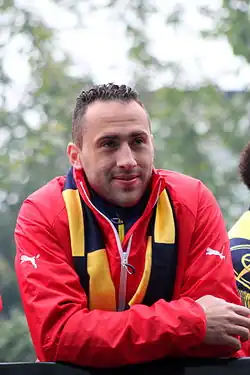
.jpg)
| Rank | Player | Caps | Goals | Career |
|---|---|---|---|---|
| 1 | David Ospina | 129 | 0 | 2007–present |
| 2 | James Rodríguez | 122 | 31 | 2011–present |
| 3 | Juan Cuadrado | 116 | 11 | 2010–2023 |
| 4 | Carlos Valderrama | 111 | 11 | 1985–1998 |
| 5 | Radamel Falcao | 104 | 36 | 2007–2023 |
| 6 | Mario Yepes | 102 | 6 | 1999–2014 |
| 7 | Leonel Álvarez | 101 | 1 | 1985–1997 |
| 8 | Carlos Sánchez | 88 | 0 | 2007–2018 |
| 9 | Freddy Rincón | 84 | 17 | 1990–2001 |
| 10 | Luis Carlos Perea | 78 | 2 | 1987–1994 |
Top goalscorers
| Rank | Player | Goals | Caps | Average | Career |
|---|---|---|---|---|---|
| 1 | Radamel Falcao (list) | 36 | 104 | 0.35 | 2007–2023 |
| 2 | James Rodríguez | 31 | 122 | 0.25 | 2011–present |
| 3 | Arnoldo Iguarán | 25 | 68 | 0.37 | 1979–1993 |
| 4 | Luis Díaz | 21 | 70 | 0.3 | 2018–present |
| 5 | Faustino Asprilla | 20 | 57 | 0.35 | 1993–2001 |
| 6 | Freddy Rincón | 17 | 84 | 0.2 | 1990–2001 |
| 7 | Carlos Bacca | 16 | 52 | 0.31 | 2010–2018 |
| 8 | Teófilo Gutiérrez | 15 | 51 | 0.29 | 2009–2017 |
| Víctor Aristizábal | 15 | 66 | 0.23 | 1993–2003 | |
| 10 | Adolfo Valencia | 14 | 37 | 0.38 | 1992–1998 |
Competitive record
FIFA World Cup
| FIFA World Cup record | Qualification record | ||||||||||||||||
|---|---|---|---|---|---|---|---|---|---|---|---|---|---|---|---|---|---|
| Year | Round | Position | Pld | W | D | L | GF | GA | Squad | Pos | Pld | W | D | L | GF | GA | |
 1930 1930
|
Not a FIFA member | Not a FIFA member | |||||||||||||||
.svg.png) 1934 1934
| |||||||||||||||||
 1938 1938
|
Withdrew | Withdrew | |||||||||||||||
| 1950
|
Did not enter | Did not enter | |||||||||||||||
.svg.png) 1954 1954
| |||||||||||||||||
 1958 1958
|
Did not qualify | 3rd | 4 | 0 | 1 | 3 | 3 | 8 | |||||||||
 1962 1962
|
Group stage | 14th | 3 | 0 | 1 | 2 | 5 | 11 | Squad | 1st | 2 | 1 | 1 | 0 | 2 | 1 | |
| 1966
|
Did not qualify | 3rd | 4 | 1 | 0 | 3 | 4 | 10 | |||||||||
| 1970
|
3rd | 6 | 1 | 1 | 4 | 7 | 12 | ||||||||||
| 1974
|
2nd | 4 | 1 | 3 | 0 | 3 | 2 | ||||||||||
| 1978
|
3rd | 4 | 0 | 2 | 2 | 1 | 8 | ||||||||||
| 1982
|
3rd | 4 | 0 | 2 | 2 | 4 | 7 | ||||||||||
| 1986
|
3rd | 8 | 3 | 2 | 3 | 8 | 10 | ||||||||||
| 1990
|
Round of 16 | 14th | 4 | 1 | 1 | 2 | 4 | 4 | Squad | 1st1 | 6 | 3 | 2 | 1 | 6 | 3 | |
 1994 1994
|
Group stage | 19th | 3 | 1 | 0 | 2 | 4 | 5 | Squad | 1st | 6 | 4 | 2 | 0 | 13 | 2 | |
.svg.png) 1998 1998
|
21st | 3 | 1 | 0 | 2 | 1 | 3 | Squad | 3rd | 16 | 8 | 4 | 4 | 23 | 15 | ||
.svg.png)  2002 2002
|
Did not qualify | 6th | 18 | 7 | 6 | 5 | 20 | 15 | |||||||||
| 2006
|
6th | 18 | 6 | 6 | 6 | 24 | 16 | ||||||||||
 2010 2010
|
7th | 18 | 6 | 5 | 7 | 14 | 18 | ||||||||||
| 2014
|
Quarter-finals | 5th | 5 | 4 | 0 | 1 | 12 | 4 | Squad | 2nd | 16 | 9 | 3 | 4 | 27 | 13 | |
| 2018
|
Round of 16 | 9th | 4 | 2 | 1 | 1 | 6 | 3 | Squad | 4th | 18 | 7 | 6 | 5 | 21 | 19 | |
 2022 2022
|
Did not qualify | 6th | 18 | 5 | 8 | 5 | 20 | 19 | |||||||||
| 2026
|
Qualified | 3rd | 18 | 7 | 7 | 4 | 28 | 18 | |||||||||
 2030 2030
|
To be determined | To be determined | |||||||||||||||
 2034 2034
| |||||||||||||||||
| Total | Quarter-finals | 6/20 | 22 | 9 | 3 | 10 | 32 | 30 | — | — | 188 | 69 | 61 | 58 | 228 | 196 | |
- 1.^ Played Intercontinental playoffs.
Copa América
Champions Runners-up Third place Fourth place
| South American Championship / Copa América record | |||||||||
|---|---|---|---|---|---|---|---|---|---|
| Year | Round | Position | Pld | W | D | L | GF | GA | Squad |
| 1916 |
No national representative | ||||||||
| 1917
| |||||||||
| 1919
| |||||||||
| 1920
| |||||||||
| 1921
| |||||||||
| 1922
| |||||||||
| 1923
| |||||||||
| 1924
| |||||||||
| 1925 |
Not a CONMEBOL member | ||||||||
| 1926
| |||||||||
.svg.png) 1927 1927
| |||||||||
| 1929
| |||||||||
| 1935
| |||||||||
| 1937 |
Withdrew | ||||||||
| 1939
| |||||||||
| 1941
| |||||||||
| 1942
| |||||||||
| 1945 |
Fifth place | 5th | 6 | 1 | 1 | 4 | 7 | 25 | Squad |
| 1946 |
Withdrew | ||||||||
 1947 1947 |
Eighth place | 8th | 7 | 0 | 2 | 5 | 2 | 19 | Squad |
| 1949 |
8th | 7 | 0 | 2 | 5 | 4 | 23 | Squad | |
| 1953 |
Withdrew | ||||||||
| 1955
| |||||||||
| 1956
| |||||||||
| 1957 |
Fifth place | 5th | 6 | 2 | 0 | 4 | 10 | 25 | Squad |
| 1959 |
Withdrew | ||||||||
| 1959
| |||||||||
 1963 1963 |
Seventh place | 7th | 6 | 0 | 1 | 5 | 10 | 19 | Squad |
| 1967 |
Did not qualify | ||||||||
| 1975 | Runners-up | 2nd | 9 | 6 | 0 | 3 | 11 | 5 | Squad |
| 1979 | Group stage | 5th | 4 | 2 | 1 | 1 | 5 | 2 | Squad |
| 1983 | 7th | 4 | 1 | 2 | 1 | 5 | 5 | Squad | |
| 1987 |
Third place | 3rd | 4 | 3 | 0 | 1 | 8 | 3 | Squad |
| 1989 |
Group stage | 6th | 4 | 1 | 2 | 1 | 5 | 4 | Squad |
| 1991 |
Fourth place | 4th | 7 | 2 | 2 | 3 | 5 | 6 | Squad |
| 1993 |
Third place | 3rd | 6 | 3 | 2 | 1 | 6 | 4 | Squad |
| 1995 |
3rd | 6 | 3 | 1 | 2 | 7 | 8 | Squad | |
| 1997 |
Quarter-finals | 8th | 4 | 1 | 0 | 3 | 6 | 7 | Squad |
.svg.png) 1999 1999 |
5th | 4 | 3 | 0 | 1 | 8 | 4 | Squad | |
| 2001 |
Champions | 1st | 6 | 6 | 0 | 0 | 11 | 0 | Squad |
| 2004 |
Fourth place | 4th | 6 | 3 | 1 | 2 | 7 | 7 | Squad |
 2007 2007 |
Group stage | 9th | 3 | 1 | 0 | 2 | 3 | 9 | Squad |
| 2011 |
Quarter-finals | 6th | 4 | 2 | 1 | 1 | 3 | 2 | Squad |
| 2015 |
6th | 4 | 1 | 2 | 1 | 1 | 1 | Squad | |
| 2016 |
Third place | 3rd | 6 | 3 | 1 | 2 | 7 | 6 | Squad |
| 2019 |
Quarter-finals | 5th | 4 | 3 | 1 | 0 | 4 | 0 | Squad |
| 2021 |
Third place | 3rd | 7 | 2 | 3 | 2 | 7 | 7 | Squad |
| 2024 |
Runners-up | 2nd | 6 | 4 | 1 | 1 | 12 | 3 | Squad |
| Total | 1 Title | 24/35 | 130 | 53 | 26 | 51 | 154 | 194 | — |
CONCACAF Gold Cup
| CONCACAF Gold Cup record | |||||||||
|---|---|---|---|---|---|---|---|---|---|
| Year | Round | Position | Pld | W | D | L | GF | GA | Squad |
| 2000
|
Runners-up | 2nd | 5 | 2 | 1 | 2 | 5 | 7 | Squad |
| 2003
|
Quarter-finals | 5th | 3 | 1 | 1 | 1 | 2 | 3 | Squad |
| 2005
|
Semi-finals | 4th | 5 | 2 | 0 | 3 | 7 | 7 | Squad |
| Total | Runners-up | 3/3 | 13 | 5 | 2 | 6 | 14 | 17 | — |
FIFA Confederations Cup
| FIFA Confederations Cup record | |||||||||
|---|---|---|---|---|---|---|---|---|---|
| Year | Round | Position | Pld | W | D | L | GF | GA | Squad |
| 1992
|
Did not qualify | ||||||||
| 1995
| |||||||||
| 1997
| |||||||||
| 1999
| |||||||||
| 2001
| |||||||||
| 2003
|
Fourth place | 4th | 5 | 2 | 0 | 3 | 5 | 5 | Squad |
| 2005
|
Did not qualify | ||||||||
| 2009
| |||||||||
| 2013
| |||||||||
| 2017
| |||||||||
| Total | Fourth place | 1/10 | 5 | 2 | 0 | 3 | 5 | 5 | — |
Head-to-head record
Below is a result summary of all matches Colombia have played against FIFA recognized teams.[106][107]
- As of 18 November 2025
Positive Record Neutral Record Negative Record
| Opponents | Pld | W | D | L | GF | GA | GD | Win % |
|---|---|---|---|---|---|---|---|---|
 Algeria Algeria |
1 | 0 | 0 | 1 | 0 | 3 | −3 | 0% |
| Argentina |
43 | 10 | 12 | 21 | 42 | 74 | −32 | 23.26% |
| Australia |
5 | 3 | 2 | 0 | 7 | 2 | +5 | 60% |
| Bahrain |
1 | 1 | 0 | 0 | 6 | 0 | +6 | 100% |
.svg.png) Belgium Belgium |
2 | 1 | 0 | 1 | 2 | 2 | 0 | 50% |
| Bolivia |
34 | 17 | 10 | 7 | 54 | 31 | +23 | 50% |
| Brazil |
38 | 4 | 12 | 22 | 22 | 71 | −49 | 10.53% |
 Cameroon Cameroon |
4 | 2 | 0 | 2 | 8 | 3 | +5 | 50% |
| Canada |
4 | 2 | 1 | 1 | 4 | 2 | +2 | 50% |
| Chile |
44 | 12 | 17 | 15 | 59 | 70 | −11 | 27.27% |
 China China |
2 | 1 | 0 | 1 | 5 | 2 | +3 | 50% |
| Costa Rica |
15 | 12 | 0 | 3 | 37 | 16 | +21 | 80% |
 Curaçao[a] Curaçao[a] |
1 | 1 | 0 | 0 | 4 | 2 | +2 | 100% |
 East Germany East Germany |
1 | 0 | 0 | 1 | 0 | 2 | −2 | 0% |
| Ecuador |
50 | 23 | 13 | 14 | 54 | 45 | +9 | 46% |
 Egypt Egypt |
2 | 0 | 2 | 0 | 1 | 1 | 0 | 0% |
 El Salvador El Salvador |
7 | 5 | 1 | 1 | 16 | 7 | +9 | 71.43% |
| England |
6 | 0 | 3 | 3 | 4 | 11 | −7 | 0% |
 Finland Finland |
1 | 1 | 0 | 0 | 3 | 1 | +2 | 100% |
| France |
4 | 1 | 0 | 3 | 5 | 7 | −2 | 25% |
| Germany[b] |
5 | 1 | 2 | 2 | 7 | 10 | −3 | 20% |
 Greece Greece |
2 | 2 | 0 | 0 | 5 | 0 | +5 | 100% |
 Guatemala Guatemala |
5 | 3 | 2 | 0 | 14 | 6 | +8 | 60% |
 Haiti Haiti |
5 | 4 | 0 | 1 | 12 | 4 | +8 | 80% |
.svg.png) Honduras Honduras |
12 | 5 | 2 | 5 | 13 | 12 | +1 | 41.67% |
 Hungary Hungary |
1 | 0 | 0 | 1 | 1 | 3 | −2 | 0% |
 Iraq Iraq |
1 | 1 | 0 | 0 | 1 | 0 | +1 | 100% |
 Israel Israel |
2 | 1 | 1 | 0 | 1 | 0 | +1 | 50% |
 Ivory Coast Ivory Coast |
1 | 1 | 0 | 0 | 2 | 1 | +1 | 100% |
 Jamaica Jamaica |
5 | 4 | 0 | 1 | 7 | 1 | +6 | 80% |
| Japan |
6 | 4 | 1 | 1 | 9 | 4 | +5 | 66.67% |
 Jordan Jordan |
1 | 1 | 0 | 0 | 3 | 0 | +3 | 100% |
 Kuwait Kuwait |
1 | 1 | 0 | 0 | 3 | 1 | +2 | 100% |
 Liberia Liberia |
1 | 1 | 0 | 0 | 2 | 1 | +1 | 100% |
| Mexico |
29 | 10 | 9 | 10 | 31 | 29 | +2 | 34.48% |
 Montenegro Montenegro |
1 | 1 | 0 | 0 | 1 | 0 | +1 | 100% |
| Morocco |
1 | 1 | 0 | 0 | 2 | 0 | +2 | 100% |
 Netherlands Netherlands |
1 | 0 | 1 | 0 | 0 | 0 | 0 | 0% |
| New Zealand |
2 | 2 | 0 | 0 | 5 | 2 | +3 | 100% |
 Nigeria Nigeria |
4 | 3 | 1 | 0 | 4 | 1 | +3 | 75% |
.svg.png) Northern Ireland Northern Ireland |
1 | 1 | 0 | 0 | 2 | 0 | +2 | 100% |
 Norway Norway |
1 | 0 | 1 | 0 | 0 | 0 | 0 | 0% |
 Panama Panama |
7 | 5 | 0 | 2 | 20 | 7 | +13 | 71.43% |
| Paraguay |
51 | 23 | 10 | 18 | 61 | 55 | +6 | 45.1% |
| Peru |
62 | 21 | 24 | 17 | 72 | 66 | +6 | 33.87% |
 Poland Poland |
8 | 5 | 1 | 2 | 12 | 9 | +3 | 62.5% |
 Puerto Rico Puerto Rico |
1 | 1 | 0 | 0 | 4 | 1 | +3 | 100% |
| Qatar |
1 | 1 | 0 | 0 | 1 | 0 | +1 | 100% |
 Republic of Ireland Republic of Ireland |
1 | 0 | 0 | 1 | 0 | 1 | −1 | 0% |
 Romania Romania |
4 | 1 | 1 | 2 | 4 | 6 | −2 | 25% |
| Russia[c] |
3 | 0 | 2 | 1 | 5 | 7 | −2 | 0% |
| Saudi Arabia |
3 | 2 | 1 | 0 | 3 | 1 | +2 | 66.67% |
 Scotland Scotland |
3 | 1 | 2 | 0 | 3 | 2 | +1 | 33.33% |
 Senegal Senegal |
2 | 1 | 1 | 0 | 3 | 2 | +1 | 50% |
 Serbia[d] Serbia[d] |
5 | 1 | 1 | 3 | 1 | 7 | −6 | 20% |
 Slovakia Slovakia |
3 | 2 | 1 | 0 | 2 | 0 | +2 | 66.67% |
 Slovenia Slovenia |
1 | 1 | 0 | 0 | 1 | 0 | +1 | 100% |
| South Africa |
1 | 0 | 0 | 1 | 1 | 2 | −1 | 0% |
 South Korea South Korea |
8 | 1 | 3 | 4 | 9 | 14 | −5 | 12.50% |
| Spain |
4 | 1 | 2 | 1 | 4 | 4 | 0 | 25% |
| Sweden |
2 | 0 | 2 | 0 | 2 | 2 | 0 | 0% |
| Switzerland |
4 | 2 | 1 | 1 | 9 | 6 | +3 | 50% |
 Trinidad and Tobago Trinidad and Tobago |
3 | 2 | 0 | 1 | 8 | 4 | +4 | 66.67% |
 Tunisia Tunisia |
2 | 1 | 1 | 0 | 2 | 1 | +1 | 50% |
| Turkey |
1 | 0 | 0 | 1 | 1 | 2 | −1 | 0% |
 United Arab Emirates United Arab Emirates |
1 | 1 | 0 | 0 | 2 | 0 | +2 | 100% |
| United States |
22 | 14 | 5 | 3 | 33 | 15 | +18 | 63.64% |
| Uruguay |
47 | 13 | 13 | 21 | 52 | 67 | −14 | 27.66% |
| Venezuela |
44 | 22 | 15 | 7 | 64 | 29 | +35 | 50% |
| Total (69) | 647 | 265 | 179 | 203 | 837 | 737 | +100 | 41% |
- ^ Includes matches against Territory of Curaçao.
- ^ Includes matches against West Germany.
- ^ Includes matches against the Soviet Union.
- ^ Includes matches against Yugoslavia.
Honours
Continental
- Copa América
 Champions (1): 2001
 Runners-up (2): 1975, 2024
 Third place (5): 1987, 1993, 1995, 2016, 2021
- CONCACAF Gold Cup
- Runners-up (1): 2000
Regional
- Central American and Caribbean Games
- Gold medal (1): 1946
- Bronze medal (1): 1938
Friendly
- Copa Centenario de Armenia[108] (1): 1989
- Marlboro Cup (1): 1990
Awards
- FIFA Best Mover of the Year (1): 1993
- FIFA World Cup Fair Play Trophy (1): 2014
- Copa America Fair Play Award (1): 2024
Summary
| Competition | |
|
|
Total |
|---|---|---|---|---|
| CONMEBOL Copa América | 1 | 2 | 5 | 8 |
| CONCACAF Gold Cup | 0 | 1 | 0 | 1 |
| Total | 1 | 3 | 5 | 9 |
See also
- Colombia Olympic football team
- Colombia national under-20 football team
- Colombia national under-17 football team
- Colombia national under-15 football team
- Colombia national futsal team
References
- ^ "Barranquilla será la sede de los dos primeros partidos de las eliminatorias, Deportes". Semana.com. 22 August 2011. Archived from the original on 7 January 2019. Retrieved 30 June 2014.
- ^ "The FIFA/Coca-Cola Men's World Ranking". FIFA. 22 December 2025. Retrieved 22 December 2025.
- ^ a b Jaramillo Racines, Rafael (2018). Fútbol y barras bravas: Análisis de un fenómeno urbano (in Spanish) (1st ed.). Siglo del Hombre – Universidad Nacional de Colombia. p. 189. ISBN 978-958-665-507-1. Archived from the original on 25 June 2020. Retrieved 24 June 2020.
- ^ a b "La historia del estadio Moderno: Pelé, Junior y cuna del FPC". Diario As (in Spanish). 21 March 2022.
- ^ "International friendlies: Bahrain 0–6 Colombia". bbc.com. BBC. 26 March 2015. Archived from the original on 14 April 2021. Retrieved 28 March 2021.
- ^ Tabeira, Martín (12 August 2009). "Southamerican Championship 1957". RSSSF. Retrieved 17 August 2021.
- ^ Elo rankings change compared to one year ago. "World Football Elo Ratings". eloratings.net. 10 January 2026. Retrieved 10 January 2026.
- ^ "Fifa/Coca Cola World Ranking". FIFA.com. 27 May 2021. Archived from the original on 15 July 2021. Retrieved 22 July 2021.
- ^ Gutierrez, Teofilo (15 July 2015). "Gutierrez: Colombia are one big family". FIFA. Archived from the original on 28 March 2014. Retrieved 30 November 2015.
- ^ "World Cup Team Profile: COLOMBIA". 4 June 2014. Archived from the original on 22 December 2021. Retrieved 30 June 2014 – via YouTube.
- ^ Mendoza, Luis Felipe (5 September 2025). "Colombia Qualifies for 2026 World Cup After Win Against Bolivia". Colombia One: News from Colombia and the World. Retrieved 5 September 2025.
- ^ "Colombia closes its best participation in the World Championships". Sietedias.co (in Spanish). Archived from the original on 14 July 2014. Retrieved 13 July 2014.
- ^ "Barranquilla: the memory of the V Central American and Caribbean Games, in 1946" (in Spanish). Colombian Olympic Committee. Archived from the original on 25 January 2021. Retrieved 18 June 2018.
- ^ a b Andrés, Juan Pablo (18 July 2013). "Colombia – List of Champions and Runners-Up". Rec.Sport.Soccer Statistics Foundation. Juan Pablo Andrés and RSSSF. Archived from the original on 7 February 2023. Retrieved 15 November 2013.
- ^ "La Selección – Historia". Colombia.com. Archived from the original on 13 January 2019. Retrieved 1 December 2022.
- ^ Morrison, Neil; Cruickshank, Mark (2 May 2013). "Juegos del Cuarto Centenario de Cali 1937". RSSSF. Archived from the original on 29 September 2022. Retrieved 2 February 2023.
- ^ Acosta, Andrés (13 June 2013). "International Matches of Millonarios de Bogotá" (in Spanish). Rec.Sport.Soccer Statistics Foundation. Archived from the original on 5 February 2023. Retrieved 2 February 2023.
- ^ "Cuando el Junior de Barranquilla fue la Selección Colombia". Gol Caracol.com (in Spanish). Archived from the original on 23 June 2015. Retrieved 26 November 2013.
- ^ Carvajal, Tobías (22 July 2006). "Colombia barrió en los Centroamericanos de 1946". arcotriunfal.com (in Spanish). Archived from the original on 23 September 2015.
- ^ Forster, David (2011). Die Legionärie (in German). Lit Verlag Münster. ISBN 978-3643502056.
- ^ https://www.olympics.com/en/news/what-is-an-olympic-goal
- ^ https://www.vice.com/en/article/throwback-thursday-the-england-captain-and-the-bogota-bracelet-scandal/
- ^ https://www.theguardian.com/football/2020/may/28/bobby-moore-and-the-mystery-of-the-missing-bogota-bracelet?utm_source=chatgpt.com
- ^ https://www.fifamuseum.com/en/explore/fifamuseumplus/blog/The-English-Gentleman
- ^ "'The Only Thing That Unites Us' – Origin Story of Colombian Football: Part 1". 6 June 2018. Archived from the original on 1 December 2022. Retrieved 1 December 2022.
- ^ https://colombiareports.com/colombias-1990-world-cup/
- ^ "When Rincon rescued Colombia (93): 100 great World Cup moments". FIFA. Archived from the original on 16 January 2023. Retrieved 11 September 2023.
- ^ "Freddy Rincón y el Colombia vs. Alemania en Italia 1990: "Yo creo que ese día nos graduamos"". EL ESPECTADOR. 31 May 2020. Archived from the original on 16 January 2023. Retrieved 16 January 2023.
- ^ "When Rene met Roger". FIFA. 10 August 2022. Archived from the original on 15 January 2023. Retrieved 11 September 2023.
- ^ "Higuita using 1990 World Cup blunder to fight coronavirus". 22 March 2020. Archived from the original on 15 January 2023. Retrieved 15 January 2023.
- ^ "Colombia's 1990 World Cup". 2 May 2018. Archived from the original on 15 January 2023. Retrieved 15 January 2023.
- ^ "Argentina's night of shame: when Colombia went to a feisty Buenos Aires and won 5–0". These Football Times. 23 January 2019. Archived from the original on 3 April 2022. Retrieved 3 April 2022.
- ^ "El pasado 5 se septiembre se cumplieron quince años del recordado 5-0" (in Spanish). Futbolred. 5 September 2008. Archived from the original on 6 January 2015. Retrieved 2 March 2016.
- ^ "Cómo la campaña de Colombia en el Mundial de 1994 provocó el asesinato de Andrés Escobar". 21 July 2017. Archived from the original on 16 January 2023. Retrieved 16 January 2023.
- ^ "Siete pecados de la selección para no repetir". 30 May 2014. Archived from the original on 16 January 2023. Retrieved 16 January 2023.
- ^ Barry Glendenning (3 April 2018). "World Cup stunning moments: Andrés Escobar's deadly own goal". the Guardian. Archived from the original on 30 November 2020. Retrieved 17 January 2023.
- ^ Kelly, Cathal (2 July 2014). "Decades after Andres Escobar killing, Colombian soccer finally recovers". The Globe and Mail. Archived from the original on 15 January 2023. Retrieved 15 January 2023.
- ^ Mercer, Pamela (4 July 1994). "WORLD CUP '94; Outrage and Tears at Escobar Funeral". The New York Times. Archived from the original on 17 January 2023. Retrieved 17 January 2023.
- ^ "Conoce cuáles fueron las tres máximas victorias de la Selección Colombia en la historia de Copa América – Federación colombiana de fútbol". Archived from the original on 16 January 2023. Retrieved 16 January 2023.
- ^ "Colombia, ¡hora de cambiar la historia! Así le fue contra Inglaterra". 28 June 2018. Archived from the original on 16 January 2023. Retrieved 16 January 2023.
- ^ "World Cup 2014 countdown: David Beckham scores his first England goal". Independent.co.uk. 16 April 2014. Archived from the original on 16 January 2023. Retrieved 16 January 2023.
- ^ "TBT: Bonilla Goleador de Cuna". 3 June 2021. Archived from the original on 16 January 2023. Retrieved 16 January 2023.
- ^ "ESPN.com".
- ^ a b Scragg, Steven (16 February 2015). "Honduras' Legendary Copa América Odyssey". These Football Times. Archived from the original on 10 July 2015. Retrieved 9 July 2015.
- ^ "Así se hizo la Copa América de 2001 en Colombia". El Tiempo (in Spanish). 5 April 2019. Archived from the original on 23 July 2021. Retrieved 23 July 2021.
- ^ "Colombia celebrate double triumph". BBC News. 30 July 2001. Archived from the original on 16 October 2022. Retrieved 16 October 2022.
- ^ "When Iván Córdoba scored the title-winning goal for Colombia in 2001". copaamerica.com. Retrieved 10 September 2025.
- ^ "Consideran vergonzosa participación de Colombia en Copa de Oro". Mediotiempo.com (in Mexican Spanish). 25 July 2005. Archived from the original on 3 April 2022. Retrieved 3 April 2022.
- ^ "Colombia elimina a México y es semifinalista Copa Oro". El Universo (in Spanish). 17 July 2005. Archived from the original on 3 April 2022. Retrieved 3 April 2022.
- ^ "Panamá 3–2 Colombia... Los Canaleros son finalistas". Mediotiempo.com (in Mexican Spanish). 22 July 2005. Archived from the original on 3 April 2022. Retrieved 3 April 2022.
- ^ "Soccer-Copa-Santa Cruz hits hat-trick as Paraguay rout Colombia". Reuters. 29 June 2007. Archived from the original on 3 April 2022. Retrieved 3 April 2022.
- ^ "Colombia en Venezuela 2007". VAVEL (in Spanish). 2 July 2021. Archived from the original on 23 July 2021. Retrieved 23 July 2021.
- ^ "Pinto sacked in Colombia". FIFA.com. 16 September 2008. Archived from the original on 18 September 2008.
- ^ "The dark years of the Colombian National Team 2002–2010". Bolavip US. 28 May 2021. Archived from the original on 14 June 2021. Retrieved 14 June 2021.
- ^ Alsema, Adriaan (11 September 2008). "Chile beats Colombia 4-0 in World Cup qualifier". Colombia News | Colombia Reports. Archived from the original on 21 January 2023. Retrieved 21 January 2023.
- ^ "Portugal go third as Colombia fly into top ten". FIFA. 3 October 2012. Archived from the original on 10 February 2015. Retrieved 30 June 2014.
- ^ "Spain finish 2012 on top, Colombia in fifth". FIFA. 19 December 2012. Archived from the original on 14 June 2018. Retrieved 30 June 2014.
- ^ "Jose Pekerman confirmed as new Colombia coach". Goal.com. 6 January 2012. Archived from the original on 24 May 2022. Retrieved 24 May 2022.
- ^ a b "Colombia's path to qualification". FIFA.com. 12 October 2013. Archived from the original on 23 October 2013.
- ^ a b "Current soccer squad can surpass 90s greats: El Pibe". Colombiareports.co. 12 October 2012. Archived from the original on 18 July 2014. Retrieved 30 November 2015.
- ^ a b "Colombia progress with thrilling fightback". FIFA. 12 October 2013. Archived from the original on 10 December 2015. Retrieved 30 November 2015.
- ^ "Colombia back with a bang". FIFA. 26 June 2014. Archived from the original on 16 June 2014. Retrieved 30 June 2014.
- ^ "2014 FIFA World Cup Brazil™: Colombia-Côte d'Ivoire – Overview". FIFA. 19 June 2014. Archived from the original on 8 June 2014. Retrieved 30 June 2014.
- ^ "Emotions run high on day to remember". FIFA. 26 June 2014. Archived from the original on 22 June 2014. Retrieved 30 June 2014.
- ^ Irving, Duncan (27 June 2014). "World Cup 2014: Colombia Defeats Uruguay, 2–0". The New York Times. ISSN 0362-4331. Retrieved 24 May 2022.
- ^ "World Cup 2014: Brazil v Colombia". BBC. 4 July 2014. Archived from the original on 21 July 2014. Retrieved 30 November 2015.
- ^ "World Cup 2014: James Rodriguez wins Golden Boot". BBC Sport. 13 July 2014. Retrieved 10 September 2025.
- ^ Magyar, PUSKAS COM :: The official website of the Magical. "FIFA Puskás Award". PUSKAS.COM. Retrieved 10 September 2025.
- ^ "Copa América: Colombia vence 2–0 al anfitrión Estados Unidos en el partido inaugural del torneo continental". BBC News Mundo (in Spanish). 4 June 2016. Archived from the original on 16 October 2022. Retrieved 16 October 2022.
- ^ Lizarazo, Sarah Castro (9 June 2016). "James y Bacca en versión de lujo clasifican a Colombia". Diario AS (in Spanish). Archived from the original on 16 October 2022. Retrieved 16 October 2022.
- ^ "Colombia 2, Costa Rica 3: Copa America Centenario Recap". Mlssoccer.com. 11 June 2016. Archived from the original on 16 October 2022. Retrieved 16 October 2022.
- ^ "Peru vs. Colombia – Football Match Report". ESPN.com. 17 June 2016. Archived from the original on 16 October 2022. Retrieved 16 October 2022.
- ^ "United States vs. Colombia – Football Match Report". ESPN.com. 25 June 2016. Archived from the original on 16 October 2022. Retrieved 16 October 2022.
- ^ "2018 FIFA World Cup Russia". FIFA.com. FIFA. Archived from the original on 20 May 2014. Retrieved 26 June 2018.
- ^ "World Cup 2018: Japan beat 10-man Colombia in Group H". BBC Sport. 19 June 2018. Archived from the original on 21 June 2018. Retrieved 26 June 2018.
- ^ Worswick, Carl (21 June 2018). "Carlos Sánchez death threats investigated by Colombian police". The Guardian. Archived from the original on 27 June 2018. Retrieved 26 June 2018.
- ^ "2018 FIFA World Cup Russia – Matches – Colombia – Japan – FIFA". FIFA.com. FIFA. Archived from the original on 12 June 2018. Retrieved 26 June 2018.
- ^ "2018 FIFA World Cup Russia – Matches – Poland – Colombia – FIFA". FIFA.com. FIFA. Archived from the original on 12 June 2018. Retrieved 26 June 2018.
- ^ "2018 FIFA World Cup Russia – Matches – Senegal-Colombia". FIFA.com. FIFA. Archived from the original on 12 June 2018. Retrieved 28 June 2018.
- ^ Taylor, Daniel (3 July 2018). "England knock Colombia out of World Cup in last-16 penalty shootout". The Guardian. Archived from the original on 4 July 2018. Retrieved 4 July 2018.
- ^ "Argentina vs. Colombia – Match Report". ESPN. 15 June 2019. Archived from the original on 17 June 2019. Retrieved 18 June 2019.
- ^ "Colombia 1 Qatar 0: Zapata heads in late winner". Fox Sports. 20 June 2019. Archived from the original on 20 June 2019. Retrieved 20 June 2019.
- ^ "Copa America 2019 – Colombia Vs Qatar – Live!". beIN SPORTS. Archived from the original on 20 June 2019. Retrieved 20 June 2019.
- ^ "Colombia vs. Paraguay – Match Report". ESPN. 23 June 2019. Archived from the original on 23 June 2019. Retrieved 23 June 2019.
- ^ "Colombia 1 Paraguay 0: Cuellar strike seals Copa America win for fringe stars". beIN SPORTS. 23 June 2019. Archived from the original on 23 June 2019. Retrieved 23 June 2019.
- ^ "Colombia vs. Chile Match Report". ESPN.com. 28 June 2019. Archived from the original on 16 October 2022. Retrieved 16 October 2022.
- ^ "Ecuador 6–1 Colombia: goleada inédita de la Tri sobre los cafeteros, que la coloca segunda en el premundial". El Universo (in Spanish). 17 November 2020. Archived from the original on 29 September 2022. Retrieved 25 September 2022.
- ^ "Es oficial: Carlos Queiroz no dirigirá más a la Selección Colombia". Wradio.com (in Spanish). 1 December 2020. Archived from the original on 16 July 2023. Retrieved 18 September 2021.
- ^ "Colombia vs. Ecuador – Football Match Report – June 13, 2021 – ESPN". ESPN.com. Archived from the original on 18 September 2021. Retrieved 18 September 2021.
- ^ "Colombia vs. Venezuela – Football Match Report – June 17, 2021 – ESPN". ESPN.com. Archived from the original on 18 September 2021. Retrieved 18 September 2021.
- ^ "Colombia vs. Peru – Football Match Report – June 20, 2021 – ESPN". ESPN.com. Archived from the original on 18 September 2021. Retrieved 18 September 2021.
- ^ "Uruguay vs. Colombia – Football Match Report – July 3, 2021 – ESPN". ESPN.com. Archived from the original on 18 September 2021. Retrieved 18 September 2021.
- ^ "Argentina vs. Colombia – Football Match Report – July 6, 2021 – ESPN". ESPN.com. Archived from the original on 22 October 2021. Retrieved 18 September 2021.
- ^ "Colombia vs. Peru – Match Report". ESPN.com. 9 July 2021. Archived from the original on 18 September 2021. Retrieved 18 September 2021.
- ^ "Reinaldo Rueda ya no sería el técnico de la selección de Colombia". ELESPECTADOR.COM (in Spanish). 30 March 2022. Archived from the original on 16 October 2022. Retrieved 16 October 2022.
- ^ "Colombia hire Lorenzo as national team coach". 3 June 2022. Archived from the original on 23 June 2023. Retrieved 23 June 2023.
- ^ "Football with a Future: Colombia launches ambitious project with FIFA support". Archived from the original on 30 June 2023. Retrieved 30 June 2023.
- ^ "Daniel Munoz scores stunning winner as Colombia stun Spain in London friendly". FotMob. 22 March 2024. Retrieved 25 March 2024.
- ^ "Uruguay, Colombia and Paraguay Qualify for 2026 World Cup". Fox Sports. Retrieved 19 September 2025.
- ^ "Edgardo Broner: "En Venezuela, hoy la Vinotinto es más que el béisbol"". Infobae. 28 June 2019. Archived from the original on 29 June 2019. Retrieved 29 June 2019.
- ^ "Valderrama: "Venezuela se mata jugando contra nosotros"". Spain: Marca. 26 March 2013. Archived from the original on 27 March 2013. Retrieved 26 March 2013.
- ^ "Colombia-Argentina: rivalidad llena de Historia y anécdotas". Deportes.terra.com. Archived from the original on 17 July 2014. Retrieved 30 June 2014.
- ^ "The imperfect hat-trick: Martin Palermo's three missed penalties – and so much more – 20 years on". 4 July 2019.
- ^ "Convocatoria de la Selección Colombia de Mayores: amistosos internacionales de noviembre – 2025". Colombian Football Federation. 7 November 2025. Retrieved 7 November 2025.
- ^ Mamrud, Roberto. "Colombia – Record International Players". RSSSF. Archived from the original on 30 December 2008. Retrieved 2 February 2023.
- ^ "Colombia − Estadísticas ante..." worldfootball.net. 12 September 2024.
- ^ "World Football Elo Ratings: Colombia".
- ^ "Copa Centenario de Armenia 1989". RSSSF. Archived from the original on 13 August 2022. Retrieved 10 February 2022.
External links
- Official website
 (in Spanish)
 - Colombia FIFA profile
- Colombia CONMEBOL profile
- Archive of results 1938– at RSSSF
- International matches of Colombia during the Era Bilardo of 1980–1981 at RSSSF
|
.svg.png)
.svg.png)
.svg.png)
| Football in Colombia | |
|---|---|
| |
| National teams |
|
| League competitions |
|
| Domestic cups |
|
| Defunct competitions |
|
| |
| National sports teams of Colombia | |
|---|---|
| |
| |
|