Deborah
Deborah | |
|---|---|
 Deborah by Johanna Unger, 19th century | |
| Other names | Debora, Débora, Dvora, Debra |
| Occupations | Prophetess of God, Fourth Judge of Israel |
| Predecessor | Shamgar |
| Successor | Gideon |
| Spouse | Lapidoth (possibly) |
| Judges in the Hebrew Bible שופטים |
|---|
| Italics indicate individuals not explicitly described as judges |
| Book of Exodus |
| Book of Joshua |
| Book of Judges |
| First Book of Samuel |
According to the Book of Judges, Deborah (Hebrew: דְּבוֹרָה, Dəḇōrā) was a prophetess of Judaism, the fourth Judge of pre-monarchic Israel and the only female judge mentioned in the Hebrew Bible. Many scholars contend that the phrase, "a woman of Lappidoth", as translated from biblical Hebrew in Judges 4:4 denotes her marital status as the wife of Lapidoth.[1] Alternatively, "lappid"[1] translates as "torch" or "lightning", therefore the phrase, "woman of Lappidoth" could be referencing Deborah as a "fiery woman".[2] Deborah told Barak, an Israelite general[1] from Kedesh in Naphtali, that God commanded him to lead an attack against the forces of Jabin king of Canaan and his military commander Sisera (Judges 4:6–7); the entire narrative is recounted in chapter 4.
Judges 5 gives the same story in poetic form. This passage, often called The Song of Deborah, may date to as early as the twelfth century BCE.[3] It and the Song of the Sea from Exodus are sometimes cited as the earliest sample of Hebrew poetry.[4]
Bible narrative

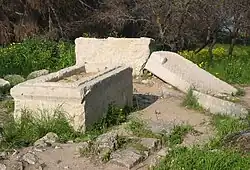
In the Book of Judges, it is stated that Deborah was a prophetess, a judge of Israel and the wife of Lapidoth.[5][6] She rendered her judgments beneath a date palm tree between Ramah in Benjamin and Bethel in the land of Ephraim.[7]
The people of Israel had been oppressed by Jabin, the king of Canaan, whose capital was Hazor, for twenty years. Stirred by the wretched condition of Israel she sends a message to Barak, the son of Abinoam, at Kedesh in Naphtali, and tells him that the Lord God had commanded him to muster ten thousand troops of Naphtali and Zebulun and concentrate them upon Mount Tabor, the mountain at the northern angle of the great plain of Esdraelon. At the same time she states that the Lord God of Israel will draw Sisera, commander of Jabin's army, to the Kishon River. Barak declines to go without the prophet. Deborah consents, but declares that the glory of the victory will therefore belong to a woman. As soon as the news of the rebellion reaches Sisera, he collects nine hundred chariots of iron and a host of people.[6]
Then Deborah said, according to Judges 4:14:
"Go! This is the day the Lord has given Sisera into your hands. Has not the Lord gone ahead of you?" So Barak went down Mount Tabor, with ten thousand men following him.
As Deborah prophesied, a battle is fought (led by Barak), and Sisera is completely defeated. He escapes on foot while his army is pursued as far as Harosheth Haggoyim and destroyed. Sisera comes to the tent of Jael and lies down to rest. He asks for a drink, she gives him milk and he falls asleep. While he is asleep she hammers a tent-pin through his temple.[6]
The Biblical account of Deborah ends with the statement that after the battle, there was peace in the land for 40 years (Judges 5:31).
The Song of Deborah
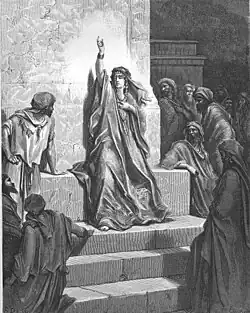
The Song of Deborah is found in Judges 5 and is a victory hymn, sung by Deborah and Barak. It describes the defeat of Canaanite adversaries by some of the tribes of Israel. The song itself differs slightly from the events described in Judges 4, mentioning six participating tribes: Ephraim, Benjamin, Machir—a group associated with the Tribe of Manasseh—Zebulun, Issachar and Naphtali, as opposed to the two tribes in Judges 4:6 (Naphtali and Zebulun) and does not mention the role of Jabin (king of Hazor).[8] The song also rebukes three other tribes (Reuben, Dan, and Asher) for their lack of patriotism,[9] not mentioning the tribes of Gad, Simeon and Judah. Michael Coogan writes that for the redactors of the Song of Deborah, that the Canaanite general Sisera ends up being murdered by a woman (Jael)—the ultimate degradation—"is a further sign that Yahweh ultimately is responsible for the victory".[10]
Though the presence of victory hymns is conventional in the Hebrew Bible, the Song of Deborah is unusual in that it is a hymn that celebrates a military victory of two women: Deborah, the prophetess and Jael, the warrior.[11] Jael—the heroine of the Song of Deborah—shares parallels with the main character of the Book of Judith, who uses her beauty and charm to kill an Assyrian general who has besieged her city, Bethulia.
The Song of Deborah is commonly identified as among the oldest texts of the Bible,[12] but the date of its composition is controversial. Many scholars claim a date as early as the 12th century BCE,[3] while others claim it to be as late as the 3rd century BCE. Some hold that the song was written no earlier than the 7th century BCE.[13]
Traditional chronology
Traditional Jewish chronology places Deborah's 40 years of judging Israel (Judges 5:31) from 1107 BC until her death in 1067 BC.[14] The Dictionary of World Biography: The Ancient World claims that she might have lived in the period between 1200 BC and 1124 BC.[15] Based on archaeological findings, different biblical scholars have argued that Deborah's war with Sisera best fits the context of either the second half of the 12th century BC[16] or the second half of the 11th century BC.[17] Sisera is a non-Semitic name, and the story is set "in the days of Shamgar", a hero famous for killing 600 Philistines. Many scholars, such as Łukasz Niesiołowski-Spanò, believe that the story is really about the Sea Peoples.[18] One archaeological stratum of Hazor dating from around 1200 BCE shows signs of catastrophic fire.[19]
Some scholars like Israel Finkelstein, who associated first monarchy of Israel with Gibeon-Gibeah polity of the early to mid 10th century BC,[20][21] placed the background of the Song of Deborah in the early 10th century BC associating with the Late Iron Age I (c. 1050–950 BCE) destruction of Megiddo, which dates to c. 1000–985 BCE.[22]
Some consider Deborah as the true founder of Israel who united all twelve tribes and the one who introduced Yahwism to Israel. Critical scholars generally believe that the tribe of Levi originated from Egyptians, the tribes of Dan, Asher, Issachar, and Zebulun from the Sea Peoples, and the other tribes from the native Canaanites.[23] Moreover, Yahwism is estimated to have spread to Israel beginning in the 10th century BC. [24] Based on these and the fact that Deborah is associated with the 10th century BC destruction of Megiddo and the Song of Deborah is the oldest record on Israelite Yahwism, critical scholarship proposes that Deborah was the first leader to unite the Israelite tribal confederation and that Yahwism likely spread into Israel during her leadership, whereas from a biblical perspective she is portrayed as having resurrected Israel after it had become fully assimilated among the Canaanites, Egyptians, and Greeks, restoring its identity by teaching and guiding the people to follow Yahweh once again. Her description as “the mother for Israel” (Judges 5:7) can be understood as reflecting her role in enabling Israel to reemerge and be reborn. Author Daniel suggested that if one follows the biblical perspective, one must interpret that Deborah “remade” the Tabernacle, its ritual objects, garments of the priests, and their associated items (similar case can be found in 1 Maccabees 4:49), and “rewrote” the Torah that might have been all lost in time as it is otherwise impossible to interpret the archaeological data, which denies the existence of these during the pre-monarchic period, biblically.[25][26][27][28]
Gallery
-
 Deborah and Barak in a miniature from the 13th-century Psalter of St. Louis
 -
 Jael, Deborah, and Barak (c. 1630) by Salomon de Bray
 -
 A statue of Deborah (1792) in Aix-en-Provence, France
 -
 Deborah depicted in a pendentive of a church dome in Tenancingo, Mexico
 -
 Deborah Judging Israel, west-facing panel at the northwest corner of the Nebraska State Capitol
See also
- Battle of Mount Tabor (biblical)
- The Deborah number
- Handel's Deborah (Handel)
References
- ^ a b c Van Wijk-Bos, Johanna WH. The End of the Beginning: Joshua and Judges. Wm. B. Eerdmans Publishing, 2019.
- ^ García Bachmann, Mercedes L., Ahida E. Pilarski, and Barbara E. Reid. "Judges". Wisdom commentary, Liturgical Press, 2018.
- ^ a b Coogan, Michael David (2006). A Brief Introduction to the Old Testament: The Hebrew Bible in its Context. Oxford, England: Oxford University Press. p. 216. ISBN 978-0195139112.
- ^ Cook, Stanley (1911). . In Chisholm, Hugh (ed.). Encyclopædia Britannica. Vol. 7 (11th ed.). Cambridge University Press. p. 904.
- ^ Judges 4:4
- ^ a b c "Deborah", Jewish Encyclopedia.
- ^ Judges 4:5
- ^ Nelson, Richard (2006). "Judges". The HarperCollins Study Bible, rev. ed. Eds. Attridge, Harold & Wayne Meeks. New York: HarperCollins, p. 353.
- ^ Singer, Isidore, ed. (1912). "Deborah, The Song of". The Jewish Encyclopedia. Vol. 4 (3 ed.). New York: Funk & Wagnalls. p. 490.
- ^ Coogan, Michael David (2006). A Brief Introduction to the Old Testament: The Hebrew Bible in its Context. Oxford, England: Oxford University Press. p. 217. ISBN 978-0195139112.
- ^ Niditch, Susan (2011). "Tales of Deborah and Jael, Warrior Women". Judges: a commentary. The Old Testament Library. Louisville, Kentucky: Westminster John Knox Press. pp. 59–67. ISBN 978-1611644937.
- ^ Hendel, Ronald; Joosten, Jan (2018). How Old Is the Hebrew Bible?: A Linguistic, Textual, and Historical Study. Yale University Press. p. 104. ISBN 978-0-300-23488-6.
The archaic nature of the Song of Deborah is granted by most scholars. [...] The consilience of linguistic and historical data indicate that this is a very early text, composed in the premonarchical or early monarchical period. It belongs to the oldest age of biblical literature.
- ^ Frolov, S. (2011). "How Old is the Song of Deborah?". Journal for the Study of the Old Testament. 36 (2): 163–84. doi:10.1177/0309089211423720. S2CID 170121702.
'To be sure, the consensus outlined here is by no means perfect; several publications that appeared in the 1980s and 1990s diverge from it, sometimes in a major way. In particular, Alberto Soggin, Ulrike Schorn, and Barnabas Lindars see the Song, or at least the bulk thereof, as a product of the early monarchy; Ulrike Bechmann and Manfred Görg place it in the late pre-exilic period; Michael Waltisberg advocates early post-exilic provenance (fifth to third centuries BC); and B.-J. Diebner shifts the composition's date to the turn of the era.' (p. 165); 'With the text's internal parameters and the external conditions of its existence considered systematically, what we know as Judg. 5.2–31a presents itself as an integral part of the Deuteronomistic oeuvre and should be dated, accordingly, between c. 700 and c. 450 BCE.' (p. 183)
- ^ Jewish History: Deborah the Prophetess, Chabad.
- ^ Northen Magill, Frank and Christina J. Moose (2003-01-23). "Deborah". Dictionary of World Biography: The Ancient World. Taylor & Francis. ISBN 978-1-57958040-7. Retrieved 1 April 2013.
- ^ Albright, W. F. (1937). "Further Light on the History of Israel from Lachish and Megiddo". Bulletin of the American Schools of Oriental Research. 68 (68): 22–26. doi:10.2307/3218855. JSTOR 3218855. S2CID 163435967.
- ^ Mayes, A. D. H. (1969). "The Historical Context of the Battle against Sisera". Vetus Testamentum. 19 (3): 353–360. doi:10.2307/1516506. JSTOR 1516506.
- ^ Niesiolowski-Spano, Ł., & Kantor, M. (2015). Goliath's legacy: Philistines and Hebrews in biblical times (Philippika). Harrassowitz Verlag. ISBN 978-3447103466.
- ^ "Hatzor - The Head of all those Kingdoms". embassies.gov.il. 2024-04-25. Archived from the original on 2023-10-26. Retrieved 2025-08-09.
- ^ Finkelstein, Israel (2020). "Saul and Highlands of Benjamin Update: The Role of Jerusalem". In Joachim J. Krause; Omer Sergi; Kristin Weingart (eds.). Saul, Benjamin, and the Emergence of Monarchy in Israel: Biblical and Archaeological Perspectives. Atlanta, GA: SBL Press. p. 48. ISBN 978-0-88414-451-9.
- ^ Finkelstein, Israel (2019). "First Israel, Core Israel, United (Northern) Israel". Near Eastern Archaeology. American Schools of Oriental Research (ASOR). 82 (1): 12. doi:10.1086/703321. S2CID 167052643. Retrieved 22 March 2020.
- ^ Albright Live (2021). Episode Twenty-one: Heroic Stories in the Book of Judges, 12:25–19:45.
- ^ Daniel. (2026). 사해 문서로 다시 보는 에녹서, 226–239 하움출판사. ISBN 979-11-7374-266-8. Levitical cities, such as Gath-Rimmon (Tel Gerisa), were Egyptian garrisons in Canaan; during the Late Bronze Age collapse, some Egyptians stationed in Canaan did not leave when the Egyptian army withdrew, a fact confirmed archaeologically through artifacts; that the name “Levi” means “attached” or “joined”; and that the names of individuals from the tribe of Levi are of Egyptian origin; the claim that the tribe of Dan descended from the Denyen(Danuna) is supported by archaeological findings from Tel Dan, including Aegean-style cultic structures, ritual objects, and pottery; ’šr (Asher?) and sbrj (Zebulun?) appears in Onomasticon of Amenope among the Sea Peoples; “Iš-Tjekker (Issachar)” means “the people of Tjeker,” and Dor, recorded as the territory of the Tjeker settled in Canaan in the 11th-century BC Egyptian text, the Story of Wenamun, appears as the territory of the tribe of Issachar in Joshua 17:11; the tribe of Benjamin might be identical to the Amorite tribe of Binu-Jamina, which appears in 19-18th century BC Mesopotamian records; the tribe of Judah is presumed to be emerged as a southern desert nomadic confederation only in the 10th century BC as the archaeological sites in the territory of Judah were largely established only by the 10th century BC and the population growth in this region began around the same time; the 9th-century BC Mesha Stele shows that the tribe of Gad may have been a subgroup of Moab.
- ^ Daniel, 2026, pp. 226–239. This is supported by several lines of evidence: population inflows and the establishment of new settlements in southern desert regions such as the Negev from the 10th century BC onward; the earliest and most reliable archaeological evidence of contact between Israelites and the Kenites—namely figurines similar to dedication artifacts from the Hathor temple in Timna, associated with the Kenites, as well as Qurayyah pottery sherds archaeologically linked to the Kenites—found in Stratum II at Tel Masos dating to the 10th century BC; and the earliest textual evidence of Israelite Yahwism in the 9th-century BC Mesha Stele.
- ^ Daniel, 2026, pp. 229–231
- ^ This biblical interpretation by Daniel places Exodus during the reign of Khufu, which is earlier than the 2nd millennium BC, and Eisodus of Jacob’s family during the reign of Neferkasokar; Daniel, 2026, pp. 240–243. “the period between the Exodus and the building of the Temple was not 480 years … even longer … Evidence for such claims can be found in textual variations between biblical manuscripts. For example, the Septuagint, the Samaritan Pentateuch, and Josephus’s account of Genesis 11 record the ages at which patriarchs fathered children differently from the later Masoretic Text, often in the hundreds rather than in the thirties. This suggests that numbers may have been lost or altered during the copying process. ... the MacGregor Plaque and the Abydos ivory tablet of Pharaoh Qa'a of the 1st Dynasty indicate that Semitic nomads were brought into Egypt as slaves or captives even before the Old Kingdom …”
- ^ Daniel, 2026, pp. 231–238. In addition, the destruction of Shechem and Shiloh occurred toward the end of the 11th century, around 1000 BC and is associated with the story of Abimelech in Judges 9. The destruction of Megiddo (Stratum VIA; marking the transition from Iron I to Iron II), which is linked to Deborah, is dated to 986–983 BC. After the destruction of Shechem and Shiloh, the late 11th century BC saw the rise of Gibeon, Gibeah, and Bethel. The Saulide dynasty is thought to have emerged after the destruction of Megiddo by Deborah who lived in the region between Bethel and Rama near Gibeon during the 10th century BC. Although the tabernacle and the Ark of the Covenant are depicted as being in Shiloh during the time of the Judges and the early Israelite monarchy (1 Samuel 1), Shiloh had already been destroyed in the days of Abimelech (before Deborah). Judges 20:26–27 records that during the civil war between the tribe of Benjamin and the rest of Israel, the Ark of the Covenant was not in Shiloh—as described in Samuel—but in Bethel, near Gibeon. 2 Chronicles 1:1 states that the tabernacle was in Gibeon, and 1 Samuel 21:1 describes the tabernacle and the priests as being in Nob, a town in the Gibeah–Gibeon region. Considering all this, it seems plausible that the tabernacle and the ark were actually located in Gibeon or its surrounding area (after the time of Joshua, during which they were located in the region of Shiloh), but that this was altered in the transmission of the biblical manuscripts.
- ^ Daniel, 2026, pp. 231–238. “Gath … became the Philistine center beginning around the mid-10th century BC … Based on this, scholars place the setting of the David narratives between the mid–10th and 9th centuries BC … From a biblical perspective, the period from David’s battle with Goliath of Gath to the invasion of Jerusalem by Sheshonq I during the reign of David’s grandson Rehoboam could be understood as shorter than in the conventional chronology, perhaps around 950–930 BC. One may interpret the decline of Gibeon caused by Sheshonq I’s invasion not as the cause of the fall of the Saulide dynasty; instead, the Saulide dynasty may have collapsed before Gibeon’s decline. The fact that Gibeon had not yet declined by the time of Sheshonq I’s invasion could be connected with the biblical description that Solomon offered a thousand burnt offerings at the high place of Gibeon before the Temple was built, and that the high place in Gibeon was great (1 Kings 3:4). This interpretation would allow the historical reality of a united monarchy to be acknowledged within the archaeological context.”
Further reading
- Bird, Phyllis (1974). "Images of Women in the Old Testament". In Ruether, Rosemary Radford (ed.). Religion and Sexism: Images of Women in the Jewish and Christian Traditions. Simon & Schuster. ISBN 0-671-21692-9.
- Brown, Cheryl Anne (1992). No Longer be Silent: First Century Jewish Portraits of Biblical Women: Studies in Pseudo-Philo's Biblical Antiquities and Josephus's Jewish Antiquities. Louisville, KY: Westminster J. Knox Press. ISBN 0-664-25294-X.
- Deen, Edith (1955). All the Women of the Bible. New York: Harper & Row.
- Lacks, Roslyn (1979). Women and Judaism: Myth, History, and Struggle. Garden City, NY: Doubleday. ISBN 0-385-02313-8.
- Otwell, John H. (1977). And Sarah Laughed: the Status of Woman in the Old Testament. Philadelphia: Westminster Press. ISBN 0-664-24126-3.
- Phipps, William E. (1992). Assertive Biblical Women. Westport, CT: Greenwood Press. ISBN 0-313-28498-9.
- Schroeder, Joy A. (2014). Deborah's Daughters: Gender Politics and Biblical Interpretation. New York: Oxford University Press. ISBN 978-0-19-999104-4.
- Williams, James G. (1982). Women Recounted: Narrative Thinking and the God of Israel. Sheffield: Almond Press. ISBN 0-907459-18-8.
External links



- Book of Judges article, Jewish Encyclopedia
- Debbora, Catholic Encyclopedia
- Biblical Hebrew Poetry - Reconstructing the Original Oral, Aural and Visual Experience
- Song of Deborah (Judges 5) Reconstructed
Women rabbis and Torah scholars | ||||||
|---|---|---|---|---|---|---|
Timeline of women rabbis | ||||||
| Pre-modern figures |
|  | ||||
| Modern figures |
| |||||
| Alternate rabbinical roles |
| |||||
| Organisations and midrashot |
| |||||
 Category: Women rabbis Category: Women rabbis | ||||||