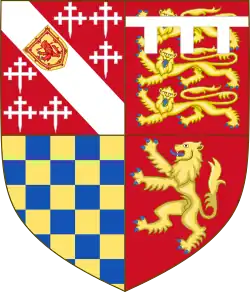
Arms: Quarterly, 1st: Gules on a Bend between six Cross-crosslets fitchy Argent an Escutcheon Or charged with a Demi-lion rampant pierced through the mouth by an arrow within a Double Tressure flory counterflory of the first (Howard); 2nd: Gules three Lions passant gardant in pale Or, Armed and Langued Azure, in chief a Label of three points Argent (Plantagenet of Norfolk); 3rd: Checky Or and Azure (Warenne); 4th: Gules a Lion rampant Or, Armed and Langued Azure (Fitzalan).
1st Duke's heirs male of the body lawfully begotten
Subsidiary titles
Earl of Arundel
Earl of Surrey
Earl of Norfolk
Earl Marshal (office)
Baron Beaumont
Baron Maltravers
Baron FitzAlan
Baron Clun
Baron Oswaldestre
Baron Howard of Glossop
Extinction date
1476 (first creation)
1483 (second creation)
Seats
Arundel Castle
Carlton Towers
Former seats
Framlingham Castle
Bungay Castle
Clun Castle
Duke of Norfolk is a title in the Peerage of England. The premier non-royal peer, the Duke of Norfolk is additionally the premier duke and earl in the English peerage.[1] The seat of the Duke of Norfolk is Arundel Castle in Sussex, although the title refers to the county of Norfolk. The current duke is Edward Fitzalan-Howard, 18th Duke of Norfolk. The dukes have historically been Catholic, a state of affairs known as recusancy in England.
All past and present dukes have been descended from Edward I. The son of Thomas Howard, 3rd Duke of Norfolk, was Henry Howard, Earl of Surrey; the earl was descended from Edward III. As all subsequent dukes after Thomas Howard, 4th Duke of Norfolk are descendants of the Earl of Surrey, this means they are also descended from Edward III.
History
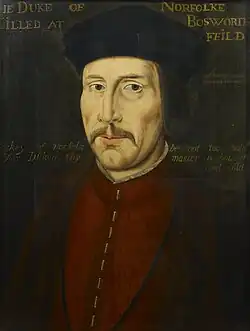
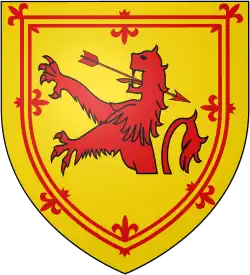
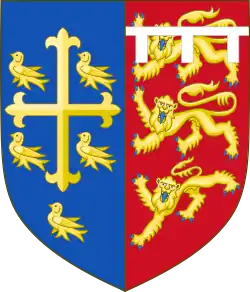
John Howard, 1st Duke of Norfolk (3rd creation)Augmentation to the arms of Thomas Howard, 2nd Duke of Norfolk, for his services at the Battle of FloddenBlazon:The Royal Shield of Scotland, having a demi-lion only, which is pierced through the mouth with an arrow.Arms of Thomas de Mowbray, 1st Duke of Norfolk (1st Creation)
Before the Dukes of Norfolk, there were the Bigod Earls of Norfolk, starting with Roger Bigod from Normandy (died 1107). Their male line ended with Roger Bigod, 5th Earl of Norfolk, who died without an heir in 1306, so their titles and estates reverted to the crown. Edward II then granted his brother, Thomas of Brotherton, the title of Earl of Norfolk in 1312. It passed to Thomas's daughter (and granddaughter of Edward I), Margaret, and then to her grandson, Thomas Mowbray.
When Richard II made Thomas Mowbray the Duke of Norfolk in 1397, he conferred upon him the estates and titles (including Earl Marshal) that had belonged to the Earls of Norfolk. His elderly grandmother, Margaret, was still alive, and so at the same time she was created Duchess of Norfolk for life. Mowbray died in exile in 1399, months after his grandmother, and his dukedom was repealed. His widow took the title of Countess of Norfolk.[2]
Between 1401 and 1476, the Mowbray family held the title and estates of the Duke of Norfolk. John de Mowbray, 4th Duke of Norfolk, died without male issue in 1476, his only surviving child being the 3-year-old Anne Mowbray. A marriage was arranged between Anne and Richard, Duke of York, the 4-year-old son of Edward IV. She remained Richard's child bride until she died at the age of 8.
In accordance with the marriage arrangements, Richard inherited the lands and wealth of the Mowbray family. He was also made Duke of Norfolk. However, upon the death of Edward IV, the throne was offered to Edward's brother, Richard III. After Prince Richard was lodged in June 1483 in the Tower of London, where his elder brother (briefly Edward V) was too, both Richard and Edward were declared illegitimate. They subsequently disappeared, and the titles of both York and Norfolk were forfeited to the crown.
This left John Howard, the son of Thomas Mowbray's elder daughter Margaret, as heir to the dukedom, and his support for Richard III's accession secured his creation as 1st Duke of Norfolk in 1483, in the title's third creation. From this point to the present, the title has remained in the hands of the descendants of John Howard, except for periods when it was temporarily forfeited.
The Catholic faith of the Howard dynasty often resulted in conflict with the reigning monarch, particularly during and after the reign of Henry VIII. In 1546, Thomas Howard, the third Duke, fell out of favour with the dying Henry and was attainted on 27 January 1547; he was stripped of his titles and his lands reverted to the Crown. Imprisoned in the Tower of London, he narrowly escaped execution through Henry's death the following day, but remained imprisoned until the death of Edward VI and the accession of the Catholic Queen Mary to the English throne in 1553, upon which his lands and titles were restored to him. However, the Duke died the following year aged around 81, and was succeeded by his grandson Thomas as the fourth Duke of Norfolk.
Following Mary's death in 1558 and the accession of her sister Elizabeth I, the Duke was imprisoned for scheming to marry Elizabeth's cousin Mary, Queen of Scots. After his release under house arrest in 1570 and subsequent participation in the Ridolfi plot to enthrone Mary and Catholicism in England, he was executed in 1572 for treason and his lands and titles again became forfeit.
In 1660, the fourth Duke's great-great-grandson, the 23rd Earl of Arundel, was restored to the family lands and dukedom. Mentally infirm, the fifth Duke never married and died in 1677. He was succeeded by his younger brother Henry as the 6th Duke, through whom the 7th Duke, 8th Duke and 9th Duke of Norfolk were descended in the male-line.
At the death of the 9th Duke, the title was inherited in 1777 by his heir male, Charles Howard, a grandson of Charles Howard of Greystoke, a younger brother of the 5th and 6th Dukes. He was succeeded by his son, Charles, whose lack of a legitimate male heir resulted in the title passing to Bernard Howard, a great-grandson of Bernard Howard of Glossop, the youngest brother of the 5th and 6th Dukes. The title then passed to his son in 1842, Henry Howard, 13th Duke of Norfolk, who was the father of Henry Fitzalan-Howard, 14th Duke of Norfolk, and Edward Fitzalan-Howard, 1st Baron Howard of Glossop. By royal licence dated 26 April 1842, the 13th Duke added "Fitzalan" before his children's surnames (but not his own), so they all became Fitzalan-Howard, which surname their male-line descendants have borne ever since.[3] Their ancestor, Thomas Howard, 4th Duke of Norfolk, married Mary FitzAlan (daughter and heiress of Henry Fitzalan, 12th Earl of Arundel) in 1555.[4]
The title passed through the line of the elder brother from 1856 until the death in 1975 of Bernard Fitzalan-Howard, 16th Duke of Norfolk without male issue. Consequently, he was succeeded by his second cousin once removed, Miles Stapleton-Fitzalan-Howard, 17th Duke of Norfolk, who was a great-grandson of the aforementioned 1st Baron Howard of Glossop.
The current Duke of Norfolk is Edward Fitzalan-Howard, 18th Duke of Norfolk, who succeeded his father, Miles Stapleton-Fitzalan-Howard, 17th Duke of Norfolk, in 2002. He succeeded as 18th Duke of Norfolk (Premier Duke of England), 36th Earl of Arundel (Premier Earl of England), 19th Earl of Surrey, 16th Earl of Norfolk, 13th Baron Beaumont, 26th Baron Maltravers, 16th Baron FitzAlan, 16th Baron Clun, 16th Baron Oswaldestre, and 5th Baron Howard of Glossop.[5]
The 15th Duke of Norfolk owned almost 50,000 acres with 19,400 acres in the West Riding of Yorkshire, 21,000 acres in Sussex and 4,400 acres in Norfolk.[6]
Duties and other titles
In addition to the ducal title, the dukes of Norfolk also hold the hereditary position of Earl Marshal, which has the duty of organising state occasions such as the coronation of the monarch and the state opening of Parliament. For the last five centuries, save some periods when it was under attainder, both the dukedom and the earl-marshalship have been in the hands of the Howard family. According to the House of Lords Act 1999, due to his duties as Earl Marshal, Norfolk is one of only two hereditary peers automatically admitted to the House of Lords, without being elected by the general body of hereditary peers (the other being the Lord Great Chamberlain).
The Duke of Norfolk participates in the formal ceremony surrounding the annual State Opening of Parliament held at the Palace of Westminster each year. He is among the four individuals who precede the monarch in procession to the House of Lords chamber, and one of the two of these who would traditionally walk facing the sovereign (thus backwards), though this has not been practised in recent years.
As the Earl Marshal, the Duke of Norfolk is head of the College of Arms, through which he regulates all matters connected with armorial bearings and standards, in addition to controlling the arrangements for state functions. He is one of three claimants to the title of Chief Butler of England.
The Duke of Norfolk currently holds the following subsidiary titles (year of present creation noted for each):
All titles are in the Peerage of England, save for the most recent, the Barony of Howard of Glossop which is in the Peerage of the United Kingdom. All descend to heirs male except the Barony of Beaumont, which can pass in the female line. The style Earl of Arundel is used as a courtesy title by the Duke's eldest son, the present holder being Henry Fitzalan-Howard, Earl of Arundel. The style Lord Maltravers is used as a courtesy title by the eldest son of the Duke's eldest son (the Duke's grandson).
Heraldic achievement (coat of arms)
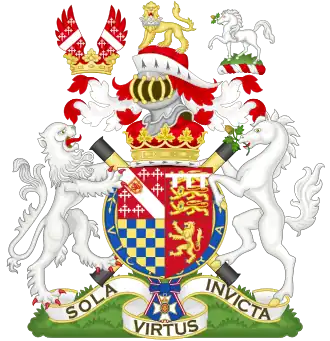
Coat of arms of the Duke of Norfolk
Adopted
1660 (by the 5th Duke of Norfolk)
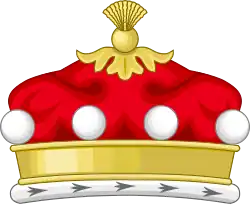
Coronet
A Coronet of a Duke
Crest
1st: Issuant from a Ducal Coronet Or a pair of Wings Gules each charged with a Bend between six Cross-crosslets fitchy Argent (Howard); 2nd: On a Chapeau Gules turned up Ermine a Lion statant gardant with tail extended Or gorged with a Ducal Coronet Argent (Thomas of Brotherton); 3rd: On a Mount Vert a Horse passant Argent holding in the mouth a Slip of Oak Vert fructed proper (Fitzalan).
Helm
Helm of a peer
Escutcheon
Quarterly, 1st: Gules on a Bend between six Cross-crosslets fitchy Argent an Escutcheon Or charged with a Demi-lion rampant pierced through the mouth by an arrow within a Double Tressure flory counterflory of the first (Howard); 2nd: Gules three Lions passant gardant in pale Or, Armed and Langued Azure, in chief a Label of three points Argent (Plantagenet of Norfolk); 3rd: Checky Or and Azure (Warenne); 4th: Gules a Lion rampant Or, Armed and Langued Azure (Fitzalan).
Supporters
Dexter a Lion, sinister a Horse both Argent the latter holding in the mouth a Slip of Oak Vert fructed proper.
Motto
Sola Virtus Invicta (Latin for "Virtue alone is unconquered").
Orders
Circlet of the Royal Victorian Order (appointed Knight Grand Cross in 2022). Often, the coat of arms of the Duke of Norfolk appears with the Garter circlet of the Order of the Garter surrounding the shield, as seen in the arms of the 17th Duke of Norfolk. However, this is not hereditary; the 17th Duke did not become a Knight of the Garter until 22 April 1983. The 18th Duke of Norfolk, as of 2022, had not been appointed to the Order of the Garter.
Other elements
Placed behind the shield are two gold batons in saltire enamelled at the ends in black, which represent the Duke of Norfolk's office as Earl Marshal and Hereditary Marshal of England.
Symbolism
The shield on the bend in the first quarter of the arms was granted as an augmentation of honour by Henry VIII to the 2nd Duke of Norfolk, to commemorate his victory at the Battle of Flodden. It is a modification of the Royal coat of arms of Scotland. Instead of its normal rampant position, the lion is shown cut in half with an arrow through its mouth, commemorating the death of King James IV at the battle.[7]
The main residences commonly associated with the Dukes of Norfolk are: Framlingham Castle, Bungay Castle, as well as Clun Castle in Shropshire, which are now largely ruins; Worksop Manor, Carlton Towers, Norfolk House in London, and most notably Arundel Castle.
18th Duke of Norfolk, then the Earl of Arundel, at Carlton Towers, 1981
Framlingham Castle was originally a part of the properties of the Earls of Norfolk, but when the title fell from use, the castle was administered by the crown. In 1397, it was given to Thomas Mowbray, 1st Duke of Norfolk, by King Richard II. And when the Mowbray line became extinct, it passed eventually to the Howard family. Major repairs to this castle were carried out in 1485 by John Howard, 1st Duke of Norfolk (second creation). The castle would remain in the Howard family, and thus the Dukes of Norfolk, for a while, but would eventually pass from their possession. In 1553, for example, Framlingham was given to Mary Tudor, sister of King Edward VI.[8]
Bungay Castle, in Bungay, Suffolk, was also originally a part of the properties of the Earls of Norfolk. In 1483, it passed into the possession of John Howard, 1st Duke of Norfolk, and the family continued to own it, apart from brief periods, until the late 20th century. However, the castle has long been in a state of decay. Consequently, in 1987, the 17th Duke of Norfolk presented the castle to the town, which had already begun its own restoration attempts, along with an endowment for funding towards its preservation. It is now owned and administered by the Castle Trust.[9]
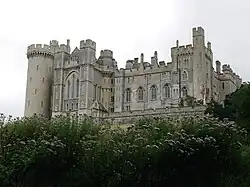
Arundel Castle
Carlton Towers is in Carlton, North Yorkshire. It is a Victoriangothic country house remodelled by Edward Welby Pugin for the 8th Baron Beaumont. It is the Yorkshire home of the Duke of Norfolk. Though the Duke of Norfolk's family still live in part of the house, it is now largely used for wedding receptions and similar events.
Arundel Castle in West Sussex has been the principal seat of the Dukes of Norfolk and their ancestors for more than 850 years. Built in the 11th century by Roger de Montgomery, Earl of Arundel, the castle was seized by the crown in 1102. Some 50 years later, in 1155, King Henry II, who had added on to the castle, confirmed William d'Aubigny as Earl of Arundel; he was given the honour, title and castle of Arundel. Arundel Castle is still to this day the home of The Duke and Duchess of Norfolk and their children. The Fitzalan Chapel, founded in 1390 by the 4th Earl of Arundel, is located on the western grounds outside the castle, and has been the burial place of the most recent Dukes of Norfolk.[10]
Glossop Hall is an occasional residence of the Dukes, situated in the High Peak District of Derbyshire. As the family became closely connected with Sheffield, the Farm in Glossop became increasingly used, particularly: when Henry Howard lived there in the 1760s; when the 14th Duke enlarged The Farm as an occasional residence; and during the time of the 15th Duke, Henry Granville Fitzalan-Howard, who had an interest in the activities of the city. The Glossop estate was sold by the family in 1925.
Son of King Edward IV and son-in-law of the 4th Duke of Norfolk
Duke of York Earl of Norfolk Earl of Nottingham
Dukes of Norfolk (1483)
Thomas Howard, 4th Duke of NorfolkMary (née Blount), Duchess of Norfolk, after whom Norfolk Island was namedMiles Fitzalan-Howard, 17th Duke of Norfolk
Lady Mary FitzAlan Margaret Audley Elizabeth Leyburne
Grandson of the preceding, executed for treason against Elizabeth I, forfeiting the dukedom
5
Thomas Howard (1627–1677)
1660–1677
unmarried
Great-great-grandson of the preceding, restored to the dukedom
Earl of Arundel Earl of Surrey Earl of Norfolk Baron Mowbray Baron Maltravers Baron Furnivall
6
Henry Howard (1628–1684)
1677–1684
Jane Bickerton
Brother of the preceding
Earl of Arundel Earl of Surrey Earl of Norfolk Earl of Norwich Baron Mowbray Baron Maltravers Baron Furnivall Baron Howard of Castle Rising
7
Henry Howard (1655–1701)
1684–1701
Mary Mordaunt, 7th Baroness Mordaunt
Son of the preceding
Baron Mowbray by writ of acceleration on 14 Jan. 1678
8
Thomas Howard (1683–1732)
1701–1732
Maria Shireburn
Nephew of the preceding
9
Edward Howard (1685–1777)
1732–1777
Mary Blount
Brother of the preceding
10
Charles Howard (1720–1786)
1777–1786
Catherine Brockholes
Second cousin of the preceding
Earl of Arundel Earl of Surrey Earl of Norfolk Baron Maltravers
11
Charles Howard (1746–1815)
1786–1815
Frances Scudamore
Son of the preceding
12
Bernard Edward Howard (1765–1842)
1815–1842
divorced
Third cousin of the preceding
13
Henry Charles Howard (1791–1856)
1842–1856
Charlotte Leveson-Gower
Son of the preceding
14
Henry Granville Fitzalan-Howard (1815–1860)
1856–1860
Augusta Lyons
Son of the preceding
15
Henry Fitzalan-Howard (1847–1917)
1860–1917
Lady Flora Paulyna Hetty Barbara Abney-Hastings Gwendolen Constable-Maxwell, 12th Lady Herries of Terregles
Son of the preceding
16
Bernard Marmaduke Fitzalan-Howard (1908–1975)
1917–1975
Lavinia Strutt
Son of the preceding
Earl of Arundel Earl of Surrey Earl of Norfolk Baron Maltravers Lord Herries of Terregles
17
Miles Francis Stapleton Fitzalan-Howard (1915–2002)
1975–2002
Anne Constable-Maxwell
Second cousin once removed of the preceding
Earl of Arundel Earl of Surrey Earl of Norfolk Baron Maltravers Baron Beaumont Baron Howard of Glossop
18
Edward William Fitzalan-Howard (b. 1956)
since 2002
Georgina Gore (m. 1987; div. 2022)
Francesca Herbert
(m. 2022)
Son of the preceding
The heir apparent is the Duke's eldest son, Henry Miles Fitzalan-Howard, styled Earl of Arundel (b. 1987).
Remainder
In 1660, the 23rd Earl of Arundel was restored to the Dukedom of Norfolk with remainder to:
the heirs male of his body (he never married)
the heirs male of his father Henry Howard, the 22nd Earl
Hon. Henry Howard (extinct in 1777)
Hon. Philip Howard (extinct in 1694)
Hon. Charles Howard (extinct in 1815)
Hon. Talbot Howard
Hon. Edward Howard
Hon. Francis Howard
Hon. Bernard Howard (the present line)
Hon. Esme Howard (extinct in 1728)
Hon. John Howard (extinct in 1711)
the heirs male of his grandfather Thomas Howard, 21st Earl
Henry Howard, the 22nd Earl
William Howard, 1st Viscount Stafford (extinct in 1762)
the heirs male of his great-grandfather Philip Howard, 20th Earl, eldest son of the fourth Duke (he had none apart from the 21st Earl)
Thomas Howard, 21st Earl
the heirs male in the line of descent from Thomas Howard, younger half-brother of Philip Howard, 20th Earl
Theophilus Howard, 2nd Earl of Suffolk (extinct in 1745)
Thomas Howard, 1st Earl of Berkshire (currently extant)
Hon. Henry Howard (extinct in 1616)
Hon. Sir Charles Howard (extinct in 1626)
Hon. Sir Robert Howard (extinct in 1653)
Hon. Sir William Howard
Edward Howard, 1st Baron Howard of Escrick (extinct in 1715)
the heirs male descended from Lord William Howard, younger half-brother of Philip Howard, 20th Earl: (both lines currently extant)
the heirs male in the senior line of descent from Lord William Howard through his elder son Sir Philip Howard, grandfather of the first Earl of Carlisle
the heirs male in the junior line of descent from Lord William Howard through his second son Francis, ancestor of the Howards of Corby Castle, Cumberland, England.
In the event all the currently extant lines of descent from the fourth Duke fail in the male line, the Dukedom of Norfolk and its subsidiary titles will become extinct; though there exists a currently extant branch of the Howard dynasty, the Earls of Effingham, in descent from the second Duke, their line was unaccountably omitted from the 1660 remainder.
Succession to the Dukedom
Line of succession (simplified)
Thomas Howard, 4th Duke of Norfolk (1536–executed 1572, when the dukedom was forfeited)
Saint Philip Howard, 13th Earl of Arundel (1557–1595)
Thomas Howard, 14th Earl of Arundel (1585–1646)
Henry Howard, 15th Earl of Arundel (1608–1652)
Thomas Howard, 5th Duke of Norfolk (1627–1677, succeeded as Earl of Arundel 1652, restored to Dukedom of Norfolk 1660 with the above remainder)
Henry Howard, 6th Duke of Norfolk (1628–1684)
Henry Howard, 7th Duke of Norfolk (1655–1701)
Lord Thomas Howard (1662–1689)
Thomas Howard, 8th Duke of Norfolk (1683–1732)
Edward Howard, 9th Duke of Norfolk (1686–1777)
Hon. Charles Howard (1630–1713)
Henry Charles Howard (d. 1720)
Charles Howard, 10th Duke of Norfolk (1720–1786)
Charles Howard, 11th Duke of Norfolk (1746–1815)
Hon. Bernard Howard (1641–1717)
Bernard Howard (1674–1735)
Henry Howard (1713–1787)
Bernard Howard, 12th Duke of Norfolk (1765–1842)
Henry Howard, 13th Duke of Norfolk (1791–1856)
Henry Fitzalan-Howard, 14th Duke of Norfolk (1815–1860)
Henry Fitzalan-Howard, 15th Duke of Norfolk (1847–1917)
Bernard Fitzalan-Howard, 16th Duke of Norfolk (1908–1975)
Edward Fitzalan-Howard, 1st Baron Howard of Glossop (1818–1883)
Francis Fitzalan-Howard, 2nd Baron Howard of Glossop (1859–1924)
Bernard Fitzalan-Howard, 3rd Baron Howard of Glossop (1885–1972)
Miles Stapleton-Fitzalan-Howard, 17th Duke of Norfolk (1915–2002)
Edward Fitzalan-Howard, 18th Duke of Norfolk (b. 1956)
(1). Henry Fitzalan-Howard, Earl of Arundel (b. 1987)
(2). Lord Thomas Jack Fitzalan-Howard (b. 1992)
(3). Lord Philip Fitzalan-Howard (b. 1996)
(4). Lord Gerald Bernard Fitzalan-Howard (b. 1962)
(5). Arthur Stapleton Desmond Fitzalan-Howard (b. 1991)
Lord Michael Fitzalan-Howard (1916–2007)
male issue in line
Lord Martin Fitzalan-Howard (1922–2003)
male issue in line
other male issue in line
Edward Charles Howard (1774-1816)
Edward Gyles Howard (1805-1840)
Edward Henry Howard (1829-1892) cardinal
Lord Henry Howard-Molyneux-Howard (1766–1824)
Henry Howard (1802–1875)
Stafford Howard (1851–1916)
Stafford Vaughan Stepney Howard (1915–1991)
Nicholas Stafford Howard (1937–2008)
male issue in line
other male issue in line
Robert Mowbray Howard (1854–1928)
Henry Ralph Mowbray Howard-Sneyd (1883–1950)
Thomas Henry Gavin Howard-Sneyd (1940–2010)
male issue in line
Esmé Howard, 1st Baron Howard of Penrith (1863–1939)
Barons Howard of Penrith
Thomas Howard, 1st Earl of Suffolk (1561–1626)
Thomas Howard, 1st Earl of Berkshire (1587–1669)
Philip Howard (1629–1717)
Charles Howard (1681–1707)
Philip Howard (1704–1741)
John Howard, 15th Earl of Suffolk, 8th Earl of Berkshire (1739–1820)
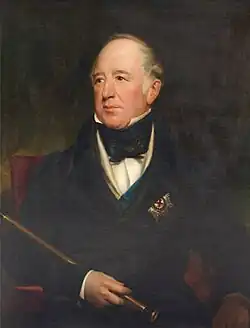
12th Duke of Norfolk shown wearing the star and sash of the Order of the Garter
The following list is of the dukes of Norfolk, along with their year of investiture, who were also knights of the Order of the Garter across all creations of the title.
1383 – Thomas Mowbray, 1st Duke of Norfolk
1421 – John Mowbray, 3rd Duke of Norfolk
1451 – John Mowbray, 4th Duke of Norfolk
1472 – John Howard, 1st Duke of Norfolk
1475 – Richard of Shrewsbury, 1st Duke of York, 1st Duke of Norfolk
1483 – Thomas Howard, 1st Earl of Surrey; degraded 1485; restored 1489; later 2nd Duke of Norfolk
Baron Howard of Castle Rising, 1669 Earl of Norwich (3rd creation), 1672
William Stourton (d. 1685) 12th Baron Stourton
Thomas Howard (1627–1677) 5th Duke of Norfolk, 21st/14th/2nd Earl of Arundel, 4th/6th Earl of Surrey, 16th Baron Mowbray 1660–1677 18th Baron Strange of Blackmere, 15th Baron Talbot, 14th Baron Furnivall 1654–1677
Henry Howard (1628–1684) 6th Duke of Norfolk, 22nd/15th/3rd Earl of Arundel, 5th/7th Earl of Surrey, 1st Earl of Norwich and Baron Howard of Castle Rising, 18th Baron Strange of Blackmere, 17th Baron Mowbray, 15th Baron Talbot, 14th Baron Furnivall 1672–1684
Hon. Charles Howard (1630–1713)
Col. Bernard Howard (1641–1717)
Edward Stourton (1665–1720) 13th Baron Stourton
Thomas Stourton (1667–1744) 14th Baron Stourton
Charles Stourton (1669–1739)
Henry Howard (1655–1701) 7th Duke of Norfolk, 22nd/15th/3rd Earl of Arundel, 5th/7th Earl of Surrey, 2nd Earl of Norwich and Baron Howard of Castle Rising, 18th Baron Mowbray, 19th Baron Strange of Blackmere, 15th Baron Talbot, 14th Baron Furnivall, 1684–1701
Lord Thomas Howard (1662–1689)
Henry Charles Howard (d. 1720)
Thomas Howard (1683–1732) 8th Duke of Norfolk, 23rd/16th/4th Earl of Arundel, 6th/8th Earl of Surrey, 3rd Earl of Norwich and Baron Howard of Castle Rising, 18th Baron Strange of Blackmere, 15th Baron Talbot, 14th Baron Furnivall, 19th Baron Mowbray 1701–1732
Edward Howard (1685–1777) 9th Duke of Norfolk, 24th/17th/5th Earl of Arundel, 7th/9th Earl of Surrey, 4th Earl of Norwich and Baron Howard of Castle Rising, 20th Baron Mowbray, 20th Baron Strange of Blackmere, 15th Baron Talbot, 14th Baron Furnivall 1732–1777
Philip Howard (1688–1750)
Bernard Howard (1674–1735)
Earldom of Norwich (3rd creation) and Barony of Howard of Castle Rising extinct and Baronies of Furnivall, Mowbray, Segrave, Strange of Blackmere, and Talbot abeyant, 1777
Charles Stourton (1702–1753) 15th Baron Stourton
William Stourton (1704–1781) 16th Baron Stourton
Winifred Howard (1726–1753)
Anne Howard (1742–1787)
Charles Howard (1720–1786) 10th Duke of Norfolk, 25th/18th/6th Earl of Arundel, 8th/10th Earl of Surrey 1777–1786
Henry Howard (1713–1787)
Charles Philip Stourton (1752–1816) 17th Baron Stourton
Charles Howard (1746–1815) 11th Duke of Norfolk, 26th/19th/7th Earl of Arundel, 9th/11th Earl of Surrey 1786–1815
William Stourton (1776–1846) 18th Baron Stourton
Bernard Howard (1765–1842) 12th Duke of Norfolk, 27th/20th/8th Earl of Arundel, 10th/12th Earl of Surrey 1815–1842
Charles Stourton (1802–1872) 19th Baron Stourton
Henry Howard (1791–1856) 13th Duke of Norfolk, 28th/21st/9th Earl of Arundel, 11th/13th Earl of Surrey 1842–1856
Baron Mowbray and Baron Segrave abeayance restored, 1878
Baron Howard of Glossop
Alfred Joseph Stourton (1829–1893) 24th Baron Segrave, 21st/23rd Baron Mowbray, 20th Baron Stourton
Henry Granville Fitzalan-Howard (1815–1860) 14th Duke of Norfolk, 29th/22nd/10th Earl of Arundel, 12th/14th Earl of Surrey 1856–1860
Edward George Fitzalan-Howard (1818–1883) 1st Baron Howard of Glossop
Charles Botolph Joseph Stourton (1867–1936) 25th Baron Segrave, 22nd/24th Baron Mowbray, 21st Baron Stourton
Henry Fitzalan-Howard (1847–1917) 15th Duke of Norfolk, 30th/23rd/11th Earl of Arundel, 13th/15th Earl of Surrey, Lord Maltravers, Earl of Arundel and Surrey 1860–1917
Francis Fitzalan-Howard (1859–1924) 2nd Baron Howard of Glossop
Bernard Fitzalan-Howard (1908–1975) 16th Duke of Norfolk, 31st/24th/12th Earl of Arundel, 14th/16th Earl of Surrey 1917–1975
Bernard Fitzalan-Howard (1885–1972) 3rd Baron Howard of Glossop
Charles Edward Stourton (1923–2006) 27th Baron Segrave, 24th/26th Baron Mowbray, 23rd Baron Stourton
Miles Fitzalan-Howard (1915–2002) 17th Duke of Norfolk, 32nd/25th/13th Earl of Arundel, 15th/17th Earl of Surrey, 4th Baron Howard of Glossop 1975–2002
Edward William Stephen Stourton (1953–2021) 28th Baron Segrave, 25th/27th Baron Mowbray, 24th Baron Stourton
Edward Fitzalan-Howard (b. 1956) 18th Duke of Norfolk, 33rd/26th/14th Earl of Arundel, 16th/18th Earl of Surrey, 5th Baron Howard of Glossop from 2002
James Charles Peter Stourton (b. 1991) 29th Baron Segrave, 26th/28th Baron Mowbray, 25th Baron Stourton
Henry Fitzalan-Howard (b. 1987) styled Earl of Arundel and Surrey
Family tree of Royal dukes in the United Kingdom
Includes dukes of: Albany, Albemarle, Bedford, Cambridge, Clarence, Connaught and Strathearn, Cumberland, Edinburgh, Gloucester, Gloucester and Edinburgh, Hereford, Kent, Kintyre and Lorne, Norfolk, Ross, Somerset, Sussex, Windsor, and York, but only when royally.
Non-royal dukes are not included; see Royal dukedoms in the United Kingdom. Titles mandated for use by the heir apparent (Duke of Rothesay and the 1337 creation of the Duke of Cornwall) are also not included, see Princes of Wales family tree.
Italics: This title is held by a peer who holds another of higher precedence. *This title is no longer used due to the holder ceasing its use in October 2025

.JPG)






.svg.png)
.svg.png)