Moroccan cuisine
 |
| This article is part of a series on |
| Moroccan cuisine |
|---|
|
Main dishes
|
| Pastries and desserts |
|
| Other foods |
|
| Extinct dishes |
|
| Beverages |
|
| Alcoholic beverages |
|
| See more |
|
| Related cuisine |
|
|

Moroccan cuisine (Arabic: المطبخ المغربي) is the cuisine of Morocco, fueled by interactions and exchanges with many cultures and nations over the centuries.[1] Moroccan cuisine is usually a mix of Arab, Berber, Andalusi, Mediterranean and African cuisines, with minimal European (French and Spanish) influences.[2] Traditional communal eating habits and ceremonial tea service are central to social gatherings.[3] Like the rest of the Maghrebi cuisine, Moroccan cuisine has more in common with Middle Eastern cuisine than with the rest of Africa.[4]
According to Moroccan chef and cuisine researcher Hossin Houari, the oldest traces of Moroccan cuisine that can still be observed today go back to the 7th century BC.[5]
History
Indigenous Berber Foundations
Moroccan cuisine originates with the indigenous Amazigh (Berber) populations, who remain concentrated in mountainous regions and desert fringes. Berbers have maintained distinct languages and customs while assimilating successive cultural influences. Historically, Amazigh dynasties controlled territories extending into Spain and West Africa.
Berber cuisine is generally rustic, reflecting semi-nomadic lifestyles and austere environments. Grains, legumes, and vegetables are staples, supplemented with modest amounts of meat. Traditional dishes include couscous (sksou), slow-cooked stews in clay tagines, harira, bessara, khlea, and various flatbreads such as rghayif. Religious and social festivals, including moussem celebrations, remain significant and often feature communal meals, such as roasted lamb (mechoui).[6]
Phoenicians, Romans, and the Early Invaders
Phoenician settlements along the coast, including Lixus, Tingis, Chellah, and Mogador, introduced agricultural techniques and crops such as olives, vines, and fruit trees. After Carthage fell in 146 BCE, Roman control expanded across North Africa, rebuilding cities such as Volubilis and developing wheat, olive, and vineyard production. Roman culinary practices, including fish fermentation and cooking in clay vessels, influenced local cuisine and contributed to the development of tagines.[6]
Arabs
The Arab-Islamic expansion in the seventh and eighth centuries brought Islam, Arabic language, and new governance structures. Culinary influences included spices such as cinnamon, nutmeg, ginger, and turmeric; cooking meats with fruits; aromatic spice blends; nuts; and sweetmeats with honey, almonds, and sesame. Urban centers, particularly Fès, became hubs of Arabic culture and cuisine. Morocco remained culturally linked to Al-Andalus (Muslim Spain) until the fifteenth century.[6]
Imperial Morocco
Between the eleventh and seventeenth centuries, dynasties such as the Almoravids, Almohads, Marinids, Saadians, and Alaouites consolidated authority and controlled extensive territories. Trans-Saharan caravans transported gold, salt, spices, and textiles from West Africa to Morocco, connecting oasis towns to cities such as Marrakech, Fès, and Meknès. Trade facilitated the circulation of ingredients and culinary techniques, leaving enduring legacies such as hot red pepper (felfla soudaniya).[6]
Reconquista and (Re)Settling
Following the Christian reconquest of Spain, many Muslims migrated to Morocco, with large settlements in cities such as Fès, Chefchaouen, and Tétouan. They introduced Andalusian culinary traditions emphasizing sweet-and-savory combinations, complex spice blends, and methods for preserving fruits. These influences became integrated into Moroccan urban cuisine.[6]
Jews
Jewish communities in Morocco, including those arriving after the late fifteenth-century Iberian expulsions, often resided in mellahs (designated quarters) and were active in trade, particularly in sugar and salt. Jewish culinary traditions included slow-cooked stews and preserved foods, some of which were incorporated into broader Moroccan cuisine. By the mid-twentieth century, most Moroccan Jews had emigrated, leaving only small communities in cities such as Casablanca.[6]
European Influence
Portuguese coastal settlements in the fifteenth and sixteenth centuries introduced trade and agricultural practices. French and Spanish protectorates in the early twentieth century added new culinary elements. France introduced European-style bakeries, café culture, and viticulture, while Spain influenced northern cuisine with tomatoes, paprika, and seafood preparation. These European layers were integrated alongside existing Moroccan culinary traditions.[6]
Independent Morocco
Morocco gained independence in 1956. Royal patronage and culinary education, including a cooking school in Rabat, preserved traditional techniques. Contemporary Moroccan cuisine reflects continuity and adaptation, balancing classical practices with modern influences from media, tourism, and global food markets. Riads and local eateries now offer authentic meals, while supermarkets provide both local and imported ingredients, supporting wider access to traditional cuisine.[6]
Ingredients
Morocco produces a large range of Mediterranean fruits and vegetables, as well as tropical products like snails. Common meats include beef, goat, mutton and lamb, which, together with chicken and seafood, serve as a base for the cuisine. Characteristic flavorings include lemon pickle, argan oil, preserved butter (smen), olive oil, and dried fruits.
The staple grains today are rice and wheat, used for bread and couscous, though until the mid-20th century, barley was an important staple, especially in the south.[7] Grapes are mostly eaten fresh, as a dessert; wine consumption is only about 1 liter per capita per year.[8][9][10] The traditional cooking fats are butter and animal fat, though olive oil is now replacing them.[11] Butter is used both fresh, zebeda, and preserved, smen.[12]
Flavorings
Spices and ras el hanout are used extensively in Moroccan food.[13][14][15] Although some spices have been imported to Morocco through the Arabs, introducing Persian and Arabic cooking influences, many ingredients—like saffron from Talaouine, mint and olives from Meknes, and oranges and lemons from Fes—are home-grown, and are being exported. After the Idrissids established Fes in 789, predominant in Arab culture, many spices were brought from the east.[16] Common spices include cinnamon, cumin, turmeric, ginger, paprika, coriander, saffron, mace, cloves, fennel, anise, nutmeg, cayenne pepper, fenugreek, caraway, black pepper and sesame seeds. Twenty-seven spices are combined for the Moroccan spice mixture ras el hanout.[17]
Common herbs in Moroccan cuisine include mint, parsley, coriander, oregano, peppermint, marjoram, verbena, sage and bay laurel.
Structure of meals
A typical lunch begins with a series of hot and cold salads, followed by a tagine or dwaz. Often, for a formal meal, a lamb or chicken dish is next, or couscous topped with meat and vegetables. Traditionally, Moroccans eat with their hands and use bread.[18] The consumption of pork and alcohol is uncommon due to religious restrictions.
Main dishes
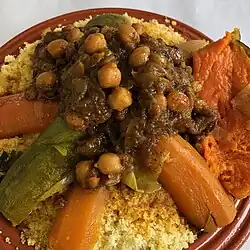
The main Moroccan dish people are most familiar with is couscous;[19] lamb is the most commonly eaten meat in Morocco, usually eaten in a tagine with a wide selection of vegetables. Chicken is also commonly used in tagines or roasted. They also use additional ingredients such as plums, boiled eggs, and lemon. Like their national food, the tagine is distinctly flavored with locally ubiquitous spices such as saffron, cumin, cinnamon, ginger, and cilantro, as well as ground red pepper.[20]
Moroccan cuisine features many seafood dishes. European pilchard is caught in large but declining quantities.[21] Other fish species include mackerel, anchovy, sardinella, and horse mackerel.[22]
Other widely known Moroccan dishes are pastilla (also spelled basteeya or bestilla), tanjia, and rfissa.
.jpg)
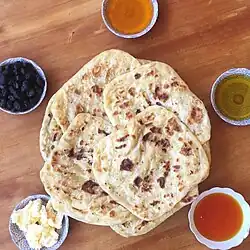
A significant part of the daily meal is bread. Bread in Morocco is principally made from durum wheat semolina known as khobz. Bakeries are common throughout Morocco and fresh bread is a staple in every city, town, and village. The most common is whole-grain coarse-ground or white-flour bread or baguettes. There are also a number of flat breads and pulled unleavened pan-fried breads.
In addition, there are dried salted meats and salted preserved meats such as khlea and g'did (basically sheep bacon), which are used to flavor tagines or used in el rghaif, a folded savory Moroccan pancake.
Soups
Harira, a typical heavy soup, is eaten during winter to warm up and is usually served for dinner. It is typically eaten with plain bread or with dates during the month of Ramadan. Bissara is a broad bean-based soup that is also consumed during the colder months of the year.[23]
Beboush, a savory and slightly spicy snail soup, is a traditional delicacy in Moroccan cuisine.[24] It is made by simmering snails in broth infused with aromatic spices, including cumin, coriander, and mint.
Salads

Salads include both raw and cooked vegetables, served either hot or cold.[25] They include zaalouk, an aubergine and tomato mixture, and taktouka, a mixture of tomatoes, smoked green peppers, garlic, and spices characteristic of the cities of Taza and Fes in the Atlas.[25] Another salad is called bakoula or khoubiza, consisting of braised mallow leaves, but can also be made with spinach or arugula, with parsley, cilantro, lemon, olive oil, and olives.
Desserts
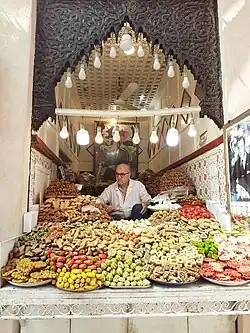
Usually, seasonal fruits rather than cooked desserts are served at the close of a meal. A common dessert is kaab el ghzal (كعب الغزال, 'gazelle ankles'), a pastry stuffed with almond paste and topped with sugar. Another is halwa chebakia, pretzel-shaped dough deep-fried, soaked in honey and sprinkled with sesame seeds; it is eaten during Ramadan. Jowhara is typical of Fes, made with fried waraq pastry, cream, and toasted almond slices.[26] Coconut fudge cakes, 'zucre coco', are also common.
Seafood
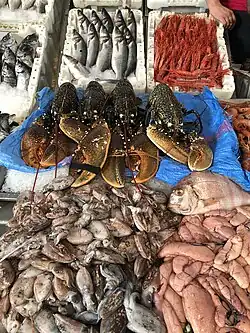
Morocco is endowed with over 3000 km of coastline. There is an abundance of fish in these coastal waters with the sardine being commercially significant as Morocco is the world's largest exporter.[27] Sardines were used in the production of garum in Lixus.
At Moroccan fish markets, one can find sole, swordfish, tuna, turbot, mackerel, shrimp, conger eel, skate, red snapper, spider crab, lobster and a variety of mollusks.
In Moroccan cuisine, seafood is incorporated into, among others, tajines, bastilla, briouat, and paella.
Drinks

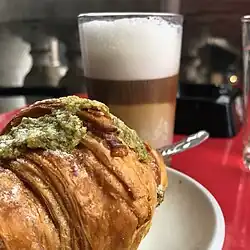
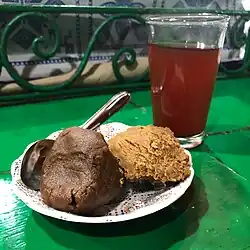
The most popular drink is Moroccan mint tea, locally called atay. Traditionally, making good mint tea in Morocco is considered an art form and the drinking of it with friends and family is often a daily tradition. The pouring technique is as crucial as the quality of the tea itself. Moroccan tea pots have long, curved pouring spouts and this allows the tea to be poured evenly into tiny glasses from a height. For the best taste, glasses are filled in two stages. The Moroccans traditionally like tea with bubbles, so while pouring they hold the teapot high above the glasses. Finally, the tea is accompanied with hard sugar cones or lumps.[28] Morocco has an abundance of oranges and tangerines, so fresh orange juice is easily found and inexpensive.
Snacks and fast food
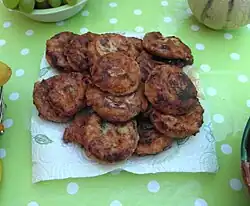
Selling fast food in the street has long been a tradition, and the best example is Djemaa el Fna square in Marrakesh. Ma'quda is a potato fritter eaten by students and people of modest means, particularly in Fes.[29] Starting in the 1980s, new snack restaurants, primarily in the north, started serving bocadillos (Spanish for 'sandwich').
Dairy product shops locally called mhlaba (محْلَبة), are prevalent all around the country. Those dairy stores generally offer all types of dairy products, juices, smoothies, and local fare such as bocadillos, msemmen and harcha.[30]
The khanz u-bnīn (خانز وبنين "stinky and delicious") is an inexpensive, frequently seen street sandwich.[31]
Another common street food in Morocco is snails, served in their juices in small bowls and eaten using a toothpick.[32]
In the late 1990s, several multinational fast-food franchises opened restaurants in major cities.[33]
Chefs
Among those who have brought Moroccan cuisine to a wider audience are TV chef Choumicha and Al-Amīn al-Hajj Mustafa an-Nakīr, chef to the former king of Morocco Hassan II.
Fatéma Hal, who opened a Moroccan cuisine restaurant in Paris named Mansouria, has been regarded by Le Figaro as "one of the most renowned ambassadors of Moroccan cuisine".[34]
See also
- Beer in Morocco
- Culture of Morocco
- History of Morocco
- Tourism in Morocco
- Languages in Morocco
- Moroccan Jewish cuisine
- List of African cuisines
- Maghrebi cuisine
References
- ^ "The Art of Moroccan Cuisine". 10 October 2007.
- ^ Howard, Herbert (2013-10-30). Ultimate African Travel - Morocco. Herbert Howard.
- ^ "Moroccan Food: Top 47 Dishes". www.tasteatlas.com. Retrieved 2025-08-03.
- ^ McCann, Jennifer (2011-01-22). Vegan Lunch Box Around the World (Large Print 16pt). ReadHowYouWant.com. p. 29. ISBN 978-1-4596-0917-4.
- ^ "Best Moroccan Chefs honored on a TV program, interview with Hossin Houari" (in Arabic and Moroccan Arabic). 21 January 2019. Archived from the original on 5 September 2023. Retrieved 15 November 2021.
- ^ a b c d e f g h Koehler, Jeff (2012). Morocco (7 ed.). Open Road Integrated Media, Inc. pp. 14–17. ISBN 9781452113654.
- ^ Amri, Ahmed; Ouammou, Latifa; Nassif, Fatima (2005). "Barley-based food in Southern Morocco". In Stefania Grando; Helen Gomez Macpherson (eds.). Food Barley: Importance, Uses and Local Knowledge. pp. 22–28.
- ^ International Organisation of Vine and Wine, [1]
- ^ Jancis Robinson, ed. (2006). "Morocco". Oxford Companion to Wine (3rd ed.). Oxford: Oxford University Press. pp. 453–454. ISBN 0-19-860990-6.
- ^ Moroccan wine and Muslims Archived 2008-06-09 at the Wayback Machine, Decanter 2008-06-06
- ^ Patricia Crocker, Tastes of the Kasbah, 2005, ISBN 097369131X, p. 33
- ^ Pamela Goyan Kittler, Kathryn P. Sucher, Marcia Nelms, Food and Culture, 2016, ISBN 1305886879, p. 436
- ^ "What Is Baharat Spice? - Baharat vs. Ras el Hanout". Archived from the original on 2021-10-29. Retrieved 2022-10-06.
- ^ Paula Wolfert (January 2012). The Food of Morocco, Ras El Hanout. A&C Black. p. 32. ISBN 9781408827468.
- ^ Raghavan, Susheela (2006-10-23). Handbook of Spices, Seasonings, and Flavorings. CRC Press. p. 150. ISBN 978-1-4200-0436-6.
- ^ Morocco: A Culinary Journey with Recipes from the Spice-Scented Markets of Marrakech to the Date-Filled Oasis of Zagora. Chronicle Books. 2012-05-16. p. 15. ISBN 978-0-8118-7738-1.
- ^ Otal, 1999, p. 3
- ^ Trnka, Susanna; Dureau, Christine; Park, Julie (2013-05-02). Senses and Citizenships: Embodying Political Life. Routledge. p. 1992. ISBN 978-1-136-69059-4.
- ^ "Moroccan Couscous Recipe" Archived 2014-05-31 at the Wayback Machine. Maroccan Kitchen Recipes Archived 2014-05-31 at the Wayback Machine (Website). Accessed April 2014.
- ^ "Food, Morocco Travel Guide" (PDF). Desert Morocco Adventure.
- ^ Lanier, B. V. (1981). The World Supply and Demand Picture for Canned Small Pelagic Fish. Food & Agriculture Org. p. 15. ISBN 978-92-5-101143-0.
- ^ "Moroccan Sardine FAO 34". Fishery Improvement Projects. Archived from the original on 19 August 2016. Retrieved 10 May 2016.
- ^ Valenta, Kyle (June 23, 2016). "How to eat breakfast like a local around the world - Provided By Advertising Publications". The Seattle Times. Archived from the original on January 13, 2018. Retrieved September 6, 2016.
- ^ "Moroccan Cuisine: The Ultimate Guide of the Best 25 foods!". 2023-10-26. Retrieved 2023-10-26.
- ^ a b Zeldes, Leah A. (Jan 12, 2024). "Eat this! Zaalouk, a cooked salad from Morocco". Authentic Moroccan Cuisine. Private Desert Tours.
- ^ "Traditional Moroccan Food | Moroccanzest". Moroccanzest. 2018-07-28. Retrieved 2018-11-05.
- ^ "Moroccan Fishery Products Exports on the World Market" (PDF).
- ^ Otal, 1999. p. 61
- ^ "فيديو.."المعقودة"..تعرف على قصة أشهر أكلة فاسية شعبية.. أكلة " الطلبة وأولاد الشعب"". فبراير.كوم | موقع مغربي إخباري شامل يتجدد على مدار الساعة. 2019-11-07. Archived from the original on 2021-02-21. Retrieved 2021-11-09.
- ^ "Dairy Development in Morocco" (PDF). Food and Agriculture Organization. Retrieved 10 May 2016.
- ^ "ربورتاج … عشـاق "خانـز وبنيـن" - جريدة الصباح". assabah.ma (in Arabic). 2018-02-10. Retrieved 2021-03-15.
- ^ "Morocco Tastiest Street Food". Moroccanzest. 2018-09-03. Retrieved 2018-11-09.
- ^ "Fast Food in Morocco". Euromonitor International. Retrieved 10 May 2016.
- ^ "Fatéma Hal". Madame Figaro (in French). Le Figaro. Retrieved 7 December 2025.
Further reading

- Wolfert, Paula (2012). Food of Morocco. Bloomsbury. ISBN 9781408827468.
Recipe books
- Connaître la cuisine marocaine, by Liliane Otal, Editions SudOuest, 1999 (in French). ISBN 978-2-879-01335-0
- Cooking at the Kasbah: Recipes from My Moroccan Kitchen, by Kitty Morse, Laurie Smith ISBN 0-8118-1503-X
- Couscous and Other Good Food from Morocco, by Paula Wolfert, Gael Greene ISBN 0-06-091396-7
- Cuisine des palais d'orient, by Alain Mordelet ISBN 2-87678-868-3
- Food of Morocco: Authentic Recipes from the North African Coast, by Fatema Hal ISBN 962-593-992-X
- Scent of Orange Blossoms: Sephardic Cuisine from Morocco, by Kitty Morse, Owen Morse ISBN 1-58008-269-6
- Traditional Moroccan Cooking: Recipes from Fez, by Madame Guinaudeau ISBN 1-897959-43-5
| Continental |
| ||||||||||||
|---|---|---|---|---|---|---|---|---|---|---|---|---|---|
| National and (regional) |
| ||||||||||||
| Ethnic |
| ||||||||||||
| Religious |
| ||||||||||||
| Historical |
| ||||||||||||
| Styles |
| ||||||||||||
| Lists |
| ||||||||||||
| Related | |||||||||||||
| |||||||||||||


African cuisine | |
|---|---|
| National cuisines |
|
| Ethnic and regional cuisines |
|
| Lists |
|
| |