Rakı
 | |
| Type | Spirit |
|---|---|
| Origin | Turkey |
| Introduced | Before 1630 |
| Alcohol by volume | 40–50% |
| Proof (US) | 80–100 |
| Colour | Transparent (milky white when mixed with water) |
| Ingredients | Grape pomace or raisins, Aniseed (flavouring) |
| Variants | Göbek (Belly), Gold (Oak-aged), Triple Distilled, Fresh Grape |
| Related products | Arak, absinthe, ouzo, pastis, sambuca |
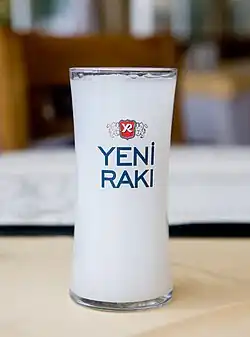
Rakı, Türk Rakısı or Turkish Raki (/rɑːˈkiː/, Turkish pronunciation: [ɾaˈkɯ] ⓘ) is an alcoholic beverage made of twice-distilled grape pomace (or raisins) and flavored with aniseed.[1] It is the national drink of Turkey and is especially popular in the coastal regions.[1][2]
Historically produced by the state monopoly Tekel, the market was liberalized in 2004, leading to a renaissance in production methods. Modern rakı is characterized by a "premiumization" trend, with producers introducing triple-distilled varieties, oak-aged reserves, and "Göbek" (belly) cuts that utilize only the highest quality center-cut of the distillate.[3]
Etymology
The term raki entered English from Turkish rakı.[4] The Arabic word arak (Arabic: عرق [ʕaraq]), means "distilled", other variants being araka, araki, ariki.[5]
History
Where or when raki was first produced is unknown. It is first mentioned by the Ottoman explorer Evliya Çelebi during his travels in 1630. In his Book of Travels, he reports that ancient people produced their own raki in small towns.[6]
Ottoman period
In the Ottoman Empire, until the 19th century, meyhanes run by Rûm (Greeks) and Albanians[7] would mainly serve wine along with meze, due to religious restrictions imposed by various sultans. During this period, rakı was produced by the distillation of grape pomace (cibre) obtained during wine fermentation. If aniseed was not added, it would take the name düz rakı ('straight rakı'), whereas rakı prepared with the addition of gum mastic was named sakız rakısı ('gum rakı').
Republic and State Monopoly (1923–2004)
With the establishment of the Republic of Turkey, grape-based rakı began to be distilled by the state-owned spirits monopoly Tekel. The first factory production took place in 1944 in İzmir. Tekel also introduced Yeni Rakı ('new rakı'), which originally utilized sugar-beet alcohol due to shortages, giving it a distinctive flavor profile that became the standard for decades.
Privatization and Premiumization (2004–Present)
The privatization of Tekel in 2004 marked a turning point for the industry. The entry of private sector players such as Mey Diageo (formerly Tekel), Elda (Efe), and later boutique producers like Sarper (Beylerbeyi) and Antalya Alkollü İçecekler (Topkapı) revolutionized the market.
This era saw the "premiumization" of rakı. Producers moved away from sugar beet alcohol, focusing on 100% grape spirits (suma). Innovations included:
- Fresh Grape Raki: Made exclusively from fresh grapes rather than raisins (e.g., Efe Yaş Üzüm).
- Oak Aging: Brands like Sarı Zeybek and Yeni Rakı Âlâ began aging rakı in oak barrels, imparting vanilla notes and a golden hue.
- Göbek (Belly) Raki: A technique prioritizing the "heart" of the distillate for smoothness (e.g., Beylerbeyi Göbek, Mercan).
- Craft Branding: New boutique brands such as Prototip and Saki have emerged, positioning rakı as a high-end gastronomic spirit comparable to single malt whiskies.
Production
Production begins with the fermentation of grape pulp (fresh grapes or raisins) to create a base spirit called suma. Traditional Turkish rakı production dictates that the sum of alcohol obtained from agricultural origin must be at least 65% grape-based (suma).
Distillation process
The suma is then redistilled in traditional copper alembics (imbik) with aniseed (Pimpinella anisum). This second distillation is critical for the flavor profile.
- Head, Heart, and Tail: During distillation, the initial liquid (head/baş) and the final liquid (tail/son) are discarded due to harsh or undesirable flavors.
- Göbek (Belly) Cut: Premium rakıs, often labeled as Göbek Rakısı, exclusively use the middle cut (heart/göbek) of the distillation. This results in a smoother, more refined spirit with fewer congeners.[8]
Aging and finishing
While standard rakı is rested in stainless steel tanks for approximately 30 days to harmonize, premium varieties may undergo:
- Triple Distillation: Some brands (e.g., Yeni Rakı Âlâ, Beylerbeyi Göbek) are distilled three times to achieve higher purity.
- Oak Aging: Certain varieties are aged in French oak barrels for periods ranging from 6 months to several years, acquiring a golden color and complex aromas of vanilla and spice.
The final product typically has an alcohol content between 40% and 50% ABV.
Serving and gastronomy

Rakı is conventionally consumed with chilled water and ice cubes. The dilution causes the ouzo effect, turning the drink milky white—a phenomenon that earned it the nickname aslan sütü ('lion's milk').
The Rakı Sofrası
Rakı is the centerpiece of the rakı sofrası ('rakı table'), a social ritual centered on conversation (muhabbet) and shared food. It is rarely drunk alone. The table typically features a progression of meze (appetizers), starting with cold dishes like beyaz peynir (white cheese), melon, and haydari, followed by hot appetizers and seafood or grilled meats.[9]
Fine dining and mixology
In recent years, rakı has found a place in Turkish fine dining. The 2024 arrival of the Michelin Guide in Istanbul, Bodrum, and Izmir highlighted several modern meyhanes (such as Karaköy Lokantası and İki Sandal) where rakı is paired with contemporary Anatolian cuisine.[10] Furthermore, a burgeoning cocktail culture in Istanbul has seen rakı used as a base spirit in mixology, blended with ingredients like pomegranate, citrus, and turnip juice (şalgam).
Types and brands
The market has expanded significantly since the end of the Tekel monopoly. Major producers and brands include:
- Mey: Produces the market leader Yeni Rakı, along with premium variants Yeni Rakı Âlâ (oak-aged), Yeni Rakı Uzun Demleme (long-distilled craft), Tekirdağ Rakısı (known for using artesian water), Kulüp Rakı (a cult classic with 50% ABV), and Altınbaş.
- Efe Alcohol: The first private producer after liberalization. Brands include Efe Klasik, Efe Yaş Üzüm (fresh grape), and Efe Gold.
- Beylerbeyi (Sarper): Gained significant market share with Beylerbeyi Göbek, a 100% fresh grape, triple-distilled raki that popularized the "göbek" style. They also produce Beylerbeyi Teragold (oak-aged).[11]
- Boutique and Emerging Brands:
- Mercan: Known for its high-quality göbek rakı.
- Prototip: A "new wave" craft brand focusing on unique botanical balances.
- Saki: Produces premium series like Saki Siyah Üzüm (black grape).
Events
Aniseed-flavoured Rakı, has been celebrated as a festival in Adana and Northern Cyprus since 2010. World Rakı Festival in Adana, emerged from a hundred-year tradition of enjoying Adana kebab, with liver, şalgam and rakı. The event turned into a nationwide popular street festival, street musicians playing drums and zurna, entertain visitors all night long at the second Saturday night of every December.[12]
See also
- Anise-flavored liqueurs
- Arak
- Ouzo
- Rakia
- Tsipouro
- Turkish cuisine
- Turkish wine
References
- ^ a b "How to drink raki: A crash course in Turkey's signature drink". CNN. 29 December 2015.
- ^ "Turkish National Drinks". Istanbul.com.
- ^ "Turkish Spirit: Modern Craft and Tradition". Master of Malt. Retrieved 15 December 2025.
- ^ "Raki Definition and Usage Examples". Dictionary.com.
- ^ "Arak". Difford's Guide.
- ^ Gostin, Alina-Ioana; Bogueva, Diana; Kakurinov, Vladimir, eds. (2021). Nutritional and Health Aspects of Food in the Balkans. Academic Press. p. 268. ISBN 9780128207864.
- ^ Naroditskaya, Inna; Austern, Linda Phyllis (2006). Music of the Sirens. Indiana University Press. p. 290. ISBN 978-0-253-34736-7.
- ^ "Production Processes". Efe Alkollü İçecekler. Retrieved 15 June 2025.
- ^ "Rakı Nights in Istanbul: A Local's Guide to the Lion's Milk Culture". Istanbul Tourist Pass. Retrieved 12 June 2025.
- ^ "İki Sandal – Bodrum - a MICHELIN Guide Restaurant". Michelin Guide. Retrieved 5 December 2025.
- ^ "Beylerbeyi Göbek Raki Product Details". Sarper İçecek. Retrieved 12 June 2025.
- ^ "Rakıcılar bir kez daha "Dünya Rakı Günü"nde buluşuyor" [Raki makers meet once again on "World Raki Day"]. CNN (in Turkish). 27 November 2014.
External links

- In Istanbul, raki and a bottomless pit of gluttony Archived 14 October 2014 at the Wayback Machine
| Beverages |
|
|---|---|
| Breads |
|
| Appetizers and salads |
|
| Cheeses |
|
| Soups |
|
| Dishes |
|
| Grilled meats |
|
| Desserts |
|
| Frequent ingredients | |
| Unique instruments | |
| Related cuisines |
|
| |