Solanum
| Solanum | |
|---|---|

| |
| Brazilian nightshade (Solanum seaforthianum) | |
Scientific classification 
| |
| Kingdom: | Plantae |
| Clade: | Tracheophytes |
| Clade: | Angiosperms |
| Clade: | Eudicots |
| Clade: | Asterids |
| Order: | Solanales |
| Family: | Solanaceae |
| Subfamily: | Solanoideae |
| Tribe: | Solaneae |
| Genus: | Solanum L.[1] |
| Type species | |
| Solanum nigrum L.[2] | |
| Subgenera | |
|
Bassovia | |
| Synonyms | |
|
List
| |
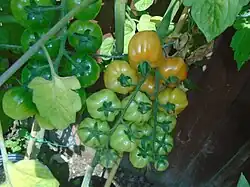
Solanum is a large and diverse genus of flowering plants, which include three food crops of high economic importance: the potato, the tomato and the eggplant (aubergine, brinjal). It is the largest genus in the nightshade family Solanaceae, comprising around 1,500 species. It also contains the so-called horse nettles (unrelated to the genus of true nettles, Urtica), as well as numerous plants cultivated for their ornamental flowers and fruit.
Solanum species show a wide range of growth habits, such as annuals and perennials, vines, subshrubs, shrubs, and small trees. Many formerly independent genera like Lycopersicon (the tomatoes) and Cyphomandra are now included in Solanum as subgenera or sections. Thus, the genus today contains roughly 1,500–2,000 species.
Name
The generic name was first used by Pliny the Elder (AD 23–79) for a plant also known as strychnos, most likely S. nigrum. Its derivation is uncertain, possibly stemming from the Latin word sol, meaning "sun", referring to its status as a plant of the sun.[3]
Species having the common name "nightshade"
The species most commonly called nightshade in North America and Britain is Solanum dulcamara, also called bittersweet or woody nightshade (so-called because it is a scandent shrub). Its foliage and egg-shaped red berries are poisonous, the active principle being solanine, which can cause convulsions and death if taken in large doses. Black nightshades (many species in the Solanum nigrum complex, Solanum sect. Solanum) have varying levels of toxins and are considered too toxic to eat by many people in North America and Europe, but young stems and leaves or fully ripened fruit of various species are cooked and eaten by native people in North America, Africa, and Asia. Deadly nightshade (Atropa belladonna) belongs, like Solanum, to subfamily Solanoideae of the nightshade family, but, unlike that genus, is a member of tribe Hyoscyameae (Solanum belongs to tribe Solaneae).[4] The chemistry of Atropa species is very different from that of Solanum species and features the very toxic tropane alkaloids, the best-known of which is atropine.[5]
Taxonomy
The genus was established by Carl Linnaeus in 1753.[6] Its subdivision has always been problematic, but slowly some sort of consensus is being achieved.
The following list is a provisional lineup of the genus' traditional subdivisions, together with some notable species.[6] Many of the subgenera and sections might not be valid; they are used here provisionally as the phylogeny of this genus is not fully resolved yet and many species have not been reevaluated.
Cladistic analyses of DNA sequence data suggest that the present subdivisions and rankings are largely invalid. Far more subgenera would seem to warrant recognition, with Leptostemonum being the only one that can at present be clearly subdivided into sections. Notably, it includes as a major lineage several members of the traditional sections Cyphomandropsis and the old genus Cyphomandra.[1]
Subgenus Bassovia
Section Allophylla
- Solanum granuloso-leprosum
Section Cyphomandropsis
- Solanum glaucophyllum Desf. – Waxy-leaved nightshade
Section Pachyphylla
- Solanum betaceum Cav. – Tamarillo
- Solanum exiguum
- Solanum roseum
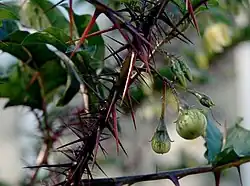
Subgenus Leptostemonum
.jpg)
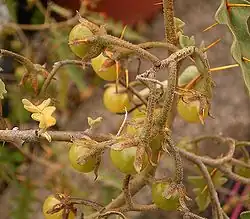
Section Acanthophora
- Solanum aculeatissimum Jacq. – Indian nightshade
- Solanum atropurpureum Schrank – Five-minute plant
- Solanum capsicoides – Cockroach berry, polohauaiʻi (Polynesian)
- Solanum mammosum – Nipplefruit, titty fruit, cow's udder, apple of Sodom
- Solanum palinacanthum Dunal
- Solanum viarum Dunal – Tropical soda apple
Section Androceras
12 spp.[7]
- Series Androceras
- Series Violaceiflorum
- Series Pacificum
Section Anisantherum
Section Campanulata
Section Crinitum
Section Croatianum
Section Erythrotrichum
- Solanum robustum H.L.Wendl. – Shrubby nightshade
Section Graciliflorum
Section Herposolanum
- Solanum wendlandii Hook.f. – Giant potatocreeper
Section Irenosolanum
- Solanum incompletum Dunal – Pōpolo kū mai (Hawaiʻi)
- Solanum nelsonii Dunal – Nelson's horsenettle, ʻĀkia (Hawaiʻi)
- Solanum sandwicense Hook. & Arn. – Hawaiian horsenettle, Pōpoloʻaiakeakua (Oʻahu, Kauaʻi)
Section Ischyracanthum
Section Lasiocarpa
- Solanum lasiocarpum Dunal
- Solanum pseudolulo – lulo de perro (Colombia)
- Solanum quitoense – lulo (Colombia), naranjilla (Ecuador)
- Solanum sessiliflorum – Cocona
Section Melongena
- Solanum aculeastrum – Soda apple, sodaapple nightshade, goat apple, poison apple, "bitter-apple"
- Solanum campechiense – Redberry nightshade
- Solanum carolinense – Carolina horsenettle, radical weed, sand brier, devil's tomato, "bull nettle", "tread-softly", "apple of Sodom", "wild tomato" (southeastern United States)
- Solanum cataphractum (northern Western Australia, including Coronation Island)[8]
- Solanum citrullifolium A.Braun – Watermelon nightshade (southern United States)
- Solanum dimidiatum Raf. – Torrey's nightshade
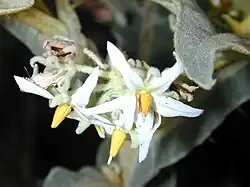
- Solanum elaeagnifolium – Silver-leaved nightshade, prairie berry, silverleaf nettle, white horsenettle, silver nightshade, "bull-nettle", "trompillo" (Spanish); Silver-leaf bitter-apple, satansbos (South Africa)
- Solanum heterodoxum Dunal – Melon-leaved nightshade
- Solanum incanum L.
- Solanum linnaeanum – Devil's apple, apple of Sodom
- Solanum macrocarpon L.
- Solanum marginatum L.f. – White-margined nightshade
- Solanum melongena – Eggplant, aubergine (including S. ovigerum)
- Solanum rostratum Dunal – Buffalo bur, Texas thistle
- Solanum sisymbriifolium Lam. – Sticky nightshade, fire-and-ice
- Solanum virginianum L.
Section Micracantha
- Solanum jamaicense Mill. – Jamaican nightshade
- Solanum lanceifolium Jacq. – Lance-leaved nightshade
- Solanum tampicense Dunal – Wetland nightshade
Section Monodolichopus
Section Nycterium
Section Oliganthes
- Solanum aethiopicum – Ethiopian eggplant, nakati, mock tomato, Ethiopian nightshade; including S. gilo (scarlet eggplant, Gilo or jiló)
- Solanum centrale – Australian desert raisin, bush raisin, bush sultana, "bush tomato", akatjurra (Alyawarre), kampurarpa (Pitjantjatjara), merne akatyerre (Arrernte), kutjera
- Solanum cleistogamum – "bush tomato", merne mwanyerne (Arrernte)
- Solanum ellipticum – Potato bush, "bush tomato"
- Solanum pyracanthos Lam. – Porcupine tomato, Devil's Thorn
- Solanum quadriloculatum F.Muell. – "bush tomato", "wild tomato" (Australia)
Section Persicariae
- Solanum bahamense L. – Bahama nightshade, canker berry, berengena de playa
- Solanum ensifolium Dunal – Erubia
Section Polytrichum
Section Pugiunculifera
Section Somalanum
Section Torva
- Solanum asteropilodes
- Solanum chrysotrichum Schltdl. – Giant devil's-fig
- Solanum lanceolatum – Orangeberry nightshade
- Solanum paniculatum – Jurubeba
- Solanum torvum – Turkey berry, devil's fig, prickly nightshade, shoo-shoo bush, wild eggplant, pea eggplant
Subgenus Lyciosolanum
- Solanum guineense L.
Subgenus Solanum
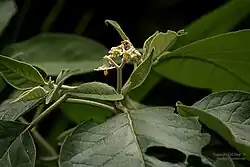
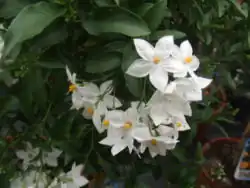
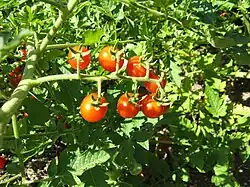
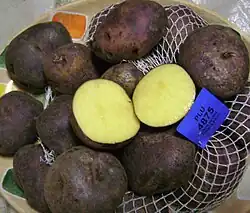
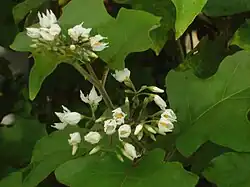
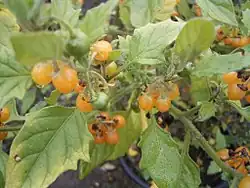
Also known as: Solanum sensu stricto.
Section Afrosolanum
Section Anarrhichomenum
- Solanum baretiae[9]
Section Archaesolanum
- Solanum aviculare – Poroporo (New Zealand), kangaroo apple (Australia)
Section Basarthrum
- Solanum catilliflorum[10]
- Solanum muricatum – Pepino dulce, pepino melon, melon pear, "pepino", "tree melon"
- Solanum perlongistylum[10]
- Solanum tergosericeum[11]
Section Benderianum
Section Brevantherum
- Solanum bullatum
- Solanum erianthum D.Don – Potato tree, "mullein nightshade"
- Solanum mauritianum – Woolly nightshade, ear-leaved nightshade, flannel weed, bugweed, tobacco weed, kerosene plant, "wild tobacco" (Australia)
- Solanum evolvuloides
Section Dulcamara
- Solanum crispum – Chilean potato vine, Chilean nightshade, Chilean potato tree
- Solanum dulcamara – Bittersweet
- Solanum imbaburense
- Solanum laxum Spreng. – Jasmine nightshade
- Solanum leiophyllum
- Solanum seaforthianum Andrews – Brazilian nightshade
- Solanum triquetrum Cav. – Texas nightshade
- Solanum wallacei – Wallace's nightshade, Catalina nightshade, Clokey's nightshade, "wild tomato" (including S. clokeyi)
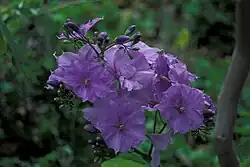
- Solanum xanti – Purple nightshade, San Diego nightshade
Section Herpystichum
Section Holophylla
- Solanum diphyllum L. – Twin-leaved nightshade
- Solanum pseudocapsicum – Jerusalem cherry, Madeira winter cherry, "winter cherry" (including S. capsicastrum)
- Solanum pseudoquina (including S. inaequale Vell.)
Section Juglandifolia
- Solanum juglandifolium
- Solanum ochranthum
Section Lemurisolanum
Section Lycopersicoides
- Solanum lycopersicoides Dunal – Peruvian wolfpeach
- Solanum sitiens
Section Lycopersicon
Also known as: tomato lineage.
- Solanum arcanum Peralta – "wild tomato"
- Solanum chilense
- Solanum corneliomulleri
- Solanum huaylasense Peralta
- Solanum peruvianum L. – Peruvian nightshade, "wild tomato"
- Solanum cheesmaniae (L.Riley) Fosberg
- Solanum chmielewskii
- Solanum galapagense S.C.Darwin & Peralta
- Solanum habrochaites
- Solanum lycopersicum – Tomato
- Solanum neorickii
- Solanum pennellii
- Solanum pimpinellifolium – Currant tomato
Section Macronesiotes
Section Normania
- †Solanum nava (?)
Section Petota
Also known as the "potato lineage". Including: subsections Estolonifera and Potatoe.
- Solanum albornozii
- Solanum bulbocastanum – Ornamental nightshade
- Solanum bukasovii Juz. ex Rybin
- Solanum burtonii
- Solanum cardiophyllum – Heart-leaved nightshade
- Solanum chilliasense
- Solanum commersonii Dunal – Commerson's nightshade
- Solanum demissum Lindl. – Dwarf wild potato
- Solanum jamesii – Wild potato
- Solanum minutifoliolum
- Solanum paucijugum
- Solanum phureja Juz. & Bukasov
- Solanum pinnatisectum Dunal – Tansy-leaved nightshade
- Solanum regularifolium
- Solanum stoloniferum Schltdl. – Tigna potato, Fendler's horsenettle
- Solanum stenotomum (including S. goniocalyx)
- Solanum ternatum (including S. ternifolium)
- Solanum tuberosum – Potato
Section Pteroidea
Section Quadrangulare
Section Regmandra
Section Solanum
- Solanum adscendens Sendtner – Sonoita nightshade (Americas)
- Solanum americanum Mill. – American nightshade, American black nightshade, West Indian nightshade, glossy nightshade (Americas, Hawaiʻi)
- Solanum chenopodioides Lam. – Goosefoot nightshade, slender nightshade (including S. gracilius)
- Solanum douglasii Dunal – Green-spotted nightshade
- Solanum alatum – Eastern black nightshade
- Solanum interius Rydb.
- Solanum melongena L.[12]
- Solanum nigrescens M.Martens & Galeotti – Divine nightshade
- Solanum nigrum L. – European black nightshade, "black nightshade"
- S. nigrum guineense – "Garden Huckleberry"
- Solanum pseudogracile Heiser – Glowing nightshade
- Solanum retroflexum – Wonderberry, sunberry
- Solanum sarrachoides – Hairy nightshade
- Solanum scabrum Mill. – Garden huckleberry
- Solanum triflorum Nutt. – Cut-leaved nightshade
- Solanum villosum Mill. – Yellow nightshade
Notable species not otherwise placed
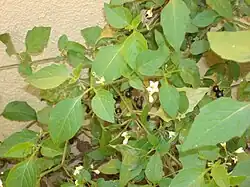
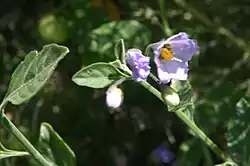
- Solanum abutiloides – Dwarf tamarillo
- Solanum amygdalifolium Steud.
- Solanum bellum
- Solanum cajanumense
- Solanum chimborazense
- Solanum chrysasteroides
- Solanum cinnamomeum
- Solanum conocarpum Rich. ex Dunal – Marron bacoba
- Solanum cowiei Martine
- Solanum cremastanthemum
- Solanum crinitum
- Solanum davisense Whalen – Davis' horsenettle
- Solanum densepilosulum
- Solanum donianum Walp. – Mullein nightshade
- Solanum dolichorhachis
- Solanum etuberosum – representative member of a clade that gave rise to the potatoes (petota clade) by hybridization with a member of the tomato clade[13]
- Solanum fallax
- Solanum ferox L. – Hairy-fruited eggplant, Thai hairy-fruited eggplant
- Solanum fortunense
- Solanum furcatum – Forked nightshade
- Solanum glabratum Dunal
- Solanum haleakalaense H.St.John
- Solanum hindsianum Benth. – Hinds' nightshade
- Solanum hypermegethes
- Solanum hypocalycosarcum
- Solanum interandinum
- Solanum latiflorum
- Solanum leucodendron
- Solanum lumholtzianum Bartlett – Sonoran nightshade
- Solanum luteoalbum (including S. semicoalitum)
- Solanum lycocarpum – Wolf apple, fruta-de-lobo, lobeira (Brazil)
- Solanum melissarum Bohs
- Solanum nudum Dunal – Forest nightshade
- Solanum ovum-fringillae
- Solanum paralum
- Solanum parishii A.Heller – Parish's nightshade
- Solanum physalifolium Rusby
- Solanum pinetorum
- Solanum polygamum Vahl – Cakalaka berry
- Solanum pyrifolium Lam.
- Solanum pubescens Willd.
- Solanum riedlei Dunal – Riedle's nightshade
- Solanum rudepannum Dunal
- Solanum rugosum Dunal – tabacon aspero
- Solanum sibundoyense
- Solanum sodiroi (including S. carchiense)
- Solanum sycocarpum
- Solanum tenuipes Bartlett – Fancy nightshade
- Solanum tobagense
- Solanum trilobatum L.
- Solanum umbelliferum – Bluewitch nightshade
- Solanum violaceum Ortega
- Solanum viride Spreng. – Green Nightshade
- Solanum woodburyi Howard – Woodbury's nightshade
Formerly placed here
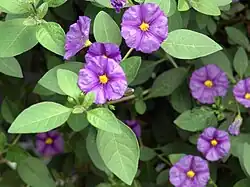
Some plants of other genera were formerly placed in Solanum:
- Chamaesaracha coronopus (as S. coronopus)
- Cordia alliodora (as S. mucronatum)
- Lycianthes biflora (as S. multifidum Buch.-Ham. ex D.Don)
- Lycianthes denticulata (as S. gouakai var. angustifolium and var. latifolium)
- Lycianthes lycioides (as S. lycioides var. angustifolium)
- Lycianthes mociniana (as S. uniflorum Dunal in Poir. and S. uniflorum Sessé & Moc.)
- Lycianthes rantonnetii (as S. rantonnetii, S. urbanum var. ovatifolium and var. typicum)
- Undetermined species of Lycianthes have been referred to under names such as S. chrysophyllum, S. ciliatum Blume ex Miq., S. corniculatum Hiern, S. lanuginosum, S. retrofractum var. acuminatum, S. violaceum Blume, S. violifolium f. typicum, S. virgatum notst β albiflorum, S. uniflorum Lag. or S. uniflorum var. berterianum.
Phylogeny
The following phylogeny of Solanaceae is from Zhang et al. (2025) figure 1B. It is based on a consensus of 500 trees randomly sampled from 1-Mb genomic windows with 200-kb step size.[13]
| |||||||||||||||||||||||||||||||||||||||||||||||||||||||||||||||||||||||||||||||||||||||||||||||||||||||||||||||||||
| |||||||||||||||||||||||||||||||||||||||||||||||||||||||||||||||||||||||||||||||||||||||||||||||||||||||||||||||||||
The non-italicized names inside of Solanum refer to the major clade names within Solanum. These names usually include the similarly-named section but do not have taxonomic standing.[13]
Ecology
Solanum species are used as food plants by the larvae of some Lepidoptera species (butterflies and moths).
Toxicity
Most parts of the plants,[14] especially the green parts and unripe fruit, are poisonous to humans (although not necessarily to other animals), with some species even being deadly.
Uses
Many species in the genus bear some edible parts, such as fruits, leaves, or tubers. Three crops in particular have been bred and harvested for consumption by humans for centuries, and are now cultivated on a global scale:
- Tomato, S. lycopersicum
- Tomato varieties are sometimes bred from both S. lycopersicum and wild tomato species such as S. pimpinellifolium, S. peruvianum, S. cheesmanii, S. galapagense, S. chilense, etc. (such varieties include—among others—Bicentennial, Dwarf Italian, Epoch, Golden Sphere, Hawaii, Ida Red, Indigo Rose,[15] Kauai, Lanai, Marion, Maui, Molokai, Niihau, Oahu, Owyhee, Parma, Payette, Red Lode, Super Star, Surecrop, Tuckers Forcing, V 121, Vantage, Vetomold, and Waltham.)[16]
- Potato, S. tuberosum, fourth largest food crop.
- Less important but cultured relatives used in small amounts include S. stenotomum, S. phureja, S. goniocalyx, S. ajanhuiri, S. chaucha, S. juzepczukii, S. curtilobum.
- Eggplant (also known as brinjal or aubergine), S. melongena
Other species are significant food crops regionally, such as Ethiopian eggplant or scarlet eggplant (S. aethiopicum), naranjilla or lulo (S. quitoense), cocona (S. sessiliflorum), turkey berry (S. torvum), pepino or pepino melon (S. muricatum), tamarillo (S. betaceum), wolf apple (S. lycocarpum), garden huckleberry (S. scabrum) and "bush tomatoes" (several Australian species).
Ornamentals
The species most widely seen in cultivation as ornamental plants are:
- Solanum aviculare G.Forst. - (kangaroo apple)
- Solanum crispum Ruiz & Pav. - (Chilean potato tree)
- Solanum laciniatum Aiton - (kangaroo apple)
- Solanum laxum Spreng. - (potato vine)
- Solanum mammosum L. - (Nipplefruit, titty fruit, cow's udder, apple of Sodom)
- Solanum pseudocapsicum L. - (Christmas cherry, winter cherry)
- Solanum seaforthianum Andrews - (Italian jasmine, St. Vincent lilac)
- Solanum mauritianum Scop. - (woolly nightshade, earleaf nightshade)
- Solanum wendlandii Hook.f. - (paradise flower, potato vine)[17]
Medicine
Several species are locally used in folk medicine, particularly by native people who have long employed them.
References
- ^ a b "Solanum L." Germplasm Resources Information Network. United States Department of Agriculture. 2009-09-01. Retrieved 2013-07-15.
- ^ Solanum | International Plant Names Index. (n.d.). Retrieved August 11, 2023, from https://www.ipni.org/n/30000630-2
- ^ Quattrocchi, U. (2000). CRC World Dictionary of Plant Names: Vol. 4, R-Z. Taylor and Francis. p. 2058. ISBN 978-0-8493-2678-3.
- ^ Armando T. Hunziker 2001: The Genera of Solanaceae. A.R.G. Gantner Verlag, Ruggell, Liechtenstein. ISBN 3-904144-77-4.
- ^ Frohne, Dietrich and Pfänder, Hans Jürgen. 1984 A Colour Atlas of Poisonous Plants : A Handbook for Pharmacists, Doctors, Toxicologists, and Biologists transl. from 2nd German ed. by Norman Grainger Bisset, London : Wolfe Atlases. Wolfe Publishing.
- ^ a b "Solanum Phylogeny". Solanaceae Source. Natural History Museum. Retrieved 2009-11-01.
- ^ Whalen, Michael D (1979). "Allozyme Variation and Evolution in Solanum Section Androceras". Systematic Botany. 4 (3): 203–222. Bibcode:1979SysBo...4..203W. doi:10.2307/2418419. JSTOR 2418419.
- ^ "Factsheet – Solanum cataphractum". Electronic Flora of South Australia. Retrieved 8 November 2020.
- ^ Tepe, E. J.; Ridley, G.; Bohs, L. (2012). "A new species of Solanum named for Jeanne Baret, an overlooked contributor to the history of botany". PhytoKeys (8): 37–47. Bibcode:2012PhytK...8...37T. doi:10.3897/phytokeys.8.2101. PMC 3254248. PMID 22287929.
- ^ a b Anderson, G. J.; Martine, C. T.; Prohens, J.; Nuez, F. (2006). "Solanum perlongistylum and S. catilliflorum, New Endemic Peruvian Species of Solanum, Section Basarthrum, Are Close Relatives of the Domesticated Pepino, S. muricatum". Novon. 16 (2): 161–67. doi:10.3417/1055-3177(2006)16[161:SPASCN]2.0.CO;2. ISSN 1055-3177. S2CID 85629504.
- ^ Ochoa, C. M. (2006). "Solanum tergosericeum (Solanaceae sect. Basarthrum): A new species from Peru". Phytologia. 88 (2): 212–15. doi:10.5962/bhl.part.27433.
- ^ Reina, Antonio Maria Martinez; Zumaqué, Lilibeth Tordecilla; Martínez, Liliana María Grandett; Pinto, María del Valle Rodríguez (2020-08-25). "Adopcion Adopción de la variedad de berenjena C015 (Solanum melongena L.) en la región Caribe colombiana: measuring adoption". Ciencia y Agricultura (in Spanish). 17 (3): 1–10. doi:10.19053/01228420.v17.n3.2020.11062. ISSN 2539-0899. S2CID 225303476.
- ^ a b c Zhang, Zhiyang; Zhang, Pingxian; Ding, Yiyuan; Wang, Zefu; Ma, Zhaoxu; Gagnon, Edeline; Jia, Yuxin; Cheng, Lin; Bao, Zhigui; Liu, Zinan; Wu, Yaoyao; Hu, Yong; Lian, Qun; Lin, Weichao; Wang, Nan; Ye, Keyi; Wang, Hongru; Zhang, Jinzhe; Zhou, Yongfeng; Liu, Liang; Li, Suhua; Lucas, William J.; Särkinen, Tiina; Knapp, Sandra; Rieseberg, Loren H.; Liu, Jianquan; Huang, Sanwen (July 2025). "Ancient hybridization underlies tuberization and radiation of the potato lineage". Cell. doi:10.1016/j.cell.2025.06.034.
- ^ "Archived TJM 1993 treatment for Solanum douglasii". ucjeps.berkeley.edu. Retrieved 2025-01-27.
- ^ "Purple tomato debuts as 'Indigo Rose'". Extension Service. Oregon state university. 2012-01-27. Retrieved 2018-06-25.
- ^ "Vegetable Cultivar Descriptions for North America | Cucurbit Breeding". NCSU. Retrieved 2018-06-25.
- ^ RHS A-Z encyclopedia of garden plants. United Kingdom: Dorling Kindersley. 2008. p. 1136. ISBN 978-1405332965.
Further reading
Updated taxonomic treatments not yet integrated:
- Aubriot, Xavier; Knapp, Sandra (1 June 2022). "A revision of the 'spiny solanums' of Tropical Asia (Solanum, the Leptostemonum Clade, Solanaceae)". PhytoKeys. 198: 1–270. doi:10.3897/phytokeys.198.79514. PMC 9849010. – subgen. Leptostemonum
- Knapp, Sandra (10 May 2013). "A revision of the Dulcamaroid Clade of Solanum L. (Solanaceae)". PhytoKeys. 22 (0): 1–428. doi:10.3897/phytokeys.22.4041. PMC 3689140.
- Knapp, Sandra; Särkinen, Tiina; Barboza, Gloria E. (29 August 2023). "A revision of the South American species of the Morelloid clade (Solanum L., Solanaceae)". PhytoKeys. 231: 1–342. doi:10.3897/phytokeys.231.100894. PMC 10481398. – last article in a three-part series of monographic treatments of the morelloid clade
General references:
External links
 Media related to Solanum at Wikimedia Commons
 Data related to Solanum at Wikispecies
- Dressler, S.; Schmidt, M. & Zizka, G. (2014). "Solanum". African plants – a Photo Guide. Frankfurt/Main: Forschungsinstitut Senckenberg.
- Meet the TomTato: Tomatoes and potatoes grown as one – CBS News (September 26, 2013)