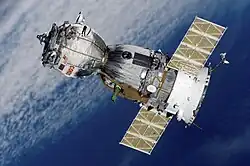
The Soyuz programme (/ˈsɔɪjuːz/SOY-yooz, /ˈsɔː-/SAW-; Russian: Союз[sɐˈjus], meaning "Union") is a human spaceflight programme initiated by the Soviet Union in the early 1960s. The Soyuz spacecraft was originally part of a Moon landing project intended to put a Soviet cosmonaut on the Moon.[1] It was the third Soviet human spaceflight programme after the Vostok (1961–1963) and Voskhod (1964–1965) programmes.[2]
The programme consists of the Soyuz capsule and the Soyuz rocket and is now the responsibility of Roscosmos.[3][4] After the retirement of the Space Shuttle in 2011, the Soyuz was the only way for humans to get to the International Space Station (ISS) until 30 May 2020 when Crew Dragon flew to the ISS for the first time with astronauts.[4][5]
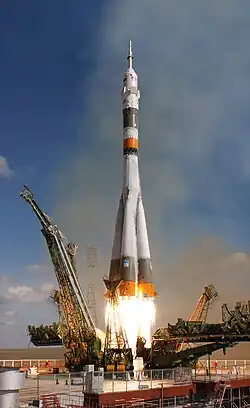
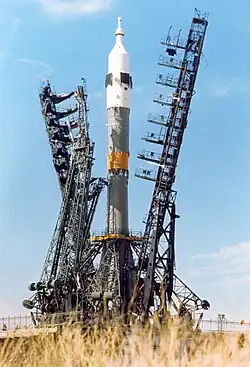
Soyuz rocket
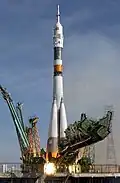
Soyuz TMA-13 lifting off from Gagarin's Start at Baikonur Cosmodrome in 2008Soyuz rocket on launch pad
The launch vehicles used in the Soyuz expendable launch system are manufactured at the Progress State Research and Production Rocket Space Center (TsSKB-Progress) in Samara, Russia. As well as being used in the Soyuz programme as the launcher for the crewed Soyuz spacecraft, Soyuz launch vehicles are now also used to launch robotic Progress supply spacecraft to the International Space Station and commercial launches marketed and operated by TsSKB-Progress and the Starsem company. Currently Soyuz vehicles are launched from the Baikonur Cosmodrome in Kazakhstan and the Plesetsk Cosmodrome in northwest Russia and, since 2011, Soyuz launch vehicles are also being launched from the Guiana Space Centre in French Guiana.[6] The Spaceport's new Soyuz launch site has been handling Soyuz launches since 21 October 2011, the date of the first launch.[7] As of December 2019, 19 Guiana Soyuz launches had been made from French Guiana Space Centre, all successful.[8][9][10]
The Soyuz rocket family is one of the most dependable and widely utilized launch vehicles in the history of space travel. It has been in operation for nearly six decades, having been developed by the Soviet Union and presently run by Russia. The Soyuz rockets have played an important role in both crewed and uncrewed space missions, launching people to the International Space Station (ISS) and delivering satellites and scientific payloads.[11]
The basic Soyuz spacecraft design was the basis for many projects, many of which were never developed. Its earliest form was intended to travel to the Moon without employing a huge booster like the Saturn V or the Soviet N-1 by repeatedly docking with upper stages that had been put in orbit using the same rocket as the Soyuz. This and the initial civilian designs were done under the Soviet Chief Designer Sergei Pavlovich Korolev, who did not live to see the craft take flight. Several military derivatives took precedence in the Soviet design process, though they never came to pass.
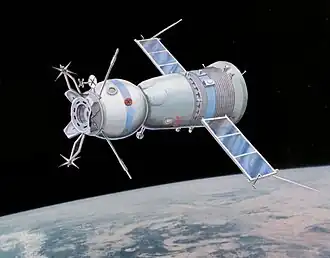
A Soyuz spacecraft consists of three parts (from front to back):
a spheroid orbital module
a small aerodynamic reentry module
a cylindrical service module with solar panels attached
There have been many variants of the Soyuz spacecraft, including:
Sever early crewed spacecraft proposal to replace Vostok (1959)
L1-1960 crewed circumlunar spacecraft proposal (1960); evolved into the Soyuz-A design
L4-1960 crewed lunar orbiter proposal (1960)
L1-1962 crewed lunar flyby spacecraft proposal (1962); early design led to Soyuz
Soyuz 7K-T-AF (1973); 7K-T modified for space station flight with Orion 2 space telescope
Soyuz 7K-T/A9 (1974–1978); 7K-T modified for flights to military Almaz space stations
Soyuz 7K-TM (1974–1976)
7K-MF6 (1976); 7K-TM modified for space station flight with MKF-6 camera
Soyuz-T (1976–1986)
Zarya planned 'Super Soyuz' replacement for Soyuz and Progress (1985)
Alpha Lifeboat rescue spacecraft based on Zarya (1995); cancelled in favor of a modified Soyuz TM
Big Soyuz enlarged version of Soyuz reentry vehicle (2008)
Soyuz-TM (1986–2003)
Soyuz TMA (2003–2012)
Soyuz-ACTS (2006)
Soyuz TMA-M (2010–2016)
Soyuz MS (since 2016)
Military Soyuz (P, PPK, R, 7K-VI Zvezda, and OIS)
Soyuz P crewed satellite interceptor proposal (1962); cancelled in 1964 in favor of the Istrebitel Sputnikov program
Soyuz R command-reconnaissance spacecraft proposal (1962); cancelled in 1966 and replaced by Almaz
The Soyuz MS spacecraft and its Soyuz FG rocketSoyuz 7K-TK transport spacecraft proposal for delivering cosmonauts to Soyuz R military stations (1966); cancelled in 1970 in favor of the TKS spacecraft
Soyuz PPK revised version of Soyuz P (1964)
Soyuz 7K-VI Zvezda space station proposal (1964)
Soyuz-VI crewed combat spacecraft proposal; cancelled in 1965
Soyuz OIS (1967)
Soyuz OB-VI space station proposal (1967)
Soyuz 7K-S military transport proposal (1974)
Soyuz 7K-ST concept for Soyuz T and TM (1974)
Derivatives
The Zond spacecraft was designed to take a crew around the Moon, but never achieved the required degree of safety or political need. Zond 5 did circle the Moon in September 1968, with two tortoises and other life forms, and returned safely to Earth although in an atmospheric entry which probably would have killed human travelers.
The Progress series of robotic cargo ships for the Salyut, Mir, and ISS use the engine section, orbital module, automatic navigation, docking mechanism, and overall layout of the Soyuz spacecraft, but are incapable of reentry.
While not a direct derivative, the Chinese Shenzhou spacecraft follows the basic template originally pioneered by Soyuz.[12][13]
Soyuz crewed flights
Soviet human spaceflight missions started in 1961 and ended in 1991 with the dissolution of the Soviet Union.
The Russian human spaceflight missions program started in 1991 and continues to this day. Soyuz crewed missions were the only spacecraft visiting the International Space Station, starting from when the Space Shuttle program ended in 2011, until the launch of Crew Dragon Demo-2 on 30 May 2020.[14][15] The International Space Station always has at least one Soyuz spacecraft docked at all times for use as an escape craft.[16][17]
Uncrewed missions are designated as Kosmos instead of Soyuz; exceptions are noted "(uncrewed)". The † sign designates failed missions. Italics designates cancelled missions.

 Soyuz TMA-3 launch
_spacecraft.jpg) Soyuz 19 as seen from the Apollo spacecraft during Apollo–Soyuz Test Project, July 1975
Soyuz 19 as seen from the Apollo spacecraft during Apollo–Soyuz Test Project, July 1975.jpg) Soyuz TMA-14M landing
Soyuz TMA-14M landing.jpg) Soyuz TMA-16M approaching the ISS
Soyuz TMA-16M approaching the ISS