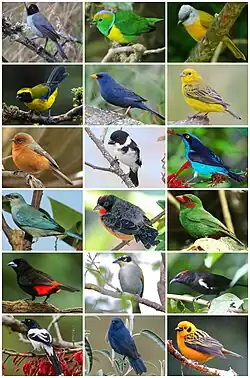
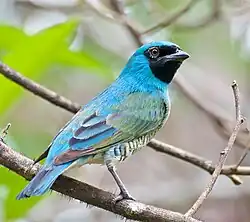
The tanagers (singular /ˈtænədʒər/) comprise the bird familyThraupidae, in the order Passeriformes. The family has a Neotropical distribution and is the second-largest family of birds. It represents about 4% of all avian species and 12% of the Neotropical birds.[1]
Traditionally, the family contained around 240 species of mostly brightly colored fruit-eating birds.[2] As more of these birds were studied using modern molecular techniques, it became apparent that the traditional families were not monophyletic. Euphonia and Chlorophonia, which were once considered part of the tanager family, are now treated as members of the Fringillidae, in their own subfamily (Euphoniinae). Likewise, the genera Piranga (which includes the scarlet tanager, summer tanager, and western tanager), Chlorothraupis, and Habia appear to be members of the family Cardinalidae,[3] and have been reassigned to that family by the American Ornithological Society.[4]
Description
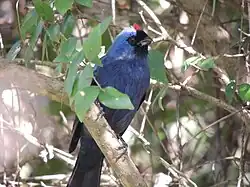
Tanagers are small to medium-sized birds. The shortest-bodied species, the white-eared conebill, is 9 cm (4 in) long and weighs 6 g (0.2 oz), barely smaller than the short-billed honeycreeper. The longest, the magpie tanager is 28 cm (11 in) and weighs 76 g (2.7 oz). The heaviest is the white-capped tanager, which weighs 114 g (4.02 oz) and measures about 24 cm (9.4 in). Both sexes are usually the same size and weight.
Tanagers are often brightly colored, but some species are black and white. Males are typically more brightly colored than females and juveniles. Most tanagers have short, rounded wings. The shape of the bill seems to be linked to the species' foraging habits.
Distribution
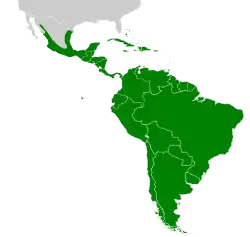
Tanagers are restricted to the Western Hemisphere and mainly to the tropics. About 60% of tanagers live in South America, and 30% of these species live in the Andes. Most species are endemic to a relatively small area.
Behavior
Most tanagers live in pairs or in small groups of three to five individuals. These groups may consist simply of parents and their offspring. These birds may also be seen in single-species or mixed flocks. Many tanagers are thought to have dull songs, though some are elaborate.
Diet
Tanagers are omnivorous, and their diets vary by genus. They have been seen eating fruits, seeds, nectar, flower parts, and insects. Many pick insects off branches or from holes in the wood. Other species look for insects on the undersides of leaves. Yet others wait on branches until they see a flying insect and catch it in the air. Many of these particular species inhabit the same areas, but these specializations alleviate competition.
Breeding
The breeding season is March through June in temperate areas and in September through October in South America. Some species are territorial, while others build their nests closer together. Little information is available on tanager breeding behavior. Males show off their brightest feathers to potential mates and rival males. Some species' courtship rituals involve bowing and tail lifting.
Most tanagers build cup nests on branches in trees. Some nests are almost globular. Entrances are usually built on the side of the nest. The nests can be shallow or deep. The species of the tree in which they choose to build their nests and the nests' positions vary among genera. Most species nest in an area hidden by very dense vegetation. No information is yet known regarding the nests of some species.
The clutch size is three to five eggs. The female incubates the eggs and builds the nest, but the male may feed the female while she incubates. Both sexes feed the young. Five species have helpers assist in feeding the young. These helpers are thought to be the previous year's nestlings.
Taxonomy
The family Thraupidae was introduced (as the subfamily Thraupinae) in 1847 by German ornithologist Jean Cabanis. The type genus is Thraupis.[5][6]
The family Thraupidae is a member of an assemblage of over 800 birds known as the New World, nine-primaried oscines. The traditional pre-molecular classification was largely based on the different feeding specializations. Nectar-feeders were placed in Coerebidae (honeycreepers), large-billed seed-eaters in Cardinalidae (cardinals and grosbeaks), smaller-billed seed-eaters in Emberizidae (New World finches and sparrows), ground-foraging insect-eaters in Icteridae (blackbirds) and fruit-eaters in Thraupidae.[1] This classification was known to be problematic as analyses using other morphological characteristics often produced conflicting phylogenies.[7] Beginning in the last decade of the 20th century, a series of molecular phylogenetic studies led to a complete reorganization of the traditional families. Thraupidae now includes large-billed seed eaters, thin-billed nectar feeders, and foliage gleaners as well as fruit-eaters.[1]
One consequence of redefining the family boundaries is that for many species their common names are no longer congruent with the families in which they are placed. As of July 2020 there are 39 species with "tanager" in the common name that are not placed in Thraupidae. These include the widely distributed scarlet tanager and western tanager, which are both now placed in Cardinalidae. There are also 106 species within Thraupidae that have "finch" in their common name.[8]
A molecular phylogenetic study published in 2014 revealed that many of the traditional genera were not monophyletic.[1] In the resulting reorganization six new genera were introduced, eleven genera were resurrected, and seven genera were abandoned.[9][8]
As of March 2025 the family contains 393 species which are divided into 15 subfamilies and 105 genera.[1][8] For a complete list, see the article List of tanager species.
List of genera
Catamblyrhynchinae
The plushcap has no close relatives and is now placed in its own subfamily. It was previously placed either in the subfamily Catamblyrhynchinae within the Emberizidae or in its own family Catamblyrhynchidae.[1]
Image
Genus
Species
CatamblyrhynchusLafresnaye, 1842
Plushcap – Catamblyrhynchus diadema
Charitospizinae
The coal-crested finch is endemic to the grasslands of Brazil and has no close relatives. It is unusual in that both sexes have a crest. It was formerly placed in Emberizidae.
Image
Genus
Species
CharitospizaOberholser, 1905
Coal-crested finch – Charitospiza eucosma
Orchesticinae
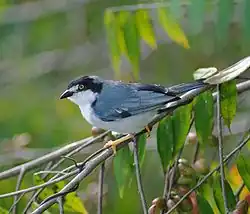
Two species with large thick bills. Parkerthraustes was formerly placed in Cardinalidae.
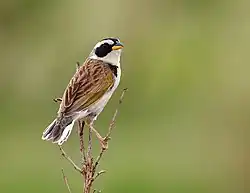
Grassland dwelling birds that were formerly placed in Emberizidae.
Image
Genus
Species
CoryphaspizaG.R. Gray, 1840
Black-masked finch – Coryphaspiza melanotis
EmbernagraLesson, 1831
Serra finch – Embernagra longicauda
Pampa finch – Embernagra platensis
EmberizoidesTemminck, 1822
Wedge-tailed grass finch – Emberizoides herbicola
Duida grass finch – Emberizoides duidae
Lesser grass finch – Emberizoides ypiranganus
Porphyrospizinae
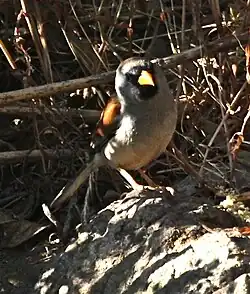
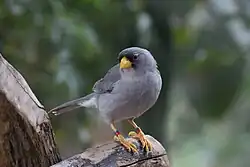
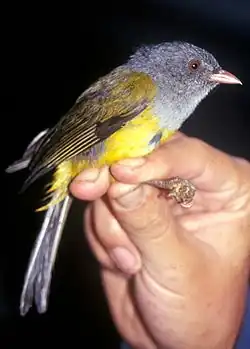
Yellow billed birds. The blue finch (Rhopospina caerulescens) was formerly placed in Cardinalidae; the other species were formerly placed in Emberizidae.
Image
Genus
Species
IncaspizaRidgway, 1898
Great Inca finch – Incaspiza pulchra
Rufous-backed Inca finch – Incaspiza personata
Grey-winged Inca finch – Incaspiza ortizi
Buff-bridled Inca finch – Incaspiza laeta
Little Inca finch – Incaspiza watkinsi
RhopospinaCabanis, 1851
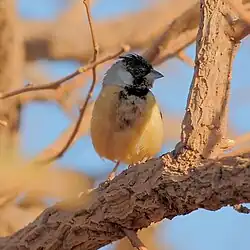
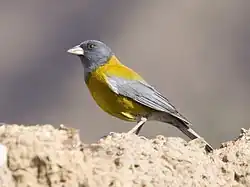
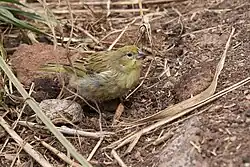
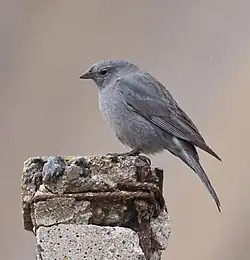
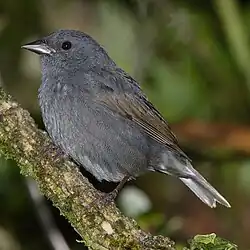
Mourning sierra finch – Rhopospina fruticeti
Blue finch – Rhopospina caerulescens
Band-tailed sierra finch – Rhopospina alaudina
Carbonated sierra finch – Rhopospina carbonaria
Hemithraupinae
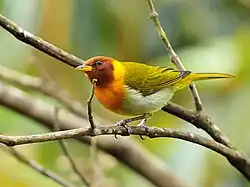
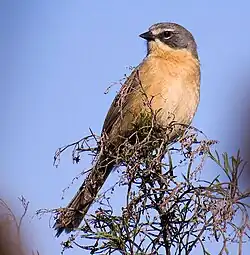
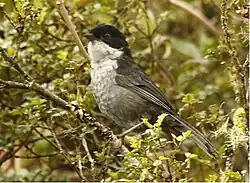
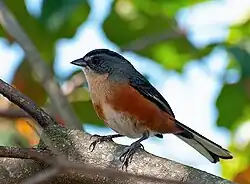
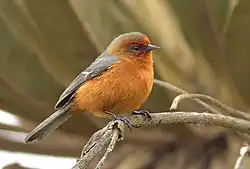
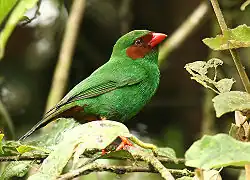
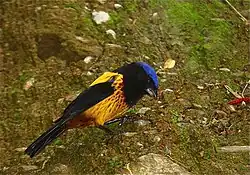
These species are sexually dichromatic and many have yellow and black plumage. Except for Heterospingus, they have slender bills.
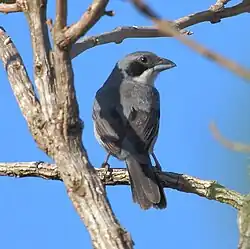
Bluish-grey saltator or Amazonian grey saltator – Saltator coerulescens
Cinnamon-bellied saltator or northern grey saltator – Saltator grandis
Olive-grey saltator or Caribbean grey saltator – Saltator olivascens
Streaked saltator – Saltator striatipectus
Lesser Antillean saltator – Saltator albicollis
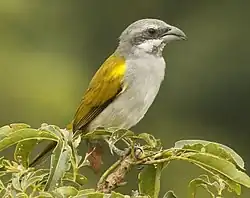
Buff-throated saltator – Saltator maximus
Black-winged saltator – Saltator atripennis
Black-headed saltator – Saltator atriceps
Black-cowled saltator – Saltator nigriceps
Black-throated grosbeak – Saltator fuliginosus
Slate-coloured grosbeak – Saltator grossus
Masked saltator – Saltator cinctus
Thick-billed saltator – Saltator maxillosus
Golden-billed saltator – Saltator aurantiirostris
Coerebinae
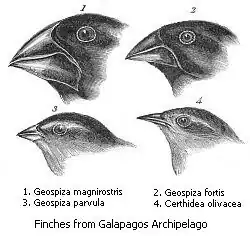
Diversity of Darwin's finches
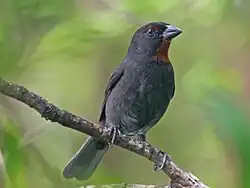
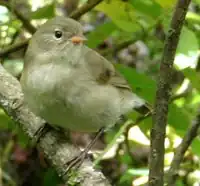
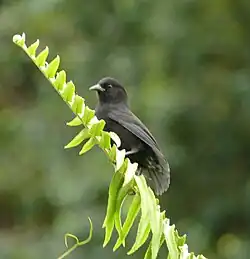
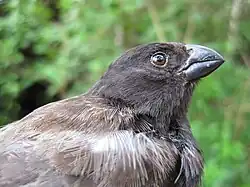
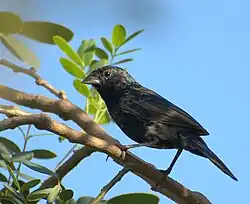
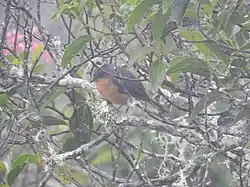
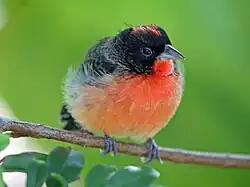
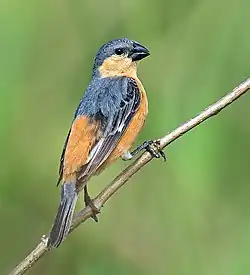
This subfamily includes Darwin's finches, of which all but the Cocos finch are endemic to the Galápagos Islands. Most Coerebinae species were formerly placed in Emberizidae; the exceptions are the bananaquit that was placed in Parulidae and the orangequit that was placed in Thraupidae. These species build domed or covered nests with side entrances. They have evolved a variety of foraging techniques, including nectar-feeding (Coereba, Euneornis), seed-eating (Geospiza, Loxigilla, Tiaris), and insect gleaning (Certhidea).[1]
Image
Genus
Species
CoerebaVieillot, 1809
Bananaquit – Coereba flaveola
TiarisSwainson, 1827
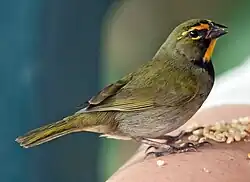
Yellow-faced grassquit – Tiaris olivaceus
EuneornisFitzinger, 1856
Orangequit – Euneornis campestris
MelopyrrhaBonaparte, 1853
Puerto Rican bullfinch – Melopyrrha portoricensis (formerly placed in Loxigilla)
†St. Kitts bullfinch – Melopyrrha grandis
Greater Antillean bullfinch – Melopyrrha violacea (formerly placed in Loxigilla)
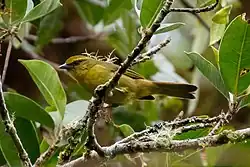
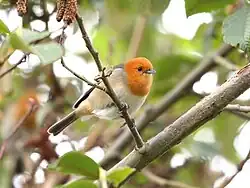
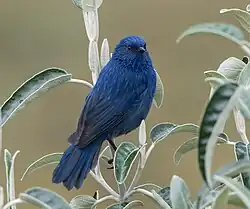
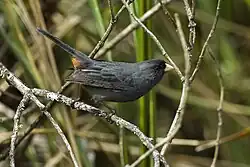
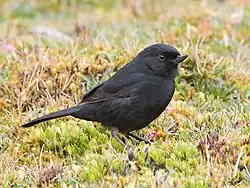
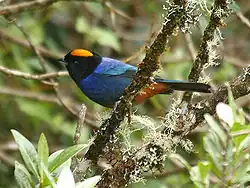
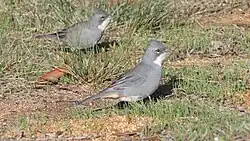
This is a morphologically diverse group that includes seed-eaters (Nesospiza, Sicalis, Catamenia, Haplospiza), arthropod feeders (Conirostrum), a bamboo specialist (Acanthidops), an aphid feeder (Xenodacnis), and boulder field specialists (Idiopsar). Many species live at high altitudes. Conirostrum was previously placed in Parulidae, Diglossa was placed in Thraupidae, and the remaining genera were placed in Emberizidae.[1]
^Storer, Robert W. (1970). "Subfamily Thraupinae". In Paynter, Raymond A. Jr (ed.). Check-List of Birds of the World. Vol. 13. Cambridge, Massachusetts: Museum of Comparative Zoology. pp. 246–408.
^Yuri, T.; Mindell, D. P. (May 2002). "Molecular phylogenetic analysis of Fringillidae, "New World nine-primaried oscines" (Aves: Passeriformes)". Molecular Phylogenetics and Evolution. 23 (2): 229–243. Bibcode:2002MolPE..23..229Y. doi:10.1016/S1055-7903(02)00012-X. PMID12069553.
^ abcGill, Frank; Donsker, David; Rasmussen, Pamela, eds. (February 2025). "Tanagers and allies". IOC World Bird List Version 15.1. International Ornithologists' Union. Retrieved 23 March 2025.
^Burns, K.J.; Unitt, P.; Mason, N.A. (2016). "A genus-level classification of the family Thraupidae (Class Aves: Order Passeriformes)". Zootaxa. 4088 (3): 329–354. doi:10.11646/zootaxa.4088.3.2. PMID27394344.

.jpg)
.jpg)
%253B_Ramal_do_Pau_Rosa%252C_Manaus%252C_Amazonas%252C_Brazil.jpg)
.jpg)
%253B_Janu%C3%A1ria%252C_Minas_Gerais%252C_Brazil.jpg)


%252C_Colca_Canyon%252C_Peru.jpg)
_male.jpg)


.jpg)
.jpg)


.jpg)
_-_Flickr_-_Alejandro_Bayer_(13).jpg)
.JPG)
_Illustrations_of_the_birds_of_Jamaica_(1849).jpg)

.jpg)
.jpg)
.jpg)
.jpg)
.jpg)

_04.jpg)
.jpg)
.jpg)
.jpg)
_male.jpg)
.jpg)


.jpg)

.jpg)
.jpg)

.jpg)
.jpg)
_male.JPG)
.JPG)
_(15341916183).jpg)
.jpg)
.JPG)
.jpg)

.jpg)
_(8077568246).jpg)
.jpg)
_(16394162371).jpg)

.jpg)


.jpg)

.jpg)
%253B_Iber%C3%A1_marshes%252C_Corrientes%252C_Argentina.jpg)
.jpg)
_no_Parque_Nacional_da_Serra_da_Canastra.jpg)

.jpg)
.jpg)
_(10937083674).jpg)