2013 official orchestral and choral vocal recording (first and second verse)
file
help
"İstiklal Marşı" (Turkish:[isticˈlalmaɾˈʃɯ]; lit.'Independence March') is the national anthem of both the Republic of Turkey and the Turkish Republic of Northern Cyprus. It was officially adopted by the Grand National Assembly on 12 March 1921 – 2½ years before the 29 October 1923 establishment of the nation – both as a motivational musical saga for the troops fighting in the Turkish War of Independence, and as an aspirational anthem for a Republic that was yet to be established.
Penned by Mehmet Âkif Ersoy, and ultimately composed by Osman Zeki Üngör, the theme is one of affection for the Turkish homeland, freedom, and faith, as well as praise for the virtues of hope, devotion, and sacrifice in the pursuit of liberty, all explored through visual, tactile, and kinesthetic imagery as these concepts relate to the flag, the human spirit, and the soil of the homeland. The original manuscript by Ersoy carries the dedication Kahraman Ordumuza ('To Our Heroic Army'), in reference to the national forces that ultimately won the Turkish War of Independence, with lyrics that reflect on the sacrifices of the soldiers during the war.
It is regularly heard during state and military events, as well as during national festivals, bayrams, sporting events, and school ceremonies. Visual depictions can also be found adorning state or public displays, such as in the form of a scroll displaying the first two quatrains of the anthem on the reverse of the Turkish 100 lira banknotes of 1983–1989.[1]
Of the ten-stanza anthem, only the first two quatrains are sung.
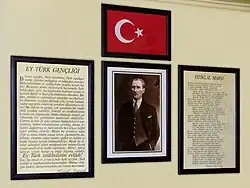
A framed version of the national anthem typically occupies the wall above the blackboard in the classrooms of Turkish schools, accompanied by a Turkish flag, a photograph of the country's founding savior Atatürk, and a copy of Atatürk's speech to the nation's youth from the concluding remarks to his 20 October 1927 address to the Parliament.
An example of a common classroom display in Turkey, including the national anthem at far right
The present-day anthem is a collective effort by several prominent poets, musicians, and composers that took form over several years due to the relatively tumultuous nature of the period in which it was crafted.
Even before the full official dissolution of the Ottoman Empire, a nationwide competition was organized in 1921 by the Turkish National Movement — an independent and self-organized militia force led by Mustafa Kemal Atatürk waging a lengthy campaign for independence against both invading foreign powers and the Ottoman Court itself, due to the latter being treasonous and complicit in the partitioning of the Turkish homeland in the aftermath of the 1920 Treaty of Sèvres. The goal of the competition was to select an original composition suitable for a National March, intended to both motivate the militia forces fighting for independence across the country, and to provide inspiration and pride for a new homeland that would be established once victory was achieved.
A total of 724 poems were submitted. Mehmet Akif Ersoy, a well-known poet of the period, initially refused to participate due to a monetary prize being offered in the competition, but was subsequently contacted and convinced by the National Parliament to submit a poem and disregard the reward. The resulting ten-stanza-long poem written by Ersoy was recited to the National Assembly by representative Hamdullah Suphi, on 1 March 1921,[4] where it was unanimously adopted by the deputies following evaluation by a parliamentary committee. The prize of the competition was later bestowed on a society of veterans.
This early composition by Çağatay lasted only six years. In 1930, a new composition by Osman Zeki Üngör, virtuoso composer and the first conductor of the Presidential Symphony Orchestra of the Republic of Turkey, was adopted as a permanent musical arrangement by Parliament.[4] Shortly thereafter, in 1932, the musician Edgar Manas was commissioned by the Turkish government to harmonize and orchestrate the melody created by Üngör,[5][6][7] and the final and official version of the anthem took form.
Lyrics
The full lyrics of the Turkish national anthem consist of 41 lines of verses, with ten stanzas total, though only the first two verses (shown in bold) are performed in official ceremonies.
Korkma! Sönmez bu şafaklarda yüzen al sancak, Sönmeden yurdumun üstünde tüten en son ocak. O benim milletimin yıldızıdır, parlayacak; O benimdir, o benim milletimindir ancak.
Çatma, kurban olayım, çehreni ey nazlı hilal! Kahraman ırkıma bir gül; ne bu şiddet, bu celal? Sana olmaz dökülen kanlarımız sonra helal... Hakkıdır, Hakk’a tapan milletimin istiklal!
Ben ezelden beridir hür yaşadım, hür yaşarım,
Hangi çılgın bana zincir vuracakmış? Şaşarım!
Kükremiş sel gibiyim, bendimi çiğner, aşarım,
Yırtarım dağları, enginlere sığmam, taşarım.
Garbın afakını sarmışsa çelik zırhlı duvar,
Benim iman dolu göğsüm gibi serhaddim var.
Ulusun, korkma! Nasıl böyle bir imanı boğar,
“Medeniyet” dediğin tek dişi kalmış canavar?
Arkadaş! Yurduma alçakları uğratma sakın,
Siper et gövdeni, dursun bu hayâsızca akın.
Doğacaktır sana vadettiği günler Hakk’ın,
Kim bilir, belki yarın belki yarından da yakın.
Bastığın yerleri “toprak” diyerek geçme, tanı,
Düşün altındaki binlerce kefensiz yatanı.
Sen şehit oğlusun, incitme, yazıktır atanı,
Verme, dünyaları alsan da bu cennet vatanı.
Kim bu cennet vatanın uğruna olmaz ki feda?
Şüheda fışkıracak, toprağı sıksan şüheda!
Canı, cananı, bütün varımı alsın da Hüda,
Etmesin tek vatanımdan beni dünyada cüda.
Ruhumun senden İlahî, şudur ancak emeli:
Değmesin mabedimin göğsüne namahrem eli.
Bu ezanlar, ki şehadetleri dinin temeli,
Ebedî, yurdumun üstünde benim inlemeli.
O zaman vecd ile bin secde eder, varsa taşım,
Her cerihamdan, İlahî, boşanıp kanlı yaşım,
Fışkırır ruhumücerret gibi yerden naaşım,
O zaman yükselerek arşa değer belki başım.
Dalgalan sen de şafaklar gibi ey şanlı hilal!
Olsun artık dökülen kanlarımın hepsi helal.
Ebediyen sana yok, ırkıma yok izmihlal.
Hakkıdır, hür yaşamış bayrağımın hürriyet;
Hakkıdır, Hakk’a tapan milletimin istiklal!
قورقمه، سونمز بو شفقلرده یوزن آل سانجاق سونمدن یوردمڭ اوستنده توتن اڭ صوڭ اوجاق. او بنم ملتمڭ یلدزدر پارلایاجاق؛ او بنمدر. او بنم ملتمڭدر آنجاق.
چاتمه قربان اولایم چهرڭی، ای نازلی هلال! قهرمان عرقمه بر گل، نه بو شدت، بو جلال ساڭا اولماز دوكولن قانلریمز صوڭرا حلال؛ حقدر، حقه طاپان ملتمڭ، استقلال!
او زمان وجد ایله بیڭ سجده ایدهر – وارسه – طاشم.
هر جریحهمدن، الهی، بوشانوب قانلی یاشم،
فیشقیریر روح مجرد گبی یردن نعشم؛
او زمان یوكسهلهرهڭ عرشه دگهر بلكه باشم!
دالغالان سن ده شفقلر گبی ای شانلی هلال!
اولسڭ آرتق دكولن قانلریمڭ هپسی حلال!
ابدیا سڭا یوق، عرقمه یوق اضمحلال!
حقیدر حر یاشامش بایراغمڭ حریت؛
حقیدر حقه طاپان ملتمڭ استقلال!
Fear not! For the red flag that proudly ripples in this glorious twilight, shall never fade,
Before the last fiery hearth that is ablaze within my nation is extinguished.
For That is the star of my nation, and it will forever shine;
It is mine; and solely belongs to my valiant nation.
Frown not, I beseech you, oh thou coy crescent,
But smile upon my heroic race! Why the anger, why the rage?
Our blood which we shed for you will not be blessed otherwise;
For freedom is the absolute right of my God-worshiping nation.
I have been free since the beginning and forever will be so.
What madman shall put me in chains! I defy the very idea!
I'm like the roaring flood; powerful and independent,
I'll tear apart mountains, exceed the heavens and still gush out!
The lands of the West may be armored with walls of steel,
But I have borders guarded by the mighty chest of a believer.
Recognize your innate strength, my friend! And think: how can this fiery faith ever be killed,
By that battered, single-fanged monster you call "civilization"?
My friend! Leave not my homeland to the hands of villainous men!
Render your chest as armor and your body as trench! Stop this disgraceful rush!
For soon shall come the joyous days of divine promise…
Who knows? Perhaps tomorrow? Perhaps even sooner!
View not the soil you tread on as mere earth, recognize it!
And think about the shroudless thousands who lie so nobly beneath you.
You're the noble son of a martyr, take shame, hurt not your ancestor!
Unhand not, even when you're promised worlds, this paradise of a homeland.
What man would not die for this heavenly piece of land?
Martyrs would gush out were one to just squeeze the soil! Martyrs!
May God take all my loved ones and possessions from me if He will,
But may He not deprive me of my one true homeland for the world.
Oh glorious God, the sole wish of my pain-stricken heart is that,
No heathen's hand should ever touch the bosom of my sacred Temples.
These adhans, whose shahadahs are the foundations of my religion,
And may their noble sound last loud and wide over my eternal homeland.
For only then, shall my fatigued tombstone, if there is one, prostrate a thousand times in ecstasy,
And tears of fiery blood shall flow out of my every wound,
And my lifeless body shall gush out from the earth like an eternal spirit,
Perhaps only then, shall I peacefully ascend and at long last reach the heavens.
So flap and wave like the bright dawning sky, oh thou glorious crescent,
So that our every last drop of blood may finally be worthy!
Neither you nor my race shall ever be extinguished!
For freedom is the absolute right of my ever-free flag;
For freedom is the absolute right of my God-worshiping nation!
^Vefatını 72. yılında Mehmet Âkif Ersoy bilgi șöleni 3: Mehmed Âkif edebî ve fikrî akımlar. Ankara: Türkiye Yazarlar Birliği. 2009. p. 54. ISBN 9789757382409.
^Külekçi, Cahit (2010). Sosyo-kültürel açıdan Ermeniler ve Türkler: İstanbul Ermenileri (in Turkish). 432: Kayihan. p. 340.{{cite book}}: CS1 maint: location (link)
^"İstiklâl Marşı"(PDF). Presidency of the Republic of Turkey. 2019. Archived(PDF) from the original on 2022-03-24. Retrieved 2022-05-11.
Official Records of the Grand National Assembly of The Republic of Turkey on the parliamentary debates and history of the İstiklal Marşı – Zabit Ceridesi – 12.03.1921(in Turkish)
_matbu.png)