Walter Scheel (German:[ˈvaltɐˈʃeːl]ⓘ; 8 July 1919 – 24 August 2016)[1] was a German statesman. A member of the Nazi Party who joined the Free Democratic Party of Germany (FDP) in 1946, he first served in government as the Federal Minister of Economic Cooperation and Development from 1961 to 1966 and later as President of Germany from 1974 to 1979. He led the FDP from 1968 to 1974.[2]
During the chancellorship of Willy Brandt, Scheel was Federal Minister of Foreign Affairs and the Vice Chancellor. Scheel became acting Chancellor of West Germany from 7–16 May 1974 following Brandt's resignation after the Guillaume Affair. He was elected shortly after as the president of West Germany, remaining in the role until 1979. Scheel was a member of the Protestant Church in Germany.
Scheel became a member of the Nazi Party in 1942.[4] During World War II, he served in the Luftwaffe during the last years of the war as a radar operator on a Bf 110 night fighter.
Political career
When his Free Democratic Party reentered government in a coalition with Konrad Adenauer's Christian Democratic Union in 1961, Scheel was appointed federal minister of economic cooperation and development. He continued in that office under Chancellor Ludwig Erhard but brought about the downfall of the latter in late 1966 by resigning.
A Christian Democratic/Social Democratic Grand Coalition followed. During this time, in 1968, Scheel took over the party presidency from right wing liberal Erich Mende. According to one study, the election of Walter Scheel to the FDP leadership in 1968 "represented a turn to the left and the Free Democrats then indicated their wooing of the SPD by voting for the successful Social Democratic candidate for the Presidency of the Republic, Gustav Heinemann, in 1969."[5]
In 1969, he led his party to form a new coalition with the Social Democrats. Under Chancellor Willy Brandt, Scheel became Foreign Minister and Vice Chancellor. Under their leadership, West Germany pursued a course of rapprochement and détente with the Soviet bloc and officially recognized the existence of the German Democratic Republic (GDR). This policy caused a massive public debate, with various Free and Social Democrats switching sides to the opposition. Though an attempt to oust Brandt failed, the coalition had lost its slender majority. The parliamentary stalemate was ended by the dissolution of parliament and early elections in 1972, which brought great gains for the Social Democrats and enabled the coalition to continue.
On 7 May 1974, Brandt resigned as chancellor after one of his aides, Günter Guillaume, was arrested as a spy for the East German state. Though this had been internally suspected since 1973, Brandt accepted responsibility and resigned. Scheel, as acting chancellor, chaired the government meetings for a little over a week, until Helmut Schmidt was elected.[6] One of his first official acts as acting Chancellor was the award of the war blind radio play prize to Alfred Behrens on 8 May 1974. On 14 May, he chaired the cabinet meeting once.[7]Hans Dietrich Genscher became Scheel's successor as party chairman and as minister.
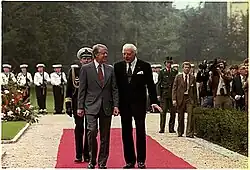
Scheel was elected President of West Germany, a week after relinquishing his other government roles. He held the office from July 1974 until June 1979. At the funeral of Hanns Martin Schleyer in October 1977, Scheel gave a speech entitled shame. After the federal presidency, Scheel was Chairman of the Bilderberg Conference as well as President of the European Movement in Germany from 1980 to 1985. From 1980 to 1989 he was also President of the German section of the Union of European Federalists (UEF). He was named honorary chairman of the Friedrich Naumann Foundation in 1991.
Death
Scheel died on 24 August 2016 following a long illness.[8][9][10] Having lived to 97 years, 47 days he holds the record as the longest-lived German head of state, either imperial or elected.
Publications
with Karl-Hermann Flach and Werner Maihofer: Die Freiburger Thesen der Liberalen. Rowohlt, Hamburg 1972, ISBN 3-499-11545-X.
Die Zukunft der Freiheit – Vom Denken und Handeln in unserer Demokratie. Econ, 1979.
Wen schmerzt noch Deutschlands Teilung? 2 Reden zum 17. Juni, Rowohlt, Reinbek 1986, ISBN 3-499-18346-3.
with Otto Graf Lambsdorff: Freiheit in Verantwortung, Deutscher Liberalismus seit 1945. Bleicher, 1988, ISBN 3-88350-047-X.
with Jürgen Engert: Erinnerungen und Einsichten. Hohenheim-Verlag, Stuttgart 2004, ISBN 3-89850-115-9.
with Tobias Thalhammer: Gemeinsam sind wir stärker – Zwölf erfreuliche Geschichten über Jung und Alt. Allpart Media, Berlin 2010, ISBN 978-3-86214-011-4.
Notes
^Due to the division of Germany, Walter Scheel was only the President of West Germany. The term West Germany is the common English name for the Federal Republic of Germany between its formation on 23 May 1949 and the German reunification through the accession of East Germany on 3 October 1990.
^Due to the division of Germany, Walter Scheel was only the chancellor in West Germany. The term West Germany is the common English name for the Federal Republic of Germany between its formation on 23 May 1949 and the German reunification through the accession of East Germany on 3 October 1990. The office of chancellor did not exist in East Germany.
Literature
Hans-Dietrich Genscher (Hrsg.): Heiterkeit und Härte: Walter Scheel in seinen Reden und im Urteil von Zeitgenossen. Deutsche Verlagsanstalt, Stuttgart 1984, ISBN 3-421-06218-8.
Hans-Roderich Schneider: Präsident des Ausgleichs. Bundespräsident Walter Scheel. Ein liberaler Politiker. Verlag Bonn aktuell, Stuttgart 1975, ISBN 3-87959-045-1.
Berg (from 27 June 1955, from 23 February 1956 Non-attached, from 15 March 1956 Demokratische Arbeitsgemeinschaft (DA), from 26 June 1956 FVP, from 14 March 1957 DP/FVP)
Blank (from 23 February 1956 Non-attached, from 15 March 1956 Demokratische Arbeitsgemeinschaft (DA), from 26 June 1956 FVP, from 14 March 1957 DP/FVP)
Blücher (from 23 February 1956 Non-attached, from 15 March 1956 Demokratische Arbeitsgemeinschaft (DA), from 26 June 1956 FVP, from 14 March 1957 DP/FVP)
Bucher
Dannemann (until 1 July 1955)
Dehler
Drechsel
Eberhard
Euler (from 23 February 1956 Non-attached, from 15 March 1956 Demokratische Arbeitsgemeinschaft (DA), from 26 June 1956 FVP, from 14 March 1957 DP/FVP)
Fassbender (from 18 November 1955 DP, from 14 March 1957 DP/FVP)
Friese-Korn
Frühwald
Gaul
Golitschek (from 18 April 1956)
Graaff (from 4 July 1955)
Hammer
Held (from 13 September 1954)
Henn (from 23 February 1956 Non-attached, from 15 March 1956 Demokratische Arbeitsgemeinschaft (DA), from 26 June 1956 FVP, from 14 March 1957 DP/FVP)
Hepp (from 23 February 1956 Non-attached, from 15 March 1956 Demokratische Arbeitsgemeinschaft (DA), from 26 June 1956 FVP, from 14 March 1957 DP/FVP)
Hoffmann
Hübner (from 23 February 1956 Non-attached, from 15 March 1956 Demokratische Arbeitsgemeinschaft (DA), from 26 June 1956 FVP, from 14 March 1957 DP/FVP)
Hütter (from 29 September 1955)
Ilk
Jentzsch
Kühn
Lahr (from 23 February 1956 Non-attached, from 15 March 1956 Demokratische Arbeitsgemeinschaft (DA), from 26 June 1956 FVP, from 14 March 1957 DP/FVP)
Lenz
Löwenstein-Wertheim-Freudenberg (from 6 June 1957 Non-attached, from 25 June 1957 DP/FVP)
Luchtenberg (from 18 September 1954, until 9 April 1956)
Lüders
Manteuffel (from 23 February 1956 Non-attached, from 15 March 1956 Demokratische Arbeitsgemeinschaft (DA), from 26 June 1956 FVP, from 14 March 1957 DP/FVP)
Margulies
Mauk
Mayer (until 14 May 1956)
Mende
Middelhauve (until 10 September 1954)
Miessner
Neumayer (from 23 February 1956 Non-attached, from 15 March 1956 Demokratische Arbeitsgemeinschaft (DA), from 26 June 1956 FVP, from 14 March 1957 DP/FVP)
Onnen
Pfleiderer (until 20 September 1955)
Preiß (from 23 February 1956 Non-attached, from 15 March 1956 Demokratische Arbeitsgemeinschaft (DA), from 26 June 1956 FVP, from 14 March 1957 DP/FVP)
Preusker (from 23 February 1956 Non-attached, from 15 March 1956 Demokratische Arbeitsgemeinschaft (DA), from 26 June 1956 FVP, from 14 March 1957 DP/FVP)
Rademacher
Reif
Schäfer (from 23 February 1956 Non-attached, from 15 March 1956 Demokratische Arbeitsgemeinschaft (DA), from 26 June 1956 FVP, from 14 March 1957 DP/FVP)
Schneider (from 23 February 1956 Non-attached, from 15 March 1956 Demokratische Arbeitsgemeinschaft (DA), from 26 June 1956 FVP, from 14 March 1957 DP/FVP)
Schwann
Stahl
Stammberger
Starke
Stegner (from 13 January 1954 Non-attached, from 6 February 1957 GB/BHE)
Weber (from 15 May 1956)
Wellhausen (from 23 February 1956 Non-attached, from 15 March 1956 Demokratische Arbeitsgemeinschaft (DA), from 23 June 1956 CDU/CSU)
Weyer (until 17 September 1954)
Will
Wirths (until 16 June 1955)
DPS:
Schneider (from 4 January 1957, Guest of FDP-Fraktion)
Schwertner (from 4 January 1957, from 8 January 1957 Guest of FDP-Fraktion)
Wedel (from 4 January 1957, Non-attached, from 8 January 1957 Guest of FDP-Fraktion)
GB/BHE
GB/BHE
Speaker: Horst Haasler until 15 March 1955; Karl Mocker 15 March 1955 till 26 April 1956; Erwin Feller from 26 April 1956]]
Members:
Bender (from 12 July 1955 Non-attached, from 14 July 1955 Group Kraft/Oberländer, from 15 July 1955 Guest of CDU/CSU-Fraktion, from 20 March 1956 CDU/CSU)
Czermak (from 14 July 1955 FDP)
Eckhardt (from 12 July 1955 Non-attached, from 14 July 1955 Group Kraft/Oberländer, from 15 July 1955 Guest of CDU/CSU-Fraktion, from 20 March 1956 CDU/CSU)
Elsner
Engell
Feller
Fiedler (until 13 October 1953)
Finck (from 12 July 1955 Non-attached, from 14 July 1955 Group Kraft/Oberländer, from 15 July 1955 Guest of CDU/CSU-Fraktion, from 20 March 1956 CDU/CSU)
Finselberger
Gemein
Gille
Haasler (from 12 July 1955 Non-attached, from 14 July 1955 Group Kraft/Oberländer, from 15 July 1955 Guest of CDU/CSU-Fraktion, from 20 March 1956 CDU/CSU)
Keller
Klötzer
Körner (from 12 July 1955 Non-attached, from 14 July 1955 FDP, from 23 February 1956 Non-attached, from 15 March 1956 Demokratische Arbeitsgemeinschaft (DA), from 26 June 1956 FVP, from 14 March 1957 DP/FVP)
Kraft (from 12 July 1955 Non-attached, from 14 July 1955 Group Kraft/Oberländer, from 15 July 1955 Guest of CDU/CSU-Fraktion, from 20 March 1956 CDU/CSU)
Kunz
Kutschera
Meyer-Ronnenberg (from 20 August 1954 CDU/CSU)
Mocker
Oberländer (from 12 July 1955 Non-attached, from 14 July 1955 Group Kraft/Oberländer, from 15 July 1955 Guest of CDU/CSU-Fraktion, from 20 March 1956 CDU/CSU)
Petersen
Reichstein
Samwer (from 15 October 1953, from 12 July 1955 Non-attached, from 14 July 1955 Group Kraft/Oberländer, from 15 July 1955 Guest of CDU/CSU-Fraktion, from 20 March 1956 CDU/CSU)
Seiboth
Sornik
Srock
Strosche
DP
DP
Speaker: Hans-Joachim von Merkatz until 11 September 1955; Ernst-Christoph Brühler from 11 September 1955]]
Members:
Becker (from 14 March 1957 DP/FVP)
Brühler (from 14 March 1957 DP/FVP)
Eickhoff (from 14 March 1957 DP/FVP)
Elbrächter (from 14 March 1957 DP/FVP)
Hellwege (until 27 May 1955)
Kalinke (from 3 June 1955, from 14 March 1957 DP/FVP)
Matthes (from 14 March 1957 DP/FVP)
Merkatz (from 14 March 1957 DP/FVP)
Müller (from 14 March 1957 DP/FVP)
Schild (from 14 March 1957 DP/FVP)
Schneider (from 14 March 1957 DP/FVP)
Schranz (from 14 March 1957 DP/FVP)
Seebohm (from 14 March 1957 DP/FVP)
Walter (from 14 March 1957 DP/FVP)
Wittenburg (from 14 March 1957 DP/FVP)
Zimmermann (from 14 March 1957 DP/FVP)
OTHER
Independent
Members:
Böhner (Non-attached, until 8 January 1954)
Brockmann (Non-attached)
Heix (from 23 September 1953 CDU/CSU)
Rösing (from 14 January 1954, Non-attached, from 25 June 1954 Guest of CDU/CSU-Fraktion, from 6 June 1955 CDU/CSU)


.svg.png)
.svg.png)
.svg.png)