1041
| Years |
|---|
| Millennium |
| 2nd millennium |
| Centuries |
| Decades |
| Years |
| 1041 by topic |
|---|
| Leaders |
|
| Birth and death categories |
| Births – Deaths |
| Establishments and disestablishments categories |
| Establishments – Disestablishments |
| Gregorian calendar | 1041 MXLI |
| Ab urbe condita | 1794 |
| Armenian calendar | 490 ԹՎ ՆՂ |
| Assyrian calendar | 5791 |
| Balinese saka calendar | 962–963 |
| Bengali calendar | 447–448 |
| Berber calendar | 1991 |
| English Regnal year | N/A |
| Buddhist calendar | 1585 |
| Burmese calendar | 403 |
| Byzantine calendar | 6549–6550 |
| Chinese calendar | 庚辰年 (Metal Dragon) 3738 or 3531 — to — 辛巳年 (Metal Snake) 3739 or 3532 |
| Coptic calendar | 757–758 |
| Discordian calendar | 2207 |
| Ethiopian calendar | 1033–1034 |
| Hebrew calendar | 4801–4802 |
| Hindu calendars | |
| - Vikram Samvat | 1097–1098 |
| - Shaka Samvat | 962–963 |
| - Kali Yuga | 4141–4142 |
| Holocene calendar | 11041 |
| Igbo calendar | 41–42 |
| Iranian calendar | 419–420 |
| Islamic calendar | 432–433 |
| Japanese calendar | Chōkyū 2 (長久2年) |
| Javanese calendar | 944–945 |
| Julian calendar | 1041 MXLI |
| Korean calendar | 3374 |
| Minguo calendar | 871 before ROC 民前871年 |
| Nanakshahi calendar | −427 |
| Seleucid era | 1352/1353 AG |
| Thai solar calendar | 1583–1584 |
| Tibetan calendar | ལྕགས་ཕོ་འབྲུག་ལོ་ (male Iron-Dragon) 1167 or 786 or 14 — to — ལྕགས་མོ་སྦྲུལ་ལོ་ (female Iron-Snake) 1168 or 787 or 15 |
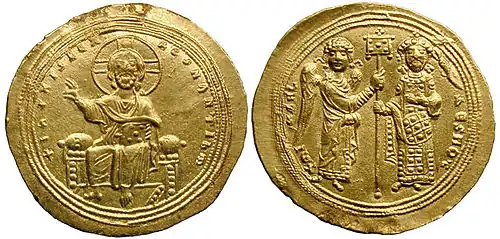
Year 1041 (MXLI) was a common year starting on Thursday of the Julian calendar.
Events
By place
Byzantine Empire
- December 10 – Emperor Michael IV the Paphlagonian dies after a 6-year reign. His wife, Empress Zoë, elevates (on the advice of her lover John the Orphanotrophos) her adoptive son to the throne of the Byzantine Empire, as Michael V Kalaphates. Shortly after, Michael comes into conflict with his uncle John, and banishes him to a monastery.
Europe
- March 17 – Battle of Olivento: Norman troops and their Lombard allies, led by William Iron Arm, are victorious against the Byzantines at the feet of the Monte Vulture, near the River Olivento in Apulia.
- May 4 – Battle of Montemaggiore: Lombard-Norman rebel forces, led by William, are again victorious, and defeat a Byzantine army (18,000 men) on the hill of Montemaggiore, near the River Ofanto.
- September 3 – Battle of Montepeloso: Lombard-Norman rebel forces, led by William, defeat the Byzantines at Montepeloso. During the battle, Boioannes, governor of the Catepanate of Italy, is captured.
- Winter – Battle of Ostrovo: The Byzantines, with the help of the Varangian Guard, led by Harald Hardrada (future king of Norway), defeat the Bulgarian troops, near Lake Ostrovo in Greece.
England
- King Harthacnut invites his half-brother Edward the Confessor to return to England from exile in Normandy as his heir as king of England,[1] with the support of Godwin, Earl of Wessex.[2]
- The city of Worcester rebels against the naval taxes of Harthacnut. He reduces the navy from 60 to 32 ships.
Africa
- The Zirid dynasty rejects Shi'ite obedience and Fatimid domination, and recognizes the Abbasids as their overlords.[3]
Asia
- At about this time, the number of enlisted soldiers in the Song dynasty Chinese military reaches well over 1,250,000 troops, an increase since 1022, when there were a million soldiers.
Births
- Ōe no Masafusa, Japanese poet (d. 1111)
- Raymond IV, Count of Toulouse (Raymond of Saint-Gilles), French nobleman (d. 1105) (approximate date)
Deaths
- February 4 – Fujiwara no Kintō, Japanese poet (b. 966)
- December 10 – Michael IV the Paphlagonian, Byzantine emperor (b. 1010)
- Adolf II of Lotharingia, German nobleman (b. 1002)
- Akazome Emon, Japanese waka poet (approximate date)
- Eadwulf IV of Bamburgh, Northumbrian ruler
- Edmund of Durham (or Eadmund), English bishop
- Gangeyadeva, Indian ruler of the Kalachuris of Tripuri
- Mac Beathaidh mac Ainmire, Irish poet and Chief Ollam
- Muhammad of Ghazni, sultan of the Ghaznavids (b. 998)
- Muhammad ibn Rustam Dushmanziyar, Buyid emir
- Peter Delyan, Bulgarian rebel leader and ruler (tsar)
- Sampiro, Spanish bishop, politician and intellectual
- Tancred of Hauteville, Norman nobleman (b. 980)
- Vikramabahu, Prince of Ruhuna (or Kassapa), ruler of Sri Lanka (b. 1017)
References
- ^ Lawson, M. K. (September 23, 2004). "Harthcnut". Oxford Dictionary of National Biography (online ed.). Oxford University Press. doi:10.1093/ref:odnb/12252. (Subscription, Wikipedia Library access or UK public library membership required.)
- ^ Quadripartitus.
- ^ Gilbert Meynier (2010). L'Algérie cœur du Maghreb classique. De l'ouverture islamo-arabe au repli (658-1518). Paris: La Découverte; p.50.