698
| Years |
|---|
| Millennium |
| 1st millennium |
| Centuries |
| Decades |
| Years |
| 698 by topic |
|---|
| Leaders |
|
| Categories |
|
| Gregorian calendar | 698 DCXCVIII |
| Ab urbe condita | 1451 |
| Armenian calendar | 147 ԹՎ ՃԽԷ |
| Assyrian calendar | 5448 |
| Balinese saka calendar | 619–620 |
| Bengali calendar | 104–105 |
| Berber calendar | 1648 |
| Buddhist calendar | 1242 |
| Burmese calendar | 60 |
| Byzantine calendar | 6206–6207 |
| Chinese calendar | 丁酉年 (Fire Rooster) 3395 or 3188 — to — 戊戌年 (Earth Dog) 3396 or 3189 |
| Coptic calendar | 414–415 |
| Discordian calendar | 1864 |
| Ethiopian calendar | 690–691 |
| Hebrew calendar | 4458–4459 |
| Hindu calendars | |
| - Vikram Samvat | 754–755 |
| - Shaka Samvat | 619–620 |
| - Kali Yuga | 3798–3799 |
| Holocene calendar | 10698 |
| Iranian calendar | 76–77 |
| Islamic calendar | 78–79 |
| Japanese calendar | Shuchō 13 (朱鳥13年) |
| Javanese calendar | 590–591 |
| Julian calendar | 698 DCXCVIII |
| Korean calendar | 3031 |
| Minguo calendar | 1214 before ROC 民前1214年 |
| Nanakshahi calendar | −770 |
| Seleucid era | 1009/1010 AG |
| Thai solar calendar | 1240–1241 |
| Tibetan calendar | མེ་མོ་བྱ་ལོ་ (female Fire-Bird) 824 or 443 or −329 — to — ས་ཕོ་ཁྱི་ལོ་ (male Earth-Dog) 825 or 444 or −328 |
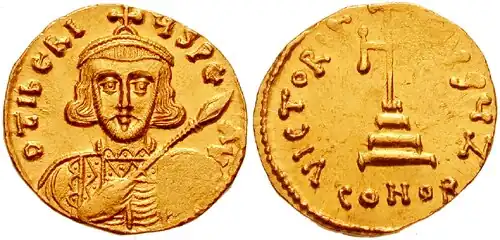
Year 698 (DCXCVIII) was a common year starting on Tuesday of the Julian calendar. The denomination 698 for this year has been used since the early medieval period, when the Anno Domini calendar era became the prevalent method in Europe for naming years.
Events
By place
Byzantine Empire
- Spring–summer – Arab forces under Hasan ibn al-Nu'man capture Carthage, ending Byzantine rule in North Africa. The defeated Byzantine fleet revolts and proclaims Tiberios III, who deposes Leontios after a brief siege of Constantinople, Byzantine Emperor.[1][2]
- Autumn–winter – The Byzantine general Heraclius, brother of Tiberios III, crosses the mountain passes of the Taurus Mountains into Cilicia with an army. He launches a campaign in Syria, defeats an Arab force from Antioch, and raids as far as Samosata (modern Turkey).[3][4]
- Outbreak of bubonic plague in Constantinople, Syria and Mesopotamia: Theophanes the Confessor reports that the plague lasted four months and describes a large number of deaths in Constantinople. Emperor Leontios orders the destruction of a market in the Neorion cargo port of Constantinople, where animals are sold and which is considered to be the source of infected animals brought from Syria. The Arab army is forced to suspend its military operations. According to Syrian sources, the plague in Syria lasted another two years.
Europe
- Wittiza, son of King Ergica, becomes co-ruler of the Visigoth Kingdom in Hispania (approximate date).
Britain
- Berhtred, Anglo-Saxon nobleman, is killed leading a Northumbrian army against the Picts. The kingdom of Cait (or Cat) in northern Scotland is absorbed (approximate date).
- Fiannamail ua Dúnchado becomes king of Dál Riata (Scotland), until his death around 700 (approximate date).
Arabian Empire
- Berber forces led by Queen Kahina ("The Diviner") are crushed by Arab invaders at Aures (Algeria). She has rallied the Berbers since the collapse of Byzantine power (see 647).
Asia
- Dae Jo-young establishes the kingdom of Balhae in Manchuria (approximate date).
- Khun Lo, a Thai prince, conquers Muang Sua, an early Laotian kingdom.
- Qapaghan Qaghan conquers parts of Transoxiana (Central Asia).
- The festival of first-fruits (Daijo-sai) is held in Japan.
Central America
- March 24 – Itzamnaaj K'awiil becomes the new ruler of the Mayan city state at Dos Pilas in Guatemala and reigns until 726.
By topic
Religion
- Council of Aquileia: The bishops of the diocese of Aquileia decide to end the Schism of the Three Chapters and return to communion with Rome.
- Willibrord, Anglo-Saxon missionary, establishes an abbey at Echternach (Luxembourg), presented to him by Irmina, daughter of King Dagobert II.
- Probable date of Cuthbert's burial behind the altar at Lindisfarne (approximate date).
- Princess Taki is sent to Saikū, as a Saiō of the Ise Shrine (Japan).
Births
- Shang, emperor of the Tang dynasty (or 695)
- Wang Changling, Chinese poet and official (d. 756)
Deaths
- May 6 – Eadberht, bishop of Lindisfarne
- July 22 – Wu Chengsi, nephew of Chinese sovereign Wu Zetian
- Ainbcellach mac Ferchair, king of Dál Riata (Scotland)
- Berthtred, Anglo-Saxon noblemen (approximate date)
- Rieul, bishop of Reims (approximate date)
- Suraqah al-Bariqi, Arab poet (b. 621)
- Trudo, Frankish abbot (approximate date)
References
- ^ Venning 2006, p. 187.
- ^ Treadgold 1997, pp. 337–339.
- ^ Venning 2006, p. 188.
- ^ Treadgold 1997, p. 339.
Sources
- Treadgold, Warren (1997). A History of the Byzantine State and Society. Stanford, California: Stanford University Press. ISBN 0-8047-2630-2.
- Venning, Timothy, ed. (2006). A Chronology of the Byzantine Empire. Palgrave Macmillan. ISBN 1-4039-1774-4.