695
| Years |
|---|
| Millennium |
| 1st millennium |
| Centuries |
| Decades |
| Years |
| 695 by topic |
|---|
| Leaders |
|
| Categories |
|
| Gregorian calendar | 695 DCXCV |
| Ab urbe condita | 1448 |
| Armenian calendar | 144 ԹՎ ՃԽԴ |
| Assyrian calendar | 5445 |
| Balinese saka calendar | 616–617 |
| Bengali calendar | 101–102 |
| Berber calendar | 1645 |
| Buddhist calendar | 1239 |
| Burmese calendar | 57 |
| Byzantine calendar | 6203–6204 |
| Chinese calendar | 甲午年 (Wood Horse) 3392 or 3185 — to — 乙未年 (Wood Goat) 3393 or 3186 |
| Coptic calendar | 411–412 |
| Discordian calendar | 1861 |
| Ethiopian calendar | 687–688 |
| Hebrew calendar | 4455–4456 |
| Hindu calendars | |
| - Vikram Samvat | 751–752 |
| - Shaka Samvat | 616–617 |
| - Kali Yuga | 3795–3796 |
| Holocene calendar | 10695 |
| Iranian calendar | 73–74 |
| Islamic calendar | 75–76 |
| Japanese calendar | Shuchō 10 (朱鳥10年) |
| Javanese calendar | 587–588 |
| Julian calendar | 695 DCXCV |
| Korean calendar | 3028 |
| Minguo calendar | 1217 before ROC 民前1217年 |
| Nanakshahi calendar | −773 |
| Seleucid era | 1006/1007 AG |
| Thai solar calendar | 1237–1238 |
| Tibetan calendar | ཤིང་ཕོ་རྟ་ལོ་ (male Wood-Horse) 821 or 440 or −332 — to — ཤིང་མོ་ལུག་ལོ་ (female Wood-Sheep) 822 or 441 or −331 |
Year 695 (DCXCV) was a common year starting on Friday of the Julian calendar. The denomination 695 for this year has been used since the early medieval period, when the Anno Domini calendar era became the prevalent method in Europe for naming years.
Events
By place
Byzantine Empire
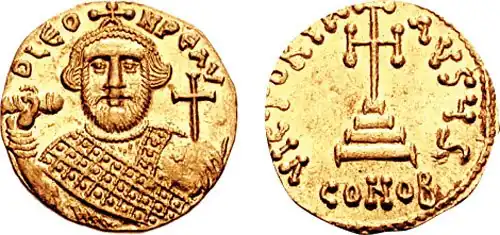
- The population of Byzantium revolts under Leontios, the strategos (military governor) of the Anatolic Theme, and proclaims him emperor.[1] Justinian II is deposed and his nose is cut off (leading to his subsequent nickname of "the Slit-nosed"). He is exiled to Cherson (Crimea), and begins to plot an attempt to retake the throne.[2]
Britain
- September 6 – King Wihtred of Kent, who maintains Kentish independence against the growing expansion of Mercia, issues one of the earliest known law codes of Britain.[3]
- King Aldfrith of Northumbria marries Princess Cuthburh, sister of King Ine of Wessex (approximate date).
Central America
- June 15 – Uaxaclajuun Ub'aah K'awiil ("Eighteen Rabbit") becomes the new ruler of the Mayan city state of Copán in Honduras upon the death of Chan Imix K'awiil, and rules until his death in 736.
- The Mayan city state of Tikal defeats Calakmul in what is now Guatemala, ending a centuries-long rivalry, but ushering in another century of warfare that ultimately leads to both cities' abandonment in the 9th century.
Europe
- Childebert III succeeds Clovis IV as sole king of the Franks. He is the son of Theuderic III and becomes a puppet—a roi fainéant—of Pepin of Herstal, mayor of the palace of Austrasia.
- Pepin institutes his son Drogo as mayor of the palace of Burgundy. His younger son Grimoald II becomes mayor of the palace of Neustria.
- The Saxons defeat the Bructeri between the Lippe and the Ruhr, and occupy Westphalia in Germany (approximate date).
By topic
Religion
- November 21 – Willibrord, Northumbrian missionary, becomes the first bishop of Utrecht (Netherlands). He returns to Frisia to preach, and builds numerous churches (approximate date).
- Willibrord establishes a Benedictine training centre for priests and young noblemen. This seminary later becomes Utrecht University.
- Suitbert, Anglo-Saxon missionary, founds a monastery at Kaiserswerth (near Düsseldorf) in Germany (approximate date).
Births
- Fujiwara no Maro, Japanese statesman (d. 737)
- Herlindis of Maaseik, Frankish abbess (approximate date)
- Kibi no Makibi, Japanese scholar (d. 775)
- Muhammad ibn al-Qasim, Umayyad general (d. 715)
- Ōtomo no Koshibi, Japanese general (d. 777)
- Emperor Shang of Tang, Chinese ruler (or 698)
- Theophilus of Edessa, Greek astrologer (d. 785)
- Zayd ibn Ali, Arab imam and grandson of Husayn ibn Ali (d. 740)
Deaths
- Ado, duke of Friuli (Northern Italy)
- Ansbert of Rouen, Frankish bishop
- Chan Imix K'awiil, Mayan ruler (ajaw)
- Sæbbi, king of Kent (approximate date)
- Stephen the Persian, chief eunuch and sakellarios of the Byzantine Empire under Justinian II
References
- ^ Ostrogorsky 1956, pp. 116–122.
- ^ Ostrogorsky 1956, pp. 124–126.
- ^ Whitelock 1968, p. 357.
Sources
- Ostrogorsky, George (1956). History of the Byzantine State. Oxford: Blackwell.
- Whitelock, Dorothy, ed. (1968). English Historical Documents, vol. I, c.500–1042. London: Eyre & Spottiswoode.