862
| Years |
|---|
| Millennium |
| 1st millennium |
| Centuries |
| Decades |
| Years |
| 862 by topic |
|---|
| Leaders |
|
| Categories |
|
| Gregorian calendar | 862 DCCCLXII |
| Ab urbe condita | 1615 |
| Armenian calendar | 311 ԹՎ ՅԺԱ |
| Assyrian calendar | 5612 |
| Balinese saka calendar | 783–784 |
| Bengali calendar | 268–269 |
| Berber calendar | 1812 |
| Buddhist calendar | 1406 |
| Burmese calendar | 224 |
| Byzantine calendar | 6370–6371 |
| Chinese calendar | 辛巳年 (Metal Snake) 3559 or 3352 — to — 壬午年 (Water Horse) 3560 or 3353 |
| Coptic calendar | 578–579 |
| Discordian calendar | 2028 |
| Ethiopian calendar | 854–855 |
| Hebrew calendar | 4622–4623 |
| Hindu calendars | |
| - Vikram Samvat | 918–919 |
| - Shaka Samvat | 783–784 |
| - Kali Yuga | 3962–3963 |
| Holocene calendar | 10862 |
| Iranian calendar | 240–241 |
| Islamic calendar | 247–248 |
| Japanese calendar | Jōgan 4 (貞観4年) |
| Javanese calendar | 759–760 |
| Julian calendar | 862 DCCCLXII |
| Korean calendar | 3195 |
| Minguo calendar | 1050 before ROC 民前1050年 |
| Nanakshahi calendar | −606 |
| Seleucid era | 1173/1174 AG |
| Thai solar calendar | 1404–1405 |
| Tibetan calendar | ལྕགས་མོ་སྦྲུལ་ལོ་ (female Iron-Snake) 988 or 607 or −165 — to — ཆུ་ཕོ་རྟ་ལོ་ (male Water-Horse) 989 or 608 or −164 |
Year 862 (DCCCLXII) was a common year starting on Thursday of the Julian calendar.
Events
By place
Central Europe
- King Lothair II of Lotharingia tries to divorce his wife Teutberga, on trumped-up charges of incest. With the support of his brother, Louis II, the bishops give him permission to remarry during a synod at Aachen.
- March – Viking raiders led by Weland are trapped at Trilbardou Bridge (Northern France), and submit to King Charles the Bald. He and his family accept Christianity (they are baptised) before leaving Neustria.
- Robert the Strong, margrave of Neustria, captures 12 Viking ships and kills their crews. He pays tribute (Danegeld) for keeping the Vikings out of Neustria.[1]
- Carloman, eldest son of King Louis the German, revolts against his father. He is captured, but manages to escape to the Ostmark (or 861).
- First raid of the Hungarians in the Carpathian Basin at the request of Rastislav of Moravia against the East Frankish Kingdom.[2]
- Viking forces sack Cologne.
Britain
- April 13 – King Donald I of Scotland dies after a 4-year reign. He is succeeded by his nephew Constantine I, as ruler of Scotland.
- Áed Findliath is crowned High King of Ireland, after the death of Máel Sechnaill mac Maíl Ruanaid (until 879).
Eastern Europe
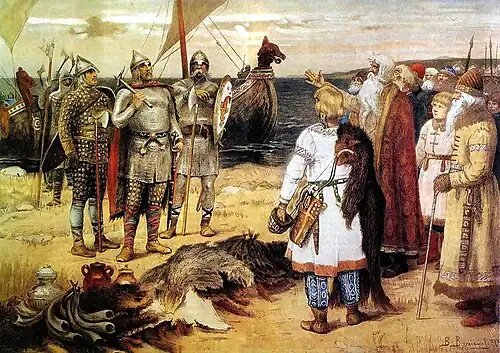
- The Varangians (called Rus'), under the leadership of Rurik, a Viking chieftain, arrive (with his brothers, Sineus and Truvor) at Staraya Ladoga. He builds a trade settlement near Novgorod (modern Russia), and founds the Rurik Dynasty.
- The first written record (according to the Primary Chronicle) is made of the towns of Belozersk and Murom (Northern Russia).
Abbasid Caliphate
- June – Caliph al-Muntasir dies after just a half-year reign. He is succeeded by al-Musta'in (son of prince Muhammad), as ruler of the Abbasid Caliphate.
- Ashot I ("the Great") is recognized as the 'Prince of Princes' of Armenia, by the Abbasids.
China
- Fan Chuo finishes his Manchu ("Book of the Southern Tribes"), during the Tang Dynasty.
By topic
Religion
- Constantine the Philosopher (alias Saint Cyril) invents the 42-letter Slavonic alphabet (Cyrillic script) as a tool for converting the Moravians to Christianity (approximate date).
- During the Council of Shirakavan representatives of the Armenian, Byzantine and West-Syrian Churches convenes to discuss church union. Though this is not achieved, an agreement is formulated which allows for the peaceful co-existence of Orthodox and non-Chalcedonians in the Byzantine-Armenian borderlands.[3]
Births
- June 8 – Xi Zong, emperor of the Tang Dynasty (d. 888)
- Li Cunxin, general of the Tang Dynasty (d. 902)
- Li Cunshen, general of Later Tang (d. 924)
- Wang Chuzhi, Chinese warlord (d. 922)
- Wang Shenzhi, founder of Min (Ten Kingdoms) (d. 925)
- Xiao Qing, chancellor of Later Liang (d. 930)
- Xu Wen, general and regent of Wu (d. 927)
- Yúnmén Wényǎn, Chinese Zen master (or 864)
- Zhou Ben, general of Wu (d. 938)
Deaths
- April 13 – Donald I, king of Scotland (b. 812)
- July 2 – Swithun, bishop of Winchester
- September 26 – Musa ibn Musa al-Qasawi, Muslim military leader (b. c. 790)
- Æthelred II, king of Northumbria
- Al-Muntasir, Muslim caliph (b. 837)
- Bugha al-Kabir, Muslim general
- Lupus Servatus, Frankish abbot (approximate date)
- Máel Sechnaill mac Maíl Ruanaid, High King of Ireland
- Ruarc mac Brain, king of Leinster (Ireland)
- Tahir ibn Abdallah, Muslim governor
References
- ^ John Haywood (1995). Historical Atlas of the Vikings, p. 61. Penguin Books: ISBN 978-0-140-51328-8.
- ^ Bóna, István (2000). The Hungarians and Europe in the 9th-10th centuries. Budapest: Historia - MTA Történettudományi Intézete, p. 13. ISBN 963-8312-67-X.
- ^ Dorfmann-Lazarev, Igor (2016). "'Chapter III. The Armenian-Syrian-Byzantine Council of Širakawan, 862'". Journal of Eastern Christian Studies. 68 (3–4): 293–313. Retrieved October 26, 2024.