863
| Years |
|---|
| Millennium |
| 1st millennium |
| Centuries |
| Decades |
| Years |
| 863 by topic |
|---|
| Leaders |
|
| Categories |
|
| Gregorian calendar | 863 DCCCLXIII |
| Ab urbe condita | 1616 |
| Armenian calendar | 312 ԹՎ ՅԺԲ |
| Assyrian calendar | 5613 |
| Balinese saka calendar | 784–785 |
| Bengali calendar | 269–270 |
| Berber calendar | 1813 |
| Buddhist calendar | 1407 |
| Burmese calendar | 225 |
| Byzantine calendar | 6371–6372 |
| Chinese calendar | 壬午年 (Water Horse) 3560 or 3353 — to — 癸未年 (Water Goat) 3561 or 3354 |
| Coptic calendar | 579–580 |
| Discordian calendar | 2029 |
| Ethiopian calendar | 855–856 |
| Hebrew calendar | 4623–4624 |
| Hindu calendars | |
| - Vikram Samvat | 919–920 |
| - Shaka Samvat | 784–785 |
| - Kali Yuga | 3963–3964 |
| Holocene calendar | 10863 |
| Iranian calendar | 241–242 |
| Islamic calendar | 248–249 |
| Japanese calendar | Jōgan 5 (貞観5年) |
| Javanese calendar | 760–761 |
| Julian calendar | 863 DCCCLXIII |
| Korean calendar | 3196 |
| Minguo calendar | 1049 before ROC 民前1049年 |
| Nanakshahi calendar | −605 |
| Seleucid era | 1174/1175 AG |
| Thai solar calendar | 1405–1406 |
| Tibetan calendar | ཆུ་ཕོ་རྟ་ལོ་ (male Water-Horse) 989 or 608 or −164 — to — ཆུ་མོ་ལུག་ལོ་ (female Water-Sheep) 990 or 609 or −163 |
Year 863 (DCCCLXIII) was a common year starting on Friday of the Julian calendar.
Events
By place
Byzantine Empire
- September 3 – Battle of Lalakaon: A Byzantine army confronts an invasion by Muslim forces, led by Umar al-Aqta, Emir of Malatya. The Muslims raid deep into Byzantine territory, reaching the Black Sea coast at the port city of Amisos. Petronas annihilates the Arabs near the River Lalakaon, in Paphlagonia (modern Turkey).
Europe
- January 25 – Emperor Louis II claims Provence, after the death of his brother Charles. King Lothair II receives Lower Burgundy and a part of the Jura Mountains.
- King Louis the German suppresses the revolt of his son Carloman (for the second time), who wants a partition (mainly of Bavaria) of the East Frankish Kingdom.
- Viking raiders again plunder Dorestad (modern Netherlands), a Frankish port on the mouth of the river Rhine. It thereafter disappears from the chronicles.
- Danish Vikings loot along the Rhine. They settle on an island near Cologne, but are driven off by the combined forces of Lothair II and the Saxons.
- The Christianization of Kievan Rus begins, ceasing the 63-year-long dominance of the Rus' Khaganate (approximate date).
- The first written record is made of Smolensk (according to the Primary Chronicle).
- The Byzantine Empire invades Bulgaria in order to impose Orthodox Christianity on Boris I.
Britain
- King Osberht of Northumbria engages in a dispute for royal power, with a rival claimant named Ælla. After Osberht is replaced, Ælla wields power in Northumbria, but the civil war continues.[1]
Asia
- Duan Chengshi, Chinese author and scholar, writes about the Chinese maritime trade and the Arab-run slave trade in East Africa.[2]
Armenia
- 13 February – Dvin earthquake. It took place in the city of Dvin on 13 February, 863. During the 9th century, Dvin was the only "heavily populated" city in Muslim-dominated Armenia. The city was part of the wider Abbasid Caliphate, and had a multiethnic population.[3]
By topic
Religion
- Pope Nicholas I sends archbishops Gunther and Theotgaud to a synod of Metz, which confirms the permission given to King Lothair II of Lotharingia to remarry.
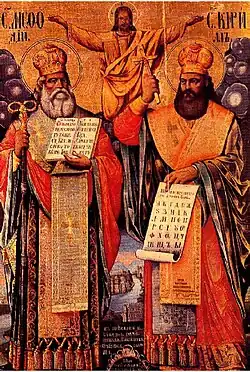
- The Byzantine missionaries Cyril and Methodius arrive with a few disciples in Moravia, by request of Prince Rastislav.[4]
- Nicholas I excommunicates Patriarch Photios I of Constantinople.
Births
- Bertha, duchess regent of Lucca and Tuscany (d. 925)
- Li Decheng, general of Wu (Five Dynasties) (d. 940)
- Louis III, king of the West Frankish Kingdom (or 865)
- Shen Song, chancellor of Wuyue (d. 938)
- Wang Yanzhang, general of Later Liang (d. 923)
Deaths
- January 25 – Charles of Provence, Frankish king (b. 845)
- June 4 – Charles, archbishop of Mainz
- June 6 – Abu Musa Utamish, Muslim vizier
- October 4 – Turpio, Frankish nobleman
- Ali ibn Yahya al-Armani, Muslim governor
- Bivin of Gorze, Frankish nobleman
- Daniél ua Líahaiti, Irish abbot and poet
- Duan Chengshi, Chinese official and scholar
- Karbeas, leader of the Paulicians
- Mucel, bishop of Hereford (approximate date)
- Muirecán mac Diarmata, king of Leinster
- Umar al-Aqta, emir of Melitene
- Yahya ibn Muhammad, Idrisid emir of Morocco[5]
References
- ^ Kirby, D. P. (1991). The Earliest English Kings (Illustrated ed.). Unwin Hyman. p. 197. ISBN 978-0-04-445692-6.
- ^ Levathes, Louise (1994). When China Ruled The Seas: The Treasure Fleet Of The Dragon Throne 1405-1433 (Illustrated ed.). Simon & Schuster. p. 38. ISBN 0-671-70158-4.
- ^ Guidoboni, Emanuela; Traina, Giusto (1995), "A new catalogue of earthquakes in the historical Armenian area from antiquity to the 12th century", Annals of Geophysics, 38 8: 121–123, doi:10.4401/ag-4134
- ^ Barford, Paul M. (2001). The Early Slavs: Culture and Society in Early Medieval Eastern Europe (Illustrated ed.). Cornell University Press. pp. 109–110. ISBN 978-0-8014-3977-3.
- ^ Eustache, D. (1971). "Idrīsids". In Lewis, B.; Ménage, V. L.; Pellat, Ch. & Schacht, J. (eds.). The Encyclopaedia of Islam, Second Edition. Volume III: H–Iram. Leiden: E. J. Brill. pp. 1035–1037. OCLC 495469525.