354
| Years |
|---|
| Millennium |
| 1st millennium |
| Centuries |
| Decades |
| Years |
| 354 by topic |
|---|
| Leaders |
|
| Categories |
|
| Gregorian calendar | 354 CCCLIV |
| Ab urbe condita | 1107 |
| Assyrian calendar | 5104 |
| Balinese saka calendar | 275–276 |
| Bengali calendar | −240 – −239 |
| Berber calendar | 1304 |
| Buddhist calendar | 898 |
| Burmese calendar | −284 |
| Byzantine calendar | 5862–5863 |
| Chinese calendar | 癸丑年 (Water Ox) 3051 or 2844 — to — 甲寅年 (Wood Tiger) 3052 or 2845 |
| Coptic calendar | 70–71 |
| Discordian calendar | 1520 |
| Ethiopian calendar | 346–347 |
| Hebrew calendar | 4114–4115 |
| Hindu calendars | |
| - Vikram Samvat | 410–411 |
| - Shaka Samvat | 275–276 |
| - Kali Yuga | 3454–3455 |
| Holocene calendar | 10354 |
| Iranian calendar | 268 BP – 267 BP |
| Islamic calendar | 276 BH – 275 BH |
| Javanese calendar | 236–237 |
| Julian calendar | 354 CCCLIV |
| Korean calendar | 2687 |
| Minguo calendar | 1558 before ROC 民前1558年 |
| Nanakshahi calendar | −1114 |
| Seleucid era | 665/666 AG |
| Thai solar calendar | 896–897 |
| Tibetan calendar | ཆུ་མོ་གླང་ལོ་ (female Water-Ox) 480 or 99 or −673 — to — ཤིང་ཕོ་སྟག་ལོ་ (male Wood-Tiger) 481 or 100 or −672 |
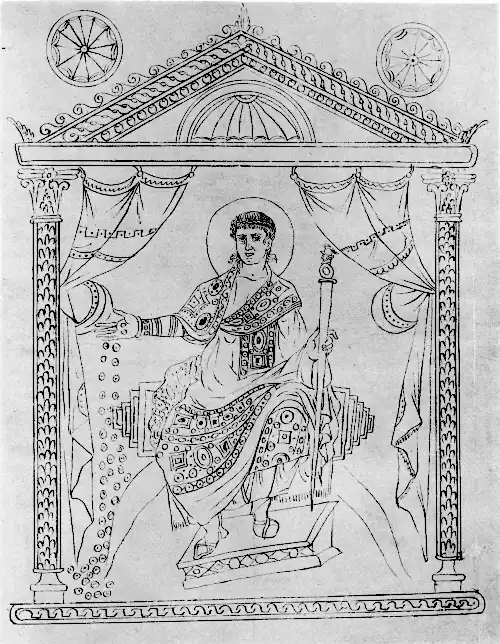
Year 354 (CCCLIV) was a common year starting on Saturday of the Julian calendar. At the time, it was known as the Year of the Consulship of Constantius and Constantius (or, less frequently, year 1107 Ab urbe condita). The denomination 354 for this year has been used since the early medieval period, when the Anno Domini calendar era became the prevalent method in Europe for naming years.
Events
By place
Roman Empire
- Emperor Constantius II recalls his Caesar (and cousin) Constantius Gallus to Constantinople after hearing unfavorable reports about him. Gallus, Caesar of the East, has suppressed revolts in Syria Palaestina and central Anatolia. Constantius strips him of his powers and later has him executed in Pola (Croatia).
- The Roman Calendar of 354, an illuminated manuscript, is drawn up and becomes the earliest dated codex.
Europe
- As a result of the armies of the West having been largely withdrawn by the usurper Magnus Magnentius, to fight Constantius II, hordes of barbarians (Franks and Alemanni) cross the upper Rhine into Gaul and invade the lands of the Helvetians.
- The Bulgars are first mentioned in extant European chronicles.
China
- Fu Sheng, emperor of the Former Qin, reigns in northern China.
By topic
Religion
- Libanius becomes a teacher of rhetoric in Antioch; his students include John Chrysostom and Theodore of Mopsuestia.
Births
- November 13 – Augustine of Hippo, North African bishop (d. 430)
- Apa Bane, Christian hermit and saint (approximate date)
- Paulinus of Nola, French bishop and writer (d. 431)
- Pelagius, English monk and theologian (d. 418)[1]
Deaths
- Constantina, daughter of Constantine the Great (b. c. 320)
- Constantius Gallus, Roman consul and statesman (b. 326)
- Fu Xiong (or Yuancai), Chinese general and politician
- Pei, Chinese princess and wife of Zhang Chonghua
- Ran Zhi, Chinese nobleman and prince of Ran Wei
- Xie Ai, Chinese general of Former Liang (b. 301)
References
- ^ "Pelagius | Biography, Beliefs, & Facts". Encyclopedia Britannica. Retrieved March 30, 2020.