359
| Years |
|---|
| Millennium |
| 1st millennium |
| Centuries |
| Decades |
| Years |
| 359 by topic |
|---|
| Leaders |
|
| Categories |
|
| Gregorian calendar | 359 CCCLIX |
| Ab urbe condita | 1112 |
| Assyrian calendar | 5109 |
| Balinese saka calendar | 280–281 |
| Bengali calendar | −235 – −234 |
| Berber calendar | 1309 |
| Buddhist calendar | 903 |
| Burmese calendar | −279 |
| Byzantine calendar | 5867–5868 |
| Chinese calendar | 戊午年 (Earth Horse) 3056 or 2849 — to — 己未年 (Earth Goat) 3057 or 2850 |
| Coptic calendar | 75–76 |
| Discordian calendar | 1525 |
| Ethiopian calendar | 351–352 |
| Hebrew calendar | 4119–4120 |
| Hindu calendars | |
| - Vikram Samvat | 415–416 |
| - Shaka Samvat | 280–281 |
| - Kali Yuga | 3459–3460 |
| Holocene calendar | 10359 |
| Iranian calendar | 263 BP – 262 BP |
| Islamic calendar | 271 BH – 270 BH |
| Javanese calendar | 241–242 |
| Julian calendar | 359 CCCLIX |
| Korean calendar | 2692 |
| Minguo calendar | 1553 before ROC 民前1553年 |
| Nanakshahi calendar | −1109 |
| Seleucid era | 670/671 AG |
| Thai solar calendar | 901–902 |
| Tibetan calendar | ས་ཕོ་རྟ་ལོ་ (male Earth-Horse) 485 or 104 or −668 — to — ས་མོ་ལུག་ལོ་ (female Earth-Sheep) 486 or 105 or −667 |
Year 359 (CCCLIX) was a common year starting on Friday of the Julian calendar. At the time, it was known as the Year of the Consulship of Eusebius and Hypatius (or, less frequently, year 1112 Ab urbe condita). The denomination 359 for this year has been used since the early medieval period, when the Anno Domini calendar era became the prevalent method in Europe for naming years.
Events
By place
Roman Empire
- King Shapur II the Great of the Persian Empire invades southern Armenia. The Romans implement a scorched earth policy and place strong guards at the Euphrates crossings.
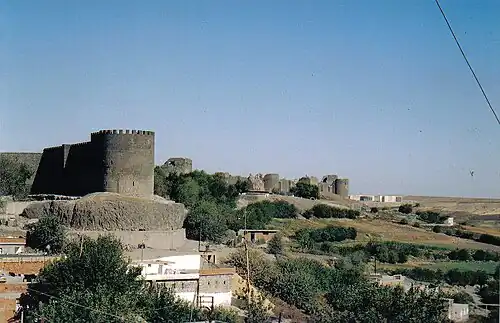
- Siege of Amida: Shapur II besieges the Roman fortress of Amida (modern Diyarbakir). After seventy-three days the city is conquered and the population is massacred by the Persians. Ammianus Marcellinus is a fortunate survivor and flees to Singara (Iraq).
- The first known Prefect of the city of Constantinople, Honoratus, takes office.
- Famine in Upper Rhineland: A fleet of 800 river boats, built for the Rhine, cross to the British east coast, and carry back enough corn to raise the famine.[1]
- Winter – Shapur II halts his campaign, due to heavy casualties during the Persian invasion.
By topic
Art
- The Sarcophagus of Junius Bassus, in the Old St. Peter's Basilica, Vatican, is made (approximate date).
Religion
- July – Emperor Constantius II convenes the Council of Rimini, to resolve the crisis over Arianism in the Church. Some 400 bishops of the Western portion of the Roman Empire attend, while the Eastern bishops simultaneously hold a meeting at Seleucia. Given Saint Jerome's comment that, "The whole world groaned in astonishment to find itself Arian", it appears to have failed. Pope Liberius rejects the new creed at Rimini.
Births
- Godigisel, king of the Vandals (d. 406)
- Gratian, Roman emperor (d. 383)
- Murong Chong, Chinese emperor (d. 386)
- Stilicho, Roman general (d. 408)
Deaths
- Barbatio, Roman general (magister militum)
- Hosius of Corduba, Christian bishop (b. 256)
- Junius Bassus Theotecnius, Roman politician
- Xun Xian (or Lingze), Chinese general (b. 322)
- Zhang Guan, Chinese general and regent
References
- ^ Wheeler, William Henry (1896). A History of the Fens of South Lincolnshire (2nd ed.). Boston, London: J.M. Newcombe and Simpkin, Marshall & Co. p. 5. doi:10.1680/ahotfosl2e.50358.