395
| Years |
|---|
| Millennium |
| 1st millennium |
| Centuries |
| Decades |
| Years |
| 395 by topic |
|---|
| Leaders |
|
| Categories |
|
| Gregorian calendar | 395 CCCXCV |
| Ab urbe condita | 1148 |
| Assyrian calendar | 5145 |
| Balinese saka calendar | 316–317 |
| Bengali calendar | −199 – −198 |
| Berber calendar | 1345 |
| Buddhist calendar | 939 |
| Burmese calendar | −243 |
| Byzantine calendar | 5903–5904 |
| Chinese calendar | 甲午年 (Wood Horse) 3092 or 2885 — to — 乙未年 (Wood Goat) 3093 or 2886 |
| Coptic calendar | 111–112 |
| Discordian calendar | 1561 |
| Ethiopian calendar | 387–388 |
| Hebrew calendar | 4155–4156 |
| Hindu calendars | |
| - Vikram Samvat | 451–452 |
| - Shaka Samvat | 316–317 |
| - Kali Yuga | 3495–3496 |
| Holocene calendar | 10395 |
| Iranian calendar | 227 BP – 226 BP |
| Islamic calendar | 234 BH – 233 BH |
| Javanese calendar | 278–279 |
| Julian calendar | 395 CCCXCV |
| Korean calendar | 2728 |
| Minguo calendar | 1517 before ROC 民前1517年 |
| Nanakshahi calendar | −1073 |
| Seleucid era | 706/707 AG |
| Thai solar calendar | 937–938 |
| Tibetan calendar | ཤིང་ཕོ་རྟ་ལོ་ (male Wood-Horse) 521 or 140 or −632 — to — ཤིང་མོ་ལུག་ལོ་ (female Wood-Sheep) 522 or 141 or −631 |
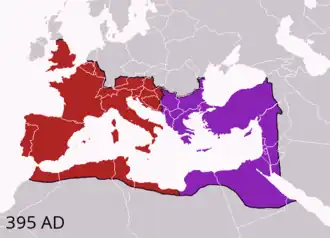
Year 395 (CCCXCV) was a common year starting on Monday of the Julian calendar. At the time, it was known as the Year of the Consulship of Olybrius and Probinus (or, less frequently, year 1148 Ab urbe condita). The denomination 395 for this year has been used since the early medieval period, when the Anno Domini calendar era became the prevalent method in Europe for naming years.
Events
By place
Roman Empire
- January 17 – Emperor Theodosius I, age 48, dies of a disease involving severe edema in Milan.[1] The Roman Empire is divided for the final time into an eastern and a western half. The Eastern Roman Empire is centered in Constantinople under Arcadius, son of Theodosius, and the Western Roman Empire in Mediolanum under his brother Honorius.
- April 27 – Arcadius marries Aelia Eudoxia, daughter of the Frankish general Flavius Bauto (without the knowledge or consent of Rufinus, Praetorian prefect of the East). His seven-year-old half-sister, Galla Placidia, is sent to Rome, where she spends her childhood in the household of Stilicho and his wife Serena.
- Revolt of Alaric I:
- Alaric, Visigothic leader of the foederati, renounces Roman fealty and is declared king, waging war against both parts of the Roman Empire, and ending a 16-year period of peace.
- Alaric besieges Constantinople. After commitments from Rufinus, the Pretorian prefect of the East, and chief adviser to Arcadius, the Goths move further west.
- Stilicho arrives in the fall with his army to fight the Goths. Rufinus, the strong man of the east, persuades the emperor to cancel Stilicho's campaign. Emperor Arcadius forbite Stilicho to attack Alaric and demandes that his army leave the territory of the East Roman Empire.
- The Goths, led by Alaric, invade and devastate Thrace and Macedonia and impose a tribute on Athens.
- November 27 – Rufinus, Praetorian prefect of the East, is murdered by Gothic mercenaries under Gainas.
Asia
- December 8 – Later Yan is defeated by its former vassal Northern Wei at the Battle of Canhe Slope, during the Southern and Northern Dynasties period of China.
- The Huns begin their large-scale attack on the Eastern Roman Empire. They invade Armenia, Cappadocia, and enter parts of Syria, threatening Antioch.[2]
India
- King Rudrasimha III, ruler of the Western Satraps (India), is defeated by the Gupta Empire.
By topic
Agriculture
- An estimated 330,000 acres of farmland lie abandoned in Campania (southern Italy), partly as a consequence of malaria from mosquitoes bred in swampy areas, but mostly because imprudent agriculture has ruined the land.
Religion
- Augustine, age 40, becomes bishop of Hippo Regius (modern Algeria). His assignment is the reunification of the Roman Catholic Church in Africa, primarily focusing on the Donatist movement led by Primianus of Carthage.
- Russian astronomer Nikolai Alexandrovich Morozov claimed that Revelation to John could be astronomically dated to September 30, 395.
Births
Deaths
- January 17 – Theodosius I, Roman emperor (b. 347)
- November 27 – Rufinus, Roman consul and politician
- Apa Bane, Christian hermit and saint
- Ausonius, Roman poet and rhetorician
- Gelasius of Caesarea, Christian bishop
- Macarius of Alexandria, Christian monk