543
| Years |
|---|
| Millennium |
| 1st millennium |
| Centuries |
| Decades |
| Years |
| 543 by topic |
|---|
| Leaders |
|
| Categories |
|
| Gregorian calendar | 543 DXLIII |
| Ab urbe condita | 1296 |
| Assyrian calendar | 5293 |
| Balinese saka calendar | 464–465 |
| Bengali calendar | −51 – −50 |
| Berber calendar | 1493 |
| Buddhist calendar | 1087 |
| Burmese calendar | −95 |
| Byzantine calendar | 6051–6052 |
| Chinese calendar | 壬戌年 (Water Dog) 3240 or 3033 — to — 癸亥年 (Water Pig) 3241 or 3034 |
| Coptic calendar | 259–260 |
| Discordian calendar | 1709 |
| Ethiopian calendar | 535–536 |
| Hebrew calendar | 4303–4304 |
| Hindu calendars | |
| - Vikram Samvat | 599–600 |
| - Shaka Samvat | 464–465 |
| - Kali Yuga | 3643–3644 |
| Holocene calendar | 10543 |
| Iranian calendar | 79 BP – 78 BP |
| Islamic calendar | 81 BH – 80 BH |
| Javanese calendar | 430–431 |
| Julian calendar | 543 DXLIII |
| Korean calendar | 2876 |
| Minguo calendar | 1369 before ROC 民前1369年 |
| Nanakshahi calendar | −925 |
| Seleucid era | 854/855 AG |
| Thai solar calendar | 1085–1086 |
| Tibetan calendar | ཆུ་ཕོ་ཁྱི་ལོ་ (male Water-Dog) 669 or 288 or −484 — to — ཆུ་མོ་ཕག་ལོ་ (female Water-Boar) 670 or 289 or −483 |
Year 543 (DXLIII) was a common year starting on Thursday of the Julian calendar, the 543rd year of the Common Era (CE) and Anno Domini (AD) designations, the 543rd year of the 1st millennium, the 43rd year of the 6th century, and the 4th year of the 540s decade. As of the start of 543, the Gregorian calendar was 2 days ahead of the Julian calendar, which was the dominant calendar of the time.
Events
By place
Europe
- Spring – Siege of Naples (542–543): The Byzantine garrison (1,000 men) in Naples surrenders to the Ostrogoths, pressed by famine and demoralized by the failure of two relief efforts. The defenders are well treated by King Totila, and the garrison is allowed safe departure, but the city walls are partly razed.[1]
Africa
- The fortress city of Old Dongola (modern Sudan) along the River Nile becomes the capital of the Kingdom of Makuria. Several churches are built, including the "Old Church" (approximate date).
Persia
- Summer – Khosrow I, Shahanshah of the Sasanian Empire, invades Syria again, and turns south towards Edessa to besiege the fortress city.
- The Hephthalites threaten the Sasanian Empire from the East. They extend their domain in Central Asia (approximate date).
- Battle of Anglon: A Byzantine invasion of Persarmenia is defeated by a much smaller force from the Sasanian Empire.
Asia
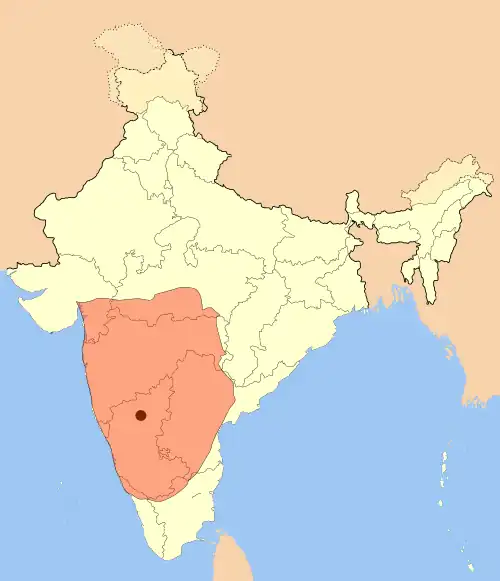
- King Pulakeshin I establishes the Chalukya dynasty in India. He extends his kingdom by conquering Vakataka and the west coast of Karnataka, giving him access to the valuable Arabian Sea trade routes.[2]
By topic
Learning
- Approximate date – The Yupian (玉篇) Chinese dictionary is edited by Gu Yewang.
Religion
- The doctrine of apocatastasis is condemned by the Synod of Constantinople.
- Barsanuphius, a famous hermit close to Gaza, retreats fully from the world after the death of Seridus, abbot of the nearby monastery, and fellow hermit John the Prophet with whom he wrote over 850 letters to people seeking his advice and guidance. Aelianos follows Seridus as abbot of the monastery.[3][4]
Births
- Brunhilda, queen of Austrasia (approximate date)
- Columbanus, Irish missionary (d. 615)
- Jing Di, emperor of the Liang dynasty (d. 558)
- Wu Di, emperor of Northern Zhou (d. 578)
Deaths
- Octa, king of Kent (approximate date) (b. 500)
- Adolius, Byzantine officer
- John the Prophet, Palestinian hermit and Desert Father[5]
- Seridus of Gaza, Palestinian abbot[3]
References
- ^ Bury (1923). Vol. II, Chapter XIX, p. 231-233.
- ^ Bauer, Susan Wise (2010). The History of the Medieval World: "From the Conversion of Constantine to the First Crusade". ISBN 978-0-393-05975-5 p. 231.
- ^ a b Chryssavgis, John (March 2017). John Climacus From the Egyptian Desert to the Sinaite Mountain. Taylor & Francis. p. 160. ISBN 9781351925211. Retrieved November 12, 2023.
- ^ Storin, Bradley K.; Sogno, Cristiana; Watts, Edward J. (November 2019). Late Antique Letter Collections A Critical Introduction and Reference Guide. University of California Press. ISBN 9780520308411. Retrieved November 13, 2023.
- ^ Chryssavgis, John (March 2017). John Climacus From the Egyptian Desert to the Sinaite Mountain. Taylor & Francis. p. 159. ISBN 9781351925211. Retrieved November 12, 2023.