579
| Years |
|---|
| Millennium |
| 1st millennium |
| Centuries |
| Decades |
| Years |
| 579 by topic |
|---|
| Leaders |
|
| Categories |
|
| Gregorian calendar | 579 DLXXIX |
| Ab urbe condita | 1332 |
| Armenian calendar | 28 ԹՎ ԻԸ |
| Assyrian calendar | 5329 |
| Balinese saka calendar | 500–501 |
| Bengali calendar | −15 – −14 |
| Berber calendar | 1529 |
| Buddhist calendar | 1123 |
| Burmese calendar | −59 |
| Byzantine calendar | 6087–6088 |
| Chinese calendar | 戊戌年 (Earth Dog) 3276 or 3069 — to — 己亥年 (Earth Pig) 3277 or 3070 |
| Coptic calendar | 295–296 |
| Discordian calendar | 1745 |
| Ethiopian calendar | 571–572 |
| Hebrew calendar | 4339–4340 |
| Hindu calendars | |
| - Vikram Samvat | 635–636 |
| - Shaka Samvat | 500–501 |
| - Kali Yuga | 3679–3680 |
| Holocene calendar | 10579 |
| Iranian calendar | 43 BP – 42 BP |
| Islamic calendar | 44 BH – 43 BH |
| Javanese calendar | 468–469 |
| Julian calendar | 579 DLXXIX |
| Korean calendar | 2912 |
| Minguo calendar | 1333 before ROC 民前1333年 |
| Nanakshahi calendar | −889 |
| Seleucid era | 890/891 AG |
| Thai solar calendar | 1121–1122 |
| Tibetan calendar | ས་ཕོ་ཁྱི་ལོ་ (male Earth-Dog) 705 or 324 or −448 — to — ས་མོ་ཕག་ལོ་ (female Earth-Boar) 706 or 325 or −447 |
Year 579 (DLXXIX) was a common year starting on Sunday of the Julian calendar. The denomination 579 for this year has been used since the early medieval period, when the Anno Domini calendar era became the prevalent method in Europe for naming years.
Events
By place
Byzantine Empire
- Byzantine-Sassanid War: King Khosrau I seeks peace, but dies before an agreement can be reached. The Mesopotamian front becomes stalemated, and Maurice (magister militum of the East) fortifies the borders in Armenia and Syria.
Central America
- September 2 – Uneh Chan becomes the ruler of the Mayan city state of Calakmul in southern Mexico and reigns until 611.
Europe
- Hermenegild, son of Visigothic king Liuvigild, marries Ingund. He rebels against his father, starting in Seville (Southern Spain), and declares himself Catholic.
- Heavy taxes levied by Merovingian king Chilperic I of Neustria produce a revolt at Limoges (central France), as he sells bishoprics to the highest bidder.
Britain
- Frithuwald succeeds his brother Theodoric as king of Bernicia (Scotland). He rules from 579–585 (approximate date).
Persia
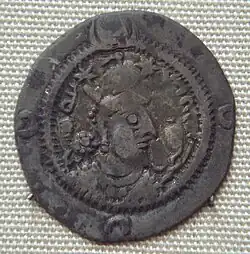
- Khosrau I dies after a 48-year reign, during which he has extended his realm from the River Oxus to the Red Sea. He is succeeded by his son Hormizd IV, who becomes king of the Persian Empire.
- Summer – Hormizd IV refuses to give up territories, and breaks off negotiations with the Byzantine Empire.[1] The Türks invade Khorasan and reach Hyrcania on the Caspian Sea.
Asia
- Emperor Xuan Di abdicates the throne to his son Jing Di, age 6, and rules as regent the Northern Zhou dynasty.
- Jinpyeong becomes king of the Korean kingdom of Silla.[2]
By topic
Religion
- July 30 – Pope Benedict I dies after a 4-year reign, and is succeeded by Pelagius II as the 63rd pope. During the Lombard siege of Rome, he labors to solve the problems of famine.
- Pelagius II sends Gregory as his apocrisiarius (ambassador to the imperial court in Constantinople).[3] He is part of a Roman delegation to ask for military aid against the Lombards.
- Leander, Catholic bishop of Seville, is exiled by Liuvigild and withdraws to Constantinople. At the Byzantine court he composes works against Arianism (approximate date).
Births
- Fang Xuanling, chancellor of the Tang dynasty (d. 648)
Deaths
- July 30 – Pope Benedict I
- Khosrau I, king of the Persian Empire
- Theodric, king of Bernicia (Scotland)
References
- ^ Greatrex & Lieu 2002, pp. 160–162
- ^ "List of Rulers of Korea". www.metmuseum.org. Retrieved April 21, 2019.
- ^ Ekonomou, 2007, p. 8
- Bibliography
- Greatrex, Geoffrey; Lieu, Samuel N. C. (2002). The Roman Eastern Frontier and the Persian Wars (Part II, 363–630 AD). New York, New York and London, United Kingdom: Routledge (Taylor & Francis). ISBN 0-415-14687-9.