618
| Years |
|---|
| Millennium |
| 1st millennium |
| Centuries |
| Decades |
| Years |
| 618 by topic |
|---|
| Leaders |
|
| Categories |
|
| Gregorian calendar | 618 DCXVIII |
| Ab urbe condita | 1371 |
| Armenian calendar | 67 ԹՎ ԿԷ |
| Assyrian calendar | 5368 |
| Balinese saka calendar | 539–540 |
| Bengali calendar | 24–25 |
| Berber calendar | 1568 |
| Buddhist calendar | 1162 |
| Burmese calendar | −20 |
| Byzantine calendar | 6126–6127 |
| Chinese calendar | 丁丑年 (Fire Ox) 3315 or 3108 — to — 戊寅年 (Earth Tiger) 3316 or 3109 |
| Coptic calendar | 334–335 |
| Discordian calendar | 1784 |
| Ethiopian calendar | 610–611 |
| Hebrew calendar | 4378–4379 |
| Hindu calendars | |
| - Vikram Samvat | 674–675 |
| - Shaka Samvat | 539–540 |
| - Kali Yuga | 3718–3719 |
| Holocene calendar | 10618 |
| Iranian calendar | 4 BP – 3 BP |
| Islamic calendar | 4 BH – 3 BH |
| Japanese calendar | N/A |
| Javanese calendar | 508–509 |
| Julian calendar | 618 DCXVIII |
| Korean calendar | 2951 |
| Minguo calendar | 1294 before ROC 民前1294年 |
| Nanakshahi calendar | −850 |
| Seleucid era | 929/930 AG |
| Thai solar calendar | 1160–1161 |
| Tibetan calendar | མེ་མོ་གླང་ལོ་ (female Fire-Ox) 744 or 363 or −409 — to — ས་ཕོ་སྟག་ལོ་ (male Earth-Tiger) 745 or 364 or −408 |
Year 618 (DCXVIII) was a common year starting on Sunday of the Julian calendar. The denomination 618 for this year has been used since the early medieval period, when the Anno Domini calendar era became the prevalent method in Europe for naming years.
Events
By place
Byzantine Empire
- Byzantine–Sassanian War: A Persian expeditionary force under Shahrbaraz invades Egypt, and occupies the province. After defeating the Byzantine garrisons in the Nile Valley, the Persians march across the Libyan Desert as far as Cyrene.
- The Persians besiege Alexandria; the defence of the city is led by Nicetas (cousin of emperor Heraclius). The Byzantine resistance is undermined by a blockade of the harbor; the usual grain supplies are cut off from Egypt to Constantinople.
Asia
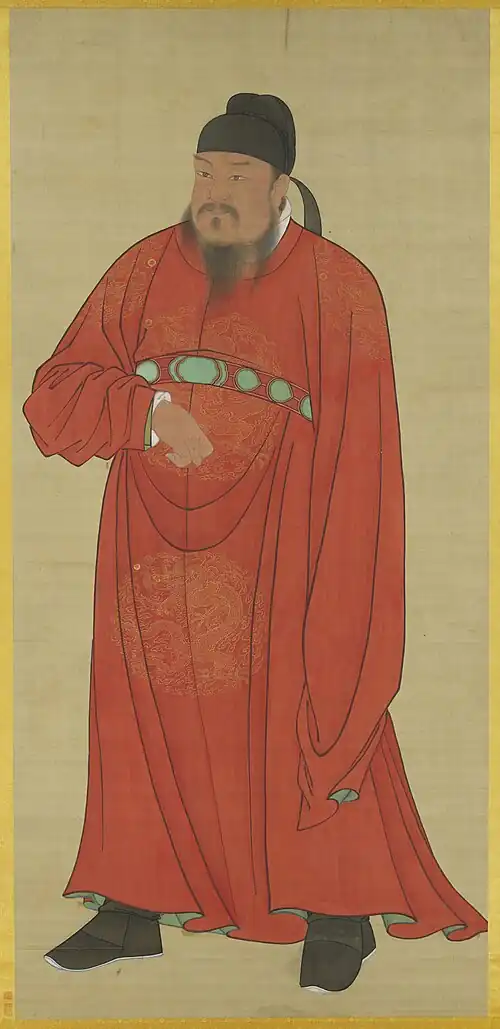
- June 18 – The Sui dynasty ends: Rebel leader Li Yuan captures Luoyang, and has Emperor Yángdi murdered. He proclaims himself emperor Gao Zu and establishes the Tang dynasty, one of the most notable dynasties in Chinese history, which will last for almost 300 years.
- October 6 – Battle of Yanshi: Wang Shichong decisively defeats Li Mi, during the transition from Sui to Tang civil war.
- November 29 – Battle of Qianshuiyuan: The Tang dynasty scores a decisive victory over their rival Xue Rengao.
- Tong Yabghu Qaghan becomes the new ruler (khagan) of the Western Turkic Khaganate, founding the Khazar Khaganate. He maintains close relations with the Tang dynasty, and possibly marries into the imperial family.[1]
- Songtsän Gampo becomes the first emperor of the Tibetan Empire, after his father Namri Songtsen is poisoned. During his reign he expands Tibet's power beyond Lhasa (Tibetan Plateau) and the Yarlung Valley.
- Yeongnyu becomes ruler of the Korean kingdom of Goguryeo.[2]
By topic
Religion
- November 8 – Pope Adeodatus I dies in Rome after a 3-year reign, in which he has reversed the policies of his predecessors, Boniface IV and Gregory I, who favored monks over the secular clergy. Adeodatus will not be replaced until next year.
Births
Deaths
- April 11 – Emperor Yang of Sui, emperor of the Sui dynasty (b. 569)
- September 3 – Xue Ju, emperor of Qin
- November 8 – Pope Adeodatus I[3]
- December 14 – Xue Rengao, emperor of Qin
- Dou Wei, chancellor of the Tang dynasty
- Fíngen mac Áedo Duib, king of Munster (Ireland)
- John of Conza, Italian rebel leader (or 615)
- Kevin of Glendalough, Irish abbot (b. 498)
- Namri Songtsen, king of Tibet (approximate date)
- Shikui Khagan, ruler of the Western Turkic Khaganate
- Yang Gao, prince of the Sui dynasty (b. 607)
- Yang Hao, prince of the Sui dynasty (b. 586)
- Yang Jian, prince of the Sui dynasty (b. 585)
- Yang Xiu, prince of the Sui dynasty
- Yeongyang, king of Goguryeo (Korea)[2]
- Yu Shiji, official of the Chen- and Sui dynasty
References
- ^ Golden 1992, p. 135. According to Chinese historical sources, the marriage was never carried out because of interference by the Eastern Göktürk Illig Qaghan, whose territory sat between his territory and Tang territory, and who felt threatened by the proposed marriage. Zizhi Tongjian, vol. 192.
- ^ a b "List of Rulers of Korea". www.metmuseum.org. Retrieved April 19, 2019.
- ^ "Saint Deusdedit | pope". Encyclopedia Britannica. Retrieved July 14, 2021.
Sources
- Golden, Peter Benjamin (1992). Introduction to the History of the Turkic Peoples. Wiesbaden: Harrasowitz. p. 135. ISBN 978-3-447-03274-2.