661
| Years |
|---|
| Millennium |
| 1st millennium |
| Centuries |
| Decades |
| Years |
| 661 by topic |
|---|
| Leaders |
|
| Categories |
|
| Gregorian calendar | 661 DCLXI |
| Ab urbe condita | 1414 |
| Armenian calendar | 110 ԹՎ ՃԺ |
| Assyrian calendar | 5411 |
| Balinese saka calendar | 582–583 |
| Bengali calendar | 67–68 |
| Berber calendar | 1611 |
| Buddhist calendar | 1205 |
| Burmese calendar | 23 |
| Byzantine calendar | 6169–6170 |
| Chinese calendar | 庚申年 (Metal Monkey) 3358 or 3151 — to — 辛酉年 (Metal Rooster) 3359 or 3152 |
| Coptic calendar | 377–378 |
| Discordian calendar | 1827 |
| Ethiopian calendar | 653–654 |
| Hebrew calendar | 4421–4422 |
| Hindu calendars | |
| - Vikram Samvat | 717–718 |
| - Shaka Samvat | 582–583 |
| - Kali Yuga | 3761–3762 |
| Holocene calendar | 10661 |
| Iranian calendar | 39–40 |
| Islamic calendar | 40–41 |
| Japanese calendar | Hakuchi 12 (白雉12年) |
| Javanese calendar | 552–553 |
| Julian calendar | 661 DCLXI |
| Korean calendar | 2994 |
| Minguo calendar | 1251 before ROC 民前1251年 |
| Nanakshahi calendar | −807 |
| Seleucid era | 972/973 AG |
| Thai solar calendar | 1203–1204 |
| Tibetan calendar | ལྕགས་ཕོ་སྤྲེ་ལོ་ (male Iron-Monkey) 787 or 406 or −366 — to — ལྕགས་མོ་བྱ་ལོ་ (female Iron-Bird) 788 or 407 or −365 |
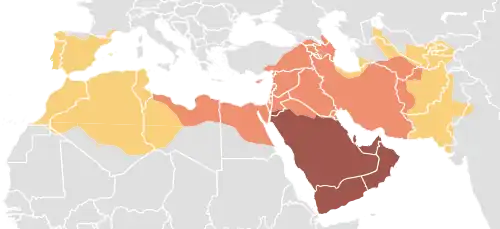
Expansion under Muhammad, 622–632
Expansion during the Rashidun Caliphate, 632–661
Expansion during the Umayyad Caliphate, 661–750
Year 661 (DCLXI) was a common year starting on Friday of the Julian calendar. The denomination 661 for this year has been used since the early medieval period, when the Anno Domini calendar era became the prevalent method in Europe for naming years.
Events
By place
Europe
- King Chlothar III of Neustria and queen regent Balthild found Corbie Abbey in Picardy (northern France), giving it immunity from taxation, and visits from local bishops in exchange for prayer.
- Perctarit and Godepert become co-rulers of the Lombards, following the death of their father Aripert I. They split the kingdom, and establish their capitals in Milan and Pavia (northern Italy).
Britain
- Battle of Posbury: King Cenwalh of Wessex invades Dumnonia (south-west England). He is victorious over the native Briton tribes near Crediton in Devon, and drives them to the coast.
- King Wulfhere of Mercia and his army harry the Berkshire Downs (south of Thame) and move south to conquer the Meonwara and the Isle of Wight.
- Wulfhere appoints Æthelwealh as king of Sussex, and Æthelwealh is baptized in Mercia. He receives the recently-conquered territories in modern-day Hampshire.
Arabian Empire (Islamic Caliphate)

- January 26 – Assassination of Ali: Ali ibn Abi Talib, first Shia imam and fourth caliph of the Rashidun Caliphate, is struck on the head with a poisoned sword by the Khawarij Abd-al-Rahman ibn Muljam, while at prayer at a shrine at Kufa (modern-day), dying two days later. His son, Hasan ibn Ali, is chosen by Muslims to succeed him as the next leader. According to the Umayyads, he is succeeded by Muawiyah I as Caliph, age 59, who moves his seat of government to Damascus, and founds the Umayyad Caliphate, ending the Rashidun Caliphate.[1]
- Approximate date – Muawiya I imprisons patriarch Giwargis I, after his refusal to pay tribute. Christians are persecuted and their churches are destroyed.
Japan
- Approximate date – The imperial fleet of Japan invades Kyūshū by the order of Empress Saimei. On its way, princess Nukata composes a famous poem at Nikitatsu in Iyo Province.
- c. May – Empress Saimei builds the palace of Asakura in Kyūshū, from trees cut down from the shrines. Two months later she dies. People say it is because the gods are angry with her for destroying the shrines.
- July 24 – Emperor Tenji ascends to the throne of Japan after his mother Empress Saimei’s death. He sends an expeditionary force under Abe no Hirafu to Korea, to help the allied kingdom of Baekje.
Korea
By topic
Religion
- Maximus the Confessor, Christian monk, is recalled from exile in Thrace. He is tried, and sentenced to mutilation. His tongue and his right hand are cut off to prevent his further opposition to the Monothelites.
- Approximate date – In Gaul all Roman bishops are replaced with Frankish bishops. They become increasingly common, as Frankish leaders control the episcopate.
Births
- February 12 – Ōku, Japanese princess (d. 702)
- Early June – Al-Hajjaj ibn Yusuf, Arab governor (d. 714)
- Approximate date – Ælfwine, Northumbrian king of Deira (k. 679)
- Chen Zi'ang, Chinese poet and official (d. 702)
- Liu Zhiji, Chinese historian (d. 721)
Deaths
- January 3 – Benjamin, Coptic Orthodox Patriarch of Alexandria (b. c.590)
- January 28 – Ali, first Shia Imam and Fourth Rashidun Caliph (b. 601) (martyred)
- February 17 – Finan of Lindisfarne, Irish-born bishop
- July 24 – Kōgyoku (also Saimei), twice empress of Japan (b. 594)
- Aripert I, king of the Lombards
- Cenberht, West Saxon king in Wessex[3]
- Cuthred, West Saxon prince in Wessex[3]
- Approximate date – Landry, bishop of Paris
- Al-Ash'ath ibn Qays, companion of the Muhammad
References
- ^ Roberts 1994.
- ^ "List of Rulers of Korea". www.metmuseum.org. Retrieved April 21, 2019.
- ^ a b Anglo-Saxon Chronicle.
Sources
- Roberts, J.M. (1994). History of the World. Penguin.