734
| Years |
|---|
| Millennium |
| 1st millennium |
| Centuries |
| Decades |
| Years |
| 734 by topic |
|---|
| Leaders |
|
| Categories |
|
| Gregorian calendar | 734 DCCXXXIV |
| Ab urbe condita | 1487 |
| Armenian calendar | 183 ԹՎ ՃՁԳ |
| Assyrian calendar | 5484 |
| Balinese saka calendar | 655–656 |
| Bengali calendar | 140–141 |
| Berber calendar | 1684 |
| Buddhist calendar | 1278 |
| Burmese calendar | 96 |
| Byzantine calendar | 6242–6243 |
| Chinese calendar | 癸酉年 (Water Rooster) 3431 or 3224 — to — 甲戌年 (Wood Dog) 3432 or 3225 |
| Coptic calendar | 450–451 |
| Discordian calendar | 1900 |
| Ethiopian calendar | 726–727 |
| Hebrew calendar | 4494–4495 |
| Hindu calendars | |
| - Vikram Samvat | 790–791 |
| - Shaka Samvat | 655–656 |
| - Kali Yuga | 3834–3835 |
| Holocene calendar | 10734 |
| Iranian calendar | 112–113 |
| Islamic calendar | 115–116 |
| Japanese calendar | Tenpyō 6 (天平6年) |
| Javanese calendar | 627–628 |
| Julian calendar | 734 DCCXXXIV |
| Korean calendar | 3067 |
| Minguo calendar | 1178 before ROC 民前1178年 |
| Nanakshahi calendar | −734 |
| Seleucid era | 1045/1046 AG |
| Thai solar calendar | 1276–1277 |
| Tibetan calendar | ཆུ་མོ་བྱ་ལོ་ (female Water-Bird) 860 or 479 or −293 — to — ཤིང་ཕོ་ཁྱི་ལོ་ (male Wood-Dog) 861 or 480 or −292 |
Year 734 (DCCXXXIV) was a common year starting on Friday of the Julian calendar, the 734th year of the Common Era (CE) and Anno Domini (AD) designations, the 734th year of the 1st millennium, the 34th year of the 8th century, and the 5th year of the 730s decade. The denomination 734 for this year has been used since the early medieval period, when the Anno Domini calendar era became the prevalent method in Europe for naming years.
Events
By place
Europe
- Battle of the Boarn: The Franks under Charles Martel, mayor of the palace of Neustria and Austrasia, defeat the Frisians near the mouth of the River Boarn (now the Dutch province of Friesland). During the battle, the Frisian army is beaten and King Poppo is killed.[1] The Franks gain control of the Frisian lands west of the Lauwers (Netherlands), and begin plundering the pagan sanctuaries. The Frisians become Frankish vassals, apart from the tribes living in East Frisia in present-day Germany.
- Umayyad conquest of Gaul: Muslim forces under Abd al-Malik ibn Qatn al-Fihri, governor (wali) of Al-Andalus (modern Spain), enter Provence and raid the Rhône Valley. The cities of Avignon, Arles, and probably Marseille are handed over by Count Maurontus, who is in rebellion against Charles Martel.[2]
- September 8 – Frithubeorht is consecrated Bishop of Hexham.
Mesoamerica
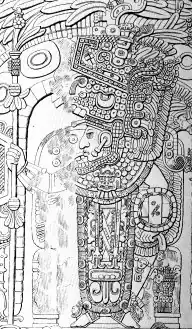
- Jasaw Chan Kʼawiil I, ruler (ajaw) of Tikal (Guatemala), dies after a 52-year reign. He is succeeded by his son Yikʼin Chan Kʼawiil, who becomes one of Tikal's most successful and expansionary rulers during the Late Classic period.
- During the Third Tikal–Calakmul War, Kʼakʼ Tiliw Chan Yopaat gives himself the title k’uhul ajaw, thus declaring Quiriguá's independence from Copán.
Asia
- March 23 – A large earthquake strikes the Tang dynasty city of Qinzhou (in the vicinity of modern-day Tianshui City), causing serious damage and killing around 4000 people.[3]
- Bilge Qaghan, khagan of the Second Turkic Khaganate, is poisoned and killed by Buyruk Chor, an emissary once sent to Tang Emperor Xuanzong. He is succeeded by his son Yollıg.[4]
- December – Khitan military chief Ketuyu and khagan Yaonian Qulie are assassinated by their subordinate Li Guozhe, ending the Ketuyu rebellion.[5]
Births
- Fujiwara no Kurajimaro, Japanese politician (d. 775)
- Khurshid II, ruler (ispahbadh) of Tabaristan (d. 761)
Deaths
- June 3 – Simeon of the Olives, Syriac bishop of Harran (b. 624/5)[6][7]
- July 30 – Tatwine, Mercian archbishop of Canterbury (b. c.670?)
- Bilge Qaghan, ruler (khagan) of the Second Turkic Khaganate (b. 683/4)
- Bilihildis, Frankish noblewoman and abbess
- Bubo, Duke of the Frisians
- Approximate date – Caintigern, Irish-born hermit
- Jasaw Chan Kʼawiil I, ruler (ajaw) of Tikal
- December – Ketuyu, Khitan military chief [5]
Sources
- Xu Elina-Qian, Historical Development of the Pre-Dynastic Khitan, University of Helsinki, 2005. 273 pages.
References
- ^ "Geschiedenis van het volk der Friezen". Boudicca.de. Archived from the original on June 8, 2009. Retrieved 2009-01-22.
- ^ David Nicolle (2008). Poitiers AD 732, Charles Martel turns the Islamic people (p. 19). ISBN 978-184603-230-1
- ^ Lei, Z.-S. (March 2007). "Textual research on the Tianshui M 7 earthquake in 734 AD and analysis of its causative structure". ResearchGate. Retrieved June 9, 2021.
- ^ "Erkin Ekrem, "Sarı Uygurların Kökeni", Modern Türklük Araştırma Dergisi, Vol. 4, No. 3, 2007, p. 175" (PDF) (in Turkish).
- ^ a b Xu Elina-Qian, p.245-248
- ^ Tannous, Jack (2016). "The Life of Simeon of the Olives: A Christian Puzzle from Islamic Syria". In Kreiner, J.; Reimitz, H. (eds.). Motions of Late Antiquity: Essays on Religion, Politics, and Society in Honour of Peter Brown. Turnhout: Brepols. pp. 315–316.
- ^ Barsoum, Aphrem (2009). "Bishops of the City of Harran". In Moose, Matti (ed.). The Collected Historical Essays of Aphram I Barsoum. Gorgias Press. p. 33. ISBN 978-1-60724-535-3.