791
| Years |
|---|
| Millennium |
| 1st millennium |
| Centuries |
| Decades |
| Years |
| 791 by topic |
|---|
| Leaders |
|
| Categories |
|
| Gregorian calendar | 791 DCCXCI |
| Ab urbe condita | 1544 |
| Armenian calendar | 240 ԹՎ ՄԽ |
| Assyrian calendar | 5541 |
| Balinese saka calendar | 712–713 |
| Bengali calendar | 197–198 |
| Berber calendar | 1741 |
| Buddhist calendar | 1335 |
| Burmese calendar | 153 |
| Byzantine calendar | 6299–6300 |
| Chinese calendar | 庚午年 (Metal Horse) 3488 or 3281 — to — 辛未年 (Metal Goat) 3489 or 3282 |
| Coptic calendar | 507–508 |
| Discordian calendar | 1957 |
| Ethiopian calendar | 783–784 |
| Hebrew calendar | 4551–4552 |
| Hindu calendars | |
| - Vikram Samvat | 847–848 |
| - Shaka Samvat | 712–713 |
| - Kali Yuga | 3891–3892 |
| Holocene calendar | 10791 |
| Iranian calendar | 169–170 |
| Islamic calendar | 174–175 |
| Japanese calendar | Enryaku 10 (延暦10年) |
| Javanese calendar | 686–687 |
| Julian calendar | 791 DCCXCI |
| Korean calendar | 3124 |
| Minguo calendar | 1121 before ROC 民前1121年 |
| Nanakshahi calendar | −677 |
| Seleucid era | 1102/1103 AG |
| Thai solar calendar | 1333–1334 |
| Tibetan calendar | ལྕགས་ཕོ་རྟ་ལོ་ (male Iron-Horse) 917 or 536 or −236 — to — ལྕགས་མོ་ལུག་ལོ་ (female Iron-Sheep) 918 or 537 or −235 |
Year 791 (DCCXCI) was a common year starting on Saturday of the Julian calendar. The denomination 791 for this year has been used since the early medieval period, when the Anno Domini calendar era became the prevalent method in Europe for naming years.
Events
By place
Europe
- The Avars, a pagan Asian nomadic horde that has settled down in what is today Hungary, invade Friuli and Bavaria. King Charlemagne assembles a Frankish army, and marches down the Danube River to ravage Avar territory. A Frankish-Lombard expeditionary force, under his son Pepin, (king of the Lombards) invades the Drava Valley and devastates Pannonia.
- Summer – Charlemagne loses most of his riding and baggage horses during an equine epidemic; many Saxons take advantage of Charlemagne's Avar setback and rebel once more.[1]
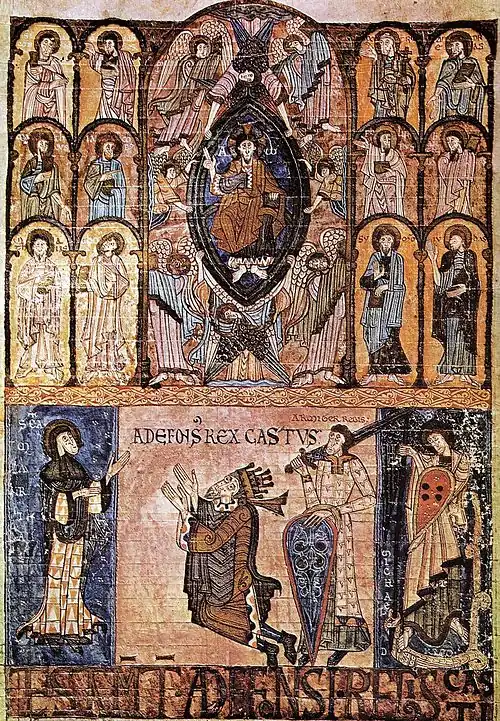
- September 14 – Alfonso II, the son of former king Fruela I, becomes ruler of Asturias (Northern Spain). He moves the capital to Oviedo, the commercial centre of the region.
Britain
- Princes Ælf and Ælfwine of Northumbria, the sons of former king Ælfwald I, are persuaded to leave their sanctuary in York Minster, and are immediately forcibly drowned in Wonwaldremere, at the instigation of King Æthelred I.
Africa
- Emir Idris I, founder of the Idrisid dynasty and kingdom of Morocco, is poisoned on orders of Caliph Harun al-Rashid.[2][3] He is succeeded by his son Idris II (only just two months old), who is raised by his mother Kenza among the Berbers of Volubilis.
Asia
- April – Tang forces retake the protectorate of Annan from rebelling Annamese chieftains Đỗ Anh Hàn, Phùng Hưng and Phùng An.[4]
Births
Deaths
- Artgal mac Cathail, king of Connacht (Ireland)
- Idris I, emir and founder of the Idrisid dynasty (b. 745)
- Wermad, bishop of Trier
- Zhang Xiaozhong, general of the Tang dynasty (b. 730)
References
- ^ David Nicolle (2014). The Conquest of Saxony AD 782–785, p. 79. ISBN 978-1-78200-825-5
- ^ Rogerson, Barnaby (2010). Marrakesh, Fez and Rabat. London: Cadogan Guides. p. 238. ISBN 978-1-86011-432-8.
- ^ "The History of Volubilis". Volubilis Project. September 25, 2003. Archived from the original on April 24, 2012. Retrieved October 29, 2012.
- ^ Taylor, K.W. (2013). A History of the Vietnamese. Cambridge University Press. p. 40. ISBN 9780520074170.