Kurt Georg Kiesinger (German:[ˈkʊʁtˈɡeːɔʁkˈkiːzɪŋɐ]; 6 April 1904 – 9 March 1988) was a German politician who served as the chancellor of West Germany from 1 December 1966 to 21 October 1969. Before he became Chancellor he served as Minister-President of Baden-Württemberg from 1958 to 1966 and as President of the Federal Council from 1962 to 1963. He was Chairman of the Christian Democratic Union from 1967 to 1971.
Kiesinger gained his certificate as a lawyer in March 1933 and worked as a lawyer in Berlin's Kammergericht court from 1935 to 1940.[1] He had joined the Nazi Party in 1933, but remained a largely inactive member. To avoid conscription, in 1940 he was appointed to the broadcast policy department of the Foreign Office by Joachim von Ribbentrop, and became deputy head of the broadcasting and propaganda departments in 1942.[2] In 1946 he became a member of the Christian Democratic Union. He was elected to the Bundestag in 1949, and was a member of the Bundestag until 1958 and again from 1969 to 1980. He left federal politics for eight years (from 1958 to 1966) to serve as Minister-President of Baden-Württemberg, and subsequently became Chancellor by forming a grand coalition with Willy Brandt's Social Democratic Party.
Kiesinger was considered an outstanding orator and mediator, and was dubbed "Chief Silver Tongue". He was an author of poetry and various books, and founded the universities of Konstanz and Ulm as Minister-President of Baden-Württemberg. Kiesinger is also considered controversial, which is mainly due to his affiliation and work with the Nazis. The student movement in particular, but also other sections of the population, saw Kiesinger as a politician who stood for the inadequacy of Germans' coming to terms with the past.
Early life
Kurt Georg Kiesinger was born in Ebingen, Kingdom of Württemberg (now Albstadt, Baden-Württemberg). His father was a commercial clerk in companies engaged in the local textile industry. Kiesinger was baptized Catholic because his mother was Catholic, though his father was Protestant. His mother died six months after he was born. His maternal grandmother exerted a strong influence on Kiesinger and encouraged him, while his father was indifferent to his advancement. After a year, his father was remarried to a Karoline Victoria Pfaff. They had seven children, of whom Kiesinger's half-sister Maria died a year after she was born. Pfaff was also a Catholic. Kiesinger was therefore shaped by both denominations and later referred to himself gladly as a "Protestant Catholic". Politically, Kiesinger grew up in a liberal, democratically-minded milieu.
Kiesinger studied law in Berlin and worked as a then as lawyer in Berlin from 1935 to 1940. As a student, he joined the (non-couleur wearing) Roman Catholic corporations KStV Alamannia Tübingen and Askania-Burgundia Berlin.
Nazi career
He became a member of the Nazi Party in February 1933. In 1940, he was called to arms but avoided mobilization by finding a job in the Foreign Office's broadcasting department, rising quickly to become deputy head of the department from 1943 to 1945 and the department's liaison with the Propaganda Ministry.[3] He worked under Joachim von Ribbentrop, who would later be condemned to death at Nuremberg. After the war, he was interned by the Americans for his connection to Ribbentrop and spent 18 months in the Ludwigsburg camp before being released as a case of mistaken identity.[4]
Franco-German journalist Beate Klarsfeld demonstrated Kiesinger's close connections to Ribbentrop and Joseph Goebbels, the head of Nazi Germany's Propaganda Ministry.[5] She also asserted that Kiesinger had been chiefly responsible for the contents of German international broadcasts which included anti-Semitic and war propaganda, and had collaborated closely with SS functionaries Gerhard Rühle and Franz Alfred Six. The latter was responsible for mass murders in Nazi-occupied Eastern Europe and was tried as a war criminal in the Einsatzgruppen Trial at Nuremberg. Even after becoming aware of the extermination of the Jews, Kiesinger had continued to produce anti-Semitic propaganda.[6] These allegations were based in part on documents that Albert Norden published about the culprits of war and Nazi crimes.[7]
Early CDU career
Kiesinger joined the Christian Democratic Union (CDU) in 1946. From 1946 he gave private lessons to law students, and in 1948 he resumed his practice as a lawyer. In 1947 he also became unpaid secretary-general of the CDU in Württemberg-Hohenzollern.
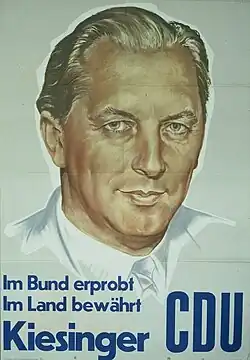
1961 election poster for Kiesinger
In the federal election in 1949 he was elected to the Bundestag, in which he went on to sit until 1958 and again from 1969 to 1980. In his first legislative term he represented the constituency of Ravensburg, in which he achieved record results of over 70 percent, from 1969 the constituency of Waldshut. For the 1976 federal election, Kiesinger renounced his own constituency and entered parliament via the Baden-Württemberg state list of his party. In the first two legislative periods (1949–1957) he was chairman of the mediation committee of the Bundestag and Bundesrat. On 19 October 1950, Kiesinger received 55 votes against his party friend Hermann Ehlers (201 votes) in the election for President of the Bundestag, although he had not been proposed. In 1951 he became a member of the CDU executive board. From 17 December 1954 to 29 January 1959, he was chairman of the Bundestag Committee on Foreign Affairs, to which he had been a member since 1949.
During that time, he became known for his rhetorical brilliance, as well as his in-depth knowledge of foreign affairs. However, despite the recognition he enjoyed within the Christian Democrat parliamentary faction, he was passed over during various cabinet reshuffles. Consequently, he decided to switch from federal to state politics.
Minister-President of Baden-Württemberg
Kiesinger became Minister-President of the state of Baden-Württemberg on 17 December 1958, an office in which he served until 1 December 1966. At that time Kiesinger was also a member of the Landtag of Baden-Württemberg. As Minister-President he was President of the German Bundesrat from 1 November 1962 to 31 October 1963. During his time in office the state founded two universities, the University of Konstanz and the University of Ulm.
In the early days of the Federal Republic of Germany, oversized coalitions were not uncommon at the state level, and so Kiesinger led a coalition of the CDU, SPD, FDP/DVP and BHE until 1960, but then a CDU/CSU-FDP coalition, coalition from 1960 to 1966. On 15 April 1961, the BHE disbanded.
In 1966, following the collapse of the existing CDU/CSU-FDP coalition in the Bundestag, Kiesinger was elected to replace Ludwig Erhard as Federal Chancellor, heading a new CDU/CSU-SPD alliance with the SPD leader Willy Brandt as Vice Chancellor and Foreign Minister. The Kiesinger government remained in power for nearly three years. Kiesinger reduced tensions with the Soviet bloc nations, establishing diplomatic relations with Czechoslovakia, Romania, and Yugoslavia, but he opposed any major conciliatory moves. A number of progressive reforms were also realised during Kiesinger's time as Chancellor. Pension coverage was extended in 1967 via the abolition of the income-ceiling for compulsory membership. In education, student grants were introduced, together with a university building programme, while a constitutional reform of 1969 empowered the federal government to be involved with the Länder in educational planning through joint planning commission. Vocational training legislation was also introduced, while a reorganisation of unemployment insurance promoted retraining schemes, counselling and advice services, and job creation places. In addition, under the Lohnfortzahlunggesetz of 1969, employers had to pay all employees’ wages for the first six weeks of sickness.[8] In August 1969,[9] the Landabgaberente (a higher special pension for farmers willing to cede farms that were unprofitable according to certain criteria) was introduced.[10]
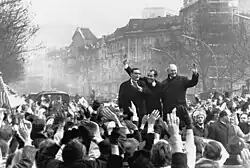
The historian Tony Judt has observed that Kiesinger's chancellorship, like the presidency of Heinrich Lübke, showed the "a glaring contradiction in the Bonn Republic's self-image" in view of their previous Nazi allegiances.[11] One of his low points as Chancellor was in 1968 when Nazi-hunter Beate Klarsfeld, who campaigned with her husband Serge Klarsfeld against Nazi criminals, publicly slapped him in the face during the 1968 Christian Democrat convention, while calling him a Nazi.[5] She did so in French and, whilst being dragged out of the room by two ushers, repeated her words in German, saying "Kiesinger! Nazi! Abtreten!" ("Kiesinger! Nazi! Step down!") Kiesinger, holding his left cheek, did not respond, though Klarsfeld was sentenced to a year in prison that same day under expedited proceedings.[12] Up to his death he refused to comment on the incident, and in other opportunities he denied explicitly that he had been opportunistic by joining the NSDAP in 1933 (although he admitted to joining the German Foreign Ministry to dodge his 1940 draft by the Wehrmacht). Other prominent critics included the writers Heinrich Böll and Günter Grass. (In 1966, Grass had written an open letter urging Kiesinger not to accept the chancellorship). In 2006, 40 years later, Grass, in an interview with the Frankfurter Allgemeine Zeitung, would confess to a Waffen-SS membership, which became a controversy on its own.[13]
After the election of 1969, the SPD preferred to form a coalition with the FDP, ending the uninterrupted post-war reign of the CDU chancellors. Kiesinger was succeeded as Chancellor by his former Vice-Chancellor Willy Brandt.
Kiesinger continued to head the CDU/CSU in opposition and remained a member of the Bundestag until 1980. In July 1971 Kiesinger was succeeded as Leader of the Christian Democratic Union by Rainer Barzel. In 1972 he held the main speech for justification to the constructive vote of no confidence by the CDU/CSU parliamentary group against Willy Brandt in the Bundestag. The election of then CDU leader Rainer Barzel as chancellor was unsuccessful because of the bribery of Julius Steiner and probably Leo Wagner by GDR's Stasi.
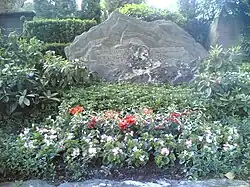
In 1980 Kiesinger ended his career as politician and worked on his memoir. Of his planned memoirs, only the first part (Dark and Bright Years) was completed, covering the years up to 1958. It was released after his death in 1989. Kiesinger died in Tübingen on 9 March 1988, 28 days short of his 84th birthday. After a requiem mass in Stuttgart's St. Eberhard Church, his funeral procession was followed by protesters (mainly students) who wanted his former membership in the Nazi Party remembered.
Die Stellung des Parlamentariers in unserer Zeit. ("The position of the parliamentarian in our time."), Stuttgart 1981.
Dunkle und helle Jahre: Erinnerungen 1904–1958. ("Dark and Bright Years: Memoirs 1904–1958."), Deutsche Verlags-Anstalt, Stuttgart 1989.
Notes
^Due to the division of Germany, Kurt Georg Kiesinger was only the Federal Chancellor in West Germany. The term West Germany is only the common English name for the Federal Republic of Germany between its formation on 23 May 1949 and the German reunification through the accession of East Germany on 3 October 1990. The office of Chancellor did not exist in East Germany.
^Jeffrey Herf, "Judenhass aus dem Äther. NS-Propaganda für die Arabische Welt während des Zweiten Weltkriegs", in Naziverbrechen. Täter, Taten, Bewältigungsversuche, edited by Martin Cüppers et al., Darmstadt 2013, pp. 45-61, here p. 49.
^Munzinger-Online, s.v.Kurt Georg Kiesinger, Accessed 16 October 2010
Philipp Gassert: Kurt Georg Kiesinger 1904–1988. Kanzler zwischen den Zeiten. DVA, München 2006, ISBN 3-421-05824-5 (Rezension Daniela Münkler und Benjamin Obermüller, rezensionen.ch, 19. Juli 2006, S. 31).
Otto Rundel: Kurt Georg Kiesinger. Sein Leben und sein politisches Wirken. Kohlhammer Verlag, Stuttgart 2006, ISBN 3-17-019341-4.
Günter Buchstab, Philipp Gassert, Peter Thaddäus Lang (Hrsg.): Kurt Georg Kiesinger 1904–1988. Von Ebingen ins Kanzleramt. Herder, Freiburg 2005, im Auftrag der Konrad-Adenauer-Stiftung, ISBN 3-451-23006-2.
Reinhard Schmoeckel, Bruno Kaiser: Die vergessene Regierung. Die große Koalition 1966–1969 und ihre langfristigen Wirkungen. Bouvier Verlag, Bonn 2005, ISBN 3-416-02246-7.
Maria Keipert (Red.): Biographisches Handbuch des deutschen Auswärtigen Dienstes 1871–1945. Herausgegeben vom Auswärtigen Amt, Historischer Dienst. Band 2: Gerhard Keiper, Martin Kröger: G–K. Schöningh, Paderborn u. a. 2005, ISBN 3-506-71841-X.
Albrecht Ernst: Kurt Georg Kiesinger 1904–1988. Rechtslehrer, Ministerpräsident, Bundeskanzler. Begleitbuch zur Wanderausstellung des Hauptstaatsarchivs Stuttgart, Stuttgart 2004, ISBN 3-00-013719-X.
Joachim Samuel Eichhorn: Durch alle Klippen hindurch zum Erfolg: Die Regierungspraxis der ersten Großen Koalition (1966–1969) (Studien zur Zeitgeschichte, Band 79); München 2009.
Speaker:Theodor Heuss until 12 September 1949; Hermann Schäfer until 10 January 1951; August-Martin Euler until 6 May 1952; Hermann Schäfer from 6 May 1952
Members:
Atzenroth
Becker
Blank
Blücher
Dannemann
Dehler
Dirscherl
Eberhard (from 3 October 1952)
Euler
Fassbender
Friedrich (from 5 October 1950 Non-attached, from 16 November 1950 BHE/DG, from 2 April 1952 FDP-Gast)
Langer (from 10 June 1952 Non-attached, from 29 March 1953 WAV)
Leuchtgens (from 21 January 1950 DRP, from 5 October 1950 Non-attached (DRP), from 6 December 1950 DP, from 27 July 1953 partei- und Non-attached)
Leuze (from 21 March 1952)
Linnert (until 27 October 1949)
Luchtenberg (from 30 October 1950)
Margulies
Mauk (from 7 April 1952)
Mayer (until 18 December 1952)
Mende
Middelhauve (until 17 October 1950)
Mulert (from 1 February 1952)
Neumayer
Nöll
Nowack (until 30 September 1952)
Oellers (until 5 June 1951)
Onnen
Pfleiderer
Preiß
Preusker
Rademacher
Rath
Rechenberg (until 19 January 1953)
Reif
Revenstorff
Rüdiger (until 20 February 1951)
Schäfer
Schneider
Stahl
Stegner
Trischler
Vries (from 5 January 1953)
Wellhausen
Wildermuth (until 9 March 1952)
Will (from 1 February 1952)
Wirths
Zawadil (from 26 November 1952 DP)
DP
DP
Speaker: Heinrich Hellwege until 2 November 1949; Friedrich Klinge until 21 December 1949; Hans Mühlenfeld until 15 March 1953; Hans-Joachim von Merkatz from 17 March 1953
Members:
Ahrens
Bahlburg (from 13 September 1951 Non-attached, from 24 January 1952 DP-Gast, from 10 September 1952 Non-attached)
Campe (from 23 January 1950, until 8 January 1952)
Eickhoff
Ewers
Farke
Fricke (from 22 March 1952)
Hedler (from 19 January 1950 Non-attached, from 28 March 1950 DRP-Gast, from 16 September 1950 Non-attached, from 29 April 1953 WAV)
Hellwege
Jaffé (from 9 January 1952)
Kalinke
Klinge (until 21 December 1949)
Kuhlemann
Matthes
Merkatz
Mühlenfeld (until 15 May 1953)
Seebohm
Tobaben
Walter
Wittenburg
Woltje (from 30 May 1953)
BP
BP
Speaker: Gebhard Seelos until 25 September 1951; Hugo Decker from 25 September 1951
Members:
Aretin (from 14 December 1951 FU)
Aumer (from 8 September 1950 Non-attached)
Baumgartner (until 1 January 1951)
Besold (from 14 December 1951 FU)
Decker
Donhauser (from 8 September 1950 Non-attached, from 17 September 1952 CSU)
Eichner (from 14 December 1951 FU)
Etzel (from 14 December 1951 FU, from 3 December 1952 Non-attached (GVP))
Falkner (until 27 October 1950)
Fink (from 14 December 1951 FU, from 5 January 1952 CSU)
Fürstenberg (from 7 November 1950 Non-attached, from 19 January 1951 CSU)
Lampl (from 10 November 1950, from 14 December 1951 FU)
Maerkl (from 1 September 1952)
Mayerhofer (from 14 December 1951 FU)
Meitinger (from 26 September 1951, from 14 December 1951 FU)
Oettingen-Wallerstein (from 8 January 1951, from 14 December 1951 FU, until 1 September 1952)
Parzinger (from 14 December 1951 FU)
Rahn (from 14 January 1950, from 8 September 1950 Non-attached, from 17 October 1950 WAV-Gast, from 14 February 1951 CSU)
Seelos (until 25 September 1951)
Volkholz (from 14 December 1951 FU)
Wartner (from 14 December 1951 FU)
Ziegler (until 30 December 1949)
KPD
KPD
Speaker: Max Reimann
Members:
Agatz
Fisch
Gundelach
Harig
Kohl (from 26 January 1950)
Leibbrand (until 26 January 1950)
Müller (from 10 May 1950 Non-attached)
Müller
Niebergall
Niebes (from 10 July 1952)
Nuding (until 20 April 1951)
Paul
Reimann
Renner
Rische
Strohbach (from 16 May 1951)
Thiele
Vesper (until 30 June 1952)
WAV
WAV
Speaker: Alfred Loritz
Members:
Bieganowski (from 21 March 1952, from 23 April 1952 DP/DPB, from 9 December 1952 Non-attached)
Fröhlich (from 13 October 1950 BHE/DG, from 21 March 1952 Non-attached)
Goetzendorff (from 29 March 1950 DRP-Gast, from 5 October 1950 Non-attached (DRP), from 29 April 1953 WAV)
Keller (from 24 April 1952, from 6 December 1951 DP, Non-attached)
Löfflad (from 6 December 1951 DP)
Loritz (from 6 December 1951 Non-attached, from 29 April 1953 WAV)
Paschek (from 29 March 1950 DRP-Gast, from 5 October 1950 Non-attached, from 30 January 1951 WAV, from 6 December 1951 DP, until 22 April 1952)
Reindl (from 6 December 1951 DP/DPB, from 9 December 1952 Non-attached, from 29 April 1953 WAV)
Schmidt (from 6 December 1951 DP/DPB, from 9 December 1952 Non-attached)
Schuster (from 6 December 1951 DP)
Tichi (from 13 October 1950 BHE/DG, from 21 March 1952 Non-attached)
Wallner (from 6 December 1951 DP/DPB, from 9 December 1952 Non-attached)
Weickert (from 13 October 1950 BHE/DG, until 16 March 1952)
Wittmann (from 6 December 1951 DP, from 9 May 1952 Non-attached, from 5 July 1952 CDU/CSU-Gast)
ZENTRUM
ZENTRUM
Speaker: Helene Wessel
Members:
Amelunxen (until 7 October 1949)
Arnold (from 14 December 1951 FU, from 9 December 1952 Non-attached (GVP))
Bertram (from 3 November 1949, from 14 December 1951 FU)
Determann (from 14 December 1951 FU)
Glasmeyer (from 23 November 1951 CDU)
Hamacher (until 29 July 1951)
Hoffmann (, from 14 December 1951 FU)
Krause (until 18 October 1950)
Pannenbecker (from 14 December 1951 FU)
Reismann (from 14 December 1951 FU)
Ribbeheger (from 14 December 1951 FU)
Wessel (from 14 December 1951 FU, from 13 November 1952 Non-attached (GVP))
Willenberg (from 26 October 1950, from 14 December 1951 FU)
DRP
DRP
Members:
Dorls (from 13 December 1950 WAV-Gast, from 17 January 1951 WAV, from 26 September 1951 Non-attached, am 23 October 1952 Mandatsaberkennung)
Frommhold (from 7 September 1949 Nationale Rechte, from 5 October 1950 Non-attached (DRP), from 26 March 1952 DP-Gast, from 11 February 1953 Non-attached)
Jaeger (from 29 February 1952)
Miessner (from 5 October 1950 FDP-Gast, from 20 December 1950 FDP)
Rößler (from 15 September 1949 Nationale Rechte, from 6 September 1950 Non-attached, from 13 December 1950 WAV-Gast, from 17 January 1951 WAV, from 26 September 1951 Non-attached, until 21 February 1952)
Thadden (from 15 September 1949 Nationale Rechte; 1950 DRP, from 20 April 1950 Non-attached)
OTHER
OTHER
Members:
Clausen (from 23 January 1952 FU-Gast, from 3 July 1953 Non-attached)
Edert (CDU/CSU-Gast)
Freudenberg (from 5 December 1952 Non-attached)
Ott (Non-attached, from 4 May 1950 WAV-Gast, from 13 October 1950 BHE/DG, from 21 March 1952 Non-attached, from 26 March 1952 DP/DPB-Gast, from 26 June 1952 Non-attached)
List of members of the 1st Bundestag
Members of the 2nd Bundestag (1953–1957)
President: Eugen Gerstenmaier (CDU)
CDU/CSU
CDU and CSU
Speaker: Heinrich von Brentano until 7 June 1955; Heinrich Krone from 15 June 1955]]
Berg (from 27 June 1955, from 23 February 1956 Non-attached, from 15 March 1956 Demokratische Arbeitsgemeinschaft (DA), from 26 June 1956 FVP, from 14 March 1957 DP/FVP)
Blank (from 23 February 1956 Non-attached, from 15 March 1956 Demokratische Arbeitsgemeinschaft (DA), from 26 June 1956 FVP, from 14 March 1957 DP/FVP)
Blücher (from 23 February 1956 Non-attached, from 15 March 1956 Demokratische Arbeitsgemeinschaft (DA), from 26 June 1956 FVP, from 14 March 1957 DP/FVP)
Bucher
Dannemann (until 1 July 1955)
Dehler
Drechsel
Eberhard
Euler (from 23 February 1956 Non-attached, from 15 March 1956 Demokratische Arbeitsgemeinschaft (DA), from 26 June 1956 FVP, from 14 March 1957 DP/FVP)
Fassbender (from 18 November 1955 DP, from 14 March 1957 DP/FVP)
Friese-Korn
Frühwald
Gaul
Golitschek (from 18 April 1956)
Graaff (from 4 July 1955)
Hammer
Held (from 13 September 1954)
Henn (from 23 February 1956 Non-attached, from 15 March 1956 Demokratische Arbeitsgemeinschaft (DA), from 26 June 1956 FVP, from 14 March 1957 DP/FVP)
Hepp (from 23 February 1956 Non-attached, from 15 March 1956 Demokratische Arbeitsgemeinschaft (DA), from 26 June 1956 FVP, from 14 March 1957 DP/FVP)
Hoffmann
Hübner (from 23 February 1956 Non-attached, from 15 March 1956 Demokratische Arbeitsgemeinschaft (DA), from 26 June 1956 FVP, from 14 March 1957 DP/FVP)
Hütter (from 29 September 1955)
Ilk
Jentzsch
Kühn
Lahr (from 23 February 1956 Non-attached, from 15 March 1956 Demokratische Arbeitsgemeinschaft (DA), from 26 June 1956 FVP, from 14 March 1957 DP/FVP)
Lenz
Löwenstein-Wertheim-Freudenberg (from 6 June 1957 Non-attached, from 25 June 1957 DP/FVP)
Luchtenberg (from 18 September 1954, until 9 April 1956)
Lüders
Manteuffel (from 23 February 1956 Non-attached, from 15 March 1956 Demokratische Arbeitsgemeinschaft (DA), from 26 June 1956 FVP, from 14 March 1957 DP/FVP)
Margulies
Mauk
Mayer (until 14 May 1956)
Mende
Middelhauve (until 10 September 1954)
Miessner
Neumayer (from 23 February 1956 Non-attached, from 15 March 1956 Demokratische Arbeitsgemeinschaft (DA), from 26 June 1956 FVP, from 14 March 1957 DP/FVP)
Onnen
Pfleiderer (until 20 September 1955)
Preiß (from 23 February 1956 Non-attached, from 15 March 1956 Demokratische Arbeitsgemeinschaft (DA), from 26 June 1956 FVP, from 14 March 1957 DP/FVP)
Preusker (from 23 February 1956 Non-attached, from 15 March 1956 Demokratische Arbeitsgemeinschaft (DA), from 26 June 1956 FVP, from 14 March 1957 DP/FVP)
Rademacher
Reif
Schäfer (from 23 February 1956 Non-attached, from 15 March 1956 Demokratische Arbeitsgemeinschaft (DA), from 26 June 1956 FVP, from 14 March 1957 DP/FVP)
Schneider (from 23 February 1956 Non-attached, from 15 March 1956 Demokratische Arbeitsgemeinschaft (DA), from 26 June 1956 FVP, from 14 March 1957 DP/FVP)
Schwann
Stahl
Stammberger
Starke
Stegner (from 13 January 1954 Non-attached, from 6 February 1957 GB/BHE)
Weber (from 15 May 1956)
Wellhausen (from 23 February 1956 Non-attached, from 15 March 1956 Demokratische Arbeitsgemeinschaft (DA), from 23 June 1956 CDU/CSU)
Weyer (until 17 September 1954)
Will
Wirths (until 16 June 1955)
DPS:
Schneider (from 4 January 1957, Guest of FDP-Fraktion)
Schwertner (from 4 January 1957, from 8 January 1957 Guest of FDP-Fraktion)
Wedel (from 4 January 1957, Non-attached, from 8 January 1957 Guest of FDP-Fraktion)
GB/BHE
GB/BHE
Speaker: Horst Haasler until 15 March 1955; Karl Mocker 15 March 1955 till 26 April 1956; Erwin Feller from 26 April 1956]]
Members:
Bender (from 12 July 1955 Non-attached, from 14 July 1955 Group Kraft/Oberländer, from 15 July 1955 Guest of CDU/CSU-Fraktion, from 20 March 1956 CDU/CSU)
Czermak (from 14 July 1955 FDP)
Eckhardt (from 12 July 1955 Non-attached, from 14 July 1955 Group Kraft/Oberländer, from 15 July 1955 Guest of CDU/CSU-Fraktion, from 20 March 1956 CDU/CSU)
Elsner
Engell
Feller
Fiedler (until 13 October 1953)
Finck (from 12 July 1955 Non-attached, from 14 July 1955 Group Kraft/Oberländer, from 15 July 1955 Guest of CDU/CSU-Fraktion, from 20 March 1956 CDU/CSU)
Finselberger
Gemein
Gille
Haasler (from 12 July 1955 Non-attached, from 14 July 1955 Group Kraft/Oberländer, from 15 July 1955 Guest of CDU/CSU-Fraktion, from 20 March 1956 CDU/CSU)
Keller
Klötzer
Körner (from 12 July 1955 Non-attached, from 14 July 1955 FDP, from 23 February 1956 Non-attached, from 15 March 1956 Demokratische Arbeitsgemeinschaft (DA), from 26 June 1956 FVP, from 14 March 1957 DP/FVP)
Kraft (from 12 July 1955 Non-attached, from 14 July 1955 Group Kraft/Oberländer, from 15 July 1955 Guest of CDU/CSU-Fraktion, from 20 March 1956 CDU/CSU)
Kunz
Kutschera
Meyer-Ronnenberg (from 20 August 1954 CDU/CSU)
Mocker
Oberländer (from 12 July 1955 Non-attached, from 14 July 1955 Group Kraft/Oberländer, from 15 July 1955 Guest of CDU/CSU-Fraktion, from 20 March 1956 CDU/CSU)
Petersen
Reichstein
Samwer (from 15 October 1953, from 12 July 1955 Non-attached, from 14 July 1955 Group Kraft/Oberländer, from 15 July 1955 Guest of CDU/CSU-Fraktion, from 20 March 1956 CDU/CSU)
Seiboth
Sornik
Srock
Strosche
DP
DP
Speaker: Hans-Joachim von Merkatz until 11 September 1955; Ernst-Christoph Brühler from 11 September 1955]]
Members:
Becker (from 14 March 1957 DP/FVP)
Brühler (from 14 March 1957 DP/FVP)
Eickhoff (from 14 March 1957 DP/FVP)
Elbrächter (from 14 March 1957 DP/FVP)
Hellwege (until 27 May 1955)
Kalinke (from 3 June 1955, from 14 March 1957 DP/FVP)
Matthes (from 14 March 1957 DP/FVP)
Merkatz (from 14 March 1957 DP/FVP)
Müller (from 14 March 1957 DP/FVP)
Schild (from 14 March 1957 DP/FVP)
Schneider (from 14 March 1957 DP/FVP)
Schranz (from 14 March 1957 DP/FVP)
Seebohm (from 14 March 1957 DP/FVP)
Walter (from 14 March 1957 DP/FVP)
Wittenburg (from 14 March 1957 DP/FVP)
Zimmermann (from 14 March 1957 DP/FVP)
OTHER
Independent
Members:
Böhner (Non-attached, until 8 January 1954)
Brockmann (Non-attached)
Heix (from 23 September 1953 CDU/CSU)
Rösing (from 14 January 1954, Non-attached, from 25 June 1954 Guest of CDU/CSU-Fraktion, from 6 June 1955 CDU/CSU)
.jpg)
_had_besprekingen_met_Kiesinger_te_Bonn%252C_v.l.n.r._Johnson%252C_Bestanddeelnr_920-2594.jpg)

.svg.png)
.svg.png)
.svg.png)
.svg.png)