1094
| Years |
|---|
| Millennium |
| 2nd millennium |
| Centuries |
| Decades |
| Years |
| 1094 by topic |
|---|
| Leaders |
|
| Birth and death categories |
| Births – Deaths |
| Establishments and disestablishments categories |
| Establishments – Disestablishments |
| Gregorian calendar | 1094 MXCIV |
| Ab urbe condita | 1847 |
| Armenian calendar | 543 ԹՎ ՇԽԳ |
| Assyrian calendar | 5844 |
| Balinese saka calendar | 1015–1016 |
| Bengali calendar | 500–501 |
| Berber calendar | 2044 |
| English Regnal year | 7 Will. 2 – 8 Will. 2 |
| Buddhist calendar | 1638 |
| Burmese calendar | 456 |
| Byzantine calendar | 6602–6603 |
| Chinese calendar | 癸酉年 (Water Rooster) 3791 or 3584 — to — 甲戌年 (Wood Dog) 3792 or 3585 |
| Coptic calendar | 810–811 |
| Discordian calendar | 2260 |
| Ethiopian calendar | 1086–1087 |
| Hebrew calendar | 4854–4855 |
| Hindu calendars | |
| - Vikram Samvat | 1150–1151 |
| - Shaka Samvat | 1015–1016 |
| - Kali Yuga | 4194–4195 |
| Holocene calendar | 11094 |
| Igbo calendar | 94–95 |
| Iranian calendar | 472–473 |
| Islamic calendar | 486–487 |
| Japanese calendar | Kanji 8 / Kahō 1 (嘉保元年) |
| Javanese calendar | 998–999 |
| Julian calendar | 1094 MXCIV |
| Korean calendar | 3427 |
| Minguo calendar | 818 before ROC 民前818年 |
| Nanakshahi calendar | −374 |
| Seleucid era | 1405/1406 AG |
| Thai solar calendar | 1636–1637 |
| Tibetan calendar | ཆུ་མོ་བྱ་ལོ་ (female Water-Bird) 1220 or 839 or 67 — to — ཤིང་ཕོ་ཁྱི་ལོ་ (male Wood-Dog) 1221 or 840 or 68 |
Year 1094 (MXCIV) was a common year starting on Sunday of the Julian calendar.
Events
By place
Byzantine Empire
- Spring – Emperor Alexios I Komnenos sends a Byzantine expeditionary force under General Tatikios to Nicaea, in an attempt to re-capture the city from the Seljuk Turks. However, the arrival of Barkiyaruq's army en route stops the Byzantines. Alexios sends reinforcements; short of supplies, the Seljuk Turks retreat. Abu'l-Qasim, Seljuk governor of Nicaea, is defeated and forced to conclude a truce with Alexios.[1]
Europe
- May – El Cid (Rodrigo Diaz de Vivar) completes his conquest of Valencia in Al-Andalus (modern Spain) and begins his rule (in the name of King Alfonso VI) there. The Almoravid campaign to regain the city fails.[2]
- May–June – Duncan, son of the late King Malcolm III of Scotland, gathers a substantial army, chiefly Anglo-Normans from England, and challenges his uncle Donald III ("the Fair") for the Kingdom of Scotland. Duncan is crowned king at Scone.[3]
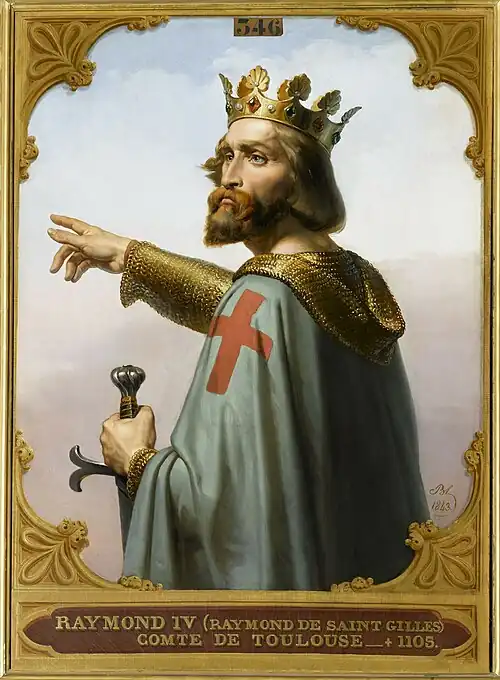
- July 28 – William Bertrand dies, and his margravial title of Provence is inherited by Raymond IV ("Saint-Gilles"), who becomes count of Toulouse (until 1105).
- November 12 – Donald III mobilizes his army and kills Duncan II in battle in the Scottish Lowlands, re-taking the Scottish throne.[3]
Fatimid Egypt
- After the death of Caliph al-Mustansir Billah, his son-in-law and vizier Al-Afdal declares al-Musta'li, a younger son of al-Mustansir, in a coup d'état as new Caliph. Al-Mustansir's designated heir, Nizar, flees to Alexandria.
Eastern Islamic world

- February 3 – Caliph of Baghdad al-Muqtadi dies and is succeeded by his nominated heir Ahmad (al-Mustazhir).
- October – Seljuk sultan Mahmud I dies after a 2-year reign. He is succeeded by his brother Barkiyaruq (one of the Seljuk princes who claim the throne) as ruler of the Seljuk Empire.
By topic
Religion
- May 15 – The Cathedral of St. Agatha in Catania (Sicily) is consecrated by the Breton abbot Ansger.
- October 8 – Doge Vitale Faliero consecrates the new Basilica of San Marco in Venice.
- King Ladislaus I of Hungary founds a diocese (alongside the bishop's see) in Zagreb.
- Al-Musta'li becomes the nineteenth imam of Musta'li Ismailism
Births
- January 14 – Eudokia Komnene, Byzantine princess (d. 1129)
- Abd al-Mu'min, Almohad caliph (approximate date)
- Ibn Zuhr (or Avenzoar), Moorish physician (d. 1162)
- Malachy, Irish archbishop and saint (d. 1148)
- Richard d'Avranches, 2nd Earl of Chester (d. 1120)
- Yelü Dashi, founder of the Qara Khitai (d. 1143)
Deaths
- January 10 – Al-Mustansir Billah, Fatimid caliph (b. 1029)
- February 3
- June 2 – Nicholas the Pilgrim, Italian shepherd (b. 1075)
- June 4 – Sancho V, king of Aragon and Pamplona
- July 28 – William Bertrand, margrave of Provence
- October 14
- October – Mahmud I, sultan of the Seljuk Empire
- November 12 – Duncan II, king of Scotland
- Abu Ali Fana-Khusrau, Buyid nobleman
- Al-Bakri, Moorish historian and geographer
- Aq Sunqur al-Hajib, Seljuk sultan of Aleppo
- Badr al-Jamali, Fatimid vizier and statesman
- Isaac Albalia, Andalusian Jewish astronomer (b. 1035)
- Jonathan I, Italo-Norman count of Carinola
- Michael of Avranches, Italian bishop
- Roger de Beaumont, Norman nobleman
- Roger de Montgomery, Norman nobleman
- Terken Khatun, Seljuk empress and regent
- William Fitzeustace, 1st Earl of Gloucester, Norman nobleman
- Wulfnoth Godwinson, English nobleman
References
- ^ Timothy Venning (2015). A Chronology of the Crusades, p. 24. ISBN 978-1-138-80269-8.
- ^ Picard C. (1997). La mer et les musulmans d'Occident au Moyen Age. Paris: Presses Universitaires de France.
- ^ a b Potter, Philip J. (2009). Gothic Kings of Britain: The Lives of 31 Medieval Rulers (1016–1399). Jefferson, NC: McFarland. pp. 127–128. ISBN 978-0-7864-4038-2.