1016
| Years |
|---|
| Millennium |
| 2nd millennium |
| Centuries |
| Decades |
| Years |
| 1016 by topic |
|---|
| Leaders |
|
| Birth and death categories |
| Births – Deaths |
| Establishments and disestablishments categories |
| Establishments – Disestablishments |
| Gregorian calendar | 1016 MXVI |
| Ab urbe condita | 1769 |
| Armenian calendar | 465 ԹՎ ՆԿԵ |
| Assyrian calendar | 5766 |
| Balinese saka calendar | 937–938 |
| Bengali calendar | 422–423 |
| Berber calendar | 1966 |
| English Regnal year | N/A |
| Buddhist calendar | 1560 |
| Burmese calendar | 378 |
| Byzantine calendar | 6524–6525 |
| Chinese calendar | 乙卯年 (Wood Rabbit) 3713 or 3506 — to — 丙辰年 (Fire Dragon) 3714 or 3507 |
| Coptic calendar | 732–733 |
| Discordian calendar | 2182 |
| Ethiopian calendar | 1008–1009 |
| Hebrew calendar | 4776–4777 |
| Hindu calendars | |
| - Vikram Samvat | 1072–1073 |
| - Shaka Samvat | 937–938 |
| - Kali Yuga | 4116–4117 |
| Holocene calendar | 11016 |
| Igbo calendar | 16–17 |
| Iranian calendar | 394–395 |
| Islamic calendar | 406–407 |
| Japanese calendar | Chōwa 5 (長和5年) |
| Javanese calendar | 918–919 |
| Julian calendar | 1016 MXVI |
| Korean calendar | 3349 |
| Minguo calendar | 896 before ROC 民前896年 |
| Nanakshahi calendar | −452 |
| Seleucid era | 1327/1328 AG |
| Thai solar calendar | 1558–1559 |
| Tibetan calendar | ཤིང་མོ་ཡོས་ལོ་ (female Wood-Hare) 1142 or 761 or −11 — to — མེ་ཕོ་འབྲུག་ལོ་ (male Fire-Dragon) 1143 or 762 or −10 |
Year 1016 (MXVI) was a leap year starting on Sunday of the Julian calendar.
Events
By place
Europe
- March 25 – Battle of Nesjar (off the coast of Norway): Olaf Haraldsson is victorious over former co-regent Sweyn Haakonsson, confirming his status as king of Norway.
- April 23 – Æthelred the Unready, king of England, dies after a 38-year reign. He is succeeded by his son Edmund II "Ironside".[1]
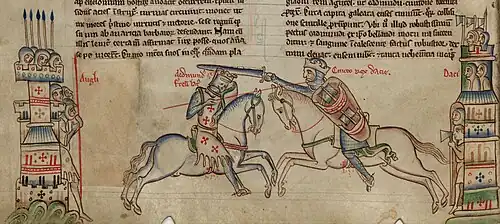
- Summer – Battle of Brentford (near London): Edmund Ironside defeats the Danes under King Cnut.[2]
- July 6 – Battle of Pontlevoy: French forces of Fulk III and Herbert I defeat Odo II which determines the balance of power in the Loire Valley.[3]
- October 18 – Battle of Assandun: Cnut defeats Edmund Ironside, leaving the latter as king of Wessex.[1]
- November 30 – Edmund II dies and Cnut takes control of the whole of the Kingdom of England.[1]
- The Pisan and the Genoese republics launch a naval offensive against the Muslim strongholds of Sardinia, in particular Porto Torres, and defeat the fleet of the taifa king of Dénia, Mujāhid al-ʿĀmirī.[4]
- Melus of Bari makes a second attempt against Byzantine-held Southern Italy. To support his cause, he hires Norman mercenaries, unwittingly triggering the rise of Norman rule over southern Italy.[5]
- Georgius Tzul, ruler of Khazaria, is captured by a combined Byzantine Empire–Kievan Rus' force, which effectively ends Khazaria's existence.
Arabian Empire
- January 7 – Fath al-Qal'i, governor of the Citadel of Aleppo, revolts against Emir Mansur ibn Lu'lu', forcing him to flee. Fath accepts an agreement with Salih ibn Mirdas and takes control of Aleppo.
Asia
- March 10 – Emperor Sanjō of Japan abdicates the throne after a 5-year reign. He is succeeded by his 7-year-old cousin Go-Ichijō as the 68th emperor of Japan. Fujiwara no Michinaga is appointed regent.
- Japanese poet Koshikibu no Naishi (lady-in-waiting to Dowager Empress Shōshi) and her husband Fujiwara no Kiminari (son of Michinaga) have a son, but the couple is not accepted because of the social gap between them.[6]
Births
- April 3 – Xing Zong, emperor of the Liao dynasty (d. 1055)
- June 9 – Deokjong, ruler of Goryeo (Korea) (d. 1034)
- July 25 – Casimir I the Restorer, duke of Poland (d. 1058)
- August 24 – Fujiwara no Genshi, Japanese empress (d. 1039)
- October 28 – Henry III, Holy Roman Emperor (d. 1056)
- Cao, empress and regent of Song dynasty China (d. 1079)
- Edward the Exile, son of Edmund II of England (d. 1057)
- Không Lộ, Vietnamese Zen master (approximate date)
- Minamoto no Tsunenobu, Japanese nobleman (d. 1097)
- Svein Knutsson, king of Norway (d. 1035)
- Yan Vyshatich, Kievan nobleman (d. 1106)
Deaths
- April 23 – Æthelred the Unready, king of England
- May 22 – Jovan Vladimir, Serbian prince (b. 990)
- September 6 – Fujiwara no Bokushi, great-grandmother of the Emperor of Japan
- October 18
- Ælfric of Hampshire, English nobleman
- Eadnoth the Younger, bishop of Dorchester in England
- Ulfcytel Snillingr, English nobleman
- November 30 – Edmund II "Ironside", king of England
- Badis ibn Mansur, Muslim emir of the Zirid dynasty
- Henry II "the Good", count of Stade (b. 946)
- Liu Chenggui, official of Song dynasty China (b. 951)
- Simeon of Mantua, Armenian Benedictine monk
- Sulayman ibn al-Hakam, caliph of Córdoba
- Uhtred the Bold, English nobleman
- Wulfgar of Abingdon, English abbot
References
- ^ a b c Williams 2005.
- ^ Palmer & Palmer 1992.
- ^ Bradbury 2004.
- ^ Benvenuti 1985.
- ^ Kleinhenz 2010.
- ^ "Koshikibu no Naishi", Mypaedia, Hitachi Systems & Services, 2007.
Sources
- Ambraseys, N. (2009). Earthquakes in the Mediterranean and Middle East: A Multidisciplinary Study of Seismicity up to 1900 (First ed.). Cambridge University Press. pp. 259, 260. ISBN 978-0521872928.
- Benvenuti, Gino (1985). Le Repubbliche Marinare. Amalfi, Pisa, Genova e Venezia (in Italian). Rome: Newton & Compton Editori. p. 33. ISBN 978-8882895297.
- Kleinhenz, Christopher, ed. (2010). Medieval Italy: an encyclopedia. Vol. 1. Routledge. p. 95. ISBN 978-0415939294.
- Palmer, Alan; Palmer, Veronica (1992). Chronology of British History. London: Century Ltd / Barrie & Jenkins. pp. 48–49. ISBN 978-0712656160.
- Williams, Hywel (2005). Cassell's Chronology of World History. Weidenfeld & Nicolson. pp. 105–106. ISBN 978-0304357307.
- Bradbury, Jim (2004). The Routledge Companion to Medieval Warfare. ISBN 0-415-22126-9.