1434
| Years |
|---|
| Millennium |
| 2nd millennium |
| Centuries |
| Decades |
| Years |
| 1434 by topic |
|---|
| Arts and science |
|
| Leaders |
|
| Birth and death categories |
| Births – Deaths |
| Establishments and disestablishments categories |
| Establishments – Disestablishments |
| Art and literature |
| 1434 in poetry |
| Gregorian calendar | 1434 MCDXXXIV |
| Ab urbe condita | 2187 |
| Armenian calendar | 883 ԹՎ ՊՁԳ |
| Assyrian calendar | 6184 |
| Balinese saka calendar | 1355–1356 |
| Bengali calendar | 840–841 |
| Berber calendar | 2384 |
| English Regnal year | 12 Hen. 6 – 13 Hen. 6 |
| Buddhist calendar | 1978 |
| Burmese calendar | 796 |
| Byzantine calendar | 6942–6943 |
| Chinese calendar | 癸丑年 (Water Ox) 4131 or 3924 — to — 甲寅年 (Wood Tiger) 4132 or 3925 |
| Coptic calendar | 1150–1151 |
| Discordian calendar | 2600 |
| Ethiopian calendar | 1426–1427 |
| Hebrew calendar | 5194–5195 |
| Hindu calendars | |
| - Vikram Samvat | 1490–1491 |
| - Shaka Samvat | 1355–1356 |
| - Kali Yuga | 4534–4535 |
| Holocene calendar | 11434 |
| Igbo calendar | 434–435 |
| Iranian calendar | 812–813 |
| Islamic calendar | 837–838 |
| Japanese calendar | Eikyō 6 (永享6年) |
| Javanese calendar | 1349–1350 |
| Julian calendar | 1434 MCDXXXIV |
| Korean calendar | 3767 |
| Minguo calendar | 478 before ROC 民前478年 |
| Nanakshahi calendar | −34 |
| Thai solar calendar | 1976–1977 |
| Tibetan calendar | ཆུ་མོ་གླང་ལོ་ (female Water-Ox) 1560 or 1179 or 407 — to — ཤིང་ཕོ་སྟག་ལོ་ (male Wood-Tiger) 1561 or 1180 or 408 |
Year 1434 (MCDXXXIV) was a common year starting on Friday of the Julian calendar.
Events
January–March
- January 9 – (Rajab 9, 837 AH) King Alfonso V of Aragon ruler of the Kingdom of Sicily as well, contracts with tapestry weaver Guillem d'Uxelles to Flanders to begin learning the Flemish methods to be duplicated in Spain, beginning the "Hispano-Flemish" style.[1]
- February 19 – In India, Mubarak Shah II, the Sultan of Delhi, is assassinated. His nephew, Muhammad Shah IV becomes the new Sultan.[2]
- March 16 – Muscovite War of Succession: Yury of Zvenigorod defeats his nephew, Vasily II, Grand Prince of Moscow, in a battle at Rostov, about 125 miles (201 km) from Moscow.[3]
- March 31 – Yury of Zvenigorod marches into Moscow with his army and plunders Vasily II's treasury.
April–June
- April 14 – The foundation stone of Nantes Cathedral in Nantes, Brittany, is laid.[4]
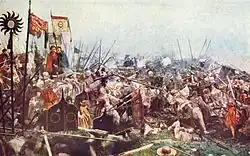
- May 30 – Hussite Wars – Battle of Lipany: The Catholics and Utraquists defeat the Taborites, ending the Hussite Wars.[5]
- June 20 – Zara Yaqob becomes Emperor of Ethiopia.[6]
- June 24 – Iron mine owner Engelbrekt Engelbrektsson begins the Engelbrekt rebellion in Sweden against King Erik, starting with an attack against the town of Borlänge, followed by Köpingehus, burning down offices there and then marching on towards Västerås.[7]
July–September
- July 5– Slightly more than three months after claiming the Grand Principality of Moscow, Yury of Zvenigorod dies suddenly at the age of 59 and is succeeded by his son, Vasily Kosoy.[3]
- July 10– In the Kingdom of León in Spain, Suero de Quiñones and his companions stage the Passo Honroso, at the bridge across the Órbigo River near Santiago de Compostela. Any knight attempting to cross the bridge is challenged to a joust by the Quiñones knights. The challenge continues for the next 30 days.[8]
- July 25 – The coronation of Wladyslaw III as King of Poland takes place at the Wawel Cathedral in Kraków.[9]
- August 9 – After fighting 166 jousts, and sustaining injuries over a month, Quiñones and his men end the Passo Honroso.[8]
- August 16 – King Eric of Pomerania is deposed from the Swedish throne at a meeting in Vadstena, though he still retains power in Denmark and Norway.
- August – Portuguese explorer Gil Eanes and his crew sail around the dangerous Cape Bojador of North Africa (off of Western Sahara) and survive, becoming the first Europeans to make the voyage and ending the legends about what lies on the other side of the "Dark Sea". The achievement is a breakthrough in trade between Europe and Asia.[10]
- September 29 – Pope Eugene IV issues the papal bull Regimini gregis, condemning the enslavement by the Kingdom of Castile of the Guanches, the indigenous people of the Canary Islands. An order to free the slaves follows three months later.[11]
October–December
- October 6 – Cosimo de' Medici returns to Florence, one year after being exiled by the Albizzi and Strozzi faction.[12]
- October 21 – The University of Catania is founded in Italy.[13]
- November 12 –
- René of Anjou becomes the new Count of Provence and Duke of Anjou, as well as a claimant to the title of King of Naples, upon the death of his brother, Louis III.
- Bishop Nils Ragvaldsson of Sweden delivers a speech at the Council of Basel, arguing the Kingdom of Sweden and its monarch, Eric of Pomerania deserve senior rank over the Spanish delegation.[14]
- December 17 – Pope Eugene IV issues the papal bull Creator Omnium, directing the freedom of the Canary Island slaves within 15 days after the bull is received.
Date unknown
- Jan van Eyck paints the Arnolfini Portrait.[15]
- In Ming Dynasty China, a long episode of drought, flood, locust infestation, and famine cripple agriculture and commerce in areas throughout the country, until 1448.
Births
- January 7 – Adolf, Duke of Bavaria (d. 1441)
- March 12 – William III, Count of Henneberg-Schleusingen (d. 1480)
- March 19 – Ashikaga Yoshikatsu, Japanese shōgun (d. 1443)
- March 25 – Eustochia Smeralda Calafato, Italian saint (d. 1485)
- June 13 – Cristoforo della Rovere, Roman Catholic cardinal (d. 1478)
- September 18 – Eleanor of Portugal, Holy Roman Empress (d. 1467)[16]
- September 23 – Yolande of Valois, Duchess consort of Savoy (d. 1478)
- December 28 – Antonio Grimani, Italian admiral (d. 1523)
- probable
- Antoinette de Maignelais, mistress of Charles VII of France (d. 1474)
- Isabella of Bourbon, Burgundian countess, spouse of Charles the Bold (d. 1465)
- Matteo Maria Boiardo, Italian poet (d. 1494)
- Kano Masanobu, Japanese painter (d. 1530)
Deaths
- January – John I, Duke of Bourbon (b. 1381)[17]
- April 20 – Alexandra of Lithuania, Duchess of Masovia
- May 30 – Prokop the Great, Hussite general (b. 1380)
- June – Amda Iyasus, Emperor of Ethiopia[18]
- June 1 – King Wladislaus II of Poland (age unknown)[19]
- June 5 – Yuri IV, Russian grand prince (b. 1374)
- November 12 – King Louis III of Anjou (b. 1403)
References
- ^ Velasco González, Alberto; Fité i Llevot, Francesc (2018). Late Gothic painting in the Crown of Aragon and the Hispanic kingdoms. Leiden Boston: Brill. ISBN 978-90-04-36384-7.
- ^ Jackson, Peter (2003). The Delhi Sultanate : a political and military history (1st ed.). Cambridge: Cambridge University Press. ISBN 9780521543293.
- ^ a b Sergei Mikhailovich Soloviev, History of Russia from Ancient Times (in Russian), Vol. 4
- ^ Kibler, William W.; Zinn, Grover A. (1995). Earp, Lawrence; Henneman, Jr., John Bell (eds.). Medieval France: An Encyclopedia. Psychology Press. p. 772. ISBN 9780824044442.
- ^ Hugh LeCaine Agnew (2004). The Czechs and the Lands of the Bohemian Crown. Hoover Press. p. 91. ISBN 978-0-8179-4492-6.
- ^ Carlo Zaghi (1973). L'Africa nella coscienza europea e l'imperialismo italiano (in Italian). Guida.
- ^ Lars-Olof Larsson, Kalmarunionens tid : Från Drottning Margareta till Kristian II (Rabén Prisma, 1997)
- ^ a b "Suero de Quiñones". Diccionario Biográfico electrónico. Real Academia de la Historia. Retrieved 10 March 2023.
- ^ Reddaway, W. F.; Penson, J. H. (1950). The Cambridge history of Poland from the origins to Sobieski - to 1696. Cambridge: University Press. p. 234. ISBN 978-1-001-28802-4. OCLC 877250752.
{{cite book}}: ISBN / Date incompatibility (help) - ^ Butel, Paul (2002-03-11). The Atlantic. London New York: Routledge. ISBN 978-1-134-84305-3.
- ^ Manuel Lopes de Almeida, et al., Monumenta Henricina Volume 5, (Coimbra, 1963) pp. 89-93
- ^ Randolph Starn (1 January 1982). Contrary Commonwealth: The Theme of Exile in Medieval and Renaissance Italy. University of California Press. p. 105. ISBN 978-0-520-04615-3.
- ^ The Universities of Italy: Fascist University Groups. Printing works of the Istituto italiano d'arti grafiche. 1934. p. 187.
- ^ Werner Söderberg (1896), "Nikolaus Ragvaldis tal i Basel 1434", Samlaren, vol. 17, p. 187
- ^ Edwin Hall (1 January 1997). The Arnolfini Betrothal: Medieval Marriage and the Enigma of Van Eyck's Double Portrait. University of California Press. ISBN 978-0-520-21221-3.
- ^ Anne Commire; Deborah Klezmer (2000). Women in World History: A Biographical Encyclopedia. Yorkin Publications. p. 106. ISBN 978-0-7876-4064-4.
- ^ Le Correspondant: religion, philosophie, politique (in French). V.-A. Waille. 1872. p. 911.
- ^ British Museum. Dept. of Oriental Printed Books and Manuscripts; William Wright (1877). Catalogue of the Ethiopic Manuscripts in the British Museum Acquired Since the Year 1847. British Museum. p. 7.
- ^ Sedlar, Jean W. (1994), East Central Europe in the Middle Ages, 1000–1500, Seattle: University of Washington Press, p. 388, ISBN 978-0-295-97290-9