827
| Years |
|---|
| Millennium |
| 1st millennium |
| Centuries |
| Decades |
| Years |
| 827 by topic |
|---|
| Leaders |
|
| Categories |
|
| Gregorian calendar | 827 DCCCXXVII |
| Ab urbe condita | 1580 |
| Armenian calendar | 276 ԹՎ ՄՀԶ |
| Assyrian calendar | 5577 |
| Balinese saka calendar | 748–749 |
| Bengali calendar | 233–234 |
| Berber calendar | 1777 |
| Buddhist calendar | 1371 |
| Burmese calendar | 189 |
| Byzantine calendar | 6335–6336 |
| Chinese calendar | 丙午年 (Fire Horse) 3524 or 3317 — to — 丁未年 (Fire Goat) 3525 or 3318 |
| Coptic calendar | 543–544 |
| Discordian calendar | 1993 |
| Ethiopian calendar | 819–820 |
| Hebrew calendar | 4587–4588 |
| Hindu calendars | |
| - Vikram Samvat | 883–884 |
| - Shaka Samvat | 748–749 |
| - Kali Yuga | 3927–3928 |
| Holocene calendar | 10827 |
| Iranian calendar | 205–206 |
| Islamic calendar | 211–212 |
| Japanese calendar | Tenchō 4 (天長4年) |
| Javanese calendar | 723–724 |
| Julian calendar | 827 DCCCXXVII |
| Korean calendar | 3160 |
| Minguo calendar | 1085 before ROC 民前1085年 |
| Nanakshahi calendar | −641 |
| Seleucid era | 1138/1139 AG |
| Thai solar calendar | 1369–1370 |
| Tibetan calendar | མེ་ཕོ་རྟ་ལོ་ (male Fire-Horse) 953 or 572 or −200 — to — མེ་མོ་ལུག་ལོ་ (female Fire-Sheep) 954 or 573 or −199 |
Year 827 (DCCCXXVII) was a common year starting on Tuesday of the Julian calendar.
Events
By place
Byzantine Empire
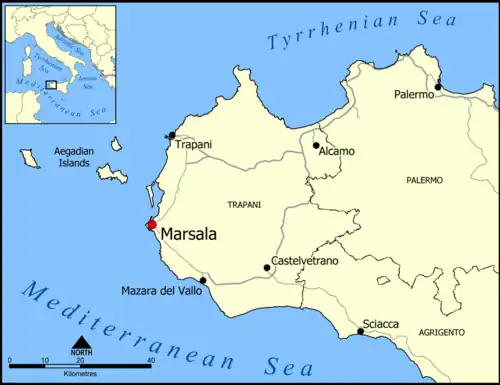
- June 14 – Euphemius, exiled Byzantine admiral, asks for the help of North African Arabs, to retake Sicily and Malta from the Byzantines.[1] Emir Ziyadat Allah I of Ifriqiya promises to return the islands to Euphemius, in exchange for a yearly tribute, and sends an Arab Muslim expeditionary force of 10,000 men under the 70-year-old Asad ibn al-Furat, which lands at Mazara del Vallo in Sicily.
- Fall – Siege of Syracuse: Muslim forces under Asad ibn al-Furat, in support of the rebel Byzantine army, besiege Syracuse, Sicily.[2]
Europe
- Summer – Omurtag, ruler (khan) of the Bulgarian Empire, launches an attack to the West, and penetrates into Pannonia. He expels the local chiefs, and installs Bulgar governors over the Slavic tribes to control them. Omurtag conquers the cities of Beograd, Braničevo, Sirmium, and most of eastern Slavonia.[3]
- Giustiniano Participazio deposes his younger brother Giovanni I, and is appointed doge of Venice. Giovanni, who is part of a pro-Frankish faction, is exiled to Zara (modern Croatia).
Britain
- Æthelstan establishes himself as king of East Anglia, after killing King Ludeca of Mercia in battle. Ludeca is succeeded by Wiglaf, father-in-law (and probably distant cousin) of the late king Ceolwulf I's daughter.
China
- Emperor Jing Zong is assassinated by a group of conspirators. He is succeeded by his brother Wen Zong, as ruler of the Tang Dynasty.
By topic
Religion
- August 27 – Pope Eugene II dies after a 3-year reign, and is succeeded by Valentine as the 100th pope of the Catholic Church.
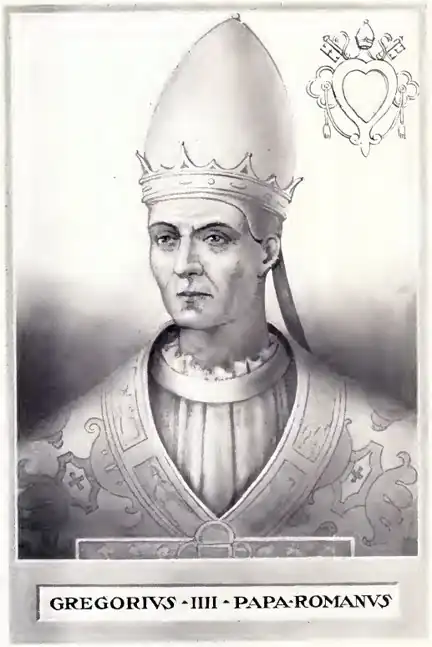
- October 10 – Pope Valentine dies just after a two-month reign, and is succeeded by Gregory IV as the 101st pope of Rome.
Science
- Khalid ibn Abd al-Malik al-Marwarrudhi and Ali ibn Isa al-Asturlabi travel to the Plain of Sinjar (modern Iraq), under orders of Caliph Al-Ma'mun, to measure the size of the Earth.
Agriculture
- The Saracens, who found spinach originally in Persia (modern Iran), introduce the plant to Sicily.[4]
Births
- Cyril, Byzantine missionary and bishop (d. 869)
- Ibn al-Rawandi, Muslim scholar and writer (d. 911)
- Maura of Troyes, Frankish noblewoman and saint (d. 850)
Deaths
- January 1 – Adalard of Corbie, Frankish abbot
- August 27 – Eugene II, pope of the Catholic Church
- October 10 – Valentine, pope of the Catholic Church
- Agnello Participazio, doge of Venice
- Claudius, archbishop of Turin
- Grigol of Kakheti, Georgian prince
- Guillemundus, Frankish nobleman
- Hildegrim, bishop of Châlons
- Jing Zong, emperor of the Tang Dynasty (b. 809)
- Li Yi, Chinese poet (or 829)
- Ludeca, king of Mercia
- Wu Chongyin, Chinese general (b. 761)
- Yaoshan Weiyan, Chinese Buddhist monk (b. 745)
References
- ^ Peter Sammartino and William Roberts, Sicily: An Informal History, p. 43.
- ^ Gilbert Meynier (2010) L'Algérie cœur du Maghreb classique. De l'ouverture islamo-arabe au repli (658-1518). Paris: La Découverte; p. 23.
- ^ John V.A. Fine, Jr. (1991). The Early Medieval Balkans: A Critical Survey from the Sixth to the Late Twelfth Century, p. 107. ISBN 978-0-472-08149-3.
- ^ Rolland, Jacques L.; Sherman, Carol (2006). The Food Encyclopedia. Toronto: Robert Rose. pp. 335–338. ISBN 978-0-778-80150-4.