839
| Years |
|---|
| Millennium |
| 1st millennium |
| Centuries |
| Decades |
| Years |
| 839 by topic |
|---|
| Leaders |
|
| Categories |
|
| Gregorian calendar | 839 DCCCXXXIX |
| Ab urbe condita | 1592 |
| Armenian calendar | 288 ԹՎ ՄՁԸ |
| Assyrian calendar | 5589 |
| Balinese saka calendar | 760–761 |
| Bengali calendar | 245–246 |
| Berber calendar | 1789 |
| Buddhist calendar | 1383 |
| Burmese calendar | 201 |
| Byzantine calendar | 6347–6348 |
| Chinese calendar | 戊午年 (Earth Horse) 3536 or 3329 — to — 己未年 (Earth Goat) 3537 or 3330 |
| Coptic calendar | 555–556 |
| Discordian calendar | 2005 |
| Ethiopian calendar | 831–832 |
| Hebrew calendar | 4599–4600 |
| Hindu calendars | |
| - Vikram Samvat | 895–896 |
| - Shaka Samvat | 760–761 |
| - Kali Yuga | 3939–3940 |
| Holocene calendar | 10839 |
| Iranian calendar | 217–218 |
| Islamic calendar | 224–225 |
| Japanese calendar | Jōwa 6 (承和6年) |
| Javanese calendar | 736–737 |
| Julian calendar | 839 DCCCXXXIX |
| Korean calendar | 3172 |
| Minguo calendar | 1073 before ROC 民前1073年 |
| Nanakshahi calendar | −629 |
| Seleucid era | 1150/1151 AG |
| Thai solar calendar | 1381–1382 |
| Tibetan calendar | ས་ཕོ་རྟ་ལོ་ (male Earth-Horse) 965 or 584 or −188 — to — ས་མོ་ལུག་ལོ་ (female Earth-Sheep) 966 or 585 or −187 |
Year 839 (DCCCXXXIX) was a common year starting on Wednesday of the Julian calendar.
Events
By place
Europe
- Prince Sicard of Benevento is assassinated by a conspiracy among the nobility. He is succeeded by Radelchis I, chief army officer and treasurer of Sicard, who proclaims himself ruler of Benevento. He imprisons Siconulf, heir and brother of Sicard, in Taranto. But Amalfitan merchants, led by Landulf I, the gastald of Capua, and with the support of Guaifer, rescue him from prison. Siconulf is proclaimed prince of Salerno, and a civil war erupts, which splits the Lombard principality in Southern Italy.[1]
- Third Civil War: King Louis the German, grandson of Charlemagne, invades Swabia. His nephew, Pepin II of Aquitaine, and his Gascon subjects, conquer territory all the way to the Loire.
- May 20 — Thirteen months before his death, Louis the Pious, successor to his father Charlemagne, consents to the division of Charlemagne's empire among his sons in a declaration at Worms. Upon Louis I's death in 840, Lothair (age 45) is devised Middle Francia that includes Switzerland and northern Italy; Louis the German (Louis II), age 36, receives Eastern Francia that includes much of Germany; and Charles the Bald (17) gets West Francia that incorporates most of France.
- The Hungarians (also known as Magyars) who until this time have lived east of the Carpathians, raid the Lower Danube at the request of the Bulgarian Empire against the Byzantine insurgents.[2]
- Approximate date – Danish Vikings return to ravage the Frisian coast (sacking Dorestad for the second time).
- The first official mention of Andorra is recorded, in the manuscripts of the cathedral at La Seu d'Urgell (modern Spain).
Britain
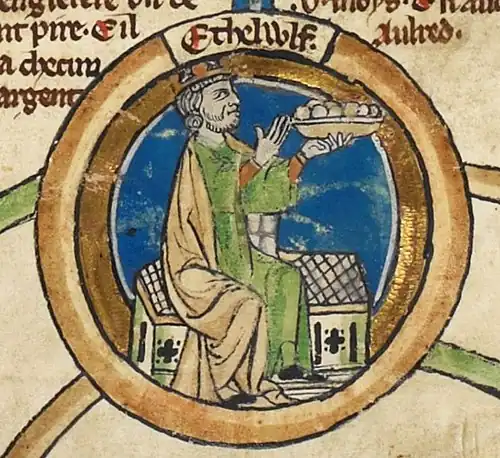
- Ecgberht, King of Wessex, dies after a 37-year reign, and is succeeded by his son Æthelwulf ("Noble Wolf") as ruler of Wessex. Æthelwulf's eldest son, Æthelstan, is made sub-king of Kent, Essex, Surrey and Sussex, under his father.[3]
- Battle of 839: Eóganan mac Óengusa, King of the Picts, his brother Bran, Áed mac Boanta, King of Dál Riata, "and others almost innumerable" are killed in a battle fought by the men of Fortriu in Scotland against Vikings.[4] Alpín mac Echdach (Alpín II) apparently succeeds Áed.
Births
- Charles the Fat, Frankish emperor (d. 888)
- He Quanhao, general of the Tang dynasty (d. 870)
- Liu Chongwang, Chancellor of the Tang dynasty (d. 900)
- Muhammad ibn Jarir al-Tabari, Persian scholar (d. 923)
Deaths
- April 21 – Pei Du, chancellor of the Tang dynasty (b. 765)
- June 16 – Rorgon I, count of Maine (or 840)
- Áed mac Boanta, king of Dál Riata
- Aznar Galíndez I, king of Aragon
- Cathal mac Muirgiussa, king of Connacht
- Chengguan, Chinese Buddhist monk (b. 738)
- Cummascach mac Congalaig, king of Brega
- Ecgberht, king of Wessex
- Eóganan mac Óengusa, king of the Picts
- Ibrahim ibn al-Mahdi, Muslim prince (b. 779)
- Muhammad at-Taqi, Muslim ninth Ismā'īlī imam (or 840)
- Muiredach mac Eochada, king of Ulaid
- Sicard, prince of Benevento
- Vache, prince of Kakheti
- Wiglaf, king of Mercia
References
- ^ Kreutz, Barbara M (1991). Before the Normans: Southern Italy in the Ninth and Tenth Centuries, p. 23 (University of Pennsylvania, Press: Philadelphia).
- ^ Bóna, István (2000). The Hungarians and Europe in the 9th-10th centuries. Budapest: Historia - MTA Történettudományi Intézete, p. 11. ISBN 963-8312-67-X.
- ^ Stenton 1971, p. 231; Kirby 2000, pp. 155–56.
- ^ Annals of Ulster.