912
| Years |
|---|
| Millennium |
| 1st millennium |
| Centuries |
| Decades |
| Years |
| 912 by topic |
|---|
| Leaders |
|
| Categories |
|
| Gregorian calendar | 912 CMXII |
| Ab urbe condita | 1665 |
| Armenian calendar | 361 ԹՎ ՅԿԱ |
| Assyrian calendar | 5662 |
| Balinese saka calendar | 833–834 |
| Bengali calendar | 318–319 |
| Berber calendar | 1862 |
| Buddhist calendar | 1456 |
| Burmese calendar | 274 |
| Byzantine calendar | 6420–6421 |
| Chinese calendar | 辛未年 (Metal Goat) 3609 or 3402 — to — 壬申年 (Water Monkey) 3610 or 3403 |
| Coptic calendar | 628–629 |
| Discordian calendar | 2078 |
| Ethiopian calendar | 904–905 |
| Hebrew calendar | 4672–4673 |
| Hindu calendars | |
| - Vikram Samvat | 968–969 |
| - Shaka Samvat | 833–834 |
| - Kali Yuga | 4012–4013 |
| Holocene calendar | 10912 |
| Iranian calendar | 290–291 |
| Islamic calendar | 299–300 |
| Japanese calendar | Engi 12 (延喜12年) |
| Javanese calendar | 811–812 |
| Julian calendar | 912 CMXII |
| Korean calendar | 3245 |
| Minguo calendar | 1000 before ROC 民前1000年 |
| Nanakshahi calendar | −556 |
| Seleucid era | 1223/1224 AG |
| Thai solar calendar | 1454–1455 |
| Tibetan calendar | ལྕགས་མོ་ལུག་ལོ་ (female Iron-Sheep) 1038 or 657 or −115 — to — ཆུ་ཕོ་སྤྲེ་ལོ་ (male Water-Monkey) 1039 or 658 or −114 |
Year 912 (CMXII) was a leap year starting on Wednesday of the Julian calendar.
Events
By place
Byzantine Empire
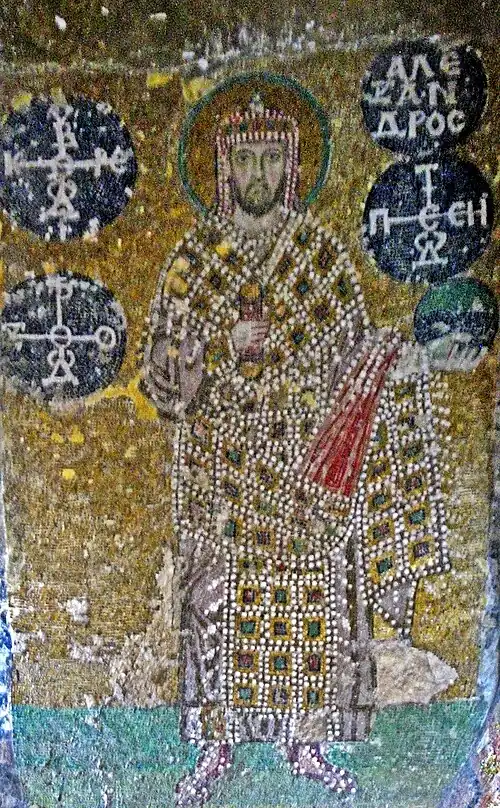
- May 11 – Emperor Leo VI (the Wise) dies after a 26-year reign, in which he has completed the Byzantine code of laws (Basilika). He is succeeded by his brother Alexander III as emperor (basileus) alongside Leo's 6-year-old son Constantine VII. Alexander becomes de facto ruler of the Byzantine Empire and expels Empress Zoe Karbonopsina, the mother of Constantine, from the palace and exiles her to a nunnery.[1]
Europe
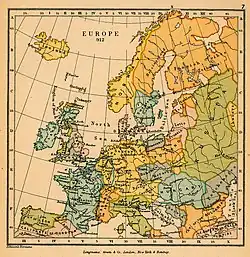
- German dukes Henry the Fowler of Saxony and Arnulf I (the Bad) of Bavaria claim themselves to be sovereign princes, not recognizing the authority of their overlord, King Conrad I of the East Frankish Kingdom, as he is not a Carolingian. Duke Erchanger II of Swabia and Conrad's brother, Duke Eberhard III of Franconia, support the Conradines.
- Orso II Participazio becomes the doge of Venice. He sends his son Pietro to Constantinople in order to re-establish the relationship with Alexander III.
- King Ordoño II of Galicia continues his expansion of the Christian polity. He sacks the cities of Mérida and Évora.[2]
Britain
- Lady Æthelflæd expands her policy by building defensive burghs at Shrewsbury and Bridgnorth. The fortifications are needed to protect Mercia against plundering Vikings from the Danelaw (Danish territory in England).[3]
Arabian Empire
- October 16 – Abd al-Rahman III succeeds his grandfather Abdullah ibn Muhammad (after his execution) and becomes emir of Córdoba (Al-Andalus).[4]
- The second rebellion in two years, of the Kutama tribesmen against the Fatimid Caliphate, occurs.[5]
China
- July 18 – Emperor Taizu (Zhu Wen) is murdered in the imperial palace at Kaifeng by his eldest living son Zhu Yougui after a 5-year reign. He succeeds his father as the ruler of Later Liang.
By topic
Religion
- Euthymius I is deposed as Patriarch of Constantinople, and Nicholas Mystikos is restored.
Births
- November 23 – Otto I, emperor of the Holy Roman Empire (d. 973)
- Alberic II, princeps and duke of Spoleto (d. 954)
- Frederick I, duke of Upper Lorraine (approximate date)
- Hyejong, king of Goryeo (Korea) (d. 945)
- Ma Xichong, governor and ruler of Chu (d. 951)
- Minamoto no Mitsunaka, Japanese nobleman and samurai (d. 997)
- Nakatsukasa, Japanese waka poet (d. 991)
- Nikephoros II, emperor of the Byzantine Empire (d. 969)
- Pelagius of Córdoba, Christian martyr (d. 926)
- Ryōgen, Japanese monk and abbot (d. 985)
- Willa of Tuscany, queen consort of Italy (or 911)
- Xue Juzheng, Chinese scholar-official and historian (d. 981)
Deaths
- May 11 – Leo VI, emperor of the Byzantine Empire (b. 866)
- May 25 – Xue Yiju, chancellor of Later Liang
- July 18 – Zhu Wen, emperor of Later Liang (b. 852)
- August 15 – Han Jian, Chinese warlord (b. 855)
- October 15 – Abdullah ibn Muhammad, Muslim emir (b. 844)
- October 25 – Rudolph I, king of Burgundy (b. 859)
- November 30 – Otto I, duke of Saxony
- Ahmad ibn Yusuf, Muslim mathematician (b. 835)
- Guanxiu, Chinese Buddhist monk and poet (b. 832)
- Hermenegildo Gutiérrez, Galician nobleman
- Hyogong, king of Silla (Korea) (b. 885)
- Ibn Khordadbeh, Persian geographer
- Notker the Stammerer, Benedictine monk
- Oleg of Novgorod, Varangian prince
- Pietro Tribuno, doge of Venice (approximate date)
- Qusta ibn Luqa, Syrian Melkite physician (b. 820)
- Rudalt, Breton nobleman (approximate date)
- Smbat I, king of Armenia (approximate date)
- Wilferth, bishop of Lichfield (approximate date)
- Zhang Ce, chancellor of Later Liang
- Zhu Youwen, prince of Later Liang
References
- ^ Ostrogorsky (1969), p. 261.
- ^ Picard, Christophe (2000). Le Portugal musulman (VIIIe-XIIIe siècle. L'Occident d'al-Andalus sous domination islamique. Paris: Maisonneuve & Larose. p. 109. ISBN 2-7068-1398-9.
- ^ Yorke. Kings and Kingdoms of Early Anglo-Saxon England, p. 123.
- ^ Rucquoi, Adeline (1993). Histoire médiévale de la Péninsule ibérique. Paris: Seuil. p. 87. ISBN 2-02-012935-3.
- ^ Gilbert Meynier (2010) L'Algérie cœur du Maghreb classique. De l'ouverture islamo-arabe au repli (658-1518). Paris: La Découverte; p. 39.