944
| Years |
|---|
| Millennium |
| 1st millennium |
| Centuries |
| Decades |
| Years |
| 944 by topic |
|---|
| Leaders |
|
| Categories |
|
| Gregorian calendar | 944 CMXLIV |
| Ab urbe condita | 1697 |
| Armenian calendar | 393 ԹՎ ՅՂԳ |
| Assyrian calendar | 5694 |
| Balinese saka calendar | 865–866 |
| Bengali calendar | 350–351 |
| Berber calendar | 1894 |
| Buddhist calendar | 1488 |
| Burmese calendar | 306 |
| Byzantine calendar | 6452–6453 |
| Chinese calendar | 癸卯年 (Water Rabbit) 3641 or 3434 — to — 甲辰年 (Wood Dragon) 3642 or 3435 |
| Coptic calendar | 660–661 |
| Discordian calendar | 2110 |
| Ethiopian calendar | 936–937 |
| Hebrew calendar | 4704–4705 |
| Hindu calendars | |
| - Vikram Samvat | 1000–1001 |
| - Shaka Samvat | 865–866 |
| - Kali Yuga | 4044–4045 |
| Holocene calendar | 10944 |
| Iranian calendar | 322–323 |
| Islamic calendar | 332–333 |
| Japanese calendar | Tengyō 7 (天慶7年) |
| Javanese calendar | 844–845 |
| Julian calendar | 944 CMXLIV |
| Korean calendar | 3277 |
| Minguo calendar | 968 before ROC 民前968年 |
| Nanakshahi calendar | −524 |
| Seleucid era | 1255/1256 AG |
| Thai solar calendar | 1486–1487 |
| Tibetan calendar | ཆུ་མོ་ཡོས་ལོ་ (female Water-Hare) 1070 or 689 or −83 — to — ཤིང་ཕོ་འབྲུག་ལོ་ (male Wood-Dragon) 1071 or 690 or −82 |
Year 944 (CMXLIV) was a leap year starting on Monday of the Julian calendar.
Events
By place
Byzantine Empire
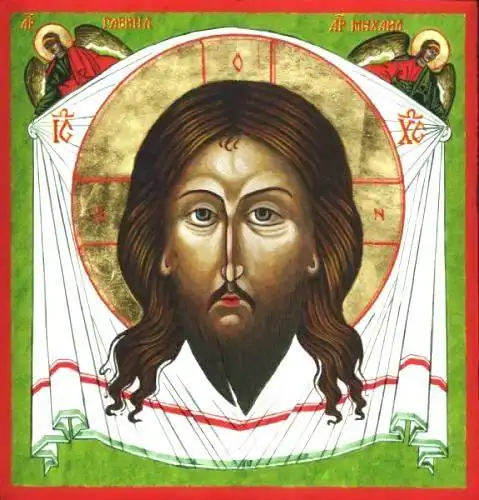
- Arab–Byzantine War: Byzantine forces are defeated by Sayf al-Dawla. He captures the city of Aleppo, and extends his control over the Al-Jazira–Upper Mesopotamia region. Al-Dawla's rule is recognized by the Ikhshidids.[1] With the recovery of Edessa, the Greeks also obtain the fabled Image of Edessa.
- August 15 – The "Holy Mandylion" (a cloth with the face of Jesus) is conveyed to Constantinople, where it arrives on the feast of the Dormition of the Theotokos. A triumphal entry is staged for the relic in the capital.
- December 16 – Emperor Romanos I is arrested and deposed after a 14-year reign by his own sons, the co-emperors Stephen and Constantine. He is carried off to the Prince Islands and forced to become a monk.
Europe
- King Hugh of Provence dispatches an embassy to King Otto I of the East Frankish Kingdom, offering a large sum of cash if he promises not to provide assistance to Berengar of Ivrea. Otto refuses this offer.
- Raymond III (or Pons I), count of Toulouse, travels to Nevers (southeast of Paris) to declare his fidelity to king Louis IV ("d'Outremer"). He is granted the title 'prince of the Aquitanians' by the king.[2]
- The largest recorded epidemic of ergotism, also known as "Saint Anthony's Fire, kills 40,000 people in France.[3]
England
- King Edmund I regains (with the help of Danish settlers) the territory he ceded to Olaf Guthfrithson. He conquers Northumbria and cedes Cumberland to Malcolm I, king of the 'Picts and Scots'.
- A great storm sweeps across Wessex and many houses are destroyed, 1,500 in London alone (a significant proportion of the town).[4]
Africa
- Abu Yazid, a Kharijite Berber leader, launches a rebellion in the Aurès Mountains (modern Algeria) against the Fatamids, seeking aid from the Caliphate of Córdoba in Al-Andalus.
- The cities of Algiers and Miliana are re-founded by the Zirid ruler (emir) Buluggin ibn Ziri.
Asia
- In Tĩnh Hải quân, after the demise of Ngô Quyền, Dương Tam Kha forced Ngô Xương Ngập, Kha's nephew-in-law, to abdicate and installed himself as king, calling himself Dương Bình Vương (King Ping of Yang).[5]
By topic
Religion
- The Al-Askari Mosque is built in Samarra (modern Iraq).
Births
- Abd al-Malik I, Samanid emir (d. 961)
- Al-Mu'ayyad Ahmad, Muslim imam (d. 1020)
- Fujiwara no Akimitsu, Japanese bureaucrat (d. 1021)
- Fujiwara no Sukemasa, Japanese statesman (d. 998)
- Ibn Juljul, Muslim physician (approximate date)
- John VIII bar Abdoun, patriarch of Antioch (d. 1033)
- Otto (or Odo), duke of Burgundy (d. 965)
Deaths
- February 25 – Lin Ding, Chinese official and chancellor
- April 8 – Wang Yanxi, emperor of Min (Ten Kingdoms)
- April 23 – Wichmann the Elder, Frankish nobleman
- Abu Mansur al-Maturidi, Muslim theologian (b. 853)
- Abu Tahir al-Jannabi, Qarmatian ruler (b. 906)
- Ch'oe Ŏn-wi, Korean minister and calligrapher (b. 868)
- Donnchad Donn, High King of Ireland
- Flaithbertach mac Inmainén, Irish abbot
- Mahipala I, Gurjara-Pratihara king
- Liu Hongchang, Chinese chancellor
- Fang Gao, Chinese official and chief of staff
- Li, empress of Min (Ten Kingdoms)
- Wang Yacheng, Chinese prince
- Duan Siping, ruler of Dali (approximate date)
- Ngo Quyen, Vietnamese king
- Harshavarman II, Angkorian king
References
- ^ Treadgold, Warren T. (1997), A History of the Byzantine State and Society, Stanford, CA: Stanford University Press, p. 486, ISBN 978-0-8047-2630-6.
- ^ Timothy Reuter (1999). The New Cambridge Medieval History, Volume III, p. 429. ISBN 978-0-521-36447-8.
- ^ Lewis' Dictionary of Toxicology, p. 286 ISBN 9781566702232
- ^ Stratton, J.M. (1969). Agricultural Records. John Baker. ISBN 0-212-97022-4.
- ^ Ngô Sĩ Liên (1993), Đại Việt sử ký toàn thư, page 54, Peripheral Records vol. 5, "Dương Tam Kha"