1390s
| Millennia |
|---|
| 2nd millennium |
| Centuries |
| Decades |
| Years |
| Categories |
|
The 1390s was a decade of the Julian Calendar which began on January 1, 1390, and ended on December 31, 1399.
Events
1390
January–December
- January 19 – The Treaty of Lyck confirms an alliance between Vytautas and the Teutonic Knights, in the Lithuanian Civil War against Vytautas's cousin, Jogaila.
- April 14 – John VII Palaiologos overthrows his grandfather, John V Palaiologos, as Byzantine Emperor.
- April 19 – Robert III succeeds his father, Robert II, as King of Scotland.
- May 26 – Lithuanian Civil War: The Treaty of Königsberg is signed in Königsberg, between Samogitian nobles and representatives of the Teutonic Knights.[1]
- September 11 – Lithuanian Civil War: The coalition of Vytautas and the Teutonic Knights begins a 5-week siege of Vilnius. The Duke of Hereford (the future King Henry IV of England) is among the western European knights serving with the coalition.[2]
- September 17 – John VII Palaiologos seeks refuge with the Ottoman sultan Bayezid I, after John V Palaiologos is restored by his son, Manuel, and the Republic of Venice.
- October 9 – Henry III succeeds his father, John I, as King of Castile and León.
Date unknown
- Fall of Philadelphia
- Barquq is restored as Mamluk Sultan of Egypt, after overthrowing Sultan Hadji II.
- Nasir ud din Muhammad Shah III overthrows his brother, Abu Bakr Shah, as Sultan of Delhi.
- Manuel III succeeds his father, Alexios III, as Emperor of Trebizond (now north eastern Turkey).
- Sikandar But-shikan succeeds Sikandar Shah, as Sultan of Kashmir.
- Ko Cheng succeeds Che Bong Nga, as King of Champa (now eastern Vietnam).
- Mahmud succeeds Sandaki as Mansa of the Mali Empire, restoring the Keita dynasty.
- N'Diklam Sare succeeds Sare N'Dyaye, as ruler of the Jolof Empire (now part of Senegal).
- The Kingdom of Kaffa is established in present day Ethiopia (approximate date).
- Templo Mayor, the main temple of the Aztec capital of Tenochtitlan (now Mexico City), is built.
- The Candi Surawana Temple is built in the Majapahit Kingdom (now Indonesia).
- Construction begins on San Petronio Basilica in Bologna.
1391
January–December
- June 6 – Massacre of 1391: Anti-Jewish pogroms erupt in Seville, Spain.[3] Many thousands of Jews are massacred, and the violence spreads throughout Spain and Portugal, especially to Toledo, Barcelona and Mallorca. This event marks a turning-point in the history of the Spanish Jews, with most of the survivors leaving the Iberian Peninsula or being forced to convert.
- July 18 – Tokhtamysh–Timur war – Battle of the Kondurcha River: Timur defeats Tokhtamysh of the Golden Horde, in present day southeast Russia.[4]
Date unknown
- Manuel II Palaiologos becomes Byzantine emperor after his father, John V Palaiologos, dies of a nervous breakdown, due to his continued humiliation by the Ottoman Empire.[5]
- Yusuf II succeeds Muhammed V, as Nasrid Sultan of Granada (now southern Spain).
- Stephen Dabiša succeeds Stephen Tvrtko I, as King of Bosnia.
- Shah Mansur becomes leader of the Timurid-occupied Muzaffarid Empire, in central Persia.
- A group of Muzaffarids under Zafar Khan Muzaffar establish a new Sultanate at Gujarat, in western India.
- Vytautas the Great, claimant to the throne of Lithuania, forms an alliance with Muscovy.
- Roman I succeeds Petru, as Prince of Moldavia (now Moldova and northeastern Romania).
- Konrad von Wallenrode succeeds Konrad Zöllner von Rotenstein, as Grand Master of the Teutonic Knights.
- Bridget of Sweden is canonized by Pope Boniface IX.
- Ushkuinik pirates from Novgorod sack the Muscovy towns of Zhukotin and Kazan.
- The Chinese invent toilet paper for use by their emperors.
- Henry I Sinclair, Earl of Orkney, takes control of the Shetland Islands and the Faroe Islands.
- The University of Ferrara is founded on the Italian Peninsula.[6]
- The Ming government orders 50 million trees planted in the Nanjing area.
1392
January–December
- June 13 – An assassination attempt by Pierre de Craon against Olivier de Clisson, Constable of France, fails.
- August 5
- General Yi Sŏng-gye crowns himself Taejo of Joseon, ending the Goryeo dynasty in the Korean Peninsula, and establishing the Joseon dynasty, which will last for more than 500 years.
- Charles VI of France (later known as "Charles the Mad") suffers a serious bout of psychosis, which will continue throughout his life.
- December 16 – Emperor Go-Kameyama of Japan abdicates in favor of rival claimant Go-Komatsu, in order to end the nanboku-cho period of conflict between the Northern and Southern imperial courts.
Date unknown
- King Jogaila of Poland and Lithuania appoints his cousin Vytautas the Great as regent of Lithuania, in return for Vytautas giving up his claim to the Lithuanian throne. Vytautas replaces Jogaila's unpopular brother Skirgaila as regent.
- Muhammed VII succeeds Yusuf II, as Nasrid Sultan of Granada (modern-day southern Spain).
- Franciscan friar James of Jülich is boiled alive, for impersonating a bishop and ordaining his own priests.
- Maria, Queen of Sicily defeats an army of rebel barons.
- William le Scrope succeeds William II de Montacute, as King of Mann.
- Seoan mac Pilib succeeds Tomas mor mac Mathghamhna as King of East Breifne, in north-central Ireland.
- The city of Afyonkarahisar (in modern-day western Turkey) is conquered by Sultan Beyazid I, of the Ottoman Empire.
- Louis de Valois is created first Duke of Orléans of the second creation.
- Erfurt University is founded in Erfurt, central Germany.
- Penistone Grammar School, later to be one of the first community comprehensive schools in England, is founded near Barnsley, England.
1393
- January 28 – Bal des Ardents: Four members of the court of Charles VI of France die in a fire, at a masquerade ball.[7]
- March 23 – Bohemian priest John of Nepomuk is killed in Prague by being thrown off Charles Bridge into the Vltava river, allegedly at the behest of king Wenceslaus IV of Bohemia. Nepomuk later will be declared a saint.[8]
- March 29 - In central Persia, the Muzzafarid Empire, led by Shah Mansur, rebels against their Timurid occupiers. The rebellion is squashed and the Shah is executed along with the whole Muzaffarid nobility, ending the Muzaffarid dynasty in Persia.[9]
- November 30 - Konrad von Jungingen succeeds Konrad von Wallenrode, as Grand Master of the Teutonic Knights.[10][11]
Date unknown
- George VII succeeds his popular father, Bagrat V, as King of Georgia.[12]
- Abdul Aziz II becomes Sultan of the Marinid dynasty in present-day Morocco, after the death of Sultan Abu Al-Abbas.[13]
- Raimondo Del Balzo Orsini succeeds Otto, Duke of Brunswick-Grubenhagen, as Prince of Taranto (now southeastern Italy).[14]
- Samsenethai succeeds his father, Fa Ngum, as King of Lan Xang (now Laos).[15]
- King James I of Cyprus inherits the title of King of Armenia, after the death of his distant cousin Leo VI (although the Mamluk conquerors from Egypt remain the true rulers).[16]
- A Ming dynasty Chinese record states that 720,000 sheets of toilet paper (two by three ft. in size) alone have been produced for the various members of the imperial court at Beijing, while the Imperial Bureau of Supplies also reports that 15,000 sheets of toilet paper alone have been designated for the royal family (made of fine soft yellow tissue and perfumed).[17]
- Bosnia resists an invasion by the Ottoman Empire.
- The Ottoman Turks capture Turnovgrad (now Veliko Tarnovo), the capital city of east Bulgaria. Emperor Ivan Shishman is allowed to remain as puppet ruler of east Bulgaria.
- Despite his treaty with the king of Poland, Roman I of Moldavia supports Fyodor Koriatovych against the king. Losing the battle, he will also lose the throne of Moldavia the next year.
- Sikander Shah I succeeds Muhammad Shah III, as Sultan of Delhi. Sikander Shah I is succeeded two months later by Mahmud II.
- Abu Thabid II succeeds Abu Tashufin II, as ruler of the Abdalwadid dynasty in present-day eastern Algeria. Abu Thabid is succeeded in the same year by his brother, Abul Hadjdjadj I.
- Maelruanaidh MacDermot succeeds Aedh MacDermot, as King of Magh Luirg in north-central Ireland.
- King Stjepan Dabiša of Bosnia signs the Contract of Djakovice, establishing peace with King Sigismund of Hungary.[18]
- Byzantium loses Thessaly to the growing Ottoman Empire.[19]
- In her aim to form The Kalmar Union, Queen Margaret I of Denmark is laying siege to Stockholm, which is controlled by troops loyal to the former Swedish king Albert of Mecklenburg.[20][21]
1394
January–December
- February 28 – Richard II of England grants Geoffrey Chaucer 20 pounds a year for life, for his services as a diplomat and Clerk of The King's Works.[22]
- June 11 – The Venetians take over possession of Argos, from Despot Theodore I Palaiologos.[23]
- September 17 – King Charles VI of France orders the expulsion of all Jews from France.[24]
- September 28 – Antipope Benedict XIII is elected to succeed Antipope Clement VII.[25]
- October 10 – Battle of Karanovasa: Wallachia (now southern Romania) resists an invasion by the Ottomans, and their Serb and Bulgarian vassals.[26]
- November 29 – The capital city of the Joseon dynasty (in present-day Korea) is moved from Gaegyeong (now Gaeseong) to Hanseong (now Seoul).
- December 6 – The astronomical clock of St. Nicholas Church in Stralsund is finished and signed by Nikolaus Lilienfeld.
Date unknown
- The Ottomans conquer Thessaly (now eastern Greece) and begin an eight-year siege of Constantinople, in the Byzantine Empire. In the same year, they begin building the Anadoluhisarı fortress to defend themselves during the siege.[27]
- Ashikaga Yoshimitsu retires as shōgun of Japan, and is succeeded by his son, Ashikaga Yoshimochi.
- Gyeongbokgung Palace and the Jongmyo royal ancestral shrine are built in Hanseong (now Seoul).
- After the death of Sultan Mahmud II, civil war breaks out in the Delhi Sultanate, splitting the state between east and west.
- Battle of Ros-Mhic-Thriúin: The Kingdom of Leinster, led by King Art mac Art MacMurrough-Kavanagh, defeats an invading army from England, led by King Richard II of England and Roger Mortimer, 4th Earl of March.
- Ştefan I succeeds Roman I, as Prince of Moldavia (now Moldova and eastern Romania).
- Abu Zayyan II succeeds his brother, Abul Hadjdjadj I, as ruler of the Abdalwadid dynasty in present-day eastern Algeria.[28]
- Abd al-Aziz II succeeds Abu al-Abbas Ahmad II, as ruler of the Hafsid dynasty in present-day Tunisia.[29]
- The Allgäuer Brauhaus brewery is founded in present-day Germany.[30]
- The Hongwu Emperor of the Ming dynasty in China orders the Ministry of Public Works to issue a public notice, that every 100 households in the lijia system are to set aside 2 mu (1,390 m2) of land, for planting mulberry and jujube trees.
1395
January–December
- February 12 – The army led by Sigismund of Luxembourg is ambushed by Stephen I of Moldavia, on its way back after conquering Neamț Citadel, and the Hungarians must retreat empty handed.
- April 15 – Tokhtamysh–Timur war – Battle of the Terek River: Timur defeats Tokhtamysh of the Golden Horde at the Volga. The Golden Horde capital city, Sarai, is razed to the ground, and Timur installs a puppet ruler on the Golden Horde throne. Tokhtamysh escapes to Lithuania.
- May 1 – The Duchy of Milan is created, after Lord Gian Galeazzo Visconti of Milan buys the title of Duke from Wenceslaus, King of the Romans.[31]
- May 17
- Battle of Rovine: With the help of the Hungarians, Wallachia resists an invasion by the Ottomans and their Serb and Bulgarian vassals. But Mircea I of Wallachia has to temporarily flee to Transylvania, and Vlad I Uzurpatorul is placed on the throne by the Ottomans.
- Mary of Hungary dies, ending of the reign of Hungary by the Capet-Anjou family. Her co-reigning estranged husband, King Sigismund, becomes sole ruler of Hungary.
- June 3 – Sultan Bayezid I of the Ottoman Empire beheads Emperor Ivan Shishman of Ottoman-occupied eastern Bulgaria, after Shishman is accused of collaborating with the Wallachians during the 1394 Battle of Karanovasa.
- August 29 – Albert IV succeeds his father, Albert III, as Duke of Austria.
- September 8 – The death of King Stjepan Dabiša leads to the election of his wife Jelena Gruba as Queen of Bosnia. However, most of the Bosnian land is soon appropriated by King Sigismund of Hungary.
Date unknown
- Ramaracha succeeds Ramesuan as ruler of the Ayutthaya Kingdom in present-day southern Thailand.
- The Gwanghwamun Gate and the Jogyesa Temple are built in present-day Seoul.
- The Theotokos of Vladimir icon is moved to Moscow.
- John Rykener, also known as Johannes Richer and Eleanor, a transvestite prostitute working mainly in London (near Cheapside), but also active in Oxford, is arrested for cross-dressing and interrogated. The records have survived, the only surviving legal records from this age which mention same-sex intercourse.
1396
January–December
- May 19 – Martin I succeeds his brother, John I, as King of Aragon (modern-day northeastern Spain).[32]
- July 20 – Queen Margaret I of Denmark, Norway and Sweden publishes the Treaty of Kalmar, proposing the personal union of the three kingdoms of Denmark, Norway (with Iceland, Greenland, the Faroe Islands, Shetland and Orkney) and Sweden (including Finland and Åland).[33]
- July 23 – Queen Margaret makes her great-nephew and adopted son Eric of Pomerania joint ruler of Sweden. Eric has already been made joint ruler of Norway.[33]
- September 19 – Duke of Brittany John V marries Joan of France.[34]
- September 25 – Battle of Nicopolis: The Ottomans defeat a joint crusade by Hungary, France, the Holy Roman Empire, and Wallachia,[35] led by King Sigismund of Hungary. This is the last large-scale crusade of the Middle Ages.[36]
- late September – Battle of the North Inch ("Battle of the Thirty"): In a mass trial by combat on the North Inch of Perth, Scotland, the Clan Cameron defeat the Clan Mackintosh.[37] Records refer to "warpipes" being carried into battle, perhaps predecessors of the Great Highland bagpipe.[38]
- October – A Transylvanian expedition captures Vlad I Uzurpatorul, thus allowing the restoration of Mircea I of Wallachia to the throne.[39]
- October 31 – The widowed Richard II of England (29), and six-year-old Isabella of Valois (daughter of Charles VI of France), are married in Calais, resulting in a temporary peace between the kingdoms of England and France.[40]
- November 24 – The Transit of Venus, the last not to be part of a pair, is possibly observed by Aztec astronomers.[41]
- November 29 – Ralph Neville, 1st Earl of Westmorland, marries Joan Beaufort in England.[42]
Date unknown
- The Ottomans capture the Bulgarian fortress of Vidin and Tsar Ivan Sratsimir, ending the Second Bulgarian Empire.[43] The Bulgarian state is reestablished in 1878 as the Principality of Bulgaria.[44]
- France conquers the Republic of Genoa.[45]
- After a 14-year interregnum, Pedro de San Superano is declared ruler of the Principality of Achaea (modern-day Peloponnese, southern Greece).[46]
- Abu Amir succeeds Abdul Aziz II as ruler of the Marinid dynasty, in modern-day Morocco.[47]
- Timur appoints his son Miran Shah, as Timurid viceroy of present-day Azerbaijan.[48]
- The Kart dynasty is brought to an end in east Persia after its remaining rulers are murdered at a banquet by Miran Shah.[49]
- Philibert de Naillac succeeds Juan Fernández de Heredia, as Grand Master of the Knights Hospitaller.[50]
- Huitzilihuitl succeeds his father, Acamapichtli, as ruler of the Aztecs.[51]
- The Ulu Camii Mosque is built in Bursa by the Ottomans.
- The Ming dynasty court of China sends two envoys, Qian Guxun and Li Sicong, to the Ava Kingdom of Burma and the Tai polity of the Mong Mao, in order to resolve a dispute between these two. The travels of the Chinese ambassadors are recorded in the historical text of the Baiyi Zhuan.[52]
- Timur orders the construction of a garden in a meadow, House of Flowers.[53]
- Peasants in the modern-day provinces of Hunan and Hubei in the east of China plant 84 million fruit trees.
- The University of Zadar is founded, the first university in Croatia.[54]
1397
January–December
- January – Mircea I takes back the throne of Wallachia.
- February 10 – John Beaufort becomes Earl of Somerset in England.
- June 6 – Richard Whittington is nominated as Lord Mayor of London for the first time.
- June 17 – Eric of Pomerania is crowned in Kalmar (Sweden) as ruler of the Kalmar Union, a personal union of the three kingdoms of Denmark, Norway (with Iceland, Greenland, the Faroe Islands, Shetland and Orkney) and Sweden (including Finland and Åland) engineered by Queen Margaret I of Denmark, his great-aunt and adoptive mother, who retains de facto power in the realm.
- July 12 – Richard II of England attempts to reassert authority over his kingdom by arresting members of a group of powerful barons known as the Lords Appellant.
- September 25 – The Treaty of Kalmar is signed.
- September 29
- John Holland, Earl of Huntingdon is created Duke of Exeter, by his half-brother King Richard II of England.
- Thomas Holland, 3rd Earl of Kent, John's brother, is created Duke of Surrey by King Richard.
- November 8 – Thomas Arundel, accused of high treason by King Richard II of England, is replaced by Roger Walden as Archbishop of Canterbury.
Date unknown
- The Ottomans capture the town of Vidin, the capital of the Tsardom of Vidin, the only remaining independent Bulgarian state. Emperor Ivan Sratsimir of Vidin is taken prisoner by early this year and later disappears while his son Constantine II becomes Emperor in his place.
- Temür Qutlugh is crowned as the Khan of Golden Horde with the help of general Edigu, although Edigu continues to hold the real power.
- The Università, a form of local government, is established in Malta.
- The Kirillo-Belozersky Monastery is founded in northwestern Russia.
- The Sretensky Monastery is founded in Moscow.
- The first hospital in al-Andalus is created, at Granada.[55]
- Neuhausergasse 4, the brewer of Spaten, is listed on the register of Munich breweries.
- Gregory of Tatev writes the Book of Questions, a ten-volume encyclopedic work, at the Tatev Monastery, in Armenia.
1398
January–December
- March 15 – Trần Thuận Tông is forced to abdicate as ruler of the Trần dynasty in modern-day Vietnam, in favour of his three-year-old son Trần Thiếu Đế.
- April–May – The Bosnian nobility dethrone Queen Helen and replace her with Stephen Ostoja.
- June 25 – Jianwen succeeds his grandfather, Hongwu, as Emperor of Ming dynasty China.
- July – The Stecknitz Canal is completed between the rivers Elbe and Trave (at Lübeck) in modern-day north Germany, one of the earliest navigable summit level canals in the world.
- September
- King Richard II of England exiles his cousin Henry Bolingbroke (the future Henry IV of England) for 10 years, in order to end Henry's feud with Thomas de Mowbray, 1st Duke of Norfolk, who is also exiled.[56]
- As France withdraws its support for Antipope Benedict XIII, an army led by Geoffrey Boucicaut occupies Avignon, and starts a five-year siege of the papal palace.
- October 12 – The Treaty of Salynas is signed by Vytautas, Grand Duke of Lithuania, and Konrad von Jungingen, Grand Master of the Teutonic Knights, in an attempt to cede Samogitia to the Knights.
- October 14 – King Taejo of Joseon abdicates the throne of the Joseon dynasty in modern-day Korea, following the murder of his heir Yi Bangsuk, during a coup by Yi's older half-brother, Yi Bang-won, in The First Strife Of Princes. Taejo's eldest son Jeongjong succeeds to the throne.
- November 11 – Janus succeeds his father, James I, as King of Cyprus and claimant to the throne of Armenian Cilicia.
- December 17 – Timur defeats the last ruler of the Delhi Sultanate, which has been weakened after four years of civil war. Following his victory, Timur's Islamic troops sack the city of Delhi, and proceed to massacre hundreds of thousands of the state's Hindu inhabitants.
Date unknown
- The Teutonic Knights recommence their raids of Lithuania.
- The Teutonic Knights conquer the island of Gotland, near Sweden, which has previously been run by the piratical Victual Brothers.
- Martin of Aragon launches a crusade against the Moors in North Africa.
- The Kingdom of Singapura falls, after being invaded by the Majapahit Empire.
- Abdullah succeeds Abu Amir as ruler of the Marinid dynasty in modern-day Morocco.
- Bunei succeeds his father, Satto, as King of Chūzan (modern-day central Okinawa, Japan).
- Glendalough monastery in Wicklow, Ireland is destroyed by English troops.
- Ferapontov Monastery is founded in modern-day northwest Russia by Therapont of Belozersk.
- The Munmyo Confucian shrine and Sungkyunkwan University are founded in modern-day Seoul.
- Mount Grace Priory is established in Yorkshire, England.
- According to fringe theorists, the Scottish explorer Henry I Sinclair, Earl of Orkney, reaches North America.
1399
January–March
- January 13 – In the Delhi Sultanate in what is now the Uttarakhand state of India, Timur the Lame captures and sacks Haridwar.[57]
- February 3 – John of Gaunt, Duke of Aquitaine uncle of King Richard II of England and father of Henry Bolingbroke, dies and King Richard becomes ruler of the Duchy.[58]
- February 19 – The Principality of Piombino is formed after Prince Gherardo Appiani sells the city of Pisa to the Duchy of Milan for 200,000 florins and possession of five cities and three islands (including Elba).[59]
- March 18 – Richard II of England cancels the legal documents allowing the exiled Henry Bolingbroke to inherit his father's lands, leading to Henry's decision to overthrow King Richard.[60]
April–June
- April 13 – The coronation of Martin of Aragon as King takes place in Barcelona.[61] His wife Maria de Luna is crowned as the Queen consort takes place on April 23.
- May 3 – Pope Boniface IX of Rome excommunicates Onorato Caetani, Great Constable of the Kingdom of Naples, who had previously been excommunicated in 1367 by Pope Urban V of Rome, and then was forgiven in 1378 by Pope Clement VII of Avignon. Boniface's action follows Caetani's continued support of the Avignon papacy, after which a crusade against Caetani's properties at Fondi.[62]
- May 10 – The Treaty of Tarbes is signed between representatives of King Charles VI of France and Archambaud of Grailly, who has been an ally of the French monarch's enemy, King Richard II of England. Under the treaty, de Grailly is made Count of Foix in southern France, in return for breaking his alliance with King Richard. Two of the Count of Foix's sons are sent as hostages to the Royal Court of France in order to secure the terms of the agreement.
- June 20 – An-Nasir Faraj becomes the Sultan of Egypt and Syria upon the death of his father, the Sultan Sayf ad-Din Barquq[63]
July–September
- July 4 – While Richard II of England is away on a military campaign in Ireland, Henry Bolingbroke, with exiled former archbishop of Canterbury Thomas Arundel as an advisor, returns to England and begins a military campaign to reclaim his confiscated lands.[64]
- July 10 – Ladislaus regains the throne of the Kingdom of Naples, after King Louis II of Anjou and his army have left the city to suppress a rebllion in Apulia.[65]
- July 17 – Władysław II Jagiełło becomes sole ruler of Poland, after the death of his co-ruling wife, Queen Jadwiga.Halecki, Oscar (1991). Jadwiga of Anjou and the Rise of East Central Europe. Polish Institute of Arts and Sciences of America. p. 257. ISBN 0-88033-206-9.
- August 6 – Prince of Yan (Zhu Di) of China starts a rebellion, the Jingnan campaign in Beijing against his nephew, the Emperor Zhu Yunwen, after two of Zhu Di's officials are arrested for "subversive activity".[66]
- August 12 – Battle of the Vorskla River: Mongol Golden Horde forces, led by Khan Temür Qutlugh and Emir Edigu, annihilate a crusading army led by former Golden Horde Khan Tokhtamysh, and Grand Duke Vytautas of Lithuania.
- August 19 – Richard II of England is taken prisoner upon his return from Ireland.
- September 29 – Having regained his father's lands, Henry Bolingbroke is urged to take the crown from the unpopular Richard II of England. Parliament charges Richard II with committing crimes against his subjects and eventually forces him to abdicate.
- September 30 – Parliament accepts Henry Bolingbroke as the new king of England.
October–December
- October 13 – Henry Bolingborke is crowned as King Henry IV of England at Westminster Abbey.[67]
- October 19 – Thomas Arundel is restored as Archbishop of Canterbury, replacing Roger Walden.
- November 1 – John V, Duke of Brittany begins his reign.
- November 28 – At Suceava (now in Romania), Iuga Voda Ologul becomes prince of Moldavia[68]
- December 10 – Manuel II Palaiologos, The Emperor of Byzantium, departs from Constantinople along with French General Jean II Le Maingre (known as Boucicaut) and a ships of the Venetian navy on a diplomatic mission to obtain military aid, traveling first to the Republic of Venice to negotiate with the Doge Antonio Venier.[69]
Date unknown
- Sultan Bayezid I of the Ottoman Empire invades Mamluk-occupied Syria. A rift forms between Sultan Bayezid and Timur of the Timurid Empire, who also wanted to conquer Syria.
- The Principality of Achaea (now southern Greece) resists an invasion by the Ottoman Empire.
- Traditional foundation date of the Kingdom of Mysore in India, which survives until 1950.
Births
1390
- October 3 – Humphrey, Duke of Gloucester (d. 1447)
- December 27 – Anne de Mortimer, claimant to the English throne (d. 1411)
- date unknown
- probable
- John Dunstaple, English composer (d. 1453)
- Engelbrekt Engelbrektsson, Swedish statesman and rebel leader (d. 1436)
- Contessina de' Bardi, politically active Florentine woman (d. 1473)
- Jan van Eyck, Flemish painter (d. 1441)
1391
- June 24 – Joan of France, Duchess of Brittany (d. 1433)
- July 31 – Cyriacus of Ancona, Italian merchant, "father of archaeology" (d. 1453/5)
- October 31 – Edward, King of Portugal (d. 1438)
- November 6 – Edmund Mortimer, 5th Earl of March, English politician (d. 1425)
- Gedun Drub, 1st Dalai Lama (d. 1474)
- Thomas West, 2nd Baron West, English soldier (d. 1415)
1392
- January 10 – Johanna van Polanen, Dutch noblewoman (d. 1445)
- December 9 – Peter, Duke of Coimbra (d. 1449)
- December 18 – John VIII Palaiologos, penultimate Byzantine emperor (d. 1448)
- date unknown
- Alain Chartier, French poet and political writer (approximate date; d. c. 1430)
- Flavio Biondo, Italian humanist and historian (d. 1463)
- Barbara of Cilli, Holy Roman Empress, queen consort of Hungary and Bohemia (d. 1451)
- John de Mowbray, 2nd Duke of Norfolk (d. 1432)
- John II of Luxembourg, Count of Ligny, French nobleman (d. 1441)
- Filippo Maria Visconti, Duke of Milan (d. 1447)
- Idris Imad al-Din, supreme leader of Tayyibi Isma'ilism, scholar and historian (d. 1468)[71]
1393
- February 3 – Henry Percy, 2nd Earl of Northumberland (d. 1455)[72]
- August 24 – Arthur III, Duke of Brittany (d. 1458)
- December – Margaret of Burgundy, Dauphine of France (d. 1442)
- date unknown
- John Capgrave, English theologian (d. 1464)
- Giovanni Antonio Del Balzo Orsini, Prince of Taranto (d. 1463)
- Anna of Moscow, Byzantine empress consort (d. 1417)[73]
- Osbern Bokenam, English Augustinian friar and poet
- Thomas de Morley, 5th Baron Morley
- Andrea Vendramin, Doge of Venice (d. 1478)
- Alvise Loredan, Venetian admiral and statesman (d. 1466)
1394
- March 4 – Prince Henry the Navigator, Portuguese patron of exploration (d. 1460)[74]
- June 4 – Philippa of England, Queen of Denmark, Norway and Sweden (d. 1430)[75]
- July 12 – Ashikaga Yoshinori, Japanese shōgun (d. 1441)
- July 25 – James I of Scotland (d. 1437)[76]
- November 24 – Charles I, Duke of Orléans, French poet (d. 1465)[77]
- date unknown
- probable – Cymburgis of Masovia, Duchess of Austria
1395
- January 11 – Michele of Valois, French princess and Duchess Consort of Burgundy (d. 1422)
- March 18 – John Holland, 2nd Duke of Exeter, English military leader (d. 1447)
- September 7 – Reginald West, 6th Baron De La Warr, English politician (d. 1427)
- date unknown
- Fra Angelico, Italian painter (d. 1455)
- Niccolò Da Conti, Italian merchant and explorer (d. 1469)
- George of Trebizond, Greek philosopher and scholar (d. 1484)
- Jacques Cœur, French merchant (d. 1456)
1396
- July 31 – Philip III, Duke of Burgundy (d. 1467)
- October 16 – William de la Pole, 1st Duke of Suffolk, English noble (d. 1450)
- date unknown
1397
- February 21 – Infanta Isabel, Duchess of Burgundy (d. 1471)
- May 15 – Sejong the Great of Joseon, ruler of Korea (d. 1450)
- August 10 – Albert II of Germany, Holy Roman Emperor (d. 1439)
- November 15 – Pope Nicholas V (d. 1455)[79]
- date unknown
1398
- August 19 – Íñigo López de Mendoza, 1st Marquis of Santillana, Spanish poet (d. 1458)
- date unknown
- Cecília Rozgonyi, Hungarian noble and heroine (d. 1434)
- Spytko III of Melsztyn, Polish nobleman (d. 1439)
- Moctezuma I, second Aztec emperor (d. 1469)
- William Waynflete, English Lord Chancellor and bishop of Winchester (d. 1486)
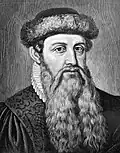
- Johannes Gutenberg, German inventor of the printing press
- Tlacaélel, Aztec warrior, thinker, high priest and noble for the Mexica Empire (d. 1487)
1399
- March 16 – Xuande Emperor of China (d. 1435)
- June 26 – John, Count of Angoulême (d. 1467)
- date unknown
- William II Canynges, English merchant (approximate date; d. 1474)
- Zara Yaqob, Emperor of Ethiopia (d. 1468)
- Rogier van der Weyden, Dutch painter (or 1400)
Deaths
1390
- January 26 – Adolph IX, Count of Holstein-Kiel (b.c 1327)
- February 16 – Rupert I, Elector Palatine (b. 1309)
- March 20 – Alexios III Megas Komnenos, Emperor of Trebizond (b. 1338)
- April 19 – King Robert II of Scotland (b. 1316)
- July 8 – Albert of Saxony, Bishop of Halberstadt and German philosopher (b. c. 1320)
- August 14 – John FitzAlan, 2nd Baron Arundel, English soldier (b. 1364)
- September 23 – John I, Duke of Lorraine (b. 1346)
- October 9 – King John I of Castile (fall from a horse) (b. 1358)
- September – Towtiwil, Prince of Black Ruthenia
- date unknown
- Sandaki Mari Djata, Mansa of the Mali Empire
- Keratsa of Bulgaria, Byzantine empress consort (b. 1348)
- Sa'ad al-Din Masud ibn Umar ibn Abd Allah al-Taftazani, Ilkhanate polymath (b. 1322)
- probable – Altichiero, Italian painter (b. 1330)
1391
- January 16 – Emir Muhammed V of Granada (b. 1338)
- February 16 – John V Palaiologos, Byzantine emperor (b. 1332)
- March 10 – King Tvrtko I of Bosnia (b. 1338)
- November 1 – Amadeus VII, Count of Savoy (b. 1360)
- Gaston III, Count of Foix, co-prince of Andorra
- date unknown
- Petru, Prince of Moldavia
- Margaret, Countess of Mar (approximate date)
1392
- March 25 – Hosokawa Yoriyuki, Japanese samurai
- April 26 – Chŏng Mong-ju, Korean civil minister, diplomat and scholar (b. 1338)
- May 17 – Zhu Biao, crown prince of the Ming dynasty, China (b. 1355)
- November 22 – Robert de Vere, Duke of Ireland (b. 1362)
- December 23 – Isabella of Castile, Duchess of York (b. 1355)
- date unknown
1393
- March 7 – Bogislaw VI, Duke of Pomerania (b. c. 1350)
- March 23 – John of Nepomuk, saint
- March 29 - Shah Mansur, Ruler of the Muzaffarids
- June 6 – Emperor Go-En'yū of Japan, former Pretender to the throne (b. 1359)
- July 23 – Konrad von Wallenrode, Grand Master of the Teutonic Knights
- July 30 – Alberto d'Este, Lord of Ferrara and Modena (b. 1347)
- August 6 – John de Ros, 5th Baron de Ros (b. 1365)[81]
- November 29 – King Leo V of Armenia (b. c. 1342)
- date unknown
1394
- June 25 – Dorothea of Montau, German hermitess (b. 1347)[82]
- March 17 – Louis, Count of Enghien, Count of Conversano and Brienne
- March 24 – Constance of Castile, claimant to the throne of Castile
- June 4 – Mary de Bohun, English countess, married to Henry IV of England[83]
- June 7 – Anne of Bohemia, queen of Richard II of England (plague) (b. 1366)[84]
- August 27 – Emperor Chōkei of Japan (b. 1343)
- September 16 – Antipope Clement VII (b. 1342)[85]
- December 28 – Maria Angelina Doukaina Palaiologina, basilissa of Epirus (b. 1350)
- date unknown
- John Hawkwood, English mercenary (b. 1320)
- Fazlallah Astarabadi, Persian founder of the mystical Hurufism sect (executed)
- Sultan Mahmud II of the Delhi Sultanate
- Former King Gongyang of Goryeo (b. 1345)
1395
- March 13 – John Barbour, Scottish poet
- May 17
- Prince Marko, Serbian leader
- Mary, Queen of Hungary, co-ruler
- June 3 – Ivan Shishman of Bulgaria, tsar (b. c.1350)
- August 29 – Duke Albert III of Austria (b. 1349)
- December 25 – Elisabeth, Countess of Neuchâtel, Swiss ruler
- date unknown
- Acamapichtli, 1st tlatoani (monarch) of Tenochtitlan (modern Mexico City), 1375-1395 (b. c. 1355)[86]
- Margaret the Barefooted, Italian saint (b. 1325)
1396
- January 11 – Isidore Glabas, Metropolitan bishop of Thessalonica (b. 1341/2)
- May 19 – John I of Aragon (b. 1350)
- July 31 – William Courtenay, Archbishop of Canterbury
- September 15 – Queen Sindeok, politically active Korean queen (b. 1356)
- November 29 – Robert Ferrers, 3rd Baron Ferrers of Wemme (b. 1373)
- date unknown
1397
- January 11 – Skirgaila, Grand Duke of Lithuania
- February 18 – Enguerrand VII, Lord of Coucy (b. 1340)
- March 14 – Henry VIII the Sparrow, Duke of Żagań–Głogów (b. c. 1357)
- April 25 – Thomas Holland, 2nd Earl of Kent (b. 1350)
- June 3 – William Montacute, 2nd Earl of Salisbury, English military leader (b. 1328)
- June 16 – Philip of Artois, Count of Eu, French soldier (b. 1358)
- July 15 – Catherine of Henneberg, German ruler (b. c. 1334)
- September 2 – Francesco Landini, Italian composer
- September 8 – Thomas of Woodstock, 1st Duke of Gloucester, son of King Edward III of England (b. 1355)
- September 15 – Adam Easton, English cardinal
- September 21 – Richard FitzAlan, 11th Earl of Arundel, English military leader (executed) (b. 1346)
- October 6 – Vuk Branković, Serbian lord (b. 1345)
1398
- January 6 – Rupert II, Elector Palatine (b. 1325)
- January 31 – Former Emperor Sukō of Japan (b. 1334)
- June 24 – Hongwu Emperor of China (b. 1328)
- July 20 – Roger Mortimer, 4th Earl of March, heir to the throne of England (b. 1374)
- July/August (uncertain) – Kadi Burhan al-Din, poet, kadi, and ruler of Sivas (b. 1345)[87]
- September 9 – James I of Cyprus (b. 1334)
- October 5 – Blanche of Navarre, Queen of France (b. 1333)
- date unknown – Chŏng Tojŏn, Korean philosopher
1399
- January 4 – Nicholas Eymerich, Catalan theologian and inquisitor
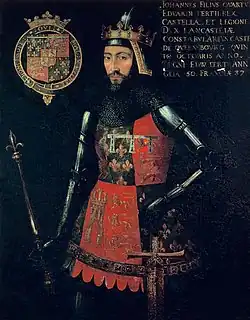
- February 3 – John of Gaunt, 1st Duke of Lancaster (b. 1340)[88]
- March 24 – Margaret, Duchess of Norfolk (b. c. 1320)
- July 13 – Peter Parler, German architect (b. 1330)
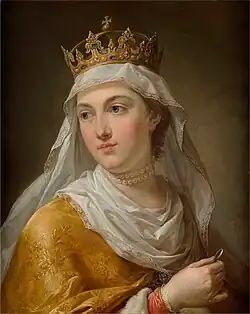
- July 17 – King Jadwiga of Poland (b. 1374)
- August 12 – Demetrius I Starshy, Prince of Trubczewsk (in battle) (b. 1327)
- August 15 – Ide Pedersdatter Falk, Danish noblewoman (b. 1358)
- August 26 – Mikhail II, Grand Prince of Tver (b. 1333)
- September 22 – Thomas de Mowbray, 1st Duke of Norfolk, English politician (b. 1366)
- October 3 – Eleanor de Bohun, English noble (b. c.1366)[89]
- October 5 – Raymond of Capua, Italian Dominic friar and venerated Christian (b. 1330)
- November 1 – John IV, Duke of Brittany (b. 1339)
- date unknown
References
- ^ Ivinskis, Zenonas (1988) [1930]. "Vytauto jaunystė ir jo veikimas iki 1392 m". In Paulius Šležas (ed.). Vytautas Didysis (in Lithuanian). Vilnius: Vyriausioji enciklopedijų redakcija. p. 36. OCLC 25726071.
- ^ Gudavičius, Edvardas (1999). Lietuvos istorija. Nuo seniausių laikų iki 1569 metų (in Lithuanian). Vilnius: Lietuvos rašytojų sąjungos leidykla. pp. 173–174. ISBN 9986-39-112-1.
- ^ Freund, Scarlett; Ruiz (1994). "Jews, Conversos, and the Inquisition in Spain, 1391–1492: The Ambiguities of History". In Perry, Marvin; Schweitzer, Frederick M. (eds.). Jewish-Christian Encounters Over the Centuries: Symbiosis, Prejudice, Holocaust, Dialogue. P. Lang. pp. 169–195. ISBN 978-0-8204-2082-0.
- ^ Tucker, Spencer C. (2009-12-23). A Global Chronology of Conflict: From the Ancient World to the Modern Middle East [6 volumes]: From the Ancient World to the Modern Middle East. ABC-CLIO. p. 428. ISBN 978-1-85109-672-5.
- ^ Barker, John W. (1969). Manuel II Palaeologus (1391-1425); a study in late Byzantine statesmanship. New Brunswick, N.J.: Rutgers University Press. pp. xxiv. ISBN 0-8135-0582-8. OCLC 11370.
- ^ Grendler, Paul F. (2004-09-29). The Universities of the Italian Renaissance. JHU Press. p. 99. ISBN 978-0-8018-8055-1.
- ^ Veenstra, Jan R. and Laurens Pignon. (1997). Magic and Divination at the Courts of Burgundy and France. New York: Brill, p. 27-95. ISBN 978-90-04-10925-4
- ^ Krčmář, Mgr. Luděk. "Saint John of Nepomuk". SJN.cz. Archived from the original on 2007-09-29.
If in 1369 John of Pomuk was a notary public, he must have been more than twenty years old. Thus he was probably born sometime between 1340 and 1350 [1349].
- ^ TÜRKLER ANSİKLOPEDİSİ CİLT 8
- ^ Friedrich Borchert: "Die Hochmeister des Deutschen Ordens in Preußen." In: Preußische Allgemeine Zeitung, 6 October 2001.
- ^ Carlqvist, Gunnar, red (1933). Svensk uppslagsbok. Bd 14. Malmö: Svensk Uppslagsbok AB. sid. 729 (Swedish).
- ^ Rayfield, Donald (2017). Georgia. Crossroads of Empires. A history of three thousand years(in Russian). Moscow: ABC-Atticus. ISBN 978-5-389-12944-3
- ^ Ilahiane, Hsain (2006-07-17). Historical Dictionary of the Berbers (Imazighen). Scarecrow Press. ISBN 978-0-8108-6490-0.
- ^ Toomaspoeg, Kristjan (2013). "ORSINI DEL BALZO, Raimondo". Dizionario Biografico degli Italiani (in Italian). Vol. 79.
- ^ Stuart-Fox, Martin (1998). The Lao Kingdom of Lan Xang: Rise and Decline. White Lotus Press.
- ^ Chris Schabel, "Like God from Heaven, but they don’t call him King. The Rebellion against James I of Cyprus [article]," Cahiers du Centre d’Études Chypriotes Année 2013 43 pp. 379-392. https://www.persee.fr/doc/cchyp_0761-8271_2013_num_43_1_1075. Accessed 2025-01-19.
- ^ Needham, Joseph (1986). Science and Civilization in China: Volume 5, Chemistry and Chemical Technology, Part 1, Paper and Printing. Taipei: Caves Books, Ltd.
- ^ Ćirković, Sima (1964). Историја средњовековне босанске државе (in Serbo-Croatian). Srpska književna zadruga, p. 170.
- ^ Savvides, Alexis (1998). "Splintered Medieval Hellenism : The Semi-Autonomous State of Thessaly (A.d. 1213/1222 to 1454/1470) and ITS Place in History". Byzantion. 68 (2): 416. JSTOR 44172339.
Following the Ottoman capture of Larissa in 1392/1393, the Turkish forces moved southward towards Hellas and invaded the Peloponnese, which had already experienced their initial devastations; the next decades would witness the building-up of local resistance in Thessaly on the part of sections of Greeks, Albanians and Vlachs, who had taken to the mountains
- ^ Lindkvist, Thomas. Margaret I of Denmark at Svenskt kvinnobiografiskt lexikon
- ^ Etting, Vivian (2004). Queen Margrete I (1353–1412) and the Founding of the Nordic Union. Brill. ISBN 978-9047404798.
- ^ Geoffrey Chaucer (1866). The Poetical Works of Geoffrey Chaucer. Bell and Daldy. pp. 37.
- ^ Manuel II Palaeologus (Emperor of the East) (1985). Manuel II Palaeologus: Funeral Oration on His Brother Theodore. Association for Byzantine Research. p. 19.
- ^ Zosa Szajkowski; Soza Szajkowski (1970). Jews and the French Revolutions of 1789, 1830 and 1848. KTAV Publishing House, Inc. pp. 220. ISBN 978-0-87068-000-7.
- ^ Sir Frederick Dixon HARTLAND (1854). A chronological dictionary or index to the genealogical chart, etc. p. 14.
- ^ Vladislav Boskovic (3 July 2009). Some Notes on Marko Kraljevic (Prince Marko). GRIN Verlag. p. 3. ISBN 978-3-640-36481-7.
- ^ John Cleave (2008). Istanbul: City of Two Continents. Editions Didier Millet. p. 10. ISBN 978-981-4217-52-1.
- ^ Anuario de estudios medievales. Instituto de Historia Medieval de España. 1990. p. 157.
- ^ Fossier, Robert; Jacques Verger; Robert Mantran; Catherine Asdracha; Charles de La Roncière (1987). Storia del medioevo III: Il tempo delle crisi (1250–1520). Giulio Einaudi editore. p. 368. ISBN 88-06-58404-9.
- ^ Adressbuch ... 8960 Kempten, Allgäu: bearb. nach d. amtl. Unterlagen d. Stadtverwaltung u. eigenen Erhebungen d. Verl. 1986. Bleicher. p. 26.
- ^ See: the Nobiles - "Compendium of the Catechism of the Catholic Church, 304–306". Vatican.va. Retrieved 30 June 2011.
- ^ Bisson, Thomas N. (1986). The Medieval Crown of Aragon: A Short History. Clarendon Press, p. 125.
- ^ a b White, Richard (2010), These Stones Bear Witness, AuthorHouse, p. 56.
- ^ Knecht, Robert (2004). The Valois: Kings of France 1328–1589. Hambledon Continuum, p. 6-7.
- ^ Nicolle, David (1999). Nicopolis 1396: The Last Crusade. Campaign Series. London: Osprey Publishing.
- ^ "Battle of Nicopolis". Encyclopædia Britannica. Retrieved 28 January 2025.
- ^ "Site Record for Perth, North Inch; 'The Battle Of The Clans'; Inch Of Perth". canmore.rcahms.gov.uk. Royal Commission on the Ancient and Historical Monuments of Scotland. Retrieved 28 January 2025.
- ^ Collinson, Francis M. (1975). The Bagpipe: The History of a Musical Instrument. London: Routledge. p. 135. ISBN 978-0-7100-7913-8.
- ^ N. Djuvara, O scurtă istorie ilustrată a Românilor. Ed. Humanitas, București, 2013, p. 119.
- ^ Williams, Deanne (2016). "Isabelle de France, Child Bride". In Martin, Catherine Gimelli; Melehy, Hassan (eds.). French Connections in the English Renaissance. Routledge, p. 32-33.
- ^ SampleContents library, Transit of Venus.https://samplecontents.library.ph/wikipedia/wp/t/Transit_of_Venus.htm Retrieved 28 January 2025.
- ^ Weir, Alison (1999). Britain's Royal Family: A Complete Genealogy. London: The Bodley Head, p. 108.
- ^ Science historian chronicles true story of Lady Florence Baker, Penn State University, 3 February 2004, Retrieved 28 January 2025.
- ^ Miller-Yianni, Martin (20 May 2010). Bulgarian History — A Concise Account. Lulu.com. ISBN 9781445716336. Retrieved 28 January 2025 – via Google Books.
- ^ Kirk, Thomas Allison (2005). Genoa and the Sea: Policy and Power in an Early Modern Maritime Republic. Johns Hopkins University Press. p. 26. ISBN 0-8018-8083-1. Archived from the original on 11 February 2020. Retrieved 28 January 2025.
- ^ Miller, William (1908). The Latins in the Levant: A History of Frankish Greece (1204–1556). E. P Dutton and Company. OCLC 1106830090. p. 317–318, 368, 651.
- ^ Ilahiane, Hsain (2006-07-17). Historical Dictionary of the Berbers (Imazighen). Scarecrow Press. ISBN 978-0-8108-6490-0, p. 156.
- ^ Barthold, Vasilii Vladimirovitch (1963). Four Studies on the History of Central Asia. Vol. 2. Brill Archive. p. 33.
- ^ Vasiliĭ Vladimirovich Bartolʹd, Four Studies on the History of Central Asia, Vol.II, (Brill, 1958), 33.
- ^ Whitworth Porter (31 October 2013). A History of the Knights of Malta. Cambridge University Press. p. 291. ISBN 978-1-108-06622-8.
- ^ Simon, Z (2021). "Ten Chronologies of Ancient Mexico"
- ^ Wade, Geoff (1996) "The Bai Yi Zhuan: A Chinese Account of Tai Society in the 14th Century," 14th Conference of the International Association of Historians of Asia (IAHA), Chulalongkorn University, Bangkok, Thailand. (Includes translation of (Jiangliang, 1980), a copy can be found at the Thailand Information Center at ChulalongkornCentral Library)[1]
- ^ HISTORY OF SAMARKAND GARDENS BUILT BY AMIR TEMUR. Kamoliddin G’aniev, Samarkand State University, Associate Professor of History of Uzbekistan. Article history: Abstract: Received: 2th April 2021 In the article on the basis of sources landscape gardening. https://scholarzest.com/index.php/esj/article/download/726/615/1477. Retrieved 28 January 2025.
- ^ "University of Zadar : About us". Unizd.hr. Retrieved 28 January 2025.
- ^ "Islamic Culture and the Medical Arts – Hospitals". U.S. National Library of Medicine. Retrieved 2018-06-17.
- ^ BBC History - Historic Figures - King Richard II. Accessed 1 May 2013
- ^ History The Imperial Gazetteer of India, v. 2, p. 570.
- ^ "John of Gaunt, duke of Lancaster". Britannica.com. 21 March 1999.
- ^ Cappelletti, Licurgo (1897). Storia della Città di Piombino (in Italian). Forni Editore. p. 35.
- ^ Barr, Helen (1994). Signes and Sothe: Language in the Piers Plowman Tradition. D.S. Brewer. p. 146. ISBN 978-0-85991-419-2..
- ^ D. A. Dietari del Consell antich barceloní. V.I. Barcelona. Impremta d’en Henrich y companyia. 1892, p. 77. (in Catalan)
- ^ Edmond-René Labande, CAETANI, Onorato, Dizionario Biografico degli Italiani - Enciclopedia Italiana - Volume 16 (1973)
- ^ .Muir, William (1896). The Mameluke; or, Slave dynasty of Egypt, 1260-1517, A. D. Smith, Elder and Co. pp. 121–128.
- ^ Brown, Alfred Lawson; Summerson, H. (2010). "Henry IV [known as Henry Bolingbroke]". Oxford Dictionary of National Biography (online ed.). Oxford University Press. doi:10.1093/ref:odnb/12951. (Subscription, Wikipedia Library access or UK public library membership required.)
- ^ Kekewich, Margaret L. (2008). The Good King: René of Anjou and Fifteenth Century Europe. Palgrave Macmillan. p. 51. ISBN 978-1-4039-8820-1.
- ^ Tsai, Shih-Shan Henry (2002). Perpetual Happiness: The Ming Emperor Yongle. Seattle and Chesham: University of Washington Press; Combined Academic. p. 63. ISBN 0295981245.
- ^ Bevan, Bryan (1994). Henry IV. New York: St. Martin's Press. p. 67. ISBN 0-3121-1696-9.
- ^ Documenta Romaniae Historica A. Moldova, vol. I (1384-1475) Institutul de Istorie și Arheologie A.D. Xenopol, Editura Academiei Republicii Socialiste România, București, 1975) pp. 10-16
- ^ Jugie, Martin (1912). "Le voyage de l'empereur Manuel Paléologue en Occident (1399-1403)" [The Voyage of Emperor Manuel Paleologos to the West (1399-1403)]. Revue des études byzantines. 15 (95): 322–332. doi:10.3406/rebyz.1912.3997.
- ^ "Moctezuma I el Grande" [Moctezuma I the Great] (in Spanish). Biografias y Vidas.com. Retrieved June 1, 2019.
- ^ Qutbuddin, Tahera (2018). "Idrīs ʿImād al-Dīn". In Fleet, Kate; Krämer, Gudrun; Matringe, Denis; Nawas, John; Rowson, Everett (eds.). Encyclopaedia of Islam (3rd ed.). Brill Online. doi:10.1163/1573-3912_ei3_COM_32368. ISSN 1873-9830.
- ^ Richard Lomas (1999). A Power in the Land: The Percys. Tuckwell Press. p. 83. ISBN 978-1-86232-067-3.
- ^ Anne Commire; Deborah Klezmer (1999). Women in World History: A Biographical Encyclopedia. Yorkin Publications. p. 360. ISBN 978-0-7876-4080-4.
- ^ Richard Henry Major (1877). The Discoveries of Prince Henry the Navigator, and Their Results; Being the Narrative of the Discovery by Sea, Within One Century, of More Than Half the World. Sampson Low, Marston, Searle and Rivington. pp. 20.
- ^ Panton, James (2011). Historical Dictionary of the British Monarchy. Scarecrow Press. p. 370. ISBN 978-0-8108-7497-8.
- ^ Gordon Donaldson; Robert S. Morpeth (1973). Who's who in Scottish history. Blackwell. p. 33. ISBN 9780631147008.
- ^ Henry Ansgar Kelly (1986). Chaucer and the Cult of Saint Valentine. BRILL. p. 146. ISBN 90-04-07849-5.
- ^ Great Britain. Court of Chancery (1918). Inquisitions Post Mortem Relating to Yorkshire: Of the Reigns of Henry IV and Henry V. Society. p. 112.
- ^ "Nicholas V | Vatican Library & Dum Diversas". Encyclopedia Britannica. Retrieved 6 May 2019.
- ^ "Chimalpopoca, "Escudo humeante (1417-1426)" [Chimalpopoca, “Smoking Shield" (1417-1426)]. Arqueologia Mexico (in Spanish). July 2, 2016.
- ^ Plantagenet Ancestry: A Study In Colonial And Medieval Families, 2nd Edition, 2011. Douglas Richardson. p. 87. ISBN 978-1-4610-4513-7.
- ^ André Vauchez; Michael Lapidge (2000). Encyclopedia of the Middle Ages: A-J. Fitzroy Dearborn Publishers, Incorporated. p. 448. ISBN 9781579582821.
- ^ Plantagenet Ancestry: A Study In Colonial And Medieval Families, 2nd Edition, 2011. Douglas Richardson. p. 352. ISBN 978-1-4610-4513-7.
- ^ Andrew, M. (2016). The Palgrave Literary Dictionary of Chaucer. Springer. p. 11. ISBN 9780230273962.
- ^ "Clement (VII) | antipope". Encyclopedia Britannica. Retrieved 18 March 2019.
- ^ "Acamapichtli, "Puñado de cañas" (1375-1395)" [Acamapichtli, "Fistful of canes" (1375-1395)]. Arqueologia Mexicana (in Spanish). July 2016. Retrieved June 3, 2019.
- ^ Rypka, Jan (1960). "Burhãn al-Dīn". In Gibb, H. A. R.; Kramers, J. H.; Lévi-Provençal, E.; Schacht, J.; Lewis, B. & Pellat, Ch. (eds.). The Encyclopaedia of Islam, Second Edition. Volume I: A–B. Leiden: E. J. Brill. pp. 1327–1328. doi:10.1163/1573-3912_islam_SIM_1543. OCLC 495469456.
- ^ "John of Gaunt, duke of Lancaster | English prince". Encyclopedia Britannica. Retrieved 26 June 2020.
- ^ "Eleanor de Bohun, Duchess of Gloucester". Westminster Abbey. Retrieved 18 March 2019.