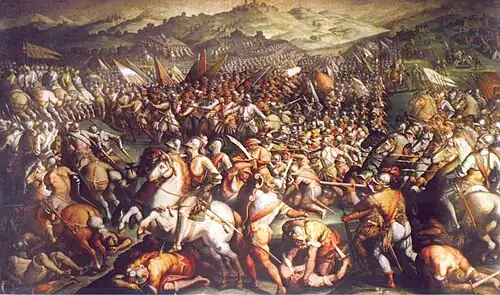
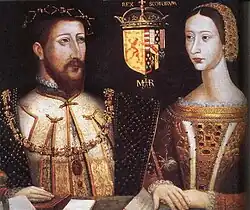
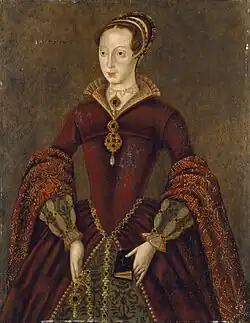
February 12: Lady Jane Grey, who was declared Queen of England for nine days in 1553, is beheaded at the Tower of LondonAugust 2: The battle of Marciano takes place in Tuscany.April 12: Mary of Guise becomes regent of Scotland until King James Vi comes of age.
January 12 (10th waxing of Tabodwe 915 ME) – Bayinnaung is crowned king of the Burmese Taungoo Dynasty at his new capital at Pegu, after a previous coronation on January 11, 1551, and takes the regnal name of Thiri Thudhamma Yaza.[1]
January 21 – Edward Courtenay, one of the four plotters of Wyatt's rebellion in England, is arrested and reveals that an attempt will be made to overthrow the English government.[2]
January 27 – Wyatt's rebellion begins in England at Maidstone as Sir Thomas Wyatt reads a proclamation that Queen Mary of England’s marriage to King Philip of Spain will "bring upon this realm most miserable servitude, and establish popish religion". Within two days, Wyatt has raised 2,000 soldiers to join his plan to overthrow Queen Mary.[4]
January 30 – Henry Grey, Duke of Suffolk, one of the English conspirators in Wyatt's rebellion, leads troops from Leicester to Coventry, but the group finds that the gates of the city are closed because the rebellion has been exposed.[5]
March 18 – Princess Elizabeth is imprisoned in the Tower of London on charges of working with the organizers of Wyatt's rebellion for the overthrow of Queen Mary of England.[7]
May 9 – Elizabeth is released from the Tower of London, although she continues to be confined at home after she is cleared of suspicion of conspiracy to overthrow the government.
June 11 – Italian General Piero Strozzi successfully defends an attack on the Republic of Siena by French troops, led by Cosimo de' Medici at the battle of Pontedera, but suffers a tremendous loss of his own troops in the process.
September 13 (Shawwal 15, 961 AH) – At the Battle of Tadla in Morocco, Mohammed ash-Sheikh, ruler of the Saadi dynasty enters the city of Fez and becomes the undisputed sultan. Ali Abu Hassun, last ruler of the Wattasid dynasty, flees.[10]
October–December
October 8 – In Peru, an 11-month long rebellion by Francisco Hernández Girón is ended at the Battle of Pucará with the rebels defeated by the Viceroy of Peru near Cuzco.[11][12]
October 21 – The Plassenburg castle in Bavaria, residence of the ruling House of Hohenzollern in the Principality of Ansbach, is destroyed during the Second Margrave War.[13]
November 1 – English captain John Lok, commanding three ships (the Trinitie, the Bartholomew and the John Evangelist), departs from Dartmouth in England to voyage to the Guinea Coast at West Africa.[14][15][16]
November 22 – Upon the death of his father, Sultan Islam Shah Suri, 10-year-old Firuz Shah Suri becomes the Sultan of the Sur Empire at Delhi, but he is murdered within a few days.
December 22 – The John Lok expedition reaches Guinea, anchoring at the Sesto River and remains for seven days to begin trading.[14]"[17]
The name of the beer brewed by New Belgium Brewing Company is based on a recipe from this date, called "1554."
Luso-Chinese agreement: Portugal reaches an agreement with the Ming Dynasty of China, to be allowed to legally trade in the province of Guangdong. This agreement is often seen as a starting point of the Portuguese colony of Macau
Rao Surjan Singh becomes ruler of Bundi.
Births
Philip William, Prince of Orange
January 1 – Louis III, Duke of Württemberg (d. 1593)
^Royal Historical Commission of Burma (2003) [1832]. Hmannan Yazawin (in Burmese). Vol. 2. Yangon: Ministry of Information, Myanmar. pp. 280–281.
^Thorp, Malcolm R. (1978). "Religion and the Wyatt Rebellion of 1554". Church History: Studies in Christianity and Culture. 47 (4): 375. doi:10.2307/3164313. JSTOR 3164313.
^Fletcher, Anthony (1970). Tudor Rebellions (Second ed.). Longman Group Limited. p. 81. ISBN 9780582313897. Retrieved November 18, 2021.
^Froude, James Anthony (1910). The Reign of Mary Tudor. London: J. M. Dent & Sons, New York: P. Dutton & Co. pp. 100–101. Retrieved December 8, 2021.
^Palmer, Alan; Palmer, Veronica (1992). The Chronology of British History. London: Century Ltd. pp. 150–153. ISBN 0-7126-5616-2.
^Prescott, H. F. M. (1953). Mary Tudor: The Spanish Tudor (1953 Reissue ed.). Phoenix. pp. 325–326. ISBN 9781842126257. Retrieved February 18, 2022. {{cite book}}: ISBN / Date incompatibility (help)
^David Loades, The Reign of Mary Tudor: Politics, Government and Religion in England, 1553–58 (Longman, 1991) pp. 224–225 ISBN 0-582-05759-0
^Samson, Alexander (2005). "Changing Places: The Marriage and Royal Entry of Philip, Prince of Austria, and Mary Tudor, July-August 1554". The Sixteenth Century Journal. 36 (3): 761–784. doi:10.2307/20477489. JSTOR 20477489.
^Jamil Marhi and Abu Al-Nasr, History of Morocco in the Islamic Era (Cambridge University Press, 1987) p.155
^Severo Martinez Pelaez, La patria del criollo: ensayo de interpretación de la realidad colonial guatemalteca (Fondo de Cultura Económica, 2013)
^ abRichard Hakluyt, The Principal Navigations, Voyages, Traffiques & Discoveries of the English Nation Made by Sea Or Overland to the Remote and Farthest Distant Quarters of the Earth at Any Time Within the Compass of These 1600 Years (1597, reprinted by J. M. Dent and Sons, Ltd., 1927) pp.47-50 ("The first day of November at nine of the clocke at night, departing from the coast of England, se set off...")
.jpg)
%252C_prins_van_Oranje_Rijksmuseum_SK-A-256.jpeg)
_-_John%252C_Prince_of_Portugal_(1537-54)_-_RCIN_403953_-_Royal_Collection.jpg)
.JPG)
