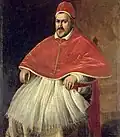
February 7 – After a 10-week conclave in Rome to elect a new Pope, Giovanni Maria Ciocchi del Monte, Bishop of Palestrina, is selected on the 61st ballot after Reginald Pole of England falls two votes short of winning. Ciocchi del Monte takes the name Pope Julius III and is crowned the next day, succeeding the late Pope Paul III.[2]
February 25 – (10th day of 2nd month of Tenbun 19) In Oita, Ōita Prefecture, an attack within the Ōtomo clan of Japanese samurai takes place after clan leader Ōtomo Yoshikazu seeks to disinherit his oldest son and to make his third son, Ōtomo Shioichimaru, as his designated successor. Supporters of the oldest son, Ōtomo Yoshishige, invade Yoshikazu's home and kill Shioichimaru and four other family members.[3]
Arauco War: Battle of Penco – Several hundred Spanish and indigenous troops under the command of Pedro de Valdivia defeat an army of 60,000 Mapuche in modern-day Chile.
March 24 – "Rough Wooing": England and France sign the Treaty of Boulogne, by which England withdraws from Boulogne in France and returns territorial gains in Scotland.[5]
April 30 – King Tabinshwehti of Burma is assassinated by two of his bodyguards while he is on a hunting trip. The two swordsmen, sent by Smim Sawhtut, Governor of Sittaung, behead the King, and a civil war begins as major governors rebel against the new Burmese King Bayinnaung.[10]
May 6 – Italian Protestant Michelangelo Florio, jailed since 1548 before being brought to trial for and sentenced to death for heresy, escapes from prison and is able flee to France.[11]
May 15 – The vestments controversy is resolved in the Church of England with a compromise on the style of clothing worn by Anglican priests. John Hopper is allowed ordination as the Bishop of Gloucester without being required to wear Anglican vestments, but must not forbid anyone in his bishoporic from wearing the vestments if they wish.[12]
May 20 – The Spanish Catalan city of Cullera is plundered by the Ottoman Empire General Dragut Reis,[13] and most of its inhabitants are sold into slavery in Algeria.
June 28 – Capture of Mahdia (1550): The Spanish Armada arrives in North Africa to begin the process of capturing the fortress of Mahdia (now in Tunisia) from control of the Ottoman Empire.[15]
July 25 – Capture of Mahdia (1550): Troops commanded by Ottoman General Turgut Reis make a counterattack on the Spanish invaders, led by General Andrea Doria. Both sides sustain heavy losses, and the Spanish succeed in forcing the Ottomans to retreat back inside Mahdia.[15]
September 2 (5th waning of Tawthalin 912 ME) – King Bayinnaung of Burma begins a four-month siege of the former Burmese capital, Toungoo, occupied by the king's rebellious brother Minkhaung.
September 10 – Spanish troops, commanded by Genoa's General Andrea Doria, capture the Tunisian fortress of Mahdia from the Ottoman Empire after fighting that began on June 28.[15]
October–December
October 2 – Battle of Sauðafell in Iceland: Daði Guðmundsson of Snóksdalur defeats the forces of Catholic Bishop Jón Arason, resulting in Iceland becoming fully Protestant.[18] Arason is captured; he is executed, along with his two sons, on November 7.
November 25 – Luis de Velasco becomes the second Viceroy of New Spain, which encompasses all Spanish territory in North America and Central America. Velasco succeeds Antonio de Mendoza, the first Viceroy, who has been ordered to become the Viceroy of Peru.
December 29 – Bhuvanaikabahu VII, King of Kotte on most of the island of Sri Lanka, is assassinated by a gunman hired by the government of Portuguese India.[20]
Date unknown
The summit level canal between the Alster and the Trave in Germany ceases to be navigable.[21]
The first grammatical description of the French language is published by Louis Maigret.[22]
January 4 – Luca Spinola is elected to a two-year term as the new Doge of the Republic of Genoa, succeeding Gaspare Grimaldi Bracelli.[26]
January 11 (5th waxing of Tabodwe 912 ME) – King Bayinnaung of Burma is successful in capturing his ancestral city of Toungoo from his rebellious half-brother Minkhaung II, and sets about to make Toungoo the capital for the first time since 1539.[27] Minkhaung is forgiven by King Bayinnaung rather than being executed, and assists in the King's campaign to capture the neighboring Kingdom of Prome.
January– Macarius, Metropolitan of Moscow, and Tsar Ivan IV of Russia preside over the reforming Stoglavy Synod ("Hundred-Chapter") church council.[28] A calendar of the saints and an ecclesiastical law code (Stoglav) are introduced.
February 14 – Alice Arden and her lover, Richard Mosbey, carry out the murder-for-hire of her husband, Thomas Arden of Faversham with the assistance of a highwayman known as "Black Will", two of Arden’s domestic servants (Michael Saunderson and Elizabeth Stafford) and Mosbye's sister (Cicely Pounder). The body is carried outside, and Thomas is reported as missing, but a discovery is made that the murder was committed inside the house. The conspirators are later executed.[29]
February 23– At the Kremlin in Moscow, Tsar Ivan IV and the Metropolitan Macarius, present the proposed code of laws, drafted by the Stoglavy Synod, to the clergy, nobility and principal Russian citizens for their approval.[30]
March 27 – French mechanical engineer Aubin Olivier becomes the director of the new Royal Mint, the Moulin des Etuves on the Île de la Cité in Paris after having learned the technique of producing uniform milled coinage during a sabbatical in Germany.[31]
April–June
April 4 – Ferdinand I, Holy Roman Emperor, issues an edict to reduce tensions among the three major ethnic groups in the Kingdom of Hungary, with an administration to have equal representation of for ethnic Hungarians, Slovaks and Germans.[32]
May 12 – The National University of San Marcos is founded in Lima in the Viceroyalty of Peru, being the first officially established university in the Americas.[34]
May 27 – Italian War of 1551–1559: A defensive alliance, placing the Duchy of Parma and Piacenza under the protection of France, is signed between representatives of King Henry II of France and Ottavio Farnese, Duke of Parma, placing Parma under French protection.
May 30 – Ilie II Rareș, Ruler of Moldavia since 1546, is forced by the Ottoman Empire to abdicate the throne.[35]
June 11 – With the approval of the Ottoman Sultan Suleiman the Magnificent, Prince Ilie's brother Ștefan VI Rareș becomes the new Prince of Moldavia.[35]
June 27 – The Edict of Châteaubriant is promulgated in France by King Henri II, providing for an increasingly severe series of measures in the Roman Catholic Kingdom to be taken against Protestants, considered to be heretics.[36]
July–September
July 7 – The fifth, and final outbreak of sweating sickness in England reaches London, as documented by Henry Machyn in his diary, and continues until July 19. Machyn notes that "ther ded from the vii day of July unto the xix ded of the swett in London of all dyssesus viij/c, iij/xx and xij and no more in alle, and so the chanseller is sertefiyd." ("There died from the 7th day of July unto the 19th dead of the sweat in London of all diseases 8 hundred, 3 score and 12 [i.e., 872], and no more in all, and so the Chancellor is certified.")[37] John Caius of Shrewsbury writes the first full contemporary account of the symptoms of the disease.
July 12 – The regency over the Kingdom of Spain by Archduchess Maria and her husband, Archduke Maximilian of Austria, ends after almost three years when Maria's brother Crown Prince Philip returns to Madrid.[38] Philip resumes his role as regent for King Charles I, the father of both Maria and Philip; Maria and Maximilian had served during the absence of both the King and the Crown Prince starting on October 1, 1548.
July 18 – Invasion of Gozo: Ottoman Turks and Barbary pirates invade the Mediterranean island of Gozo (now part of Malta), and enslave almost all of its 6,000 inhabitants.[39]
July 19 – The Treaty of Weissenburg goes into effect as John Sigismund Zápolya, King of Hungary since 1540, abdicates in favor of Archduke Ferdinand of Austria.[40] In addition, the independent Kingdom of Transylvania, ruled by Isabella Jagiellon, is ceded to the Kingdom of Hungary as part of peace with Ferdinand.
July 30 – With the surrender of the island of Gozo, the Ottoman place 6,000 survivors on ships and transporting them to Tarhuna Wa Msalata (in modern-day Libya), where they are sold into slavery. The only natives left on the island are 300 persons who escaped the citadel and 41 elderly residents.[39]
August 30 (1st waxing of Thadingyut 913 ME)– King Bayinnaung of Burma conquers the rebellious Kingdom of Prome (with a capital at Pyay) and kills the rebel Thado Thu, a former servant who had proclaimed himself as King Thado Dhamma Yaza after the 1550 assassination of King Tabinshwehti.[41]
September 21 – The Royal and Pontifical University of Mexico is founded in Mexico City (Mexico), being the second officially established university in the Americas.
September 30 – (1st day of 9th month of Tenbun 21) Tainei-ji incident: A coup in Yamaguchi, by the military establishment of the Ōuchi clan, forces their lord Ōuchi Yoshitaka to commit suicide, and the city is burned.[42]
November 20 – The Office of Cardinal Secretary of State, the second highest position in the Roman Catholic Church after the Pope, is created to temporarily fill the vacancy between the death of one Pontiff and the election of another. Cardinal Girolamo Dandini is appointed by Pope Julius III to serve as the first Secretary of State.
December 16 – George Martinuzzi, the Hungarian Archbishop of Esztergom and the Governor of Transylvania, is assassinated by Marco Aurelio Ferrari on orders of Ferdinand, King of Hungary. Martinuzzi had been suspected of treason after attempting to negotiate a separate peace treaty with the Ottoman Empire.[44]
Date unknown
Qizilbash forces under the command of Tahmasp I raid and destroy the cave monastery of Vardzia in Georgia.
In Henan province, China, during the Ming dynasty, a severe frost in the spring destroys the winter wheat crop. Torrential rains in mid summer cause massive flooding of farmland and villages (by some accounts submerged in a metre of water). In the fall, a large tornado demolishes houses and flattens much of the buckwheat in the fields. Famine victims either flee, starve, or resort to cannibalism. This follows a series of natural disasters in Henan in the years 1528, 1531, 1539, and 1545.
In Slovakia, Guta (modern-day Kolárovo) receives town status.
Juan de Betanzos begins to write his Narrative of the Incas.
The new edition of the Genevan psalter, Pseaumes octantetrois de David, is published, with Louis Bourgeois as supervising composer, including the first publication of the hymn tune known as the Old 100th.
1552
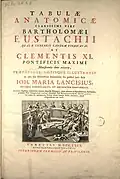
Bartolomeo Eustachi completes his Tabulae anatomicae.
April 18 – King Henry II of France enters the city of Metz, ceded to France by Saxony by the January 15 Treaty of Chambord.
April 28 – The delegates to the Council of Trent adjourn for two years after learning that the Holy Roman Emperor is fleeing from Maurice of Saxony.[48]
May 20 – Learning of the rapid approach of the Elector Maurice, the Emperor Charles V flees from Innsbruck ahead of being captured.[49]
June 6 (14th waxing of Waso 914 ME) – Minye Sithu is appointed as the Burmese Viceroy of Martaban by his older brother, Bayinnaung, King of Burma.[50]
June 16 – Yuri of Uglich, the only brother of the Russian Tsar Ivan the Terrible, is placed in charge of Russia's domestic affairs as Ivan departs Moscow to lead 150,000 troops in the Russo-Kazan War.
June 22 – Peter Ernst I von Mansfeld-Vorderort, the Spanish Governor of Luxembourg, is taken prisoner by France and remains captive for almost five years.
June 24 – The Portuguese ship São João is wrecked off of the coast of South Africa.[51] While 480 people survive initially, all but 25 of them die during the next 165 days while trying to reach the mouth of the Maputo River in what is now Mozambique.
July–September
July 6 – In Hungary, Drégely Castle is attacked by the Ottoman Empire. Captain György Szondy and c. 140 soldiers in the castle die, after 4 days of fighting against 8,000 Turkish raiders.
The Peace of Passau revokes the Augsburg Interim of 1548, and promises religious freedom to the Protestant princes.
September 9 – The Siege of Eger begins as thousands of Ottoman troops, led by General Kara Ahmed Pasha of the Ottoman Empire attack a greatly outnumbered force of Hungarian defenders, captained by István Dobó.
September 24 – The Debatable Lands on the border of England and Scotland are divided between the two kingdoms by a commission creating the Scots' Dike in an unsuccessful attempt to halt lawlessness here, but giving both countries their modern borders.
October 17 – After heavy losses by the Ottoman Empire, the Siege of Eger in Hungary is broken off by the Ottomans.
November 15 – Radu Ilie Haidăul becomes the new Prince of Wallachia in what is now Romania after defeating Prince Mircea the Shepherd at the battle of Mănești. Prince Mircea retakes the throne seven months later.
November 18 – Simeon Sulaka arrives in Rome from the Middle Eastern city of Mosul and brings a letter asking Pope Julius III to appoint him as the Patriarch of the Church of the East, leader of the Chaldean Catholic Church.
Miguel de Buría leads the first African rebellion in South America's history. This may be because Buría has more slaves than other regions in Venezuela, of which most join Miguel, and is still being contested between the Europeans and the natives, who also join his side. During this insurrection he takes over the Gold mines de San Felipe de Buría, established within the area with the consent of the Spanish Crown, to pull out the ore that was discovered in the Buria river, a task that heavily depends on slave work.
In Italy, Bartolomeo Eustachi completes his Tabulae anatomicae, presenting his discoveries on the structure of the inner ear and heart,[55] although, for fear of the Inquisition, it will not be published until 1714.
January 2 – The siege of Metz in France, started by Charles V, Holy Roman Emperor during the Italian War of 1551–59 on October 19 last[56] is lifted after 75 days. During the city's defense by the Duke of Guise and 6,000 soldiers, Charles V had lost two-thirds of his original force of at least 20,000 men.[57]
February 21 – Lieutenant General Luis Álvarez de Toledo y Osorio temporarily serves as the Spanish Viceroy of Naples (in modern-day Italy) upon the death of his father, Pedro Álvarez de Toledo. Luis steps down after Pedro Pacheco de Villena is appointed as the new Viceroy in June.
March 1 – The second (and last) session of the Parliament of England during the reign of King Edward VI is opened by the King at Westminster and lasts until March 31. Sir James Dyer serves during the session as Speaker of the House of Commons.[58]
June 3 – The first of the five Battles of Kawanakajima, the "Battle of the Fuse," commences in Japan between Takeda Shingen of Kai Province and Uesugi Kenshin of Echigo Province. The clash, fought 12 days after Shingen has taken Katsurao Castle, takes place at a shrine of Hachiman (near modern-day Yashiro, Hyōgo prefecture), is part of a major series of conflicts during the Japanese Sengoku period.[62]
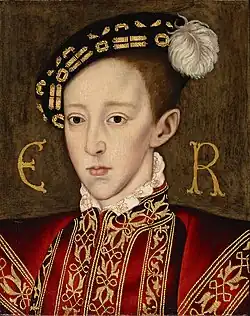
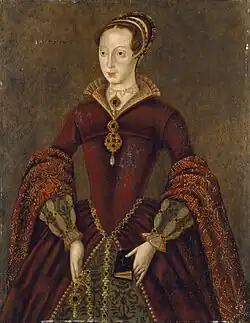
June 15 – On his deathbed, King Edward summons prominent English judges and signs his devise of the throne to Lady Jane Grey.
June 21 – Under threats from the Duke of Northumberland, the devise by King Edward to make Jane Grey the heir to the throne is signed by over 100 prominent persons.
June 26 – Two new schools, Christ's Hospital[63][64] and King Edward's School, Witley, are created by royal charter in accordance with the will of King Edward VI of England; St Thomas' Hospital, London, in existence since the 12th century, is named in the same charter.[65]
July 9 – Battle of Sievershausen: Prince-elector Maurice of Saxony defeats the Catholic forces of Margrave Albert of Brandenburg-Kulmbach. Maurice is mortally wounded.[66]
July 19 – The Lord Mayor of London proclaims Mary I the rightful Queen, following a change of allegiance by the Privy Council; Lady Jane Grey voluntarily abdicates.[68]
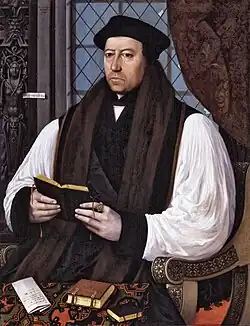
November 13 – Lady Jane Grey, who had claimed the title of Queen of England for nine days, is convicted of high treason, along with her husband Lord Guilford Dudley, two of Dudley's brothers, and Thomas Cranmer, the former Archbishop of Canterbury, after trial conducted by a special commission at Guildhall in the City of London.[68] Referred to by the court as "Jane Dudley, wife of Guildford", Lady Jane is found to have treacherously assumed the title and the power of the monarch of England, as evidenced by a number of documents she had signed as "Jane the Quene". All five defendants are sentenced to death. Beheading is the sentence for the men, while Lady Jane is to either be "burned alive on Tower Hill or beheaded as the Queen pleases", with the decision (for a private decapitation) to be made by Queen Mary.[74]
November 16 – A delegation from the English Parliament formally asks the new queen, Mary I, to choose an English husband rather than to marry Spain's Prince Philip, and suggests Edward Courtenay, 1st Earl of Devon.[75] Queen Mary's choice to marry Philip, in the interests of protecting England from an invasion, will ultimately lead to Wyatt's rebellion.
November 17 (13th waxing of Natdaw 915 ME) – Bayinnaung, King of Burma, commissions the building of the Kanbawzathadi Palace in his capital, Pegu (modern-day Bago in Myanmar).[76] The palace is completed in 1556 but is burned down in 1599.
November 25 – Second Margrave War: The city of Kulmbach, near Brandenburg in Bavaria in Germany, is sacked and burned to the ground after its margrave, Albert Alcibiades, makes an unsuccessful attempt to bring all of the Duchy of Franconia under his control.[78]
Tonbridge School is founded by Sir Andrew Judde, under letters patent of Edward VI of England.[80]
The xiii Bukes of Eneados of the famose Poete Virgill, the first complete translation of any major work of classical antiquity into one of the English languages, is published in London.
The addition of a new section of the Outer City fortifications is completed in southern Beijing, bringing the overall size of Beijing to 18 square miles (4662 hectares).
January 12 (10th waxing of Tabodwe 915 ME) – Bayinnaung is crowned king of the Burmese Taungoo Dynasty at his new capital at Pegu, after a previous coronation on January 11, 1551, and takes the regnal name of Thiri Thudhamma Yaza.[82]
January 21 – Edward Courtenay, one of the four plotters of Wyatt's rebellion in England, is arrested and reveals that an attempt will be made to overthrow the English government.[83]
January 27 – Wyatt's rebellion begins in England at Maidstone as Sir Thomas Wyatt reads a proclamation that Queen Mary of England’s marriage to King Philip of Spain will "bring upon this realm most miserable servitude, and establish popish religion". Within two days, Wyatt has raised 2,000 soldiers to join his plan to overthrow Queen Mary.[85]
January 30 – Henry Grey, Duke of Suffolk, one of the English conspirators in Wyatt's rebellion, leads troops from Leicester to Coventry, but the group finds that the gates of the city are closed because the rebellion has been exposed.[86]
March 18 – Princess Elizabeth is imprisoned in the Tower of London on charges of working with the organizers of Wyatt's rebellion for the overthrow of Queen Mary of England.[88]
May 9 – Elizabeth is released from the Tower of London, although she continues to be confined at home after she is cleared of suspicion of conspiracy to overthrow the government.
June 11 – Italian General Piero Strozzi successfully defends an attack on the Republic of Siena by French troops, led by Cosimo de' Medici at the battle of Pontedera, but suffers a tremendous loss of his own troops in the process.
September 13 (Shawwal 15, 961 AH) – At the Battle of Tadla in Morocco, Mohammed ash-Sheikh, ruler of the Saadi dynasty enters the city of Fez and becomes the undisputed sultan. Ali Abu Hassun, last ruler of the Wattasid dynasty, flees.[91]
October–December
October 8 – In Peru, an 11-month long rebellion by Francisco Hernández Girón is ended at the Battle of Pucará with the rebels defeated by the Viceroy of Peru near Cuzco.[92][93]
October 21 – The Plassenburg castle in Bavaria, residence of the ruling House of Hohenzollern in the Principality of Ansbach, is destroyed during the Second Margrave War.[94]
November 1 – English captain John Lok, commanding three ships (the Trinitie, the Bartholomew and the John Evangelist), departs from Dartmouth in England to voyage to the Guinea Coast at West Africa.[95][96][97]
November 22 – Upon the death of his father, Sultan Islam Shah Suri, 10-year-old Firuz Shah Suri becomes the Sultan of the Sur Empire at Delhi, but he is murdered within a few days.
December 22 – The John Lok expedition reaches Guinea, anchoring at the Sesto River and remains for seven days to begin trading.[95]"[98]
The name of the beer brewed by New Belgium Brewing Company is based on a recipe from this date, called "1554."
Luso-Chinese agreement: Portugal reaches an agreement with the Ming Dynasty of China, to be allowed to legally trade in the province of Guangdong. This agreement is often seen as a starting point of the Portuguese colony of Macau
Rao Surjan Singh becomes ruler of Bundi.
1555
January–March
January 22 – The Kingdom of Ava in Upper Burma falls.
February 4 – John Rogers is burned at the stake at Smithfield, London, becoming the first of the 284 Protestant martyrs of the English Reformation to be killed during the five and one-half year reign of Queen Mary I of England.[99] His death is followed within the week by that of Laurence Saunders on February 8 in Coventry, and Rowland Taylor, Rector of Hadleigh, Suffolk, and John Hooper, deposed Bishop of Gloucester on February 9.
February 26 – The Muscovy Company is chartered in England to trade with the Tsardom of Russia[100][101] and Richard Chancellor negotiates with the Tsar.
March 25 – Valencia, Venezuela, is founded by Captain Alonso Díaz Moreno.
April–June
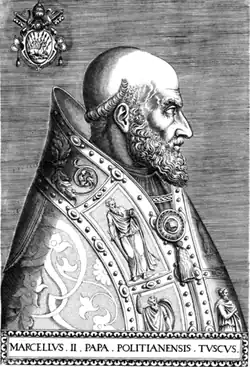
April 9 – Marcello Cervini degli Spannocchi is unanimously chosen as the successor to Pope Julius III, who died on March 23, and takes the name of Pope Marcellus II as the 222nd Pontiff of the Roman Catholic Church. He will reign for 22 days.[102]
May 1 – Foundation of St John's College, Oxford, England, to teach Catholic theology.
May 30 – Foundation of Trinity College, Oxford, England, to teach Catholic theology.
May 15 – The conclave opens with 42 of the 56 Roman Catholic cardinals to choose a successor to Pope Marcellus II, who had died on May 1.[103]
May 23 – Giovanni Pietro Carafa, Cardinal of Naples, is elected as the new Pope after Giacomo del Pozzo fails to obtain the necessary two-thirds approval.[104] Carafa, the 223rd Pope, takes the name Pope Paul IV.[105]
May 25 – Jeanne d'Albret becomes the Queen of Navarre upon the death of her father, King Henry II.[106]
June 1 – The Treaty of Amasya between the Ottoman Empire and Safavid Persia concludes the Ottoman-Safavid War.
June 22 – Adil Shah Suri becomes the Sultan of the Sur Empire at Delhi in India after Sikandar Shah Suri is forced to flee from the Mughal Empire forces.
July–September
July 12 – Pope Paul IV creates the Roman Ghetto, the first Jewish ghetto in Rome.
August 24 – England's Thomas Thirlby, the first and only Roman Catholic Archbishop of Norwich and Queen Mary's envoy to Pope Paul IV, returns to London from bearing a papal bull that confirms Queen Mary's jurisdiction over Ireland.[107]
September 25 – The Peace of Augsburg is signed between Charles V, Holy Roman Emperor, and the Lutheran Schmalkaldic League, establishing the principle Cuius regio, eius religio, that is, rulers within the Empire can choose the religion of their realm.
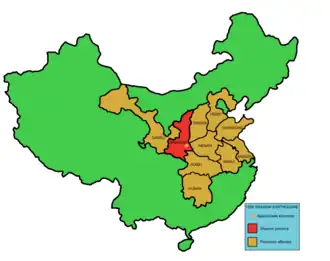
September – The 1555 Kashmir earthquake causes widespread destruction and death in Kashmir, India.[108]
November 1 – French Navy Vice-Admiral Nicolas Durand de Villegaignon leads a small fleet of two ships and 200 soldiers and colonists to take possession of Serigipe Island, near modern-day Rio de Janeiro in Brazil at Guanabara Bay, and builds Fort Coligny.[110]
December 11 – Cardinal Reginald Pole is made a cardinal-priest in the Roman Catholic Church and made the administrator of the See of Canterbury in England,[112] though he will not become the new Archbishop of Canterbury until the following March 20.
Date unknown
Russia breaks a 60-year-old truce with Sweden by attacking Finland.
English captain John Lok returns from Guinea, with five Africans to train as interpreters for future trading voyages.
Richard Eden publishes The Decades of the Newe Worlde or West India, a translation into English of parts of Pietro Martire d'Anghiera's De orbe novo decades, the Gonzalo Fernández de Oviedo y Valdés work Natural hystoria de las Indias and others, urging his countrymen to follow the lead of Spain in exploring the New World;[113] the work includes the first recorded use in English of the country name 'China'.
Establishment in England of the following grammar schools: Boston Grammar School, Gresham's School at Holt, Norfolk (founded by Sir John Gresham) and Ripon Grammar School (re-foundation).
William Annyas becomes the Mayor of Youghal, Ireland, the first Jew to hold such a position in Ireland.[114]
John Dee is charged, but cleared, of treason in England.
January 4 – In Japan, Saitō Yoshitatsu, the eldest son of Saitō Dōsan, arranges the murders of his two younger brothers, Magoshiro and Kiheiji, and forces his father to flee from the Sagiyama Castle.
January 24 – In India, at the Sher Mandal in Delhi, the Mughal Emperor Humayun trips while descending the stairs from his library and strikes the side of his head against a stone step, sustaining a fatal injury. He never regains consciousness and dies seven days later.[118]
February 5 – Truce of Vaucelles: Fighting temporarily ends between France and Spain.[119]
April 3 – In Qazvin, the Shah of Iran Tahmasp I, becomes enraged with the sexual orientation of his son Ismail II, and sends Ismail to Afghanistan to serve as the Iranian governor of Herat province.[123]
April 24 – Pál Márkházy surrenders the Hungarian fortress at Ajnácskő (now Hajnáčka in Slovakia) to the Ottoman Empire. Márkházy, accused of treachery, is stripped of his estates and title by the King of Hungary, and forced to flee to the Principality of Transylvania.[124]
May 28 (20th day of 4th month of Kōji 2) – In Japan, the Battle of Nagara-gawa takes place along the Nagara River in Mino Province near what is now the Gifu Prefecture. Saitō Yoshitatsu, with 17,500 troops, overwhelms and kills his father, Saitō Dōsan, who had attempted to avenge the Saitō family honor with less than 3,000 people.[125]
June 27 – Thirteen English Protestants (11 men and two women), the "Stratford Martyrs", are burned at the stake at Stratford-le-Bow near London after being convicted of heresy.[127][128]
July–September
July 17 – Kostajnica Fortress in what is now Croatia falls to the Ottoman Empire and remains under Turkish control for the next 132 years.
August 15 – Work begins on the Peresopnytsia Gospel at the Monastery of the Holy Trinity in the Grand Duchy of Lithuania, and continues for the next five years.[129]
October 7 – The Battle of Delhi is fought in India, at Tughlaqabad) near Delhi between forces of the Sur Empire (ruled by Muhammad Adil Shah) and the Mughal Empire (ruled by Akbar the Great). General Hemchandra Vikramaditya (Hemu) of the Suris overwhelms the forces commanded by the Mughal Governor of Delhi, Tardi Beg Khan within one day.[131]
November 5 – Second Battle of Panipat: Fifty miles north of Delhi, a Mughal army defeats the forces of Hemu and recaptures Delhi for the Mughal Empire, guaranteeing Akbar's rule.[132][133]
November 10 – The English ship Edward Bonadventure, commanded by Richard Chancellor is wrecked on the coast of Scotland at Pitsligo, killing most of its crew, including Chancellor. The few survivors include the first Russian ambassador to England, Osip Nepeya.[134]
November 17 – In the Holy Roman Empire, the Steter Kriegsrat is founded as a War Council with five generals and five civil servants to advise the Habsburg rulers.[135]
December 7 – The Mughal Emperor Akbar personally travels with Bairam Khan to lead an invasion force to defeat the Sultan of the Sur Empire, Sikandar Shah Suri.[136]
December 27 – Péter Erdődy is appointed as the Ottoman Viceroy of Croatia after the death on September 7 of Nikola IV Zrinski.
December 31 – All military authorities in the Holy Roman Empire are ordered to submit to the decisions of the Imperial War Council.
January 4 – Pietro Giovanni Chiavica Cibo becomes the new Doge of the Republic of Genoa for a term of 2 years as the term of the Doge Agostino Pinelli Ardimenti comes to an end.[142]
January 6 – Italian War of 1551–1559: Gaspard II de Coligny, the French governor of Picardy (in northern France), launches surprise attacks on Douai and Lens in the Spanish Netherlands and captures both cities for France.[143]
January 13 – Sigismund II Augustus, King of Poland and Grand Duke of Lithuania, issues an edict against Protestants, at the urging of the Archbishop Mikołaj Dzierzgowski, Primate of Poland.
January 28 – Bayinnaung, King of Burma and head of the Toungoo dynasty, conquers two the Shan States, Möng Mit and Hsipaw in what is now northern Myanmar.[144] The event is later commemorated with an inscription on the Shwezigon Pagoda Bell.[145]
February 4 – Pope Paul IV creates the metropolitan archdiocese of Portuguese India (based in Goa) separating the Goan diocese from the ecclesiastical province of Lisbon.
February 24 – Delegates from Sweden, Finland and Russia arrive at Novgorod to negotiate a treaty to end the war between the two empires.[146]
March 11 – The Burmese conquest of the Shan States continues as the capital of the Mongkawng state, Mong Kawng, falls to the Toungoo dynasty invaders, five days after the March 6 surrender of the town of Mong Yang. The event is later commemorated on the Shwezigon Pagoda Bell.
March – The Takeda clan besiege Katsurayama Castle in eastern Japan.[147] The siege ends with the last stand of the castle garrison, and the complete destruction of Katsurayama, allowing the Takeda to further expand in Shinano Province.
April–June
April 2 – The Treaty of Novgorod between Sweden and Russia is put into effect as delegates kiss the cross, as demanded by the Tsar Ivan IV.[146]
April 25 – English aristocrat Thomas Stafford attempts a rebellion against Queen Mary, landing at Scarborough, North Yorkshire with two ships and 32 followers after crossing the English Channel from Dieppe in France. Upon landing, he captures Scarborough Castle and proclaims himself "Protector of the Realm".[149]
April 28 – Henry Neville, 5th Earl of Westmorland, arrives in Scarborough and ends the Stafford rebellion, arresting Stafford and the small rebel force.[149]
April 30 – Arauco War – Battle of Mataquito: Spanish forces of Governor Francisco de Villagra launch a dawn surprise attack against the Mapuche (headed by their toqui Lautaro), in present-day Chile.
May 4 – The Stationers' Company, officially the Worshipful Company of Stationers and Newspaper Makers, is granted a royal charter and a monopoly on the English publishing industry.[150] For the next 150 years, the Stationers will regulate and censor the printing industry until the passage of the Copyright Act 1710 on April 10, 1710.
May 23 – The Shwezigon Pagoda Bell, weighing 7,560 pounds (3,430 kg), is dedicated. The Bell, commissioned by King Bayinnaung and located in the Myanmar city of Bagan, bears a detailed inscription of the 16th century Burmese conquest of the Shan States.
May 28 – English rebel Thomas Stafford and 32 of his followers are beheaded at the Tower of London after being convicted of treason.[149]
May 29 – King Philip II of Spain signs a treaty in London with Iacopo VI being restored to rule of the Principality of Piombino a bargain with Cosimo I de' Medici.[151][152]
June 10 – The New Testament of the Geneva Bible, a Protestant Bible translation into English (produced under the supervision of William Whittingham, and printed in Roman type), is published in Geneva.[154]
June 18 – Mass executions by burning at the stake resume in England for Protestants convicted of heresy under the law of England's Catholic ruler, Queen Mary. On the first day, four women and three men are put to death at Maidstone at Kent. The next day, at Canterbury, another seven prisoners are burned. On June 22, ten more people (six men and four women) burn at the stake at Lewes at Sussex. In all, 24 people (12 men and 12 women) are killed in a five-day period[155]
By June – The 1557 influenza pandemic, probably originating in China, spreads to Europe.[156]
July–September
July 3 – The small Stato dei Presidi, a 300 square kilometres (120 sq mi) section of Spanish territory on the Tuscan coast of Italy, is created by a treaty between Cosimo I de' Medici (Duke of the Florentine Republic and the future Grand Duke of Tuscany) and King Felipe II of Spain. In return, Cosimo receives the rest of the former Republic of Siena.[157]
July 24 – The Edict of Compiègne is issued by King Henri II of France, providing for the death penalty to be applied to Protestants for a variety of crimes, including a relapse after having renounced Protestantism; unauthorized travel to Geneva; publication of Protestant books; possessing graven images; and unauthorized participation in Protestant religious gatherings, whether public or private.[158]
July 25 – In India, Sikandar Shah Suri, Sultan of the Sur Empire in Punjab, surrenders the fortress at Mau in the Nurpur kingdom (now in Uttar Pradesh) after a six month siege by the Mughal Empire. Mughal General Bairam Khan allows Sikandar to live in exile in Bihar, while Bakht Mal, Raja of Nurpur is imprisoned at Lahore and later beheaded.[159]
August 27 – Battle of St. Quentin: French forces under Marshal Anne de Montmorency are decisively defeated by the Spanish and English under Emmanuel Philibert, Duke of Savoy, after a 17-day battle. Montmorency himself is captured, but Philip II refuses to press his advantage, and withdraws to the Netherlands.[160]
September 11– The Colloquy of Worms convenes in Germany as a dialog on religious issues between clerics of the German Catholic Church and the Lutheran Church.[161][162]
September 12– The Spanish occupation of the Papal States is confirmed as Pope Paul IV signs a separate peace treaty, the Peace of Cave-Palestrina, with Spain's Duke of Alba, who has massed troops outside of Rome in preparationfor an attack.[163][164]
October–December
October 8 – The Colloquy of Worms is adjourned with no resolution on reconciling the differences between Catholicism and Protestantism, after the parties are unable to agree on the concepts of original sin and theological justification.[161]
October 23 – Mohammed al-Shaykh, Sultan of Morocco since 1549, is assassinated by Ottoman soldiers who had infiltrated the Moroccan army. The assassination comes on orders of the Ottoman sultan after Mohammed makes plans for an alliance with Spain against the Ottoman Empire.[165] Mohammed is succeeded by his son, Abdallah al-Ghalib.
November 17 (27th day of the 10th month of Kōji 3) – Prince Michihito of Japan becomes the Emperor Ōgimachi almost two months after the September 27 death of his father, the Emperor Go-Nara.
With the permission of the Ming dynasty government of China, and for the benefit of both Western and Eastern merchants, the Portuguese settle in Macau (retroceded in 1999).[170] Direct Sino-Portuguese trade has existed since 1513, but this is the first official legal treaty port on traditional Chinese soil, that will form a long-term Western settlement.
Spain becomes bankrupt, throwing the German banking houses into chaos.[171]
Gonville and Caius College, Cambridge, is refounded by John Caius.[172]
Welsh-born mathematician Robert Recorde publishes The Whetstone of Witte in London, containing the first recorded use of the equals sign, and the first use in English of plus and minus signs.[177]
German adventurer Hans Staden publishes a widely translated account of his detention by the Tupí people of Brazil, Warhaftige Historia und beschreibung eyner Landtschafft der Wilden Nacketen, Grimmigen Menschfresser-Leuthen in der Newenwelt America gelegen ("True Story and Description of a Country of Wild, Naked, Grim, Man-eating People in the New World, America").[178]
February 4 – (16th day of 1st month of Eiroku 1) Takeda Shingen becomes the shugo (military governor) of Shinano Province after his successful military campaign there.
February 5 – Arauco War: Pedro de Avendaño, with sixty men, captures Caupolicán (the Mapuche Gran Toqui), who is leading their first revolt against the Spanish Empire (near Antihuala), encamped with a small band of followers.
June 23 – France is successful in the siege of Thionville in the Duchy of Luxembourg and recovers the fortress from the Spanish Empire after an operation that began on April 17 and lasted more than two months.
July–September
July 9 – The Ottoman Empire, with 15,000 troops and 150 warships, besieges the Spanish garrison at Ciutadella de Menorca at Spain's Balearic Islands. When the town falls on July 17, the 3,099 surviving inhabitants are sold into slavery.[182]
July 13 – Battle of Gravelines: Near the border between the Kingdom of France and the Spanish Netherlands, Spanish forces led by Lamoral, Count of Egmont, and assisted by the English Navy, inflict a major defeat on the French forces of Marshal Paul de Thermes.
July 18 – The city of Tartu, capital of the Bishopric of Dorpat (in modern-day Estonia) surrenders to Russia.
August 22 – In Spain, Bartolomé Carranza, the Roman Catholic Archbishop of Toledo, is arrested at Torrelaguna on orders of the Grand Inquisitor, Fernando de Valdés y Salas. Carranza is brought a prisoner to Valladolid to face accusations of heresy.[183] He remains in prison for eight years before being transferred to Rome for the Pope to hear his appeal.[184]
October–December
October 17 – Postal history of Poland: King Sigismund II Augustus appoints an Italian merchant living in Kraków to organise a consolidated postal service in Poland, the origin of Poczta Polska.
November 15 – The five Canterbury Martyrs, three men and two women, are burned at the stake, becoming the last of 312 Protestants put to death for heresy during the reign of England's last Roman Catholic ruler, Queen Mary.[186] Queen Mary dies two days later, bringing an end to her campaign. During the final year of Mary's reign, 49 Protestants are burned at the stake and three others die in prison while awaiting execution.
November 17 – Queen Mary, a devout Roman Catholic dies of uterine cancer at the age of 42, and is succeeded by her younger half-sister Elizabeth, an adherent to the Protestant Church of England, beginning the Elizabethan era in British history.
December 5 – Less than three weeks of becoming Queen of England, Elizabeth summons the members of the English Parliament with orders to assemble at Westminster on January 23. Under Elizabeth's agenda, the Parliament is charged with restoring the laws passed at the beginning of the English Reformation, and repealing the reforms made during the reign of Queen Mary.
Unknown
John Knox's attack on female rulers, The First Blast of the Trumpet Against the Monstruous Regiment of Women, is published anonymously from Geneva.[187]
English explorer Anthony Jenkinson travels from Moscow to Astrakhan and Bukhara.[188] He is the first Englishman to note that the Amu Darya changed course, to start flowing into the Aral Sea.[189]
Queen Elizabeth I of England grants rest and refreshment to pilgrims and travellers who pass by the Holy Well Spring at Malvern in England.
March 23 – Emperor Gelawdewos of Ethiopia, defending his lands against the invasion of Nur ibn Mujahid, Sultan of Harar, is killed in battle. His brother, Menas, succeeds him as king.
March 31 – The Westminster Conference 1559 opens at Westminster Hall in London with nine leading Catholic churchmen, and nine Protestant reformers of the Church of England.[191] The conference adjourns on April 3 for Easter and never reconvenes.
April–June
April 3 – Peace of Cateau Cambrésis: After two days of negotiations, France makes peace with England and Spain, ending the Italian War of 1551–59. France gives up most of its gains in Italy (including Savoy), retaining only Saluzzo, but keeps the three Lorraine bishoprics of Metz, Toul, and Verdun, and the formerly English town of Calais.
May 8 – Queen Elizabeth of England gives royal assent to the Act of Supremacy 1558 (requiring any person taking public or church office in England to swear allegiance to the English monarch as Supreme Governor of the Church of England) and to the Act of Uniformity 1558 (requiring all persons in England to attend Anglican services on penalty of a fine for noncompliance).
May 13 – At Basel, the body of Dutch Anabaptist leader David Joris is exhumed and burned, following his posthumous conviction of heresy.
June 11 – Scottish Reformation: A Protestant mob, incited by the preaching of John Knox, sacks St Andrews Cathedral.
June 22 – King Philip II of Spain and the 14-year-old Elisabeth of Valois are married in Spain, having married by proxy in January.[192]
The fatal tournament between King Henry and Lord Montgomery
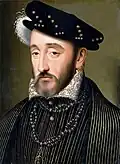
June 30 – King Henry of France participates in a jousting tournament at the Place des Vosges in Paris, where French nobles are celebrating the marriage of Princess Elisabeth to King Philip of Spain. During competition against Gabriel de Lorges, Count of Montgomery, commander of King Henry's bodyguards, the Garde Écossaise, King Henry is struck in the eye by a splinter from Montgomery's lance and fatally injured.[193] Henry survives for 10 days without treatment until dying from sepsis.
July–September
July 10 – Francis II becomes King of France following the death of his father, Henry II.[194][195] Members of the House of Guise and the new king's mother Catherine de' Medici dispute control over the kingdom.
July 25 – The Articles of Leith are signed in Edinburgh between the Protestant Lords of the Congregation and the Roman Catholic representatives of the Scottish regent, Mary of Guise, the widow of King James V, who is ruling on behalf of her daughter, the 17-year-old Mary, Queen of Scots. The Lords, who have occupied Edinburgh since June, withdraw their troops in return for the Scottish crown's agreement to not interfere with the practice of Protestantism in Scotland.[196]
July 31 – Pope Paul IV authorizes the creation of the University of Douai (which will later become the University of Lille).[197]
August 15 – Led by Don Tristán de Luna y Arellano, a Spanish missionary colony of 1,500 men, on 13 ships, arrives from Vera Cruz at Pensacola Bay, founding the oldest European settlement in the mainland U.S. (St. Augustine is founded in 1565.)
August 18 – Pope Paul IV, leader of the Roman Catholic Church since 1555, dies at the age of 83 after a reign of four years. The office of the Pope remains vacant until almost the end of the year before a successor is chosen.
September 4 – Gorkha state is established by Dravya Shah, beating local Khadka kings, which is the origin of the current country of Nepal.
September 5 – The papal conclave to elect a new pope opens 18 days after the death of Pope Paul IV at the Apostolic Palace in Rome with 47 of the 55 Roman Catholic cardinals present.[198] The conclave lasts 101 days before a successor to Pope Paul is elected.
September 19 – Just weeks after arrival at Pensacola, the Spanish missionary colony is decimated by a hurricane that kills hundreds, sinks five ships, with a galleon, and grounds a caravel; the 1,000 survivors divide to relocate/resupply the settlement, but suffer famine & attacks, and abandon the effort in 1561.
September 25 – At the age of 12, Petru cel Tânăr (Peter the Younger) is named as the new Prince of Wallachia at the capital, Târgoviște (now in Romania) after the death of his father, Mircea the Shepherd. In response, members of Wallachian nobility (boyars) opposed to Mircea's rule launch the first of three attempts to take the throne, fighting battles at Românești, Șerpătești and Boiani.
October–December
October 24 – Backed by Ottoman Empire troops, the army of Wallachia defeats the boyars at the battle of Boiani. The Ottoman central government at Constantinople confirms Petru as the rightful ruler of the principality within the Empire.
October 27 – Frederick III is terminated from his post as Duke of Legnica on orders of Ferdinand I, Holy Roman Emperor. The Emperor Ferdinand orders Frederick placed under house arrest, and restores Frederick's son, Henry XI as Duke of Legnica.
November 5 – In Scotland, Crichton Castle, home of the powerful Earl of Bothwell, is besieged and captured in an attack by the Earl of Arran.[200]
November 6 – The Ottoman Empire ends its attempt to wrest control of the island of Bahrain from Portuguese control, after a siege of Manama Castle that began on July 2.[201]
December 25 – After a conclave of almost four months, Giovanni Angelo Medici is elected as the 224th pope, and takes the name Pope Pius IV.[198]
Oda Nobunaga wins control of his native province of Owari.
Margaret of Parma becomes Governor of the Netherlands, in place of her brother, King Philip II of Spain.
Jean Nicot, French ambassador to Portugal, introduces tobacco to the French court in the form of snuff, and describes its medicinal properties. The active ingredient in tobacco is later named "nicotine" in his honor.[204]
December 7 – Lithuanian noble Barbara Radziwiłł, wife of Sigismund II Augustus, King of Poland and Duke of Lithuania since 1547, has an elaborate coronation in Kraków as Queen consort and Grand Duchess, five months before her death at the age of 30.[234]
^ abcFernández Duro, Cesáreo (1895). Armada Española desde la unión de los reinos de Castilla y Aragón (in Spanish). Vol. I. Madrid, Spain: Sucesores de Rivadeneyra. pp. 282–284.
^John S. C. Abbott, The Empire of Russia from the Remotest Period to the Present Time (Mason Brothers, 1859, reprinted 2020)("On the 23rd of February, 1551, a larger convention of the clergy...")
^Porteous, John (1969). Coins in History. New York: Putnam. pp. 178–180..
^Ernst Wilhelm Möller, History of the Christian Church: A.D. 1517-1648, Reformation and Counter-reformation (S. Sonnenschein & Company, 1900) p.240
^John S. C. Abbott, Austria : Its Rise and Present Power (P. F. Collier and Son, 1902) p.132
^Kala, U (1724). Maha Yazawin (in Burmese). Vol. 2 (2006, 4th printing ed.). Yangon: Ya-Pyei Publishing. p. 210.
^Further Selections from the Tragic History of the Sea, 1559-1565: Narratives of the Shipwrecks of the Portuguese East Indiamen (Taylor & Francis, 2017)
^Hardwick, Charles (1851). A History of the Articles of Religion. Cambridge: John Deighton. pp. 74–79.
^War and Peace in the Religious Conflicts of the Long Sixteenth Century (Vandenhoeck & Ruprecht, 2022) pp.47-48
^Fierro, Maribel, ed. (2010). "Chronology". The New Cambridge History of Islam, Volume 2: The Western Islamic World, Eleventh to Eighteenth Centuries. Cambridge: Cambridge University Press. p. xxxiii. ISBN 978-0-521-83957-0. Failed Ottoman attempt to conquer Hormuz.
^Victor Duruy, A Short History of France (J. M. Dent & sons, Ltd. 1918) p.501
^Robert Knecht, The Valois Kings of France 1328-1589 (Bloomsbury Academic, 2007) p.149 ("By the time Charles V lifted the siege, on 2 January 1553, his army had dwindled to a third of its original size.")
^Encyclopedia of Tudor England, ed. by John A. Wagner, et al. (ABC-CLIO, 2011) p.12
^David Wilmshurst, The Ecclesiastical Organisation of the Church of the East, 1318–1913 (Peeters Publishers, 2000) pp.21–22
^Ives, Eric (2009). Lady Jane Grey: A Tudor Mystery. Malden MA; Oxford UK: Wiley-Blackwell. pp. 251–252, 334. ISBN 978-1-4051-9413-6.; Bellamy, John (1979). The Tudor Law of Treason. Toronto: Routlegde, Kegan & Paul. p. 54. ISBN 0-7100-8729-2.
^Weikel, Ann (1980). Tittler, Robert; Loach, Jennifer (eds.). The Mid-Tudor Polity c.1540-1560. The Marian Council Revisited: Rowman and Littlefield. p. 53. ISBN 9780333245286. Retrieved 2 October 2021.
^Royal Historical Commission of Burma (2003) [1832]. Hmannan Yazawin (in Burmese). Vol. 2. Yangon: Ministry of Information, Myanmar. p. 281.
^Royal Historical Commission of Burma (2003) [1832]. Hmannan Yazawin (in Burmese). Vol. 2. Yangon: Ministry of Information, Myanmar. pp. 280–281.
^Thorp, Malcolm R. (1978). "Religion and the Wyatt Rebellion of 1554". Church History: Studies in Christianity and Culture. 47 (4): 375. doi:10.2307/3164313. JSTOR 3164313.
^Fletcher, Anthony (1970). Tudor Rebellions (Second ed.). Longman Group Limited. p. 81. ISBN 9780582313897. Retrieved 18 November 2021.
^Froude, James Anthony (1910). The Reign of Mary Tudor. London: J. M. Dent & Sons, New York: P. Dutton & Co. pp. 100–101. Retrieved 8 December 2021.
^Palmer, Alan; Palmer, Veronica (1992). The Chronology of British History. London: Century Ltd. pp. 150–153. ISBN 0-7126-5616-2.
^Prescott, H. F. M. (1953). Mary Tudor: The Spanish Tudor (1953 Reissue ed.). Phoenix. pp. 325–326. ISBN 9781842126257. Retrieved 18 February 2022. {{cite book}}: ISBN / Date incompatibility (help)
^David Loades, The Reign of Mary Tudor: Politics, Government and Religion in England, 1553–58 (Longman, 1991) pp. 224–225 ISBN 0-582-05759-0
^Samson, Alexander (2005). "Changing Places: The Marriage and Royal Entry of Philip, Prince of Austria, and Mary Tudor, July-August 1554". The Sixteenth Century Journal. 36 (3): 761–784. doi:10.2307/20477489. JSTOR 20477489.
^Jamil Marhi and Abu Al-Nasr, History of Morocco in the Islamic Era (Cambridge University Press, 1987) p.155
^Severo Martinez Pelaez, La patria del criollo: ensayo de interpretación de la realidad colonial guatemalteca (Fondo de Cultura Económica, 2013)
^ abRichard Hakluyt, The Principal Navigations, Voyages, Traffiques & Discoveries of the English Nation Made by Sea Or Overland to the Remote and Farthest Distant Quarters of the Earth at Any Time Within the Compass of These 1600 Years (1597, reprinted by J. M. Dent and Sons, Ltd., 1927) pp.47-50 ("The first day of November at nine of the clocke at night, departing from the coast of England, se set off...")
^p.50 ("The two and twentieth of December we came to the river of Sesto & remained there until the nine and twentieth day of said moneth.")
^Palmer, Alan; Palmer, Veronica (1992). The Chronology of British History. London: Century Ltd. pp. 150–153. ISBN 0-7126-5616-2.
^Williams, Hywel (2005). Cassell's Chronology of World History. London: Weidenfeld & Nicolson. ISBN 0-304-35730-8.
^Goldsmid, E. (ed.) (1886). The Principal Navigations, Voyages, Traffiques and Discoveries of the English Nation, collected by Richard Hakluyt, Preacher, Vol. III: North-Eastern Europe and Adjacent Countries, Part II: The Muscovy Company and the North-Eastern Passage. Edinburgh: E. & G. Goldsmid. pp. 101-112.
^ This article incorporates text from a publication now in the public domain: Cooper, Thompson (1898). "Thirlby, Thomas". In Lee, Sidney (ed.). Dictionary of National Biography. Vol. 56. London: Smith, Elder & Co. p. 137.
^Woodward, Geoffrey (2013). "8". Philip II. London, New York: Routledge. ISBN 978-1317897736.
^Sarkar, Jadunath (1960). Military History of India. Orient Longmans. p. 66. ISBN 9780861251551. {{cite book}}: ISBN / Date incompatibility (help)
^Bhardwaj, Kanwal Kishore (2000). Hemu: Napoleon of Medieval India. Mittal Publications. pp. 35–38. ISBN 978-81-7099-663-7. Retrieved 10 October 2023.
^Mubārak, Abū al-Faz̤l ibn (1902). The Akbar Nama of Abu-l-Fazl. Low Price Publications. pp. 60–62. ISBN 978-81-7536-295-6. Retrieved 10 October 2023. {{cite book}}: ISBN / Date incompatibility (help)
^Müller, Gerhard; Krause, Gerhard (1996). Theologische Realenzyklopädie (in German). De Gruyter. p. 452. ISBN 978-3-11-015155-8. Retrieved 16 October 2023.
^Pattenden, Miles (2013). Pius IV and the Fall of The Carafa: Nepotism and Papal Authority in Counter-Reformation Rome. OUP Oxford. pp. 21–22. ISBN 978-0191649615.
^Haan, Bertrand (2010). Une paix pour l'éternité: La négociation du traité du Cateau-Cambrésis. Madrid: Casa de Velázquez. pp. 37–60.
^Tagliacozzo, Eric; Siu, Helen F.; Perdue, Peter C. (5 January 2015). Asia Inside Out. Harvard University Press. p. 90. ISBN 978-0-674-59850-8. Retrieved 16 October 2023.
^Archer, Christon; et al. (2002). World History of Warfare. Lincoln: University of Nebraska Press. p. 251. ISBN 978-0-8032-4423-8.
^J. W. Ruuth (1958). "Kaupungin perustamiskirje". Porin kaupungin historia II (in Finnish). City of Pori. p. 269.
^Lucinda H. S. Dean, 'In the Absence of an Adult Monarch', Medieval and Early Modern Representations of Authority in Scotland and the British Isles (Routledge, 2016), p. 155.
^One or more of the preceding sentences incorporates text from a publication now in the public domain: Gordon, Alexander (1911). "Carranza, Bartolomé". In Chisholm, Hugh (ed.). Encyclopædia Britannica. Vol. 5 (11th ed.). Cambridge University Press. pp. 399–400.
^J. P. Kirsch, "Bartolomé Carranza," Catholic Encyclopedia (1917 ed.)
^Neale, J. E. (1954) [1934], Queen Elizabeth I: A Biography (reprint ed.), London: Jonathan Cape, p. 59, OCLC220518
^Svat Soucek (2008):"The Portuguese and Turks in the Persian Gulf", in Revisiting Hormuz: Portuguese Interactions in the Persian Gulf Region in the Early Modern Period, p.37 copies archived on January 2, 2021 on the Wayback Machine website
^Derek W. H. Thomas; John W. Tweeddale, eds. (2019). John Calvin: for a new reformation. Wheaton, Illinois: Crossway. ISBN 978-1-4335-1281-0. OCLC1091236732.
^Geister, Oliver (2006). "Große Kirchenordnung, 1559". Die Ordnung der Schule: Zur Grundlegung einer Kritik am verwalteten Unterricht. Münster. p. 145.{{cite book}}: CS1 maint: location missing publisher (link)
^G.R. Elton, ed. The New Cambridge Modern History, Vol. 2: The Reformation, 1520–1559 (1st ed. 1958)
^Lewis Spitz, The Protestant Reformation: 1517–1559 (2003).
^Lipsius, Justus (1978). Iusti Lipsi epistolae (in Dutch). Koninklijke Academie voor Wetenschappen, Letteren en Schone Kunsten van België. p. 378. ISBN 978-90-6569-655-7. Retrieved 3 October 2023.
^Ahlqvist, Alfred Gustaf (1874). Karin Månsdotter (in Swedish). Central-tryckeriets förlag. p. 2. Retrieved 3 October 2023.
^Orazio Vecchi (in Italian). Modena: Accademia di scienze, lettere e arti. 1950. p. 9. Retrieved 3 October 2023.
^Frost, Robert (2015). The Oxford History of Poland-Lithuania. Volume I: The Making of the Polish-Lithuanian Union, 1385-1569. Oxford University Press. ISBN 978-0-19-820869-3.
^Ruby, Louisa Wood (1999). Paul Bril: The Drawings. Brepols. p. 11. ISBN 978-2-503-50577-0. Retrieved 3 October 2023.
^Adejumobi, Saheed A. (30 December 2006). The History of Ethiopia. Bloomsbury Publishing USA. p. 169. ISBN 978-0-313-08823-0. Retrieved 3 October 2023.
^浦上氏一族の群像 (in Japanese). 歴史研究会. p. 54. Retrieved 6 October 2023.
^Olszewski, Edward J.; Dunbar, Burton Lewis (2008). Sixteenth-century Italian Drawings. Harvey Miller. p. 3. ISBN 978-1-905375-10-3. Retrieved 6 October 2023.
^Akyeampong, Emmanuel Kwaku; Gates Jr, Henry Louis (2 February 2012). Dictionary of African Biography. OUP USA. p. 124. ISBN 978-0-19-538207-5. Retrieved 12 October 2023.
^Miscellanea di storia italiana (in Italian). R. Deputazione sovra gli studi di storia patria per le antiche provincie e la Lombardia. 1871. p. 170. Retrieved 4 October 2023.
^"Ernst". www.deutsche-biographie.de (in German). Retrieved 9 October 2023.
^Morton, Edward John Chalmers (1882). Heroes of Science: Astronomers. Society for Promoting Christian Knowledge. p. 63. Retrieved 9 October 2023.
^Rankin, Andrew (20 November 2012). Seppuku: A History of Samurai Suicide. Kodansha USA. ISBN 978-1-56836-448-3. Retrieved 9 October 2023. An early instance of a remonstrative seppuku, recorded by Ōta Gyuichi in his biography of Oda Nobunaga, was the death of Hirate Masahide on February 25, 1553. A former general, in his sixties Masahide served as personal tutor to the young Nobunaga, whose teenage bad-boy antics are legendary in Japan.
^Mohnike, Gottlieb (1831). Hymnologische Forschungen (in German). Struck. p. 29. Retrieved 9 October 2023.
^"Aal, Johannes". hls-dhs-dss.ch (in German). Retrieved 9 October 2023.
^Донской, Дмитрий Владимирович (2008). Рюриковичи: исторический словарь (in Russian). Русская панорама. p. 273. ISBN 978-5-93165-188-0. Retrieved 9 October 2023.
^Former Director of the Warburg Institute and Professor Emeritus of the History of Classical Tradition J B Trapp (1998). The Cambridge History of the Book in Britain. Cambridge University Press. pp. 176. ISBN 978-0-521-57346-7.
^Brinkmann, Bodo (2007). Lucas Cranach. Harry N. Abrams. p. 24. ISBN 978-1-905711-13-0. Retrieved 9 October 2023.
^Jammerthal, Tobias; Janssen, David Burkhart (1 September 2019). Georg III. von Anhalt: Abendmahlsschriften (in German). Evangelische Verlagsanstalt. p. 16. ISBN 978-3-374-06295-9. Retrieved 9 October 2023.
^Loyola, Ignatius; O'Conor, Joseph (1900). The autobiography of St. Ignatius. New York: Benziger Brothers. p. 165. Retrieved 14 October 2023.
^Olszewski, Edward J.; Dunbar, Burton Lewis (2008). Sixteenth-century Italian Drawings. Harvey Miller. p. 141. ISBN 978-1-905375-10-3. Retrieved 14 October 2023.
^Aretino, Pietro (1909). L'oeuvre du divin Arétin (in French). Bibliothèque des Curieux. p. 3. Retrieved 14 October 2023.
^Wagner, John A.; Schmid, Susan Walters (9 December 2011). Encyclopedia of Tudor England. Bloomsbury Publishing USA. p. 249. ISBN 978-1-59884-299-9. Retrieved 14 October 2023.
^Parish, Graeme (1972). Image of Chile. C. Knight. p. 51. ISBN 978-0-85314-147-1. Retrieved 19 October 2023.
^"Johann II". www.deutsche-biographie.de (in German). Retrieved 19 October 2023.
^Sesso, Livia Alberton Vinco Da (1992). Dal Ponte : a dynasty of painters (in Italian). Ghedina & Tassotti. p. 81. ISBN 978-88-7691-101-9. Retrieved 17 October 2023.
^Livermore, H. V. (2 January 1966). A New History of Portugal. CUP Archive. p. 151. Retrieved 19 October 2023.




%252C_prins_van_Oranje_Rijksmuseum_SK-A-256.jpeg)
.jpg)


.jpg)
_-_John%252C_Prince_of_Portugal_(1537-54)_-_RCIN_403953_-_Royal_Collection.jpg)
.JPG)


_Founder_of_the_Jesuits.jpg)
%252C_ca._1560.jpg)
 This article incorporates text from a publication now in the public domain: Cooper, Thompson (1898). "Thirlby, Thomas". In Lee, Sidney (ed.). Dictionary of National Biography. Vol. 56. London: Smith, Elder & Co. p. 137.