1888 (MDCCCLXXXVIII) was a leap year starting on Sunday of the Gregorian calendar and a leap year starting on Friday of the Julian calendar, the 1888th year of the Common Era (CE) and Anno Domini (AD) designations, the 888th year of the 2nd millennium, the 88th year of the 19th century, and the 9th year of the 1880s decade. As of the start of 1888, the Gregorian calendar was 12 days ahead of the Julian calendar, which remained in localized use until 1923.
January 3 – The great telescope (with an objective lens of 91 cm (36 in) diameter) at Lick Observatory in California is first used.
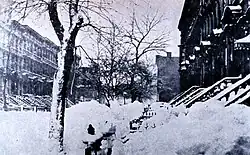
January 12 – The Schoolhouse Blizzard hits Dakota Territory and the states of Montana, Minnesota, Nebraska, Kansas and Texas, leaving 235 dead, many of them children on their way home from school.
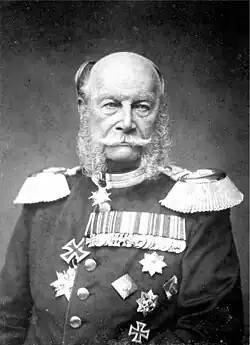
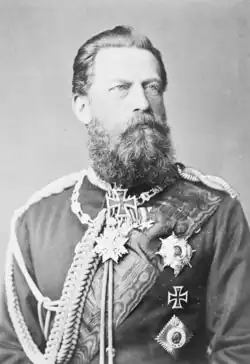
Year of the Three Emperors in Germany: Wilhelm I dies aged 90 and is succeeded as German Emperor and King of Prussia by his son, the terminally ill Frederick III.
1888 British Lions tour to New Zealand and Australia: The "English Footballers" embark for the first British rugby union tour of Australasia.
March 13 – Ritter Island eruption and tsunami: The summit of Ritter Island off the coast of New Guinea collapses, resulting in a tsunami and the deaths of an estimated 500 to 3,500 people.[1]
March 15 – The Sikkim Expedition, a British military expedition to expel the Tibetans from northern Sikkim, begins.
March 16 – The foundation stone for a new National Library of Greece is laid in Athens.
March 20 – The first Romani language operetta premieres in Moscow, Russia.
March 23 – A meeting called by William McGregor to discuss establishment of The Football League is held in London.
March 25 – Opening of an international Congress for Women's Rights organized by Susan B. Anthony in Washington, D.C., leading to formation of the International Council of Women, a key event in the international women's movement.
London prostitute Emma Elizabeth Smith is brutally attacked by two or three men, dying of her injuries the following day, first of the Whitechapel murders, but probably not a victim of Jack the Ripper.
The Brighton Beach Hotel in Coney Island (New York) is moved 520 ft (160 m), using six steam locomotives, by civil engineer B. C. Miller, to save it from ocean storms.
April 6 – The first New Year's Day is observed, of the solar calendar adopted by Siamese King Chulalongkorn, with the 106th anniversary of Bangkok's founding in 1782 as its epoch (reference date).
The Kingdom of Sedang is formed, in modern-day Vietnam.
American writer Ernest Thayer's baseball poem "Casey at the Bat" is first published (under the pen name "Phin") as the last of his humorous contributions to The San Francisco Examiner.
June 14 – The White Rajahs territories become the British protectorate of Sarawak.
June 15 – Year of the Three Emperors in Germany: Frederick III dies after ruling for 99 days and is succeeded as German Emperor and King of Prussia by his son, Wilhelm II, who will reign until his abdication in 1918.
July 2–27 – London matchgirls strike of 1888: About 200 workers, mainly teenaged girls, strike following the dismissal of three colleagues from the Bryant and May match factory, precipitated by an article on their working conditions published on June 23 by campaigning journalist Annie Besant, and the workers unionise on July 27.[7]
July 15 – Eruption of Mount Bandai: An explosive eruption of the stratovolcano Mount Bandai in the Fukushima Prefecture of Japan results in pyroclastic flows and the deaths of at least 477 people (according to Japanese government sources).[9][10]
July 25 – Frank Edward McGurrin, a court stenographer from Salt Lake City, Utah, purportedly the only person using touch typing at this time, wins a decisive victory over Louis Traub in a typing contest held in Cincinnati, Ohio. This date can be called the birthday of the touch typing method that is widely used in modern times.
August 5 – Bertha Benz arrives in Pforzheim having driven 40 miles (64 km) from Mannheim in a car manufactured by her husband Carl Benz, thus completing the first "long-distance" drive in the history of the automobile.
A fire destroys the Main Building, the heart of Wells College in Aurora, New York, causing a loss of $130,000.[12]
The Oaths Act permits the oath of allegiance taken to the Sovereign by Members of Parliament (MPs) to be affirmed, rather than sworn to God, thus confirming the ability of atheists to sit in the House of Commons of the United Kingdom.
August 10 – Dr Friedrich Hermann Wölfert’s motorised airship successfully completes the world’s first engine-driven flight, from Cannstatt to Kornwestheim in Germany.[13]
August 13 – The Local Government Act, effective from 1889, establishes county councils and county borough councils in England and Wales, redraws some county boundaries, and gives women the vote in local elections. It also declares that "bicycles, tricycles, velocipedes, and other similar machines" be carriages within the meaning of the Highway Acts (which remains the case), and requires that they give audible warning when overtaking "any cart or carriage, or any horse, mule, or other beast of burden, or any foot passenger", a rule abolished in 1930.
August 20 – A mutiny at Dufile, Equatoria, results in the imprisonment of the Emin Pasha.
August 22 – Earliest evidence of a death and injury by a meteorite, in Sulaymaniyah, Iraq.[14]
August 24 –The first trams in Tallinn (Reval), horsecars, begin operation.
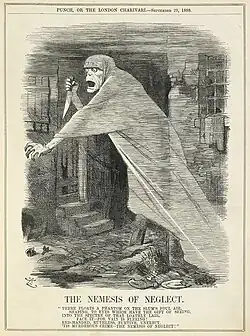
August 31 – Whitechapel murders: The mutilated body of London prostitute Mary Ann Nichols is found; she is considered the first victim of Jack the Ripper.
September 6 – Australian cricketer Charles Turner becomes the first bowler to take 250 wickets in an English season – a feat since accomplished only by Tom Richardson (twice), J. T. Hearne, Wilfred Rhodes (twice) and Tich Freeman (six times).
Patagonian sheep farming boom: The Great Herding (Spanish: El Gran Arreo) begins with thousands of sheep being herded from the Argentine outpost of Fortín Conesa to Santa Cruz near the Strait of Magellan.[15]
Whitechapel murders: The mutilated body of London prostitute Annie Chapman is found (considered to be the second victim of Jack the Ripper).
In a letter accepting renomination as President of the United States, Grover Cleveland declares the Chinese "impossible of assimilation with our people and dangerous to our peace and welfare".
Whitechapel murders: The 'Dear Boss letter' signed "Jack the Ripper", the first time the name is used, is received by London's Central News Agency.[11]
September 30 – Whitechapel murders: The bodies of London prostitutes Elizabeth Stride and Catherine Eddowes, the latter mutilated, are found. They are generally considered Jack the Ripper's third and fourth victims, respectively.
October
October 1 – Sofia University officially opens, becoming the first university in liberated Bulgaria.
October 2 – The Whitehall Mystery: Dismembered remains of a woman's body are discovered at three central London locations, one being the construction site of the police headquarters at New Scotland Yard.
Louis Le Prince films the first motion picture: Roundhay Garden Scene in Roundhay, Leeds, West Yorkshire, England, two seconds and 18 frames in length (followed by his movie Leeds Bridge and Accordion Player).
Battle of Guté Dili: Seeking to extend Mahdist control over what is becomes southwestern Ethiopia, governor Khalil al-Khuzani is routed by an alliance of Shewan forces, under Ras Gobana Dacche and Moroda Bekere, ruler of Leqa Naqamte. Only a handful, including Khalil, barely manage to flee the battlefield.
October 25 – St Cuthbert's Society at the University of Durham in England is founded, after a general meeting chaired by the Reverend Hastings Rashdall.
October 30 – The Rudd Concession, a written concession for exclusive mining rights in Matabeleland, Mashonaland and adjoining territories, is granted by King Lobengula of Matabeleland to Charles Rudd, James Rochfort Maguire and Francis Thompson, who are acting on behalf of South African-based politician and businessman Cecil Rhodes, providing a basis for white settlement of Rhodesia.
November 8 – Joseph Assheton Fincher files a patent in the United Kingdom for the parlour game which he calls "Tiddledy-Winks".
November 9 – Whitechapel murders: The mutilated body of London prostitute Mary Jane Kelly is found. She is considered to be the fifth, and last, of Jack the Ripper's victims. A number of similar murders in England follow, but the police attribute them to copy-cat killers.
November 16 – First signs of famine in Ethiopia, caused by drought combined with early spread of the 1890s African rinderpest epizootic.
December 18 – Richard Wetherill and his brother-in-law, Charlie Mason, discover the Indian ruins of Mesa Verde in southwestern Colorado.
December 23 – During a bout of mental illness (and having quarreled with his friend Paul Gauguin), DutchpainterVincent van Gogh infamously cuts off the lower part of his own left ear, taking it to a brothel, and is removed to the local hospital in Arles in the south of France.
Date unknown
The dolphin Pelorus Jack is first sighted in Cook Strait, New Zealand.
John Robert Gregg first publishes Gregg shorthand in the United States.
The Camborne School of Mines is founded in Cornwall, England.
The Baldwin School is founded in Bryn Mawr, Pennsylvania, as "Miss [Florence] Baldwin's School for Girls, Preparatory for Bryn Mawr College".
Letitia Alice Walkington becomes the first woman in the United Kingdom to receive a degree of Bachelor of Laws, from the Royal University of Ireland at Queen's College, Belfast.
^West Virginia Archives and History (2019). "John Warren Davis". West Virginia Department of Arts, Culture and History. Archived from the original on February 29, 2020. Retrieved February 29, 2020.
^ Cyrus Adler and Judah David Eisenstein (1901–1906). "ASH, ABRAHAM JOSEPH". In Singer, Isidore; et al. (eds.). The Jewish Encyclopedia. New York: Funk & Wagnalls.
^Cárdenas Álvarez, Renato (January 17, 2005). "La historia del pirata chilote Pedro Ñancúpel" (in Spanish). El Llanquihue. Retrieved January 10, 2019. Cuando es capturado en Melinka ya era una leyenda porque había evadido la persecución.
1888 Annual Cyclopedia (1889) highly detailed coverage of "Political, Military, and Ecclesiastical Affairs; Public Documents; Biography, Statistics, Commerce, Finance, Literature, Science, Agriculture, and Mechanical Industry" for year 1888; massive compilation of facts and primary documents; worldwide coverage; 831 pp


.jpg)

.jpg)



 Cyrus Adler and Judah David Eisenstein (1901–1906). "ASH, ABRAHAM JOSEPH". In Singer, Isidore; et al. (eds.). The Jewish Encyclopedia. New York: Funk & Wagnalls.