1770

April 29: James Cook lands at Botany Bay in Australia.
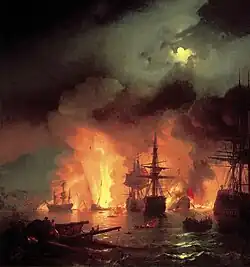
July 5: Russia defeats Ottomans at the Battle of Chesma (painting by Ivan Aivazovsky)

1770 (MDCCLXX) was a common year starting on Monday of the Gregorian calendar and a common year starting on Friday of the Julian calendar, the 1770th year of the Common Era (CE) and Anno Domini (AD) designations, the 770th year of the 2nd millennium, the 70th year of the 18th century, and the 1st year of the 1770s decade. As of the start of 1770, the Gregorian calendar was 11 days ahead of the Julian calendar, which remained in localized use until 1923.

1770 in various calendars
Gregorian calendar1770
MDCCLXX
Ab urbe condita2523
Armenian calendar1219
ԹՎ ՌՄԺԹ
Assyrian calendar6520
Balinese saka calendar1691–1692
Bengali calendar1176–1177
Berber calendar2720
British Regnal year10 Geo. 3 – 11 Geo. 3
Buddhist calendar2314
Burmese calendar1132
Byzantine calendar7278–7279
Chinese calendar己丑年 (Earth Ox)
4467 or 4260
    — to —
庚寅年 (Metal Tiger)
4468 or 4261
Coptic calendar1486–1487
Discordian calendar2936
Ethiopian calendar1762–1763
Hebrew calendar5530–5531
Hindu calendars
 - Vikram Samvat1826–1827
 - Shaka Samvat1691–1692
 - Kali Yuga4870–4871
Holocene calendar11770
Igbo calendar770–771
Iranian calendar1148–1149
Islamic calendar1183–1184
Japanese calendarMeiwa 7
(明和7年)
Javanese calendar1695–1696
Julian calendarGregorian minus 11 days
Korean calendar4103
Minguo calendar142 before ROC
民前142年
Nanakshahi calendar302
Thai solar calendar2312–2313
Tibetan calendarས་མོ་གླང་ལོ་
(female Earth-Ox)
1896 or 1515 or 743
    — to —
ལྕགས་ཕོ་སྟག་ལོ་
(male Iron-Tiger)
1897 or 1516 or 744


Events

January– March

  • January 1 – The foundation of Fort George, Bombay is laid by Colonel Keating, principal engineer, on the site of the former Dongri Fort.
  • February 1Thomas Jefferson's home at Shadwell, Virginia is destroyed by fire, along with most of his books.[1]
  • February 14 – Scottish explorer James Bruce arrives at Gondar, capital of Abyssinia (modern-day Ethiopia) and is received by the Emperor Tekle Haymanot II and Ras Mikael Sehul.[2]
  • February 22 – Christopher Seider, an 11-year-old boy in Boston in the British Province of Massachusetts Bay, is shot and killed by a colonial official, Ebenezer Richardson. The funeral sets off anti-British protests that lead to the massacre days later.[3]
  • March 5Boston Massacre: Eleven American men are shot (five fatally) by British troops, in an event that helps start the American Revolutionary War five years later.
  • March 21 – King Prithvi Narayan Shah shifts to the newly constructed Basantapur Palace, in the capital Kathmandu, as the first King of the Unified Kingdom of Nepal.
  • March 26 – First voyage of James Cook: English explorer Captain James Cook and his crew aboard HMS Endeavour complete the circumnavigation of New Zealand.

April–June

  • April 12 – The Townshend Acts are repealed by Britain's Parliament by the efforts of Prime Minister Frederick North, with the exception of the increased duties on imported tea. The American colonists, in turn, stop their embargo on British imports.[4]
  • April 18 (April 19 by Cook's log)[5] 18:00 – First voyage of James Cook: English explorer Captain James Cook and his crew become the first recorded Europeans to encounter the eastern coastline of the Australian continent. Land is sighted at Point Hicks, and named after Lieutenant Hicks who first observes landform at 6am.
  • April 20 – Battle of Aspindza: Georgian king Erekle II defeats the Ottoman forces, despite being abandoned by an ally, Russian General Totleben.
  • April 29 – First voyage of James Cook: Captain Cook drops anchor on HMS Endeavour in a wide bay, about 16 km (10 mi) south of the present city of Sydney, Australia. Because the young botanist on board the ship, Joseph Banks, discovers 30,000 specimens of plant life in the area, 1,600 of them unknown to European science, Cook names the place Botany Bay on May 7.
  • May 16 – 14-year-old Marie Antoinette of Austria marries Louis-Auguste (who in 1774 becomes King Louis XVI) at the Palace of Versailles.
  • May 20 – A stampede at a celebration of the newly wedded Marie Antoinette and Louis-Auguste in Paris kills more than a hundred people.[6]
  • June 3
  • June 9 – Falklands Crisis (1770): Some 1,600 Spanish marines, sent by the Spanish governor of Buenos Aires in five frigates, seize Port Egmont in the Falkland Islands. The small British force present promptly surrenders.[7]
  • June 11 – First voyage of James Cook: HMS Endeavour grounds on the Great Barrier Reef.

July– September

  • July 1 – Lexell's Comet (D/1770 L1) passes the Earth at a distance of 2,184,129 kilometres (1,357,155 mi), the closest approach by a comet in recorded history.[8]
  • July 5 – Battle of Chesma and Battle of Larga: The Russian Empire defeats the Ottoman Empire in both battles. When the news of the defeat reaches the Ottoman city of Smyrna (July 8), the crowd attacks the Greek community of the city (perceived as favourable to the Russian cause) and kills an estimated 200 Greeks and three Western Europeans (although some reports estimate the number of victims at 3,000 or even 5,000 including "3 or 4 thousands who die due to the fright").[9][10]
  • August 1 (July 21 O.S.) – Russo-Turkish War (1768–74) – Battle of Kagul: Russian commander Pyotr Rumyantsev routs 150,000 Turks.
  • August 22 (August 23 by Cook's log) – First voyage of James Cook: Captain Cook determines that New Holland (Australia) is not contiguous with New Guinea, and claims the whole of its eastern coast for Great Britain, later naming it all New South Wales.
  • c. September – Johann Gottfried Herder meets Johann Wolfgang von Goethe in Strasbourg.
  • September 24 – In Hillsborough, North Carolina, the Regulator Movement riots against local authorities.[11]

October–December

  • October 11 – Phillis Wheatley becomes the first African American woman to have her work published, after having written a poetic elegy to the late Reverend George Whitefield.[12]
  • November 14 – James Bruce discovers what he believes to be the source of the Nile.
  • December 7 – King Louis XV of France issues the "Edict of December", dismissing the rebellious magistrates of the Parlements of Paris and the other 13 provinces.[13][14]
  • December 24 – France's Secretary of the Navy, César Gabriel de Choiseul, is dismissed from his position by the king.[15]

Date unknown


Births

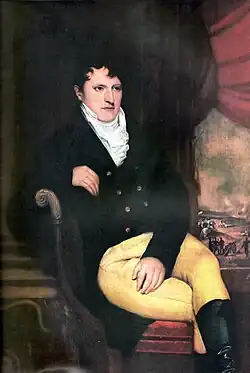
Manuel Belgrano
Georg Wilhelm Friedrich Hegel
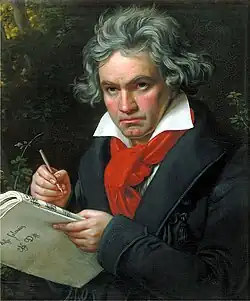
Ludwig van Beethoven


Deaths

George Whitefield

References

  1. ^ Allen Jayne, Jefferson's Declaration of Independence: Origins, Philosophy, and Theology (University Press of Kentucky, 2015) p41
  2. ^ "Bruce, James", in Encyclopædia Britannica, 11th Edition, Volume IV (Cambridge University Press, 1911) p676
  3. ^ James Marten, Children in Colonial America (NYU Press, 2007) p173
  4. ^ Gordon Carruth, ed., The Encyclopedia of American Facts and Dates 3rd Edition (Thomas Y. Crowell, 1962) pp78-79
  5. ^ Hinks, Arthur R. (1935). "Nautical time and civil date". The Geographical Journal. 86 (2): 153–157. Bibcode:1935GeogJ..86..153H. doi:10.2307/1786590. JSTOR 1786590.
  6. ^ Helene Delalex; Alexandre Maral; Nicolas Milovanovic (2016). Marie-Antoinette. Getty Publications. p. 25. ISBN 9781606064832.
  7. ^ "Nationalism and the Falkland Islands War". Archived from the original on June 5, 2011. Retrieved August 19, 2007.
  8. ^ "D/1770 L1 (Lexell)". Gary W. Kronk's Cometography. Retrieved July 2, 2012.
  9. ^ Rear, Marjorie (2015). "William Barker. Member of the Right Worshipful Levant Company 1731-1825. A Life in Smyrna" (PDF). p. 30. Archived (PDF) from the original on October 9, 2022.
  10. ^ Blondy, Alain; Labat Saint Vincent, Xavier (2014). Malte et Marseille au XVIIIème siècle. La Fondation de Malte. p. 161. ISBN 9781291435467.
  11. ^ Charles D. Rodenbough, Governor Alexander Martin: Biography of a North Carolina Revolutionary War Statesman (McFarland, 2004) p28
  12. ^ Vincent Carretta, Phillis Wheatley: Biography of a Genius in Bondage (University of Georgia Press, 2014) p78
  13. ^ Leonore Loft, Passion, Politics, and Philosophie: Rediscovering J.-P. Brissot (Greenwood Publishing Group, 2002) p55
  14. ^ Dale K. Van Kley, The Religious Origins of the French Revolution: From Calvin to the Civil Constitution, 1560-1791 (Yale University Press, 1996) p249
  15. ^ Antony Strugnell, Diderot’s Politics: A Study of the Evolution of Diderot’s Political Thought after the Encyclopedie (Martinus Nijhoff, 2012) p123
  16. ^ Some Bible and Cemetery Records of the MacKethan / Robeson Family (Booklet I, Bible Records) – via Digital Collections of the State Archives of North Carolina and the State Library of North Carolina.
  17. ^ "History of George Grenville - GOV.UK". www.gov.uk. Retrieved June 19, 2023.

Further reading