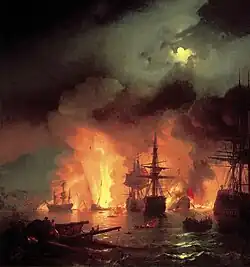
April 29: James Cook lands at Botany Bay in Australia.July 5: Russia defeats Ottomans at the Battle of Chesma (painting by Ivan Aivazovsky)
1770 (MDCCLXX) was a common year starting on Monday of the Gregorian calendar and a common year starting on Friday of the Julian calendar, the 1770th year of the Common Era (CE) and Anno Domini (AD) designations, the 770th year of the 2nd millennium, the 70th year of the 18th century, and the 1st year of the 1770s decade. As of the start of 1770, the Gregorian calendar was 11 days ahead of the Julian calendar, which remained in localized use until 1923.
February 14 – Scottish explorer James Bruce arrives at Gondar, capital of Abyssinia (modern-day Ethiopia) and is received by the Emperor Tekle Haymanot II and Ras Mikael Sehul.[2]
February 22 – Christopher Seider, an 11-year-old boy in Boston in the British Province of Massachusetts Bay, is shot and killed by a colonial official, Ebenezer Richardson. The funeral sets off anti-British protests that lead to the massacre days later.[3]
March 21 – King Prithvi Narayan Shah shifts to the newly constructed Basantapur Palace, in the capital Kathmandu, as the first King of the Unified Kingdom of Nepal.
April 12 – The Townshend Acts are repealed by Britain's Parliament by the efforts of Prime Minister Frederick North, with the exception of the increased duties on imported tea. The American colonists, in turn, stop their embargo on British imports.[4]
April 18 (April 19 by Cook's log)[5] 18:00 – First voyage of James Cook: English explorer Captain James Cook and his crew become the first recorded Europeans to encounter the eastern coastline of the Australian continent. Land is sighted at Point Hicks, and named after Lieutenant Hicks who first observes landform at 6am.
April 20 – Battle of Aspindza: Georgian king Erekle II defeats the Ottoman forces, despite being abandoned by an ally, Russian General Totleben.
April 29 – First voyage of James Cook: Captain Cook drops anchor on HMS Endeavour in a wide bay, about 16 km (10 mi) south of the present city of Sydney, Australia. Because the young botanist on board the ship, Joseph Banks, discovers 30,000 specimens of plant life in the area, 1,600 of them unknown to European science, Cook names the place Botany Bay on May 7.
The 7.5 Mw Port-au-Prince earthquake affects the French colony of Saint-Domingue with a maximum Mercalli intensity of X (Extreme), killing 250 or more.
June 9 – Falklands Crisis (1770): Some 1,600 Spanish marines, sent by the Spanish governor of Buenos Aires in five frigates, seize Port Egmont in the Falkland Islands. The small British force present promptly surrenders.[7]
July 1 – Lexell's Comet (D/1770 L1) passes the Earth at a distance of 2,184,129 kilometres (1,357,155 mi), the closest approach by a comet in recorded history.[8]
July 5 – Battle of Chesma and Battle of Larga: The Russian Empire defeats the Ottoman Empire in both battles. When the news of the defeat reaches the Ottoman city of Smyrna (July 8), the crowd attacks the Greek community of the city (perceived as favourable to the Russian cause) and kills an estimated 200 Greeks and three Western Europeans (although some reports estimate the number of victims at 3,000 or even 5,000 including "3 or 4 thousands who die due to the fright").[9][10]
August 22 (August 23 by Cook's log) – First voyage of James Cook: Captain Cook determines that New Holland (Australia) is not contiguous with New Guinea, and claims the whole of its eastern coast for Great Britain, later naming it all New South Wales.
September 24 – In Hillsborough, North Carolina, the Regulator Movement riots against local authorities.[11]
October–December
October 11 – Phillis Wheatley becomes the first African American woman to have her work published, after having written a poetic elegy to the late Reverend George Whitefield.[12]
November 14 – James Bruce discovers what he believes to be the source of the Nile.
December 7 – King Louis XV of France issues the "Edict of December", dismissing the rebellious magistrates of the Parlements of Paris and the other 13 provinces.[13][14]
December 24 – France's Secretary of the Navy, César Gabriel de Choiseul, is dismissed from his position by the king.[15]
.jpg)



.jpg)