1790s
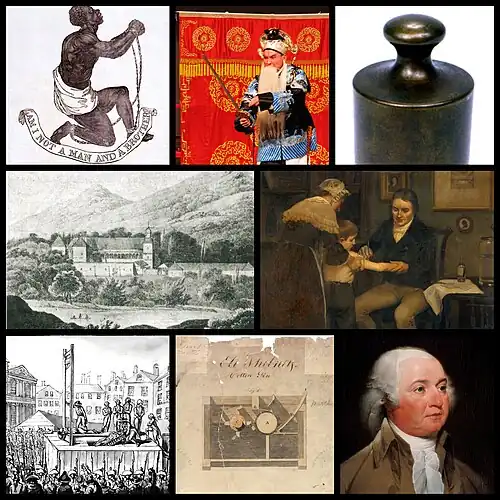
The 1790s (pronounced "seventeen-nineties") was the decade that began on January 1, 1790, and ended on December 31, 1799. Considered as some of the Industrial Revolution's earlier days, the 1790s called for the start of an anti-imperialist world, as new democracies such as the French First Republic and the United States began flourishing at this era. Revolutions – both political and social – forever transformed global politics and art, as wars such as the French Revolutionary Wars and the American Revolutionary War moulded modern-day concepts of liberalism, partisanship, elections, and the political compass.
| Millennia |
|---|
| 2nd millennium |
| Centuries |
| Decades |
| Years |
| Categories |
|
Events
1790
January–March
- January 8 – United States President George Washington gives the first State of the Union address, in New York City.[1]
- January 11 – The 11 minor states of the Austrian Netherlands, which took part in the Brabant Revolution at the end of 1789, sign a Treaty of Union, creating the United States of Belgium.
- January 14 – U.S. Secretary of the Treasury Alexander Hamilton submits his proposed plan for payment of American debts, starting with $12,000,000 to pay the foreign debts of the confederation, followed by $40 million for domestic debts, and $21.5 million for the war debts of the states. The plan is narrowly approved 14-12 in the Senate, and 34-28 in the House.[2]
- January 15 – Fletcher Christian & 8 mutineers aboard the Bounty land on Pitcairn.
- January 26 – Mozart's opera Così fan tutte premieres in Vienna.
- January 30
- The first boat specialized as a rescue lifeboat is tested on the River Tyne in England.
- Olowalu Massacre: American Captain Simon Metcalfe opens fire with cannon towards villagers in canoes, killing about one hundred Hawaiians, and wounding many others.[3]
- February 1 – In New York City, the Supreme Court of the United States convenes for the first time.[4]
- February 4 – King Louis XVI declares to the French National Assembly that he will maintain the constitutional laws.
- February 11 – Two Quaker delegates petition the United States Congress for the abolition of slavery.
- February 25 – North Carolina cedes its western territories (modern day Tennessee) to the federal government.[2]
- March 1 – The first United States Census is authorized; it is held later in the year.[2]
- March 4 – France is divided into 83 départements, which cut across the former provinces, in an attempt to dislodge regional loyalties based on noble ownership of land.
- March 6 – The New York legislature consents to the admission to the Union of a new state, Vermont, formed within the boundaries of New York, contingent upon the successful conclusion of negotiations concerning disputed real-estate claims, and the boundary between the two states.
- March 21 – Thomas Jefferson reports to President George Washington in New York, as the new United States Secretary of State.
April–June
- April 10 – The United States patent system is established.
- May 13 – Battle of Reval: Gustav III of Sweden sends the battlefleet to eliminate the Russian squadron wintering at Reval (Estonia), but is defeated; 8 Russians, 130 Swedes are killed, up to 520 captured, 1 ship is burnt, another captured.
- May 17–18 – Battle of Andros: An Ottoman–Algerian fleet destroys the fleet of the Greek privateer Lambros Katsonis.
- May 26 – Congress passes an act to govern the creation of states from the "Southwest Territory", from which Tennessee, Alabama, and Mississippi will be formed.[2]
- May 29 – Rhode Island ratifies the United States Constitution, and becomes the last of the 13 original states to do so.[2]
- June 9 – Royal assent is given to establishment of the port of Milford Haven in Wales.
- June 20 – Compromise of 1790: Thomas Jefferson, James Madison, and Alexander Hamilton come to an agreement: Madison agrees to not be "strenuous" in opposition for the assumption of state debts by the federal government; Hamilton agrees to support the capital site being above the Potomac.
- June 23 – The alleged London Monster is arrested in London; he later receives 40 years for 10 assaults.
July–September
- July – Louis XVI accepts a constitutional monarchy in France.
- July 9 – Russo-Swedish War – Second Battle of Svensksund: In a massive Baltic Sea battle of 300 ships, the Swedish Navy captures one third of the Russian galley fleet: 304 Swedes are killed, 3,500 Russians killed and 6,000 captured, 51 Russian galleys and other rowing craft are sunk and 22 are taken.
- July 10 — The U.S. House of Representatives votes 32–29 to approve creating the District of Columbia from portions of Maryland and Virginia for the eventual seat of government and national capital.[2]
- July 12 – French Revolution: The Civil Constitution of the Clergy is passed. This completes the destruction of the monastic orders, legislating out of existence all regular and secular chapters for either sex, abbacies and priorships.
- July 14 – French Revolution: Citizens of Paris celebrate the unity of the French people and the national reconciliation, in the Fête de la Fédération.
- July 16 – U.S. President George Washington signs the Residence Act into law, establishing a site along the Potomac River as the District of Columbia and the future site of the capital of the United States. The move comes after the bill is narrowly approved on July 1 by the Senate, 14 to 12, and on July 9 by the House, 32 to 29.[5] At the same time, plans are made to move the national capital from New York to Philadelphia until the Potomac River site can be completed.
- July 26 – Alexander Hamilton's Assumption Bill, giving effect to his First Report on the Public Credit, is passed in the United States Congress, allowing the federal government to assume the consolidated debts of the U.S. states.
- July 27 – The Convention of Reichenbach is signed between Prussia and Austria.
- July 31 – Inventor Samuel Hopkins becomes the first to be issued a U.S. patent (for an improved method of making potash).
- August 4 – A newly passed U.S. tariff act creates the system of cutters for revenue enforcement (later named the United States Revenue Cutter Service), the forerunner of the Coast Guard.
- August 14 – The Treaty of Värälä ends the Russo-Swedish War.
- September 25 – The Peking Opera is born, when the Four Great Anhui Troupes introduce Anhui opera to Beijing, in honor of the Qianlong Emperor's 80th birthday.
- September 30 – Leopold II, Holy Roman Emperor starts to rule.
October–December
- October 7-22 – The Harmar Campaign ends in a defeat of U.S. Army General Josiah Harmar and Colonel John Hardin by the Western Confederacy of Indians, led by Chief Little Turtle or Mihšihkinaahkwa of the Miami tribe and Blue Jacket or Weyapiersenwah of the Shawnee at Kekionga (now Fort Wayne, Indiana).[2]
- October 7 – Commissioners appointed by the New York legislature announce the successful conclusion of negotiations between New York and Vermont, concerning disputed real-estate claims, and the consent of New York's legislature to the admission to the Union of the state of Vermont as the 14th State (which was formed within what New York claimed as its territory, under an Order in Council, that King George III issued on July 20, 1764).
- October 10 – At least 3,000 people die in Algeria when an earthquake and tsunami strikes the city of Oran. The city is destroyed and Spanish forces eventually flee in 1792.[6]
- October–December – Vincent Ogé leads a rebellion of freed blacks in Saint-Domingue. The rebellion is suppressed and Ogé executed.
- November 27 – France's Constituent Assembly passes a law requiring all Roman Catholic priests to swear an oath of acceptance of the new French Constitution.[7]
- November 27 – U.S. President George Washington and his wife, Martha Washington, arrive in the new temporary U.S. capital, Philadelphia, and take up residence at the President's House located at 524 Market Street.[8]
- December 2 – Holy Roman Empire forces recapture Brussels, bringing an end to the short-lived United States of Belgium and restoring the Austrian Netherlands.[9][10]

December 22: Capture of Izmail - December 6 – The United States Congress opens its first session in the new temporary U.S. capital in Philadelphia.[11]
- December 10 – The Hawkesbury and Nepean Wars begin in New South Wales, Australia, as a result of deterioration in relations and increasing colonization.
- December 17 – The Aztec calendar stone is discovered at El Zócalo, Mexico City.
- December 22 – Russo-Turkish War (1787–92): The Turkish fortress of Izmail is stormed and captured by Alexander Suvorov and his Russian armies. During Suvorov's storm of Izmail, 26,000 Turkish soldiers lose their lives.
- December 26 – Louis XVI gives his public assent to Civil Constitution of the Clergy during the French Revolution.
1791
January–March
- January 1 – Austrian composer Joseph Haydn arrives in England, to perform a series of concerts.
- January 2 – Northwest Indian War: Big Bottom Massacre – The war begins in the Ohio Country, with this massacre.
- January 12 – Holy Roman troops reenter Liège, heralding the end of the Liège Revolution, and the restoration of its Prince-Bishops.
- January 25 – The British Parliament passes the Constitutional Act 1791, splitting the old province of Quebec into Upper and Lower Canada.
- February 8 – The Bank of the United States, based in Philadelphia, is incorporated by the federal government with a 20-year charter and started with $10,000,000 capital.[12]
- February 21 – The United States opens diplomatic relations with Portugal.
- March 2 – French Revolution:
- The abolition of guilds is enacted.
- A mechanical semaphore line for rapid long-distance communication is demonstrated by Claude Chappe in Paris.
- March 4 – Vermont is admitted as the 14th U.S. state.
- March 13 – Thomas Paine's chief work Rights of Man (first part) is published in London.[13]
- March – French Revolution: In France, the National Constituent Assembly accepts the recommendation of its Commission of Weights and Measures that the nation should adopt the metric system.
April–June
- April 21 – The first of forty boundary markers of the original District of Columbia, delineating the borders of the new District in the United States is laid at Jones Point Light in Alexandria, Virginia.
- April 29–May 8 – The first American ships reach Japan, brigantine Lady Washington captained by John Kendrick of Boston, and the brig Grace.[14][15]
- May 3 – The Sejm of the Polish–Lithuanian Commonwealth proclaims the Constitution of May 3, 1791, the first modern codified constitution in Europe.
- June 20 – French Revolution: Flight to Varennes – The French Royal Family is captured when they try to flee in disguise.
- June 21 – The Ordnance Survey is founded in Great Britain for the production of maps.[16]
July–September
-
 Translation of Voltaire
 -
-
.jpg) Champ de Mars massacre
Champ de Mars massacre -
 Declaration of Pillnitz
- July 8 – Austrian composer Joseph Haydn, on his visit to England, is awarded an honorary doctorate of music at the University of Oxford.
- July 11 – The ashes of Voltaire are transferred to the Panthéon in Paris.
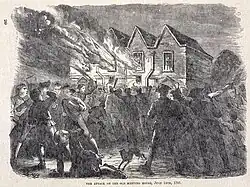
- July 14–17 – Priestley Riots against Dissenters in Birmingham, England.
- July 17 – French Revolution: The Champ de Mars massacre occurs in Paris.
- August 4 – The Treaty of Sistova is signed, ending the Ottoman–Habsburg wars.
- August 6 – The Brandenburg Gate in Berlin (Prussia) is finished.
- August 7 – George Hammond is appointed as Great Britain's first minister to the United States.[12]
- August 21 – Haitian Revolution: A slave rebellion breaks out in the French colony of Saint-Domingue.
- August 26 – John Fitch is granted a patent for the steamboat in the United States.
- August 27
- Declaration of Pillnitz: A proclamation by Frederick William II of Prussia and the Habsburg Leopold II, Holy Roman Emperor, affirms their wish to "put the King of France in a state to strengthen the bases of monarchic government."
- Third Anglo-Mysore War: Battle of Tellicherry – Off the south-west coast of India, a British Royal Navy patrol forces a French convoy bound for Mysore to surrender.
- September 5
- An ordinance is written barring the game of baseball within 80 yards of the Meeting House in Pittsfield, Massachusetts, the first known reference to the game of baseball in North America.[17]
- Declaration of the Rights of Woman and of the Female Citizen is written by activist Olympe de Gouges in response to the Declaration of the Rights of Man and of the Citizen.[18]
- September 6 – Wolfgang Amadeus Mozart's opera seria, La clemenza di Tito, premières at the Estates Theatre in Prague with Mozart conducting to mark the coronation of Leopold II as King of Bohemia.
- September 9 – The capital of the United States, Washington, D.C., is named after the incumbent 1st President George Washington.
- September 12 – The first serious secondary education school open to girls in Denmark, the Døtreskolen af 1791, is founded in Copenhagen.
- September 13 – French Revolution: King Louis XVI accepts the final version of the completed constitution.
- September 14 – French Revolution: The Papal States lose Avignon to Revolutionary France.
- September 25 – Mission Santa Cruz is founded by Basque Franciscan Father Fermín Lasuén, becoming the 12th mission in the California mission chain.
- September 28 – French Revolution: The law on Jewish emancipation is promulgated in France, the first such legislation in modern Europe.
- September 30 – Wolfgang Amadeus Mozart's singspiel opera The Magic Flute (Die Zauberflöte) premières at the Freihaus-Theater auf der Wieden in Vienna with Mozart conducting.
October–December
- October 1 – French Revolution: The Legislative Assembly (France) convenes.
- October 9 – Mission Nuestra Señora de la Soledad is founded by Father Fermín Lasuén, becoming the 13th mission in the California mission chain.
- October 19 – The Treaty of Drottningholm is signed between the Russian Empire and Sweden establishing an alliance between the two.[19][20]
- October 28 – French Revolution: The Declaration of the Rights of Woman and of the Female Citizen is published in France.
- November 4 – St. Clair's Defeat, the worst loss suffered by the United States Army in fighting against American Indians, takes place in modern-day Mercer County, Ohio. Miami fighters led by Chief Mihsihkinaahkwa (Little Turtle) and by Shawnee warriors commanded by War Chief Weyapiersenwah (Blue Jacket) rout the forces of General Arthur St. Clair and kill 630 U.S. soldiers, along with hundreds of civilians.[21]
- December 4 – The first issue of The Observer, the world's first Sunday newspaper, is published in London.
- December 5 – Austrian composer Wolfgang Amadeus Mozart dies early this morning aged 35 at his home in Vienna, having been bedridden since November 20 with a serious illness, perhaps acute rheumatic fever. On a mild and misty December 7, following a funeral service in St. Stephen's Cathedral, he is buried in a common unmarked grave (as customary at this time) in St. Marx Cemetery in the presence of Salieri, Süssmayr, van Swieten (his patron) and two other musicians.[22]
- December 15 – Ratification by the states of the first ten amendments to the United States Constitution is completed, creating the United States Bill of Rights. Two additional amendments remain pending, and one of these is finally ratified in 1992, becoming the Twenty-seventh Amendment.
- December 23 – The Pale of Settlement is established by ukase of Catherine the Great, specifying those areas of the Russian Empire in which Jews are permitted permanent residency.
Date unknown
- The School for the Indigent Blind, the oldest continuously operating specialist school of its kind in the world, is founded in Liverpool, England, by blind ex-merchant seaman, writer and abolitionist Edward Rushton.
- Camembert cheese reputedly first made by Marie Harel, a farmer from Normandy.[23]
- The Dar Hassan Pacha (palace) in the Casbah of Algiers is completed.[24]
- The first printed manuscript of Dream of the Red Chamber by Cao Xueqin, one of the Classic Chinese Novels, begins publication posthumously.
1792
January–March
- January 9 – The Treaty of Jassy ends the Russian Empire's war with the Ottoman Empire over Crimea.[25]
- January 25 – The London Corresponding Society is founded.
- February 18 – Thomas Holcroft produces the comedy The Road to Ruin in London.
- February 20
- The Postal Service Act, establishing the United States Post Office Department, is signed by President George Washington.[26]
- Parliament House, Dublin catches fire during a legislative session. "Although in imminent danger of the roof falling in," it is noted later, "the House did not adjourn until a proper motion had been put and carried in the affirmative."[27]
- March 1 – Francis II, Holy Roman Emperor, the last emperor, takes office.
- March 7 – A settlement is formed in Sierra Leone in West Africa as a home for freed slaves.[28]
- March 16 – Assassination of Gustav III: King Gustav III of Sweden is shot in the back by Jacob Johan Anckarström, at a midnight masquerade at the Royal Opera in Stockholm; he lives until March 29, and is then succeeded by his 14-year-old son, Gustav IV Adolf.
- March 20 – A new capital of North Carolina, and seat of the newly formed Wake County, is established after North Carolina State senator and surveyor William Christmas submits his design for the city. A few months later, the capital is officially named Raleigh, in honor of Sir Walter Raleigh.
- March 22 – Haitian Revolution: Battle of Croix-des-Bouquets – Black slave insurgents gain a victory in the first major battle of the revolution.[29]
- March 25 – The National Legislative Assembly (France) agrees that the guillotine should be used for judicial executions.
April–June
- April 2 – The Coinage Act is passed, establishing the United States Mint.[26]
- April 5 – United States President George Washington vetoes a bill designed to apportion representatives among U.S. states. This is the first time the presidential veto is used in the United States.
- April 20 – France declares war against Austria, beginning the French Revolutionary Wars and the War of the First Coalition.
- April 21 – Tiradentes, a leading figure in the Inconfidência Mineira conspiracy, is executed in Rio de Janeiro, Brazil.
- April 25
- Highwayman Nicolas Pelletier becomes the first person executed by guillotine in France.
- La Marseillaise, the French national anthem, is composed by Claude Joseph Rouget de Lisle.
- May 11 – Robert Gray's Columbia River expedition: Captain Robert Gray, on the Columbia Rediviva, becomes the first white man to discover the mouth of the Columbia River.[26]
- May 17 – The Buttonwood Agreement is signed, beginning the New York Stock Exchange.
- May 18 – War in Defence of the Constitution: Russia invades Poland.
- May 21 – 1792 Unzen earthquake and tsunami: An old lava dome collapses in Kyūshū, Japan, due to activity of Mount Unzen volcano; the resulting avalanche and tsunami kill about 14,300 people.
- May 29 – The Great Sejm of the Polish–Lithuanian Commonwealth is disbanded following the Russian invasion of Poland.
- June 1 – Kentucky becomes the 15th state of the United States of America.[26]
- June 4 – Captain George Vancouver claims Puget Sound for Great Britain.
- June 13
- Vancouver becomes the first European to enter Burrard Inlet.
- Prussia declares war against France.
July–September
- July 18 – Polish–Russian War: Battle of Dubienka – Soldiers of the Polish–Lithuanian Commonwealth, led by Tadeusz Kościuszko, resist an attack from Imperial Russian Army forces five times their size.
- July 25 – Charles William Ferdinand, Duke of Brunswick, commander of the Allied army issues the Brunswick Manifesto threatening the Parisians with military execution and complete destruction should the French royal family be harmed in any way.
- August 10 – French Revolution: Insurrection of 10 August 1792 – The Tuileries Palace is stormed and Louis XVI is arrested and taken into custody.
- August 29–September 2 – War of the First Coalition: Battle of Verdun – Prussian forces defeat French troops led by Nicolas-Joseph Beaurepaire.[30]
- August 21 – Royalist Louis Collenot d'Angremont becomes the first person executed by guillotine for political reasons, in Paris.
- September – Macartney Embassy: George Macartney, 1st Earl Macartney, sails from Portsmouth in HMS Lion as the first official envoy from Great Britain to China.
- September 2–7 – French Revolution: September Massacres – Rampaging mobs slaughter three Roman Catholic bishops and more than 200 priests, together with at least 1,000 other criminals.
- September 11 – Six men steal some of the former French Crown Jewels from a warehouse where the revolutionary government has stored them.
- September 12 – The town of Fort Borbon is founded by Governor Joaquín Alós y Bru. Nowadays it is called Fuerte Olimpo.
- September 14 – Radical antimonarchist Thomas Paine flees from England to France after being indicted for treason. He is tried in absentia during December and outlawed.[31]
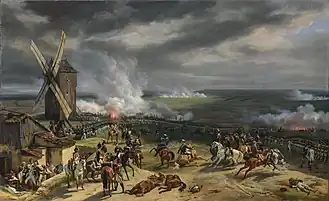
- September 20 – French Revolutionary Wars: Battle of Valmy – The French revolutionary army defeats the Prussians under the Duke of Brunswick after a 7-hour artillery duel.
- September 21 – French Revolution: A Proclamation of the abolition of the monarchy by the French Convention goes into effect, and the French First Republic is established, effective the following day.
- September 22 – French Revolution: The Era of the historical French Republican Calendar begins.
- September 30 – Chickamauga Cherokee launch an attack on Middle Tennessee to exterminate the White settlers; they are stopped at the opening battle at Buchanan's Station outside Nashboro.
October–December
- October 2 – The Baptist Missionary Society is founded in Kettering, England.
- October 3 – A militia departs from the Spanish stronghold of Valdivia to quell a Huilliche uprising in southern Chile.[32]
- October 12 – The first Columbus Day celebration in the United States is held in New York City, 300 years after his arrival in the New World.
- October 13 – Foundation of Washington, D.C.: The cornerstone of the United States Executive Mansion (known as the White House after 1818) is laid.

- October 29 – Mount Hood (Oregon) is named after British Admiral Lord Hood by Lt. William Broughton of the Vancouver Expedition, who spots the mountain near the mouth of the Willamette River.
- November 6
- War of the First Coalition: Battle of Jemappes – Austrian armies under the command of Duke Albert of Saxe-Teschen are defeated in Belgium (at this time part of the Austrian Netherlands) by the French Army led by General Charles François Dumouriez.[33]
- The second United States presidential election is held. Incumbent President George Washington receives all 132 electoral votes for president, and incumbent Vice President John Adams is re-elected with 77 of 132 votes, with George Clinton receiving 50.[26]
- November 19 – France's National Convention passes a resolution pledging French support for the overthrow of the governments of other nations.[34]
- December 3 – George Washington is re-elected president of the United States.
- December 26 – The trial of Louis XVI of France begins.
Date unknown
- Tipu Sultan invades Kerala, India, but is repulsed.
- Hungarian astronomer Franz Xaver von Zach publishes The Tables of the Sun, an essential early work for navigation.
- Claude Chappe successfully demonstrates the first semaphore line, between Paris and Lille.
- Scottish engineer William Murdoch begins experimenting with gas lighting.
- George Anschutz constructs the first blast furnace in Pittsburgh, Pennsylvania.
- Mary Wollstonecraft's A Vindication of the Rights of Woman, one of the earliest works of feminist literature, is published in London.
- Barthélemy Catherine Joubert, future French general, becomes sub-lieutenant.
- Johann Georg Albrechtsberger becomes Kapellmeister in Vienna.
- The State Street Corporation is founded, in Boston, Massachusetts.
- The Insurance Company of North America (later Chubb) is founded in Philadelphia, Pennsylvania.
- Shiloh Meeting House, predecessor of Shiloh United Methodist Church in Lynchburg, Virginia, is founded.
- The first written examinations in Europe are held at the University of Cambridge in England.
- The composer Ludwig van Beethoven moves to Vienna from Bonn to study with Haydn. He would live in Vienna for the rest of his life.
- James Johnstone establishes that Vancouver Island is an island.
1793
January–June
- January 7 – The Ebel riot occurs in Sweden.
- January 9 – Jean-Pierre Blanchard becomes the first to fly in a gas balloon in the United States.
- January 13 – Nicolas Jean Hugon de Bassville, a representative of Revolutionary France, is lynched by a mob in Rome.
- January 21 – French Revolution: After being found guilty of treason by the French National Convention, Citizen Capet, formerly King Louis XVI, is guillotined in Paris.[35]
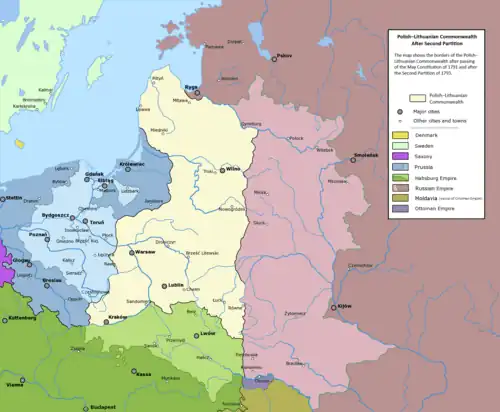
Second Partition of Poland in 1793 - January 23 – Second Partition of Poland: The Russian Empire and the Kingdom of Prussia partition the Polish–Lithuanian Commonwealth.
- February – In Manchester, Vermont, the wife of a captain falls ill, probably with tuberculosis. Some locals believe that the cause of her illness is that a demon vampire is sucking her blood. As a cure, Timothy Mead burns the heart of a deceased person in front of a crowd of a few hundred people.[36]
- February 1 – French Revolutionary Wars: The French First Republic declares war on Great Britain, the Dutch Republic and (on March 7) Spain.[37] During the year, the War of the First Coalition is joined by Portugal, the Holy Roman Empire, Naples and Tuscany in opposition to France.
- February 11 – French expedition to Sardinia (Expédition de Sardaigne): A French fleet under admiral Laurent Truguet debarks troops near Cagliari in Sardinia.
- February 22 – French expedition to Sardinia: A small French and Corsican force briefly occupies the small Sardinian island of La Maddalena, then withdraws to Corsica. 23-year-old lieutenant Napoleon Buonaparte is second-in-command.
- February 25 – George Washington holds the first Cabinet meeting as President of the United States.
- February 27 – The Giles Resolutions are introduced to the United States House of Representatives, asking the House to condemn Alexander Hamilton's handling of loans.
- March 1–3 – John Langdon serves as President pro tempore of the United States Senate.
- March 4 – George Washington is sworn in as the president of the United States in Philadelphia, for his second term.[38]
- March 5 – French troops are defeated by Austrian forces, and Liège is recaptured.
- March 18
- Second Battle of Neerwinden: A coalition army of Habsburg monarchy and Dutch Republic troops repulses attacks from French Republican forces, near Neerwinden, Flemish Brabant.
- The first republican state in Germany, the Republic of Mainz, is declared by Andreas Joseph Hofmann.
- April 6 – French Revolutionary Wars: The Committee of Public Safety is established in France, with Georges Danton as its head.
- April 9 – Edmond-Charles Genêt, France's new Minister to the United States, arrives at Charleston, South Carolina.[38]
- April 22 – George Washington signs the Neutrality Proclamation.[38]
- April 25 – The pioneer parishes of New Orleans and Louisiana are erected, as well as incorporated into the Roman Catholic Diocese of Louisiana and the Two Floridas.
- May 25 – French expedition to Sardinia: The last French troops occupying the small Sardinian island of San Pietro surrender to a Spanish fleet.
- May 31 – French Revolution: Regular troops under François Hanriot demand that the Girondins be expelled from the National Convention.
- June – The Macartney Embassy, a British diplomatic mission to China led by George Macartney, 1st Earl Macartney, reaches Canton, but will be rebuffed by the Qianlong Emperor.[37]
- June 2 – French Revolution: The Girondins are overthrown in France.
- June 10 – French Revolution: The Jardin des Plantes and the Muséum national d'histoire naturelle are created by the National Convention. The museum opens in Paris the following year, and the garden houses one of the first public zoos.
- June 20–22 – Haitian Revolution: Battle of Cap-Français – French Republican troops and black slave insurgents defeat Royalist and slave owner settlers.[39]
- June 21 – The town of Hamilton, Massachusetts, is incorporated.[40]
July–December
- July 9 – The Act Against Slavery is passed in Upper Canada.
- July 13 – French Revolution: Charlotte Corday kills Jean-Paul Marat in his bath.
- July 17 – French Revolution: Charlotte Corday is executed.
- July 20 – Scottish explorer Alexander Mackenzie's 1792–1793 Peace River expedition to the Pacific Ocean reaches its goal at Bella Coola, British Columbia, making him the first known person to complete a transcontinental crossing of northern North America.
- July 29 – John Graves Simcoe decides to build a fort and settlement at Toronto, having sailed into the bay there.
- July 31 – Oulu Castle in Finland is destroyed in an explosion following the burning of a powder cellar.[41]
- August – France decrees all the slaves on Saint-Domingue to be free.
- August 1–November 9 – The yellow fever epidemic of 1793 hits Philadelphia, Pennsylvania; 5,000 die.
- August 10 – French Revolution – Feast of Unity
- Crowds in Paris burn monarchist emblems.
- The Louvre in Paris opens to the public as an art museum.
- August 23 – French Revolution: The following universal conscription decree is enacted in France: "The young men shall go to battle and the married men shall forge arms. The women shall make tents and clothes and shall serve in the hospitals; children shall tear rags into lint. The old men will be guided to the public places of the cities to kindle the courage of the young warriors and to preach the unity of the Republic and the hatred of kings."
- September 5 – French Revolution: The National Convention begins the 10-month Reign of Terror.
- September 8 – The first Círio de Nazaré is celebrated in Belém.
- September 17 – The Army of the Eastern Pyrenees, one of the French Revolutionary armies, defeats a Spanish force at the Battle of Peyrestortes.
- September 18 – The cornerstone to the future United States Capitol is dedicated by U.S. President Washington at the site of the new Federal City on the Potomac River.[38]
- September 20 – British troops from Jamaica land on the island of Saint-Domingue to join the Haitian Revolution in opposition to the French Republic and its newly-freed slaves; on 22 September the main French naval base on the island surrenders peacefully to the Royal Navy.[42][43]
- October 5 – War of the First Coalition: Raid on Genoa – The British Royal Navy boards and captures French warships, sheltering in the neutral port of Genoa.
- October 15–16 – War of the First Coalition: Battle of Wattignies – A French Republican force commanded by Jean-Baptiste Jourdan compels a Habsburg Austrian Coalition army to retire.
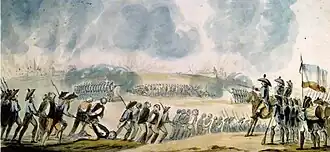
Mass killings in the Vendée during the Reign of Terror in France - October 16 – French Revolution: Marie Antoinette, the widowed queen consort of Louis XVI, is guillotined in the Place de la Révolution in Paris at the conclusion of a 2-day trial before the Revolutionary Tribunal.
- October 24 – French Revolution:The French Republican Calendar is adopted by the National Convention.
- November 10 – The dechristianization of France during the French Revolution reaches a climax with the celebration of the Goddess of Reason in the cathedral of Notre Dame de Paris.
- November 12 – French Revolution: Jean Sylvain Bailly, the first Mayor of Paris, is guillotined.
- December 8 – French Revolution: Madame du Barry is guillotined.
- December 9 – New York City's first daily newspaper, the American Minerva, is established by Noah Webster.
- December 18 – French forces under Dugommier capture Toulon from royalists and British forces under Vice Admiral Lord Hood. The British fire the dockyards and take 16 ships, one of which, the Lutine, becomes a famous treasure ship.
- December 23 – French Revolution: War in the Vendée: Battle of Savenay – A Republican force decisively defeats the counterrevolutionary Catholic and Royal Army, ending the Virée de Galerne.
Undated
- Eli Whitney invents a cotton gin. This causes a resurgence of slavery in the South.
- Lawrence Academy (Groton, Massachusetts) is chartered.[44]
- Dominique Jean Larrey, chief surgeon of the French Revolutionary Army, creates the first battlefield "flying ambulance" service.
- The Al Bu Falah move to Abu Dhabi.
- The first year of regular production begins for the United States Mint, and the half cent is minted for the first time.
- Niccolò Paganini debuts as a violin virtuoso at age 11 in his birthplace of Genoa.
1794
January–March
- January 1 – The Stibo Group is founded by Niels Lund as a printing company in Aarhus (Denmark).
- January 13 – The U.S. Congress enacts a law providing for, effective May 1, 1795, a United States flag of 15 stars and 15 stripes, in recognition of the recent admission of Vermont and Kentucky as the 14th and 15th states.[45] A subsequent act restores the number of stripes to 13, but provides for additional stars upon the admission of each additional state.
- January 21 – King George III of Great Britain delivers the speech opening Parliament and recommends a continuation of Britain's war with France.
- February 4 – French Revolution: The National Convention of the French First Republic abolishes slavery.
- February 8 – Wreck of the Ten Sail on Grand Cayman.
- February 11 – The first session of the United States Senate is open to the public.
- March 4 – The Eleventh Amendment to the United States Constitution is passed by Congress for submission to the states for ratification.[46]
- March 11 – Canonsburg Academy (modern-day Washington & Jefferson College) is chartered by the Pennsylvania General Assembly.[47]
- March 12 – General Antoni Madaliński, a commander of the National Cavalry in the Polish–Lithuanian Commonwealth, disobeys an order from the ruling Russian Empire and Kingdom of Prussia imposing demobilization, advancing his troops from Ostrołęka to Kraków.
- March 14 – Eli Whitney is granted a United States patent for the cotton gin.
- March 22 – Congress prohibits American ships from supplying slaves to any nation other than the United States, setting a penalty of forfeiture of the ship and a $2,000 fine.[46]
- March 23 – British troops capture Martinique from the French.[48]
- March 24 – Tadeusz Kościuszko makes his proclamation starting the Kościuszko Uprising against the Russian Empire and Kingdom of Prussia in the Polish–Lithuanian Commonwealth and Prussian Partition.
- March 26 – The U.S. lays a 60-day embargo on all shipping to and from Great Britain.[46]
- March 27
- The United States Government authorizes the building of the first six United States Navy vessels; in 1797 the first three frigates, United States, Constellation and Constitution will go into service (not to be confused with October 13, 1775, which is observed as the Navy's Birthday).[49]
- The U.S. Senate passes a rule ending its policy of closing all of its sessions to the public.[46]
April–June
- April 4 – Battle of Racławice: Polish supporters of the Kościuszko Uprising defeat forces of the Russian Empire.
- April 5 – Reign of Terror: Georges Danton and Camille Desmoulins are executed.
- April 17–19 – Kościuszko Uprising – Warsaw Uprising: The Polish people overthrow the Russian garrison in Warsaw.
- April 19 – Britain, Prussia and the Netherlands sign a treaty of alliance against France.[48]
- April 28 – Sardinian Vespers: The people of Cagliari in Sardinia oust the viceroy and his Piedmontese functionaries.
- April 29–May 1 – Battle of Boulou: The French defeat the Spanish and Portuguese forces.
- May 7 – Robespierre establishes the Cult of the Supreme Being as the new state religion of the French First Republic.
- May 8 – Reign of Terror: chemist Antoine Lavoisier is tried, convicted and executed in Paris with 27 co-defendants also associated with the former ferme générale.
- May 18 – Battle of Tourcoing: French troops defeat British forces.
- May 21 – the French Revolutionary Government decides that the Terror would be centralised, with almost all the tribunals in the provinces closed and all the trials held in Paris.[50]
- May 28–June 1 – The Glorious First of June (Battle of Ushant): The British win a crushing tactical victory over the French fleet, but the merchant convoy escorted by the French fleet arrives safely in France.
- May 30–June 4 – Battle of Port-Républicain: British troops capture Port-au-Prince in Haiti from the French.[48]
- June 17
- The Anglo-Corsican Kingdom is established.
- Battle of Mykonos: The British Royal Navy captures French frigate Sibylle.
- June 24 – Bowdoin College is founded in Brunswick, Maine.
- June 26 – Battle of Fleurus: French forces defeat the Austrians and their allies, leading to permanent loss of the Austrian Netherlands and destruction of the Dutch Republic. French use of an observation balloon marks the first participation of an aircraft in battle.
- June–July – Mount Vesuvius erupts in Italy; the town of Torre del Greco is destroyed.[51]
July–September
- July 12 – Horatio Nelson loses the sight in his right eye in the British Siege of Calvi in Corsica.
- July 13 – Battle of Trippstadt between French forces and those of Prussia and Austria (First Coalition).
- July 13–September 6 – Kościuszko Uprising: Siege of Warsaw – The Polish people resist a siege by armies of the Russian Empire and Kingdom of Prussia.
- July 17 – The sixteen Carmelite Martyrs of Compiègne are guillotined in Paris in the last stage of the French Revolution's Reign of Terror.
- July 27 (9 Thermidor) – French Revolution – Thermidorian Reaction: Maximilien, Augustin Robespierre and Saint-Just are arrested on the orders of the French National Convention; they are executed the next day, ending the French Revolution's Reign of Terror.
- August – Colombian Antonio Nariño is denounced as a traitor after he translates and publishes the French Declaration of the Rights of Man and of the Citizen.[52]
- August 1 – Aristocrats in Sweden gather to mourn the demise of coffee after the beverage is forbidden by royal decree.[53][54]
- August 9 – Napoleon is arrested and put under house arrest at Nice for his association with the Robespierres during their fall in the Thermidorian Reaction. He is later taken to Antibes and detained in a military fort.[55]
- August 20 – Battle of Fallen Timbers in Northwestern Ohio: American troops under the command of General Anthony Wayne (nicknamed "Mad Anthony") defeat Native American tribes of the Western Confederacy.[46]
- August 21 – British troops capture Corsica following the bombardment by Nelson.[48]
- August 29 – Stonyhurst College is finally established as a Roman Catholic school in Lancashire, England, having had several European locations.
- September 10 – The University of Tennessee is established at Knoxville.
- September 23 – France occupies Aachen.[56]
- September 28 – Austria, Britain and Russia ally against France.[48]
October–December
- October 2 – Battle of Aldenhoven between French forces and those of Austria.
- October 4 – In the first and only instance of an incumbent United States president leading men into battle, George Washington arrives at Carlisle, Pennsylvania to guide the U.S. Army's suppression of the Whiskey Rebellion.[57] The rebels soon disperse and the insurrection collapses by the end of the month.
- October 10 – Battle of Maciejowice: Forces of the Russian Empire defeat Polish supporters of the Kościuszko Uprising; Tadeusz Kościuszko is wounded and captured.
- October 22 – Fort Wayne founded in what is now the U.S. state of Indiana.
- November 4 – Battle of Praga: Russian General Alexander Suvorov storms Warsaw in the war against the Polish Kościuszko Uprising and captures Praga, one of its suburbs, unwittingly killing many civilians.
- November 14 – The first recorded meeting of the Franklin Literary Society is held at Canonsburg Academy (modern-day Washington & Jefferson College).[58]
- November 16 – The Kościuszko Uprising ends in the defeat of Tadeusz Kościuszko and his forces.
- November 19 – The United States and Great Britain sign the Jay Treaty (coming into effect in 1796), which attempts to clear up some issues left over from the American Revolutionary War[59] and secures a decade of peaceful trade between the two nations.[46] Britain agrees to evacuate border forts in the Northwest Territory (roughly the area north of the Ohio River and east of the Mississippi) and thereby end British support for the Indians.
- November 20 – Battle of St-Laurent-de-la-Muga fought between French and Spanish forces.
- December 8 – The Great New Orleans Fire (1794) burns over 200 buildings in the French Quarter.
- December 23 – St. Louis Cathedral, New Orleans is dedicated.
Date unknown
- The Ayrshire (Earl of Carrick's Own) Yeomanry, a British Yeomanry Cavalry Regiment, is formed by the Earl of Cassillis at Culzean Castle, Ayrshire.
- The Oban distillery is built in Scotland.
1795
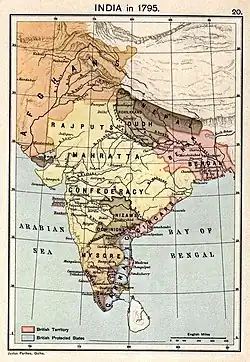
January–June
- January – Central England records its coldest ever month, in the CET records dating back to 1659.[60]
- January 14 – The University of North Carolina opens to students at Chapel Hill, becoming the first state university in the United States.
- January 16 – War of the First Coalition: Flanders campaign: The French occupy Utrecht, Netherlands.
- January 18 – Batavian Revolution in Amsterdam: William V, Prince of Orange, Stadtholder of the Dutch Republic (Republic of the Seven United Netherlands), flees the country.
- January 19 – The Batavian Republic is proclaimed in Amsterdam, ending the Dutch Republic (Republic of the Seven United Netherlands).
- January 20 – French troops enter Amsterdam.
- January 23 – Flanders campaign: Capture of the Dutch fleet at Den Helder: The Dutch fleet, frozen in Zuiderzee, is captured by the French 8th Hussars.[61]
- February 7 – The Eleventh Amendment to the United States Constitution is passed.
- March – English Benedictine monks expelled from Douai are permitted to proceed to England.
- March 13–14 – War of the First Coalition Battle of Genoa: The British and Neapolitan fleets are victorious over the French.
- March 29 – Ludwig van Beethoven makes his public debut in Vienna performing his Second Piano Concerto under the baton of his teacher Antonio Salieri.
- April 5 – The Peace of Basel is signed, between France and Prussia.
- April 7 – The metric system is adopted in France.[62]
- April 8 – George, Prince of Wales, marries Caroline of Brunswick.
- April 23
- Former Governor-General of India Warren Hastings is acquitted by the British House of Lords of misconduct.[63]
- Sweden becomes the first monarchy to recognize the French Republic - Swedish ambassador introduced into the French Convention.[64]
- May 1 – Unification of Hawai‘i: Battle of Nuʻuanu: Kamehameha I of the Island of Hawaii defeats the Oahuans, solidifying his control of the major islands of the archipelago and officially founding the Kingdom of Hawaii.
- May 31 – French Revolution: Revolutionary Tribunal suppressed.
- May–June – The Battle of Richmond Hill is fought in the colony of New South Wales, between the Darug people and British colonial forces.
- June 3 – The Dialectic and Philanthropic Societies are founded at the University of North Carolina at Chapel Hill.[65]
- June 5–7 – The Copenhagen Fire of 1795, starting in a naval warehouse, destroys 941 houses.
- June 8 – Louis XVII, Prince Royal and titular King of France, dies in captivity in the Temple (Paris) and will be buried in an unmarked grave. The heir to the French throne, his uncle Louis XVIII, succeeds him as titular king (he will become the actual king on April 6, 1814). On June 28, the French republican government announces the death, due to mycobacterial cervical lymphadenitis (many doubt the statement).
- June 16–17 – War of the First Coalition: Cornwallis's Retreat – A British Royal Navy battle squadron commanded by William Cornwallis fends off a numerically superior French Navy fleet, off the coast of Brittany.
- June 24 – The United States Senate ratifies the Jay Treaty with Great Britain.
- June 27 – War of the First Coalition:
July–December
- July 22 – The Second Treaty of Basel is signed between the French First Republic and Spain, ending the War of the Pyrenees. Spain cedes its half of the Caribbean island of Hispaniola to France.
- July 25 – Construction of the Pontcysyllte Aqueduct in Wales begins.
- August 3 – The signing of the Treaty of Greenville puts an end to the Northwest Indian War.[66]
- August 14 – President Washington signs the Jay Treaty with Britain on behalf of the United States.[66]
- August 17 – A large slave rebellion occurs in Curaçao, suppressed the following month.
- August 22 – French Revolution: The Constitution of the Year III is ratified by the National Convention.
- August 25 – British forces capture Trincomalee, Ceylon.[67]
- August 28 – The Third Treaty of Basel is signed, between the French First Republic and the Landgraviate of Hesse-Kassel.
- September 5 – The United States signs a treaty with the Dey of Algiers, ruled by Baba Hassan, pledging the payment of $23,000 a year tribute to prevent piracy against American ships.[66]
- September 11 – Battle of Krtsanisi: The Persian emperor Agha Mohammad Khan Qajar defeats the forces of Heraclius II of Georgia.
- September 15 – French Revolutionary Wars – Invasion of the Cape Colony: British forces capture Cape Town in the Dutch Cape Colony, to use its strategic facilities against the French Navy.[67]
- September 21 – Battle of the Diamond: Protestant forces defeat Catholic troops in Loughgall, Ireland, leading to the foundation of the Orange Order.
- September 28 – The Alliance of St Petersburg is formed between Britain, Russia and Austria against France.[63]
- October 1 – The Austrian Netherlands is annexed to the French Republic, as the Belgian departments.
- October 2 – British forces capture the Île d'Yeu off the coast of Brittany.[67]
- October 5 – 13 Vendémiaire: Royalist riots in Paris are crushed by troops under Paul Barras and newly-reinstalled artillery officer Napoleon Bonaparte.
- October 20 – The United States signs a treaty with Spain, opening commerce along the Mississippi River to the Gulf of Mexico, and establishing boundaries between U.S. territory and Spanish Florida.[66]
- October 24 – The Third Partition of Poland is made, dividing the territory of the Commonwealth of Poland between the Habsburg monarchy, Prussia and the Russian Empire. On November 25, Stanisław August Poniatowski formally abdicates as last King of Poland.
- October 27 – The United States and Spain sign the Treaty of Madrid, which establishes the boundaries between Spanish colonies and the U.S.
- November 2 – French Revolution: The French Directory takes power; the influence of the Sans-culottes declines.
- December 13 – Wold Cottage meteorite: A meteorite falls at Wold Newton, a hamlet in Yorkshire in England. This meteorite fall is subsequently used as a literary premise by science fiction writer Philip José Farmer, as the basis for the Wold Newton family.
- December 28 – Construction of Yonge Street, formerly recognized as the longest street in the world, begins in York, Upper Canada (modern-day Toronto).
Undated
- The Hudson's Bay Company trading post Fort Edmonton is constructed; the city of Edmonton, Alberta, eventually grows from it.
- The British Royal Navy makes the use of lemon juice mandatory, to prevent scurvy.[68]
- The harvest fails in Munich.
- Daniel McGinnis discovers the supposed Money Pit on Oak Island, Nova Scotia. (according to one story)
- Jim Beam is founded as Old Jake Beam Sour Mash.
1796
January–March
- January 16 – The first Dutch (and general) elections are held for the National Assembly of the Batavian Republic. (The next Dutch general elections are held in 1888.)
- February 1 – The capital of Upper Canada is moved from Newark to York.
- February 9 – The Qianlong Emperor of China abdicates at age 84 to make way for his son, the Jiaqing Emperor.
- February 15 – French Revolutionary Wars: The Invasion of Ceylon (1795) ends when Johan van Angelbeek, the Batavian governor of Ceylon, surrenders Colombo peacefully to British forces.
- February 16 – The Kingdom of Great Britain is granted control of Ceylon by the Dutch.[69]
- February 29 – Ratifications of the Jay Treaty between Great Britain and the United States are officially exchanged, bringing it into effect.[70]
- March 9 – Widow Joséphine de Beauharnais marries General Napoléon Bonaparte.
- March 20 – The U.S. House of Representatives demands that the U.S. State Department supply it with documents relating to the negotiation of the Jay Treaty; President Washington declines the request, citing that only the U.S. Senate has jurisdiction over treaties.[70]
- March 26 – Napoleon Bonaparte arrives at Nice to take command of the Army of Italy (37,000 men and 60 guns), which is scattered in detachments as far as Genoa.[71]
- March 30 – Carl Gauss obtains conditions for the constructibility by ruler and compass of regular polygons, and is able to announce that the regular 17-gon is constructible by ruler and compasses.
April–June
- April 2 – The only night of the supposed Shakespearean play Vortigern and Rowena (actually written by William Henry Ireland) ends in the audience's laughter.
- April 12 – War of the First Coalition – Battle of Montenotte: Napoleon Bonaparte gains his first victory as an army commander.
- April 21 - War of the First Coalition - Battle of Mondovi: Napoleon Bonaparte decisively defeats the army of Piedmont Sardinia, leaving its capital of Turin defenseless. This convinces Piedmont to sign an armistice and withdraw from the war, turning the war in Italy decisively in France's favor.
- April 26 – The French proclaim the Republic of Alba on the occupied territories. Two days later, King Victor Amadeus III of Sardinia signs the Armistice of Cherasco, in the headquarters of Napoleon. The fortresses of Coni, Tortoni and Alessandria, with all their guns, are given up.[72]
- April 27 – Case of the Lyons Mail: During the night, five highwaymen attack the mail between Paris and Lyon, kill the postmen and steal the funds sent to the armies in Italy.
- April 28 – In an impassioned speech, U.S. Representative Fisher Ames of Massachusetts persuades his fellow members of the House to support the Jay Treaty.[70]
- May 6 – Napoleon Bonaparte forms an advanced guard (3,500 infantry and 1,500 cavalry) under General Claude Dallemagne. He sends this force along the south bank of the Po River, to cross it with boats at Piacenza.[73]
- May 10
- War of the First Coalition – Battle of Lodi: General Napoleon Bonaparte defeats the Austrian rearguard, in forcing a crossing of the bridge over the Adda River in Italy. The Austrians lose some 2,000 men, 14 guns, and 30 ammunition wagons.
- Persian Expedition of 1796: Russian troops storm Derbent.
- May 14 – Edward Jenner administers the first smallpox vaccination, in England.
- May 15 – Napoleon's troops take Milan.
- May 20 – The last mock Garrat Elections are held in Surrey, England.
- June 1
- The French-Republican army divisions of the Army of Italy invade the territories of Venice.
- Tennessee is admitted as the 16th U.S. state. [70]
- June 4 - The Siege of Mantua (1796-1797) begins when Napoleon lays siege to the city of Mantua, Austria's final stronghold in Northern Italy. The siege, and Austria's attempts to relieve it, will take the majority of the Italian campaign.
- June 6–7 – Ragunda lake in Sweden bursts and drains completely leaving the Döda fallet dry.
- June 21 – Scottish explorer Mungo Park becomes the first European to reach the Niger River.[69]
- June 23 – Napoleon Bonaparte seizes the Papal States, which become part of the revolutionary Cisalpine Republic. Pope Pius VI signs the Armistice of Bologna, and is forced to pay a contribution (34 million francs).
July–September
- July 10 – Carl Friedrich Gauss discovers that every positive integer is representable as a sum of at most 3 triangular numbers.
- July 11 – The United States takes possession of Detroit from Great Britain, under the terms of the Jay Treaty.
- July 21 – Mungo Park reaches Ségou, the capital of the Bamana Empire.
- July 22 – Surveyors of the Connecticut Land Company name an area in Ohio Cleveland, after Gen. Moses Cleaveland, the superintendent of the surveying party.
- July 29 – The Habsburg army under Marshal Wurmser advances from the Alps, and captures Rivoli and Verona. The French abandon the east bank of the Mincio River, the outnumbered division (15,000 men) of Masséna retreats towards Lake Garda.
- August 4 – French Revolutionary Wars: Battle of Lonato – The French Army of Italy under Napoleon crushes an Austrian brigade.
- August 5 – French Revolutionary Wars: Battle of Castiglione – The French Army of Italy under Napoleon defeats the Habsburg army (25,000 men) under Marshal Wurmser, who thus fails to break the Siege of Mantua (1796–97), and is forced to retreat north up the Adige Valley.
- August 9 – The Wearmouth Bridge in England, designed by Rowland Burdon in cast iron, opens to traffic. Its span of 72 m (236 ft) makes it the world's longest single-span vehicular bridge extant at this date.[74][75][76]
- August 10 – A mob of peasants overtakes the Convent of St. Peter (Bludenz, Austria) and murders Ignaz Anton von Indermauer.
- August 19 – Second Treaty of San Ildefonso: Spain and France form an alliance against Great Britain.
- September 2 – Jewish emancipation in the Batavian Republic (Netherlands).
- September 8 – French Revolutionary Wars: Battle of Bassano – French forces (20,000 men) under Napoleon Bonaparte and André Masséna defeat the Austrians in Veneto. Wurmser retreats towards Vicenza with just 3,500 men of his original 11,000 left to him.
- September 9 – French Revolutionary Wars: Action of 9 September 1796 – A naval engagement between French and British squadrons off Sumatra ends inconclusively.
- September 9 – Grenelle camp affair, a failed uprising by supporters of Gracchus Babeuf against the French Directory
- September 15 – Siege of Mantua: Napoleon Bonaparte fights a pitched battle at La Favorita on the east side of the Mincio River. The Austrians withdraw into the fortress of Mantua, which is crowded with nearly 30,000 men. Within six weeks, 4,000 die from wounds or sickness.[77]
- September 17 – U.S. President George Washington issues his Farewell Address, which warns against partisan politics and foreign entanglements. In addition, he sets a precedent by declining to run for a third term. [70]
- September 28 – Empress Catherine the Great signs an agreement with Great Britain, formally joining Russia to the coalition.
October–December
- October 19 – French Revolutionary Wars: Battle of Emmendingen – Austrian forces force the French to retreat, but commanding generals on both sides are killed.
- October – Jane Austen begins writing her first draft of Pride and Prejudice, under the title First Impressions (the book will not be published until 1813).
- November 3 – John Adams defeats Thomas Jefferson, in the 1796 U.S. presidential election.
- November 4 – The Treaty of Tripoli (between the United States and Tripoli) is signed at Tripoli (see also 1797).
- November 6
- Catherine the Great dies, and is succeeded by her son Paul I of Russia. His wife Sophie Marie Dorothea of Württemberg becomes Empress consort.
- French forces (9,500 men) under Masséna attack the Austrian army at Fontaniva. After a desperate assault he is outnumbered, and forced to retreat to Verona.
- November 12
- Battle of Caldiero: French forces are defeated by the Austrians at Caldiero, and pushed back to Verona. This marks Napoleon's first defeat, losing nearly 2,000 men and 2 guns.[78]
- Groton, New Hampshire is incorporated as a town.
- November 17 – Battle of Arcole: French forces under General Napoleon defeat the Austrians at Arcole. After a bold maneuver, he outflanks the Austrian army (24,000 men) under Freiherr József Alvinczi, and cuts off its line of retreat. Alvinczi is forced to take up a defensive position behind the Brenta River.[78]
- December – The British government begins work on a 40-acre (162,000 m²) site at Norman Cross, for the world's first purpose-built prisoner-of-war camp.[79]
- December 7 – The U.S. Electoral College meets to elect John Adams president of the United States.
- December 18 – British Royal Navy ship HMS Courageux is wrecked on the Barbary Coast with the loss of 464 of the 593 onboard.
Date unknown
- The Spanish government lifts the restrictions against neutrals trading with the colonies, thus acknowledging Spain's inability to supply the colonies with needed goods and markets.
- Robert Burns's version of the Scots poem Auld Lang Syne is first published, in this year's volume of The Scots Musical Museum.[80]
- Annual British iron production reaches 125,000 tons.
- Rizla rolling papers established.
1797
January–March
- January 3 – The Treaty of Tripoli, a peace treaty between the United States and Ottoman Tripolitania, is signed at Algiers (see also 1796).
- January 7 – The parliament of the Cisalpine Republic adopts the Italian green-white-red tricolour as their official flag (this is considered the birth of the flag of Italy).
- January 13 – Action of 13 January 1797, part of the War of the First Coalition: Two British Royal Navy frigates, HMS Indefatigable and HMS Amazon, drive the French 74-gun ship of the line Droits de l'Homme aground on the coast of Brittany, resulting in over 900 deaths.
- January 14 – War of the First Coalition – Battle of Rivoli: French forces under General Napoleon Bonaparte defeat an Austrian army of 28,000 men, under Feldzeugmeister József Alvinczi, near Rivoli (modern-day Italy), ending Austria's fourth and final attempt to relieve the fortress city of Mantua.
- January 26 – The Treaty of the Third Partition of Poland is signed in St. Petersburg by the Russian Empire, Austria and the Kingdom of Prussia.
- February 2 – Siege of Mantua: Field marshal Dagobert von Wurmser surrenders the fortress city to the French; only 16,000 men of the garrison are capable of marching out as prisoners of war.
- February 3 – Battle of Faenza: A French corps (9,000 men) under General Claude Victor-Perrin defeats the forces from the Papal States, at Castel Bolognese near Faenza, Italy.
- February 4 – The Riobamba earthquake in Ecuador, estimated magnitude 8.3, causes up to 40,000 casualties.
- February 12 – "Gott erhalte Franz den Kaiser" is first performed, with the music composed in January by Joseph Haydn, which also becomes the tune to the Deutschlandlied, the German national anthem (Deutschland, Deutschland über alles, later Einigkeit und Recht und Freiheit).
- February 14 – French Revolutionary Wars – Battle of Cape St. Vincent: The British Royal Navy under Admiral Sir John Jervis defeats a larger Spanish fleet off Cape St. Vincent, Portugal.
- February 18 – Invasion of Trinidad: Spanish Governor José María Chacón peacefully surrenders the colony of Trinidad to a British naval force, commanded by Sir Ralph Abercromby.
- February 19 – Treaty of Tolentino: Pope Pius VI signs a peace treaty with Revolutionary France. He is forced to deliver works of art, treasures, territory, the Comtat Venaissin and 30 million francs.
- February 22 – The last invasion of Britain begins: French forces, under the command of American Colonel William Tate, land near Fishguard, Wales.
- February 25 – William Tate surrenders to the British at Fishguard.
- February 26 – Bank Restriction Act removes the requirement for the Bank of England (the national bank of Great Britain) to convert banknotes into gold – Restriction period lasts until 1821. The Bank of England issues the first one-pound and two-pound notes (pound notes discontinued March 11, 1988).
- March 5 – Protestant missionaries from the London Missionary Society land in Tahiti, from the Duff (celebrated as Missionary Day in French Polynesia).
- March 13 – Médée, an opera by Luigi Cherubini, is premiered in Paris.
- March 16 – Battle of Valvasone: The Austrian army, led by Archduke Charles, fights a rearguard action at the crossing of the Tagliamento River, but is defeated by Napoleon Bonaparte at Valvasone.
- March 21 – Battle of Parramatta: Resistance leader Pemulwuy leads a group of aboriginal warriors, estimated to be at least 100, in an attack on a government farm at Toongabbie in Sydney, Australia.[81][82][83][84]
April–June
- April 16 – The Spithead and Nore mutinies break out in the British Royal Navy.
- April 17
- Battle of San Juan: Sir Ralph Abercromby unsuccessfully invades San Juan, Puerto Rico in what will be one of the largest British attacks on Spanish territories in the western hemisphere, and one of the worst defeats of the British Royal Navy for years to come.
- Veronese Easter: Citizens of Verona, Italy, began an unsuccessful eight-day rebellion against the French occupying forces.
- April 18 – Armistice of Leoben: On behalf of the French Republic, a delegation under Napoleon Bonaparte signs a peace treaty with the Holy Roman Empire at Leoben.[85]
- May 10 – The first ship of the United States Navy, the frigate USS United States, is commissioned.
- May 12 – War of the First Coalition: Napoleon Bonaparte conquers Venice, ending the city and Republic of Venice's 1,100 years of independence. The last doge of Venice, Ludovico Manin, steps down. The Venetian Ghetto is thrown open.
- May 30 – English abolitionist William Wilberforce marries Barbara Ann Spooner about six weeks after their first meeting.
- June 28 – French troops disembark in Corfu, beginning the First period of French rule in the Ionian Islands.
- June 29 – Napoleon Bonaparte decrees the birth of the Cisalpine Republic; he appoints ministers and establishes the first constitution.
July–September

- July 9 – U.S. Senator William Blount becomes the first federal legislator to be expelled from office, as his fellow Senators vote 25 to 1 to block him from his seat during an investigation against him on charges of criminal conspiracy.[86]
- July 13 – Gual and España conspiracy against Spanish rule in Colonial Venezuela is exposed.
- July 24 – Horatio Nelson is wounded at the Battle of Santa Cruz, losing an arm.
- August 29 – Massacre of Tranent: British troops attack protestors against enforced recruitment into the militia at Tranent, Scotland, killing 11 and injuring 8.
- September 4 – The Coup of 18 Fructidor is carried out in France as three of the five members of The Directory, France's executive council, arrested royalist members of the Council of Five Hundred, the national legislature, and discard the results of the spring elections.[87]
- September 5 – France's new government decrees that citizens who left the country without authorization are subject to the death penalty if they return.[88]
- September 30 – Dominique-Vincent Ramel-Nogaret, French finance minister, repudiates two thirds of France's debt.
October–December
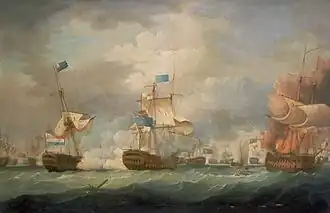
- October 11 – Battle of Camperdown: the British Royal Navy defeats the fleet of the Batavian Republic off the coast of Holland.[89]
- October 17 – The Treaty of Campo Formio ends the War of the First Coalition.
- October 18 – The XYZ Affair inflames tensions between France and the United States when American negotiators Charles Cotesworth Pinckney, John Marshall, and Elbridge Gerry meet with French government representatives Jean-Conrad Hottinguer, Pierre Bellamy and Lucien Hauteval and are told that a treaty between France and the U.S. will require payment of a bribe to France's Foreign Minister Charles Talleyrand and a large loan of American cash to France. Pinckney tells people later that his response was "No, no, not a sixpence!"; Hottinguer, Bellamy and Hauteval are referred to, respectively, as "X", "Y" and "Z" in U.S. government reports on the failed negotiations.[90]
- October 21 – In Boston Harbor, the 44-gun United States Navy frigate USS Constitution is launched to fight Barbary pirates off the coast of Tripoli; the ship will remain in commission in the 21st century.
- October 22 – André-Jacques Garnerin makes the first parachute descent, at Parc Monceau, Paris; he uses a silk parachute to descend approximately 3,000 feet (910 m) from a hot air balloon.
- November – 1797 Rugby School rebellion: The students at Rugby School in England rebel against the headmaster, Henry Ingles, after he decrees that the damage to a tradesman's windows should be paid for by the students.[91]
- November 16
- The Prussian heir apparent, Frederick William, becomes King of Prussia as Fredrick William III.
- (or November 23?) – British Royal Navy frigate HMS Tribune (1796) is wrecked on the approaches to Halifax, Nova Scotia; of the 240 on board, all but 12 are lost.[92]
Undated
- The secret Lautaro Lodge as the Logia de los Caballeros Racionales ("Lodge of Rational Knights") is founded, perhaps in Cádiz; membership will include many leaders of the Spanish American wars of independence such as Francisco de Miranda, Bernardo O'Higgins and José de San Martín.
- Shinyukan Cram School (進修館) founded by Masataka Okudaira (奥平昌孝) in Nakatsu, Buzen Province (now Oita Prefecture), Kyushu Island, as predecessor of Keio-Gijyuku University in Japan.[93]
- Joseph-Louis Lagrange publishes his treatise on differential calculus, entitled Théorie des fonctions analytiques.
1798
January–June
- January – Eli Whitney contracts with the U.S. federal government for 10,000 muskets, which he produces with interchangeable parts.
- January 4 – Constantine Hangerli enters Bucharest, as Prince of Wallachia.
- January 22 – A coup d'état is staged in the Netherlands (Batavian Republic). Unitarian Democrat Pieter Vreede ends the power of the parliament (with a conservative-moderate majority).
- February 10 – The Pope is taken captive, and the Papacy is removed from power, by French General Louis-Alexandre Berthier.
- February 15 – U.S. Representative Roger Griswold (Fed-CT) beats Congressman Matthew Lyon (Dem-Rep-VT) with a cane, after the House declines to censure Lyon for earlier spitting in Griswold's face; the House declines to discipline either man.[94]
- March – the Irish Rebellion of 1798 begins when the Irish Militia arrest the leadership of the Society of United Irishmen,[95] a group unique amongst Irish republican and nationalist movements in that it unifies Catholics and Protestants (Anglican, Presbyterian, Methodist, Baptist and others) around republican ideals. This month, Lord Castlereagh is appointed Acting Chief Secretary for Ireland and on March 30 martial law is proclaimed here. The first battles in the rebellion are fought on May 24 and it continues through September, but the rebels receive much less than the expected support from France, which sends only 1,100 men.
- March 5 – French troops enter Bern.[96]
- March 7 – French forces invade the Papal States and establish the Roman Republic.
- April 7 – The Mississippi Territory is organized by the United States, from territory ceded by Georgia and South Carolina; later it is twice expanded, to include disputed territory claimed by both the U.S. and Spain (which acquired territory in trade with Great Britain).[94]
- April 12 – The Helvetic Republic, a French client republic, is proclaimed following the collapse of the Old Swiss Confederacy after the French invasion; Aarau becomes the republic's temporary capital.
- April 26 – France annexes Geneva.
- April 30 – The United States Department of the Navy is established as a cabinet-level department. Benjamin Stoddert, a civilian businessman, is appointed as the first Navy Secretary by President Adams.[94]
- May 7 – French Revolutionary Wars: A French force attempting to dislodge a small British garrison on the Îles Saint-Marcouf is repulsed with heavy losses.[97]
- May 9 – Napoleon sets off for Toulon, sailing aboard Vice-Admiral Brueys's flagship L'Orient; his squadron is part of a larger fleet of over 300 vessels, carrying almost 37,000 troops.[98]
- May 27 – Pitt–Tierney duel takes place on Putney Heath. British Prime Minister William Pitt the Younger fights a duel against opposition politician George Tierney
- June 12
- The French take Malta.
- A moderate coup d'état in the Netherlands (Batavian Republic) deposes Pieter Vreede.
- June 13 – Mission San Luis Rey de Francia is founded in California.
- June 18 – The first of the four Alien and Sedition Acts, the Naturalization Act of 1798, is signed into law by U.S. President Adams, requiring immigrants to wait 14 years rather than five years to become naturalized citizens of the United States. On June 25, another law is signed authorizing the imprisonment and deportation of any non-citizens deemed to be dangerous.[94]
July–December
- July 1 – Egyptian Campaign: Napoleon disembarks his French army in Marabout Bay.
- July 7
- Quasi-War: The United States Congress rescinds treaties with France, sparking the war.[94]
- In the action of USS Delaware vs La Croyable, the newly-formed United States Navy makes its first capture.
- July 11 – The United States Marine Corps is re-established under its present name.[94][99]
- July 12 – Battle of Shubra Khit: French troops defeat the Mamelukes, during Napoleon's march from Alexandria to take Cairo.
- July 14 – The fourth of the Alien and Sedition Acts, the Sedition Act of 1798 is signed into law, making it a federal crime to write, publish, or utter false or malicious statements about the United States government.[94]
- July 16 – The Relief of Sick and Disabled Seamen Act is signed into law, creating the Marine Hospital Service, the forerunner to the current United States Public Health Service Commissioned Corps.
- July 21 – Battle of the Pyramids: Napoleon defeats Ottoman forces near the Pyramids.
- July 24 – Napoleon occupies Cairo.
- July 31 – A second round of elections are held in the Netherlands (Batavian Republic); no general elections this time.
- August 1 – Battle of the Nile (near Abu Qir): Lord Nelson defeats the French navy under Admiral Brueys. 11 of the 13 French battleships are captured or destroyed, including the flagship Orient whose magazine explodes; Nelson himself is wounded in the head.
- August 22 – French troops land at Kilcummin in County Mayo to assist the Irish Rebellion.
- September – Charles Brockden Brown publishes the first significant American novel, the Gothic fiction Wieland: or, The Transformation; an American Tale.
- September 5 – Conscription is made mandatory in France by the Jourdan Law.
- September 10
- The Piedmontese Republic is declared in the territory of Piedmont.
- Battle of St. George's Caye: Off the coast of British Honduras (modern-day Belize), a group of European settlers and Africans defeat a Spanish force sent from Mexico to drive them out.
- September 18 – Lyrical Ballads is published anonymously by Samuel Taylor Coleridge and William Wordsworth, inaugurating the English Romantic movement in literature.
- September 23 – Battle of Killala: in the last land battle of the Irish Rebellion of 1798, British troops defeat the remaining rebel Irish and French forces at Killala.[100]
- October 2 – The Cherokee nation signs a treaty with the United States allowing free passage through Cherokee lands in Tennessee through the Cumberland Gap through the Appalachian Mountains from Virginia into Kentucky.[94]
- October 7 – U.S. Representative Matthew Lyon of Vermont becomes the first member of Congress to be put on trial for violating the new Sedition Act of 1798.[94]
- October 12
- Battle of Tory Island: A British Royal Navy squadron, under Sir John Borlase Warren, prevents French Republican ships, commanded by Jean-Baptiste-François Bompart, from landing reinforcements for the Society of United Irishmen on the County Donegal coast; Irish leader Wolfe Tone is captured and later dies of his wounds. This ends the Irish Rebellion of 1798.
- Peasants War against the French occupiers of the Southern Netherlands begins in Overmere.
- October 22 – Capitulation of the French garrison at Hyderabad to East India Company troops under James Kirkpatrick, British Resident.
- October 23 – The Ottoman–Albanian forces of Ali Pasha of Janina defeat the French and capture the town of Preveza in the Battle of Nicopolis.[101]
- October 25 – The Ottoman–Albanian forces of Ali Pasha of Janina capture Butrint from the French after a week-long siege.[102]
- November 4 – The Russo-Ottoman siege of Corfu, held by the French, begins.
- November 8 – British whaler John Fearn becomes the first European to land on Nauru.
- November 28 – Trade between the United States and modern-day Uruguay begins when John Leamy's frigate John arrives in Montevideo.[103]
- December 5 – Peasants War in the Southern Netherlands: The revolt is crushed in Hasselt; during the uprising it is estimated that 5,000 to 10,000 people have been killed.
- December 6 – General Joubert of the Piedmontese Republic occupies the Sardinian capital of Turin.
Date unknown
- Edward Jenner publishes An Inquiry into the Causes and Effects of the Variolæ Vaccinæ, describing the smallpox vaccine, in London.
- Thomas Malthus publishes An Essay on the Principle of Population (anonymously) in London.
- Nathan Mayer Rothschild moves from Frankfurt in the Holy Roman Empire to England, settling up in business as a textile trader and financier in Manchester.
- Alois Senefelder invents lithography.
- The first census in Brazil counts 2 million blacks in a total population of 3.25 million.
- The Ayrshire (Earl of Carrick's Own) Yeomanry, a British Army Yeomanry Cavalry Regiment, formed by The Earl of Cassillis at Culzean Castle, Ayrshire in 1794, is adopted onto the British Army List.
- The platypus is first discovered by Europeans.
1799
January–March
- January 9 – British Prime Minister William Pitt the Younger introduces an income tax of two shillings to the pound, to raise funds for Great Britain's effort in the French Revolutionary Wars.
- January 17 – Maltese patriot Dun Mikiel Xerri, along with a number of other patriots, is executed.
- January 21 – The Parthenopean Republic is established in Naples by French General Jean Étienne Championnet; King Ferdinand I of the Two Sicilies flees.
- January 27 – French Revolutionary Wars: Macau Incident – French and Spanish warships encounter a British Royal Navy escort squadron in the Wanshan Archipelago of China inconclusively.
- February 7 – The Jiaqing Emperor of China comes into his full powers on the death of his father, the Qianlong Emperor. He prosecutes corrupt court official Heshen and issues a decree prohibiting the import of opium to China.[104]
- February 9 – Quasi-War: In the single-ship action of USS Constellation vs L'Insurgente in the Caribbean, the American ship is the victor.
- February 28 – French Revolutionary Wars: Action of 28 February 1799 – British Royal Navy frigate HMS Sybille defeats the French frigate Forte off the mouth of the Hooghly River in the Bay of Bengal, but both captains are killed.
- March 1 – Federalist James Ross becomes President pro tempore of the United States Senate.
- March 4 – The Russo-Ottoman Siege of Corfu (1798–1799) ends with the surrender of the French garrison,[105] bringing an end to the first period of French rule in the Ionian Islands (1797–1799).
- March 7 – War of the Second Coalition: Siege of Jaffa – Napoleon captures Jaffa in Palestine from the Ottomans and his troops proceed to kill more than 2,000 Albanian captives.
- March 14 – The public premiere of Haydn’s oratorio The Creation takes place at the Burgtheater in Vienna.
- March 21 – War of the Second Coalition: Victory of Archduke Charles and the Austrian army over the French army of Jean-Baptiste Jourdan at the Battle of Ostrach.
- March 23 – War of the Second Coalition: Victory of Franjo Jelačić and the Austrian army over the French army of André Masséna at the Battle of Feldkirch.
- March 25 – War of the Second Coalition: Victory of Archduke Charles and the Austrian army over the French army of Jean-Baptiste Jourdan at the Battle of Stockach (1799), a key crossroads at the western end of Lake Constance.
- March 29 – New York passes a law aimed at gradually abolishing slavery in the state.
April–June
- April 16 – French Revolutionary Wars: At the Battle of Mount Tabor severely outnumbered French forces repulse an Ottoman attack.
- April 27 – French Revolutionary Wars: The Battle of Cassano takes place outside of Milan, as Russian and Austrian troops commanded by General Alexander Suvorov rout the French Army under the command of General Jean Moreau.
- April 28 – Two French diplomats to the Second Congress of Rastatt are killed and another badly injured by Austrian cavalry, as they tried to leave the town. An inquiry was held, which blamed French emigres.
- May 4 – Battle of Seringapatam: Tipu Sultan is defeated and killed by the British, ending the captivity of Mangalorean Catholics at Seringapatam ends and concluding the Fourth Anglo-Mysore War.
- May 21 – The Siege of Acre ends after two months; Napoleon's attempt to widen his Middle Eastern campaign into Syria is frustrated by Ottoman forces, and he withdraws to Egypt.
- May 27 – War of the Second Coalition: Battle of Winterthur – Habsburg forces secure control of north-east Switzerland from the French Army of the Danube.
- June 7 – War of the Second Coalition: First Battle of Zurich – Four days of fighting ends in victory for Archduke Charles and the Austrian army over the French army under André Masséna.
- June 13 – Ferdinand I of the Two Sicilies is restored to his kingdom following the collapse of the Parthenopean Republic.
- June 17 – War of the Second Coalition: Battle of the Trebbia – The beginning of the battle that marked the debacle of Étienne Macdonald's French army. Suvorov scores a comprehensive victory.
- June 18 – French Revolutionary Wars: Action of 18 June 1799 – A French frigate squadron, under Rear-admiral Perrée, is captured by the British fleet under Lord Keith, off Toulon.
July–September
- July 7 – Ranjit Singh's men take their positions outside Lahore.
- July 12 – Ranjit Singh captures Lahore from the Bhangi Misl, a key step in establishing the Sikh Empire, and becoming Maharaja of the Punjab.
- July 15 – In the Egyptian port city of Rosetta, French Captain Pierre Bouchard finds the Rosetta Stone.
- July 25 – At Aboukir, Egypt, Napoleon defeats 10,000 Ottoman Mamluk troops under Mustafa Pasha.
- August 15 – War of the Second Coalition: Battle of Novi – the defeat of Barthélemy Joubert's army by Suvorov's Austrian–Russian troops.
- August 27 – War of the Second Coalition: Anglo-Russian invasion of Holland – Britain and Russia send an expedition to the Batavian Republic.
- August 29 – Pope Pius VI, at this time the longest reigning Pontiff of the Roman Catholic Church, dies as a prisoner of war in the citadel of the French city of Valence, after 24½ years of rule.
- August 30 – Anglo-Russian invasion of Holland: Vlieter Incident – A squadron of the Batavian Republic's navy, commanded by Rear-Admiral Samuel Story, surrenders to the British Royal Navy, under Sir Ralph Abercromby and Admiral Sir Charles Mitchell, near Wieringen, without joining action.
- September 10 – Anglo-Russian invasion of Holland: Battle of Krabbendam – The Russo-British expedition force defends its initial gains from attacks by Franco-Dutch forces.[106]
- September 18 – War of the Second Coalition: Battle of Mannheim – Victory of Archduke Charles and the Austrian army over a French force under Jacques Léonard Muller
- September 19 – Anglo-Russian invasion of Holland: Battle of Bergen – Franco-Dutch forces hold their ground against the Russo-British expedition force.
- September 23 – Frederick North, 5th Earl of Guilford, the Governor of British Ceylon (modern-day Sri Lanka), issues a proclamation declaring that the laws of the Netherlands for the conquered Dutch Ceylon shall be enforced until superseded by new laws.[107]
- September 29 – The Second Roman Republic, a puppet state formed by the French Army after their dissolution of the Papal States and the occupation of Rome, is dissolved 19 months after its creation on February 15, 1798.[108]
- September 30 – Suvorov's Swiss campaign: Battle of Muottental – the rout of Masséna's French troops by Suvorov's army.
October–December
- October 2 – Anglo-Russian invasion of Holland: Battle of Alkmaar – The Russo-British expedition force wins a small tactical victory over the Franco-Dutch forces.
- October 6 – Anglo-Russian invasion of Holland: Battle of Castricum – Franco-Dutch forces defeat the Russo-British expedition force.[109]
- October 9 – HMS Lutine (a famous treasure wreck) is sunk in the West Frisian Islands.
- October 12 – Jeanne Geneviève Labrosse becomes the first woman to jump from a balloon with a parachute, from an altitude of 900 metres (3,000 ft) over France.
- October 16 – War of the Second Coalition: Action of 16 October 1799 – A Spanish treasure convoy worth more than £54,000,000 is captured by the British Royal Navy off Vigo.
- October 18 – Anglo-Russian invasion of Holland: Anglo-Russian expedition forces surrender in North Holland.
- November 5 – HMS Sceptre is driven ashore and wrecked in a storm in Table Bay, South Africa, with the loss of 349 and 41 survivors.[110]
- November 9 – Coup of 18 Brumaire: Napoleon overthrows the French Directory in a coup d'état, which ends the French Revolution.
- November 10 (19 Brumaire) – A remnant of the Council of Ancients in France abolishes the Constitution of the Year III, and ordains the French Consulate with Napoleon as First Consul, with the Constitution of the Year VIII.
- November 30 – 1799–1800 Papal conclave opens in Venice at San Giorgio Monastery.
- December 3 – War of the Second Coalition: Battle of Wiesloch: Austrian Lieutenant Field Marshal Anton Sztáray defeats the French at Wiesloch.
- December 10 – France adopts the metre as its official unit of length.
- December 14 – George Washington, first President of the United States, dies at Mount Vernon, Virginia, aged 67.
- December 31 – The Dutch East India Company's charter is allowed to expire by the Batavian Republic.
Date unknown
- The Place Royale in Paris is renamed Place des Vosges, when the Department of Vosges becomes the first to pay new Revolutionary taxes.
- Eli Whitney, holding a 1798 United States government contract for the manufacture of muskets, is introduced by Oliver Wolcott Jr. to the concept of interchangeable parts, an origin of the American system of manufacturing.[111]
- Conrad John Reed, 12, finds what he describes as a "heavy yellow rock" along Little Meadow Creek in Cabarrus County, North Carolina, and makes it a doorstop in his home. Conrad's father John Reed learns that the rock is actually gold in 1802, initiating the first gold rush in the United States.
- The assassination of the 14th Tu'i Kanokupolu, Tukuʻaho, Tonga begins half a century of civil war in Tonga.
- The Nawab (provincial governor) of Oudh in northern India sends to George III of Great Britain the Padshah Nama, an official history of the reign of Shah Jahan.
- William Cockerill begins building cotton-spinning machinery in Belgium.
- The small town of Tignish, Prince Edward Island, Canada is founded.
1790s also saw the beginning of the decline of Qing Dynasty.
Significant people
- President George Washington (United States)
- President John Adams (United States)
- Catherine the Great (Russia)
- Paul I of Russia
- Frederick William II of Prussia
- Frederick William III of Prussia
- Louis XVI (France)
- Maximilien Robespierre (France)
- Napoleon (France)
- George III (United Kingdom)
- Prime Minister William Pitt the Younger (United Kingdom)
- Charles IV of Spain
- Leopold II, Holy Roman Emperor
- Francis II, Holy Roman Emperor
- Qianlong Emperor
- Jiaqing Emperor
- Pope Pius VI
See also
- List of state leaders in the 18th century
References
- ^ "Historical Events for Year 1790 | OnThisDay.com". Historyorb.com. 1790. Retrieved 2016-06-21.
- ^ a b c d e f g Harper's Encyclopaedia of United States History from 458 A. D. to 1909, ed. by Benson John Lossing and, Woodrow Wilson (Harper & Brothers, 1910) p169
- ^ Ralph S. Kuykendall, The Hawaiian Kingdom
- ^ "A Brief Overview of the Supreme Court" (PDF). United States Supreme Court. Retrieved 2016-06-21.
- ^ Carlson, Cody K. (2015-07-16). "This week in history: Washington signs the Residence Act". Deseret News. Retrieved 2024-11-14.
- ^ "Significant Earthquake Information". ngdc.noaa.gov. NOAA National Centers for Environmental Information. Retrieved 10 October 2021.
- ^ Michel Vovelle, The Fall of the French Monarchy 1787-1792 (Cambridge University Press, 1984) p131
- ^ "PHILADELPHIA, December 1", in The Pennsylvania Gazette (Philadelphia), December 1, 1790, p3 ("On Saturday last, at eleven o'clock, A.M., GEORGE WASHINGTON, President of the United States, with his Lady and Family, arrived in this city.")
- ^ George W. T. Omond, Belgium (A. & C. Black, 1908) p218
- ^ Jeff Wallenfeldt, Belgium, Luxembourg, and the Netherlands (Britannica Educational Publishing, 2013) p93
- ^ "George Washington— Key Events", MillerCenter.org
- ^ a b Harper's Encyclopaedia of United States History from 458 A. D. to 1909, ed. by Benson John Lossing and, Woodrow Wilson (Harper & Brothers, 1910) p169
- ^ The Hutchinson Factfinder. Helicon. 1999. ISBN 1-85986-000-1.
- ^ "First Encounters Between the U.S. and Japan - John Kendrick..." Consulate General of Japan in New York. Retrieved 2022-09-03.
- ^ "Logbook for Brig "Grace" (1791)". Duxbury Rural & Historical Society. Retrieved 2022-09-03.
- ^ "A short history of the Ordnance Survey of Great Britain" (PDF).
- ^ Thorn, John (2011-08-03). "The Pittsfield "Baseball" Bylaw of 1791: What It Means". Our Game. Retrieved 2019-11-04.
- ^ Internet Encyclopedia of Philosophy
- ^ The Cambridge Modern History. CUP Archive.
- ^ Anusik, Zbigniew (5 November 2017). "The Commonwealth of Poland towards Russia in the final stage of the Great Diet (1791–1792)" (PDF). Przegląd Nauk Historycznych. 16 (3): 104. doi:10.18778/1644-857X.16.03.03. Retrieved 21 November 2023.
- ^ Robert M. Owens, Red Dreams, White Nightmares: Pan-Indian Alliances in the Anglo-American Mind, 1763–1815 (University of Oklahoma Press, 2015)
- ^ Jahn, Otto (1856). Biographie Mozarts.
- ^ "The Invention of Marie Harel". Camembert de Normandie. Archived from the original on 2010-01-04. Retrieved 2020-12-06.
- ^ "Interior of Governors Palace, Algiers, Algeria". World Digital Library. 1899. Retrieved 2013-09-25.
- ^ "Historical Events for Year 1792 | OnThisDay.com". Historyorb.com. 1792. Retrieved 2016-07-14.
- ^ a b c d e Harper's Encyclopaedia of United States History from 458 A. D. to 1909, ed. by Benson John Lossing and, Woodrow Wilson (Harper & Brothers, 1910) p169
- ^ "Fires, Great", in The Insurance Cyclopeadia: Being an Historical Treasury of Events and Circumstances Connected with the Origin and Progress of Insurance, Cornelius Walford, ed. (C. and E. Layton, 1876) pp62.
- ^ "BBC History British History Timeline". Archived from the original on 2007-09-09. Retrieved 2007-09-04.
- ^ Madiou, Thomas (1847). Histoire d'Haïti, Tome I (in French). p. 102.
- ^ Blanchard, Anne; Contamine, Philippe (1992). Histoire militaire de la France (in French). Vol. 2 : de 1715 à 1871. PUF. p. 264. ISBN 978-2-13-044415-2..
- ^ Palmer, Alan; Palmer, Veronica (1992). The Chronology of British History. London: Century Ltd. pp. 232–233. ISBN 978-0-7126-5616-0.
- ^ Barros Arana, Diego (2000) [1886]. "Capítulo XVII". Historia General de Chile (in Spanish). Vol. VII (2 ed.). Santiago, Chile: Editorial Universitaria. pp. 66–70. ISBN 956-11-1535-2.
- ^ Eric J. Evans, The Forging of the Modern State: Early Industrial Britain, 1783-1870 (Routledge, 2014)
- ^ Robert Bisset, The Reign of George III: To which is Prefixed a View of the Progressive Improvements of England in Property and Strength to the Accession of His Majesty, Volume 2 (Edward Parker, 1822) p855
- ^ "Louis XVI". Encyclopædia Britannica. August 8, 2023.
- ^ Tucker, Abigail (October 2012). "The Great New England Vampire Panic". Smithsonian. Retrieved 2020-09-01.
- ^ a b Everett, Jason M., ed. (2006). "1793". The People's Chronology. Thomson Gale.
- ^ a b c d Harper's Encyclopaedia of United States History from 458 A. D. to 1909, ed. by Benson John Lossing and, Woodrow Wilson (Harper & Brothers, 1910) p170
- ^ Bell, Madison Smartt (2007). Toussaint Louverture. Actes Sud. p. 77.
- ^ "Town of Hamilton". Town of Hamilton, MA.
- ^ Aimo Halila (1953). Oulun kaupungin historia II (in Finnish). Kirjola Oy. p. 717.
- ^ Perry, James (2005). Arrogant Armies: Great Military Disasters and the Generals Behind Them. Edison: Castle Books. pp. 64–65.
- ^ "British History Timeline". BBC History. Archived from the original on 2007-09-09. Retrieved 2007-09-04.
- ^ "Welcome to Our Boarding & Day High School". Lawrence Academy.
- ^ "Flag of the United States". The Port Folio (July, 1818) p. 18.
- ^ a b c d e f Lossing, Benson John; Wilson, Woodrow, eds. (1910). Harper's Encyclopaedia of United States History from 458 A.D. to 1909. Harper & Brothers. p. 170.
- ^ Coleman, Helen Turnbull Waite (1956). Banners in the Wilderness: The Early Years of Washington and Jefferson College. University of Pittsburgh Press. p. 204. OCLC 2191890.
- ^ a b c d e Everett, Jason M., ed. (2006). "1794". The People's Chronology. Thomson Gale. Archived from the original on August 22, 2007. Retrieved 2007-06-05.
- ^ "Navy's Birthday". Archived from the original on January 1, 2015.
- ^ The French Revolution: From Enlightenment to Tyranny by Ian Davidson, p. xiv
- ^ Constantine, David (2002). Fields of Fire. London: Phoenix Press. pp. 194–5. ISBN 1842125818.
- ^ Victor M. Uribe-Uran (15 March 2000). Honorable Lives: Lawyers, Family, and Politics in Colombia, 1780–1850. University of Pittsburgh Pre. p. 40. ISBN 978-0-8229-7732-2.
- ^ Weinberg, Bennett Alan; Bealer, Bonnie K. (2001). The world of caffeine: the science and culture of the world's most popular drug. Psychology Press. pp. 92–3. ISBN 978-0-415-92722-2. Retrieved 2015-05-12.
- ^ Calestous Juma (2016). Innovation and Its Enemies: Why People Resist New Technologies. Oxford University Press. p. 62. ISBN 978-0-19-046703-6.
- ^ Dwyer, Philip (2015). "Napoleon, the Revolution and the Empire". The Oxford Handbook of the French Revolution, p. 157. Oxford University Press. ISBN 978-0-19-963974-8.
- ^ Christopher J. Kauffman (1 December 1978). Tamers of Death: The history of the Alexian Brothers from 1789 to the present. Seabury Press. p. 23. ISBN 9780816403875.
- ^ Hogeland, William (2015). The Whiskey Rebellion: George Washington, Alexander Hamilton and the Frontier Rebels Who Challenged America's Newfound Sovereignty. Simon and Schuster. p. 213.
- ^ McClelland, W. C. (1903). "A History of Literary Societies at Washington & Jefferson College". The Centennial Celebration of the Chartering of Jefferson College in 1802. Philadelphia: George H. Buchanan and Company. pp. 111–132.
- ^ Everett, Jason M., ed. (2006). "1794". The People's Chronology. Thomson Gale. Archived from the original on 2007-08-22. Retrieved 2007-06-05.
- ^ "How British people weathered exceptionally cold winters". Liverpool University. 4 January 2021. Retrieved 12 December 2022.
- ^ Eschner, Kat. "The Only Time in History When Men on Horseback Captured a Fleet of Ships". Smithsonian Magazine. Retrieved 6 November 2021.
- ^ "Decree on weights and measures". 1795. Retrieved 2008-10-02.
- ^ a b Williams, Hywel (2005). Cassell's Chronology of World History. London: Weidenfeld & Nicolson. pp. 345–346. ISBN 0-304-35730-8.
- ^ Debritt, John (1795). A Collection of State Papers Relative to the War Against France Now Carrying on by Great Britain and the Several Other European Powers. pp. 304–.
- ^ "A Guide to Petitioning the Dialectic and Philanthropic Societies" (PDF). Dialectic and Philanthropic Societies. Retrieved 26 March 2023.
- ^ a b c d Harper's Encyclopaedia of United States History from 458 A. D. to 1909, ed. by Benson John Lossing and, Woodrow Wilson (Harper & Brothers, 1910) p170-171
- ^ a b c Palmer, Alan; Palmer, Veronica (1992). The Chronology of British History. London: Century Ltd. pp. 234–235. ISBN 0-7126-5616-2.
- ^ Bown, Stephen R. (2003). Scurvy: How a Surgeon, a Mariner and a Gentleman Solved the Greatest Medical Mystery of the Age of Sail. Penguin Books Australia. p. 222.
- ^ a b Williams, Hywel (2005). Cassell's Chronology of World History. London: Weidenfeld & Nicolson. p. 346. ISBN 0-304-35730-8.
- ^ a b c d e Harper's Encyclopaedia of United States History from 458 A. D. to 1909, ed. by Benson John Lossing and, Woodrow Wilson (Harper & Brothers, 1910) p171.
- ^ Reginald George Burton (2010). Napoleon's Campaigns in Italy 1796–1797 & 1800, p. 22. ISBN 978-0-85706-356-4
- ^ Reginald George Burton (2010). Napoleon's Campaigns in Italy 1796–1797 & 1800, p. 33. ISBN 978-0-85706-356-4
- ^ Reginald George Burton (2010). Napoleon's Campaigns in Italy 1796–1797 & 1800, p. 43. ISBN 978-0-85706-356-4
- ^ Tyrrell, Henry Grattan (1911). History of Bridge Engineering. Chicago: Published by the author. pp. 153–154. Retrieved 2011-08-16.
210. The Sunderland bridge over the Wear at Wearmouth.
- ^ Troyano, Leonardo Fernández (2003). Bridge Engineering: a Global Perspective. London: Thomas Telford Publishing. p. 49. ISBN 0-7277-3215-3.
- ^ "Sunderland Wearmouth Bridge". Wearside Online. Archived from the original on November 27, 2011. Retrieved August 16, 2011.
- ^ Boycott-Brown, p. 438.
- ^ a b Burton, Reginald George (2010). Napoleon's Campaigns in Italy 1796–1797 & 1800. Leonaur Limited. pp. 75–80. ISBN 978-0-85706-356-4.
- ^ Charters, Erica; Rosenhaft, Eve; Smith, Hannah (2012). Civilians and War in Europe, 1618-1815. Liverpool University Press. ISBN 978-1-84631-711-8.
- ^ "Robert Burns – Auld Lang Syne". BBC. Retrieved 2012-01-26.
- ^ Dale, David (2008-02-16). "Who We Are: The man who nearly changed everything". The Sun Herald. Archived from the original on June 23, 2012. Retrieved April 26, 2018.
- ^ Heaton, J. Henniker (1873). Australian Dictionary of Dates and Men of the Time. Sydney.
{{cite book}}: CS1 maint: location missing publisher (link) - ^ Grassby, Al; Hill, Marji (1988). Six Australian Battlefields. North Ryde: Angus & Robertson. p. 99.
- ^ "Pemulwuy". www.nma.gov.au. Canberra, Australia: National Museum of Australia. Archived from the original on 9 March 2022. Retrieved 14 August 2022.
- ^ Rose, John Holland (1904). "Bonaparte and the Conquest of Italy". In Ward, A. W.; Prothero, G. W.; Leathes, Stanley (eds.). The Cambridge Modern History, vol. VIII: The French Revolution. Cambridge University Press. p. 582.
- ^ Lossing, Benson John; Wilson, Woodrow, eds. (1910). Harper's Encyclopaedia of United States History from 458 A.D. to 1909. New York: Harper & Brothers. p. 171.
- ^ Vincent, K. Steven (2011). Benjamin Constant and the Birth of French Liberalism. Springer. pp. 81–82.
- ^ Andress, David (2015). The Oxford Handbook of the French Revolution. Oxford University Press.
- ^ Palmer, Alan; Palmer, Veronica (1992). The Chronology of British History. London: Century Ltd. pp. 236–237. ISBN 0-7126-5616-2.
- ^ Manweller, Mathew (2012). Chronology of the U.S. Presidency. ABC-CLIO. p. 57.
- ^ A History of Rugby School. pp. 182–185.
- ^ Hepper, David J. (1994). British Warship Losses in the Age of Sail, 1650–1859. Rotherfield: Jean Boudriot. p. 85. ISBN 0-948864-30-3.
- ^ ja:進修館#創設 (Japanese language edition) Ritreveted date on 23 May 2020.
- ^ a b c d e f g h i Harper's Encyclopaedia of United States History from 458 A. D. to 1909, ed. by Benson John Lossing and, Woodrow Wilson (Harper & Brothers, 1910) p171
- ^ Everett, Jason M., ed. (2006). "1798". The People's Chronology. Thomson Gale.
- ^ "Historical Events for Year 1798 | OnThisDay.com". Historyorb.com. October 23, 1798. Retrieved July 11, 2016.
- ^ Woodman, Richard (2001). The Sea Warriors. Constable Publishers. pp. 103–04. ISBN 1-84119-183-3.
- ^ Holmes, Richard (2015). The Napoleonic Wars, Egypt and Syria campaign, p. 28. ISBN 978-1-78097-614-3
- ^ "The US Marine Corps 1775–1859".
Reestablished in 1798, the US Marine Corps fought in the Barbary Wars and the War of 1812, both at sea and on land.
- ^ Stock, Joseph (1800). A Narrative of what passed at Killalla, in the County of Mayo, and the parts adjacent, during the French invasion in the summer of 1798. Dublin; London.
- ^ Curlin, James S. (2010). "«Remember the Moment when Previsa fell»: The 1798 Battle of Nicopolis and Preveza". Preveza B. Proceedings of the Second International Symposium for the History and Culture of Preveza (16–20 September 2009). Vol. I. Preveza: University of Ioannina, Municipality of Preveza, Actia Nicopolis Foundation. pp. 265–296. ISBN 978-960-99475-1-0.
- ^ Moschonas, Nikolaos (1975). "Τα Ιόνια Νησιά κατά την περίοδο 1797-1821" [The Ionian Islands in the period 1797-1821]. In Christopoulos, Georgios A. & Bastias, Ioannis K. (eds.). Ιστορία του Ελληνικού Έθνους, Τόμος ΙΑ΄: Ο Ελληνισμός υπό ξένη κυριαρχία (περίοδος 1669 - 1821), Τουρκοκρατία - Λατινοκρατία [History of the Greek Nation, Volume XI: Hellenism under Foreign Rule (Period 1669 - 1821), Turkocracy – Latinocracy] (in Greek). Athens: Ekdotiki Athinon. pp. 382–402. ISBN 978-960-213-100-8.
- ^ Chandler, Charles L. (June 1953). "Catholic Merchants of Early Philadelphia". Records of the American Catholic Historical Society of Philadelphia. 64 (2): 94–103. JSTOR 44210305.
- ^ Greenberg, Michael (1969). British Trade and the Opening of China, 1800–42. Cambridge Studies in Economic History. Cambridge University Press. p. 29.
- ^ "Historical Events for Year 1799 | OnThisDay.com". Historyorb.com. October 12, 1799. Retrieved July 11, 2016.
- ^ * (in Dutch) Krayenhoff, C.R.T. (1832) Geschiedkundige Beschouwing van den Oorlog op het grondgebied der Bataafsche Republiek in 1799. J.C. Vieweg [1] Archived November 12, 2022, at the Wayback Machine Page=115
- ^ Nadaraja, T. (1972). The Legal System of Ceylon in Its Historical Setting. E. J. Brill. p. 181.
- ^ Formica, Marina (2004). "The Protagonists and the Principal Phases of the Roman Republic of 1798 to 1799". In Burton, Deborah; et al. (eds.). Tosca's Prism: Three Moments of Western Cultural History. Northeastern University Press. p. 67.
- ^ "not known". International Review of Military History. ICMH, International Commission of Military History: 40. 1984.
- ^ "The Autobiography of Sir John Barrow". The United Service Magazine. H. Colburn. 1847. pp. 337. Retrieved November 4, 2008.
- ^ Woodbury, Robert S. (1960). "The Legend of Eli Whitney and Interchangeable Parts". Technology and Culture. 1 (3): 235–253. doi:10.2307/3101392. JSTOR 3101392. S2CID 147367529.