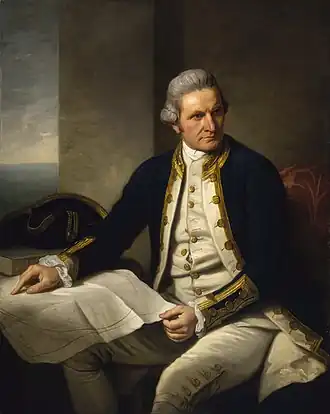
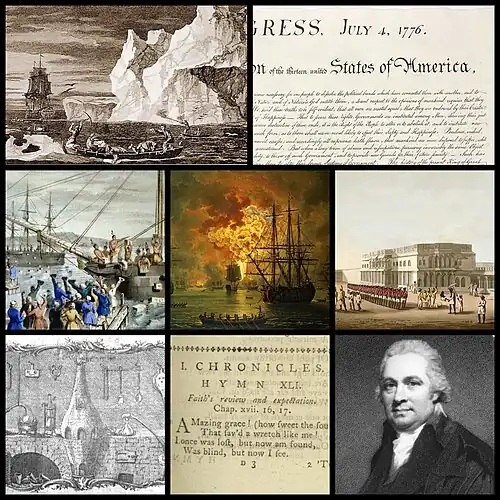
The 1770s (pronounced "seventeen-seventies") was a decade of the Gregorian calendar that began on January 1, 1770, and ended on December 31, 1779. A period full of discoveries, breakthroughs happened in all walks of life, as what emerged at this period brought life to most innovations we know today.
New lands south of the Equator were discovered and settled by Europeans like James Cook, expanding the horizons of a New World to new reaches such as Australia and French Polynesia. Deepened philosophical studies led to the publication of works such as Adam Smith's "The Wealth of Nations", whose concepts influence much of modern socio-economic thought, and sowed the seeds to the global incumbent neoliberal world order. Studies on chemistry and politics deepen to forge the Age of Reason for centuries to come.
Events
1770
January– March
January 1 – The foundation of Fort George, Bombay is laid by Colonel Keating, principal engineer, on the site of the former Dongri Fort.
February 14 – Scottish explorer James Bruce arrives at Gondar, capital of Abyssinia (modern-day Ethiopia) and is received by the Emperor Tekle Haymanot II and Ras Mikael Sehul.[2]
February 22 – Christopher Seider, an 11-year-old boy in Boston in the British Province of Massachusetts Bay, is shot and killed by a colonial official, Ebenezer Richardson. The funeral sets off anti-British protests that lead to the massacre days later.[3]
March 21 – King Prithvi Narayan Shah shifts to the newly constructed Basantapur Palace, in the capital Kathmandu, as the first King of the Unified Kingdom of Nepal.
April 12 – The Townshend Acts are repealed by Britain's Parliament by the efforts of Prime Minister Frederick North, with the exception of the increased duties on imported tea. The American colonists, in turn, stop their embargo on British imports.[4]
April 18 (April 19 by Cook's log)[5] 18:00 – First voyage of James Cook: English explorer Captain James Cook and his crew become the first recorded Europeans to encounter the eastern coastline of the Australian continent. Land is sighted at Point Hicks, and named after Lieutenant Hicks who first observes landform at 6am.
April 20 – Battle of Aspindza: Georgian king Erekle II defeats the Ottoman forces, despite being abandoned by an ally, Russian General Totleben.
April 29 – First voyage of James Cook: Captain Cook drops anchor on HMS Endeavour in a wide bay, about 16 km (10 mi) south of the present city of Sydney, Australia. Because the young botanist on board the ship, Joseph Banks, discovers 30,000 specimens of plant life in the area, 1,600 of them unknown to European science, Cook names the place Botany Bay on May 7.
The 7.5 Mw Port-au-Prince earthquake affects the French colony of Saint-Domingue with a maximum Mercalli intensity of X (Extreme), killing 250 or more.
June 9 – Falklands Crisis (1770): Some 1,600 Spanish marines, sent by the Spanish governor of Buenos Aires in five frigates, seize Port Egmont in the Falkland Islands. The small British force present promptly surrenders.[7]
July 1 – Lexell's Comet (D/1770 L1) passes the Earth at a distance of 2,184,129 kilometres (1,357,155 mi), the closest approach by a comet in recorded history.[8]
July 5 – Battle of Chesma and Battle of Larga: The Russian Empire defeats the Ottoman Empire in both battles. When the news of the defeat reaches the Ottoman city of Smyrna (July 8), the crowd attacks the Greek community of the city (perceived as favourable to the Russian cause) and kills an estimated 200 Greeks and three Western Europeans (although some reports estimate the number of victims at 3,000 or even 5,000 including "3 or 4 thousands who die due to the fright").[9][10]
August 22 (August 23 by Cook's log) – First voyage of James Cook: Captain Cook determines that New Holland (Australia) is not contiguous with New Guinea, and claims the whole of its eastern coast for Great Britain, later naming it all New South Wales.
September 24 – In Hillsborough, North Carolina, the Regulator Movement riots against local authorities.[11]
October–December
October 11 – Phillis Wheatley becomes the first African American woman to have her work published, after having written a poetic elegy to the late Reverend George Whitefield.[12]
November 14 – James Bruce discovers what he believes to be the source of the Nile.
December 7 – King Louis XV of France issues the "Edict of December", dismissing the rebellious magistrates of the Parlements of Paris and the other 13 provinces.[13][14]
December 24 – France's Secretary of the Navy, César Gabriel de Choiseul, is dismissed from his position by the king.[15]
The Baron d'Holbach's (anonymous) materialist work Le Système de la Nature ou Des Loix du Monde Physique et du Monde Moral is produced in Neuchâtel.
The last Cuman to speak the Cuman language (István Varró) dies in Hungary.
1771
January– March
January 5 – The Great Kalmyk (Torghut) Migration is led by Ubashi Khan, from the east bank of the Lower Volga River back to the homeland of Dzungaria, at this time under Qing dynasty rule.
January 9 – Emperor Go-Momozono accedes to the throne of Tokugawa shogunate Japan following his aunt's abdication.
February 12 – Upon the death of Adolf Frederick, he is succeeded as King of Sweden by his son Gustav III. At the time, however, Gustav is unaware of this, since he is abroad in Paris; the news of his father's death reaches him about a month later.
March – War of the Regulation: North Carolina Governor William Tryon raises a militia to put down the long-running uprising of backcountry militias against North Carolina's colonial government.
March 12 – The North Carolina General Assembly establishes Wake County (named for Margaret Wake, the wife of North Carolina Royal Governor William Tryon) from portions of Cumberland, Johnston and Orange counties. Bloomsberry (later known as Wake Courthouse) is made the informal county seat.
March 15 – The Smeatonian Society of Civil Engineers first meets in London, the world's oldest engineering society.[16][17]
April–June
April 4 – The first quarantines are started in Moscow and Saint Petersburg to fight the bubonic plague epidemic. Over the next 12 months, more than 52,000 people die from the plague in Moscow alone.[18]
May – Three battles of Sarbakusa: An alliance of three of the most powerful aristocrats of Ethiopia (Goshu of Amhara, Wand Bewossen and Fasil of Damot) defeats Ras Mikael Sehul and Emperor Tekle Haymanot II, taking control of Ethiopia.
May 11 – War of the Regulation: North Carolina Governor William Tryon marches his military out of Hillsborough, to come to the aid of General Hugh Waddell's beleaguered forces. Tryon's army stops at Alamance Creek, 5 miles (8.0 km) away from the Regulator army.
May 16 – War of the Regulation – Battle of Alamance: Regulators reject an appeal by Governor Tryon to disperse peacefully. Governor Tryon's forces crush the rebellion, causing many Regulators to move to frontier areas outside of North Carolina.
June 11 – The Society of Gentlemen Supporters of the Bill of Rights meets in the London Tavern and changes its platform to a comprehensive program for British parliamentary reform in advance of the next election.[19]
July–September
July 12 – The first voyage of James Cook around the world ends as HMS Endeavour returns to England after almost three years.
July 17 – Bloody Falls massacre: Chipewyan chief Matonabbee, traveling as the guide to Samuel Hearne on his Arctic overland journey, massacres a group of unsuspecting Inuit.
August 8 – The first recorded town cricket match is played, at Horsham, England.[21]
September 8 – In California, Fathers Pedro Cambon and Angel Somera found Mission Vieja, later called, Mission San Gabriel Arcángel, in what becomes San Gabriel, California.
November 3 – Siamese conquest of Ha Tien ends the Siamese civil war of 1767-71.
November 16 – During the night the River Tyne in the north of England floods, destroying many bridges and killing several people; the replacement main bridge at Newcastle upon Tyne will not be completed until 1781.
December 3 – The cause of action in Sommersett's Case, which eventually leads to the end of slavery in Great Britain, begins when escaped slave James Somerset is found imprisoned on the ship Ann and Mary.[22]
December 31 – Men, women and children of the Choctaw and Chickasaw tribes begin a 23-day encampment at Mobile, part of the British colony of West Florida, at the invitation of British Southern Indian superintendent John Stuart, as their leaders negotiate a treaty.[23]
Date unknown
The territory of Baden-Baden is inherited by Charles Frederick, Margrave of Baden-Durlach, reunifying the territories of Baden.
The trade monopoly with Iceland is transferred to the Danish crown.
The North Carolina General Assembly passes an act establishing the town of Martinsborough, named for Royal Governor Josiah Martin, on the land of Richard Evans, which will serve as the seat of Pitt County.
Construction of the Putuo Zongcheng Temple complex in Chengde, China is completed during the reign of the Qianlong Emperor.
Limoges porcelain manufacture is established in France.
Slovene literature: István Küzmics, the Hungarian Slovene writer and evangelical pastor, publishes (in Halle) the Nouvi Zákon, a translation of the New Testament into the Prekmurje Slovene language, with discrete South Slavic artwork.
1772
January–March
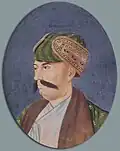
January 10 – Shah Alam II, the Mughal Emperor of India
, makes a triumphant return to Delhi 15 years after having been forced to flee.[24]
January 17 – Johann Friedrich Struensee and Queen Caroline Matilda are arrested, leading to his execution and her banishment from Denmark.
March 8 – Biela's Comet is first discovered by French astronomer Jacques Leibax Montaigne, but not proven to be a periodic comet until 1826, when Wilhelm von Biela correctly identifies its return.[26]
March 20 – Pedro Fages, the Spanish Governor of Alta California, and Juan Crespí, a Catholic priest, set off from the capital at Monterey with a party of 12 soldiers and begin the first European exploration of the lands around San Francisco Bay.[27]
April–June
April 8 – Massachusetts legislator Samuel Adams persuades his colleagues to approve his plan for creating a Committee of Correspondence to begin a dialogue with the other American colonies concerning mutual problems with England.[28][29]
April 13 – Warren Hastings begins his service for the British East India Company as Governor of Bengal, arriving at the company's headquarters at Fort William, outside of Calcutta, and including what are now parts of northeast India and Bangladesh.[30] Hastings serves for two years, then later becomes Governor-General of India.
May 8 – The Watauga Association Compact is signed in what is now East Tennessee by a group of white settlers led by William Bean, creating the first non-colonial government body in British North America.[31]
June 9 – Gaspee Affair: In an act of defiance against the British Navigation Acts, American patriots, led by Abraham Whipple, attack and burn the British customs schooner HMS Gaspee off of Rhode Island.
June 10 – The crisis of 1772 is triggered when, following the flight of their partner Alexander Fordyce to France, the London banking house of Neal, James, Fordyce and Down (which has been speculating in East India Company stock) suspends payment. The resultant panic causes other banks to fail, extends to Scotland, Amsterdam and the Thirteen Colonies and threatens the East India Company with bankruptcy.
June 22 – Somersett's Case: Lord Mansfield, the Lord Chief Justice of England and Wales, delivers the decision that leads to the end of slavery in England.[32]
July 13 – The second voyage of James Cook departs from Plymouth on Captain Cook's new ship, HMS Resolution and the companion ship HMS Adventure in an attempt to prove the existence of an uncharted continent even further south than New Zealand.[34]
August 12 – The volcano Mount Papandayan in West Java erupts and partially collapses, the debris avalanche killing several thousand.[35]
August 21 – A coup d'état by King Gustav III is completed by adopting a new Constitution, ending half a century of parliamentary rule in Sweden, and making him an enlightened despot.
Russian government offices reopen at Moscow and Saint Petersburg after being closed for 15 months because of an epidemic of bubonic plague.[37]
Second voyage of James Cook: The crew of HMS Resolution finds that the ice floes encountered on their journey south are a source of fresh water, a "discovery... of utmost importance to the success of the voyage."[38]
Date unknown
Scottish scientist Daniel Rutherford discovers nitrogen gas, isolating it from air.[39]
Frederick II, Duke of Mecklenburg-Schwerin, demands that all bodies remain unburied for three days to ensure that death has actually taken place.[40]
1773
January–March
January 1 – The hymn that becomes known as Amazing Grace, at this time titled "1 Chronicles 17:16–17", is first used to accompany a sermon led by curate John Newton in the town of Olney, Buckinghamshire, England.
January 12 – The first museum in the American colonies is established in Charleston, South Carolina; in 1915, it is formally incorporated as the Charleston Museum.[41]
January 18 – The first opera performance in the Swedish language, Thetis and Phelée, performed by Carl Stenborg and Elisabeth Olin in Bollhuset in Stockholm, Sweden, marks the establishment of the Royal Swedish Opera.
February 8 – The Grand Council of Poland meets in Warsaw, summoned by a circular letter from King Stanisław August Poniatowski to respond to the Kingdom's threatened partition between three foreign powers.[43]
February 27 – The construction of Christ Church (Alexandria, Virginia), known for being the house of worship for George Washington and the visiting site for subsequent U.S. presidents, is completed.[41]
March 9–19 – Second voyage of James Cook: Tobias Furneaux in HMS Adventure (1771) explores the coast of Van Diemen's Land.[44]
June 4 – 1773 Phipps expedition towards the North Pole sets out from Britain.
June 10 – The Regulating Act is given royal assent by King George III, creating the office of Governor General, with an advising council, to exercise political authority over the territory under British East India Company rule in India.[46]
July–September
July 14 – The first annual conference of American Methodists is convened at Philadelphia in St. George's Church.[41]
July 29 (Feast of St Martha) – Guatemala earthquake: The Santa Marta earthquake hits, with an estimated epicentral magnitude of 7.5 Mi,[47] striking Guatemala; numerous aftershocks last until December. The city of Antigua Guatemala is virtually destroyed, leading to the decision to move the country's capital to La Nueva Guatemala de la Asunción.
August 11 – Second voyage of James Cook in the Tuamotus: Captain Cook discovers Tekokota, which he names Doubtful Island.
August 12 – Second voyage of James Cook in the Tuamotus: Captain Cook discovers Marutea Nord, which he names Furneaux Island.
Daniel Boone leads the first attempt by British colonists to establish a settlement in Kentucky, but is turned back in an attack by Native Americans, in which his son is killed.
Russo-Turkish War (1768–1774): Second of the Russian occupations of Beirut begins, following a naval bombardment which began on August 2. The Russians leave Albanian mercenaries as an occupying force.[48]
Paul Revere marries Rachel Walker, his second wife.
October 14 – The Komisja Edukacji Narodowej (Polish for Commission for the Education of the People), formed in the Polish–Lithuanian Commonwealth, is considered to be the world's first ministry of education.
November 10 – Four ships – the Dartmouth, the Eleanor, the Beaver and the William – depart Britain for America, carrying the first Indian tea to be subject to the newly enacted taxes. The William is lost in a storm; the Dartmouth is the first ship to reach Boston, docking on November 28.[49]
December 23 – Moscow State Academy of Choreography was founded[50] under the reign of Catherine II. It is the second ballet school in Russia after Vaganova Academy of Russian Ballet.
Istanbul Technical University is established (under the name of Royal School of Naval Engineering) as the world's first comprehensive institution of higher learning dedicated to engineering education.
In China, written work begins on the Complete Library of the Four Treasuries, the largest literary compilation of books in China's history (surpassing the Yongle Encyclopedia of the 15th Century). Upon completion in 1782, the books are bound in 36,381 volumes (册) with more than 79,000 chapters (卷), comprising about 2.3 million pages, and approximately 800 million Chinese characters.
Scottish judge James Burnett, Lord Monboddo, begins publication of Of the Origin and Progress of Language, a contribution to evolutionary ideas of the Enlightenment.
Friedrich Gottlieb Klopstock publishes the last five cantos of his epic poemDer Messias in Hamburg.
An angry crowd in Boston, Massachusetts seizes, tars, and feathers British customs collector and Loyalist John Malcolm, for striking a boy and a shoemaker, George Hewes, with his cane.
British industrialist John Wilkinson patents a method for boring cannon from the solid, subsequently utilised for accurate boring of steam engine cylinders.[54]
February 3 – The Privy Council of Great Britain, as advisors to King George III, votes for the King's abolition of free land grants of North American lands. Henceforward, land is to be sold at auction to the highest bidder.[55]
February 6 – The Parlement of Paris votes a sentence of civil degradation, depriving Pierre Beaumarchais of all rights and duties of citizenship.[56]
February 7 – The volunteer fire company of Trenton, New Jersey, predecessor to the paid Trenton Fire Department created in 1892, is founded. In 1905, at 131 years, it claims to be the oldest continuously serving department in the U.S.[57]
February 24 – The Province of Massachusetts Bay House of Representatives votes, 92 to 8, to impeach Superior Court Chief Justice Peter Oliver, but Provincial Governor Thomas Hutchinson refuses to allow the trial to proceed.[58]
March 10 – The Boston Journal makes the first reference to the "Stars and Stripes" flag to symbolize the American colonies, reporting that "The American ensign now sparkles a door which shall shortly flame from the skies."[59]
April 17 – The first avowedly Unitarian congregation, Essex Street Chapel, is founded in London by Theophilus Lindsey.
April 19 – The premiere of Iphigénie en Aulide by Christoph Willibald Gluck sparks a huge controversy, almost a war, such as has not been seen in Paris since the Querelle des Bouffons.
June 22 – The Parliament of Great Britain passes the Quebec Act, setting out rules of governance for the colony of Quebec in British North America, enlarging its territory as far south as the Ohio River and west to the Mississippi River, in the area now occupied by the U.S. states of Michigan, Wisconsin, Illinois, Indiana and Ohio[59] and granting freedom of religion for Roman Catholics.
July–September
July 21 – Russia and the Ottoman Empire sign the Treaty of Küçük Kaynarca with Russian victory, ending six years of war. The treaty gives Russia the right to intervene in Ottoman politics, to protect its Christian subjects.
August 1 – The element oxygen is discovered for the third time (the second quantitatively, following the somewhat earlier work of Carl Wilhelm Scheele (1771–72) by Joseph Priestley, who publishes the fact in 1775, and so names the element (and usually gets all the credit, because his work was published first).
August 6 – Ann Lee and the Shakers arrive in America and settle in New York.[59]
September 1 – Powder Alarm: Thomas Gage, royal governor of the Province of Massachusetts Bay, orders British soldiers to remove gunpowder from a magazine, causing Patriots to prepare for war.
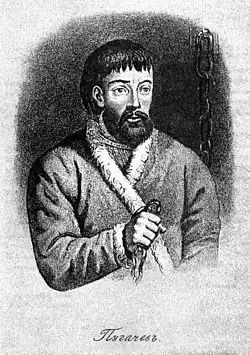
September 15 – Yemelyan Pugachev, leader of Pugachev's Rebellion against Russia by the Yaik Cossacks, is betrayed by his own men after returning to Yaitsk (now Oral, Kazakhstan).[61]
Dunmore's War – Battle of Point Pleasant: Cornstalk is forced to make peace with Dunmore at the Treaty of Camp Charlotte, ceding Shawnee land claims south of the Ohio (modern Kentucky) to Virginia.
English explorer James Cook becomes the first European to sight (and name) Norfolk Island in the Pacific Ocean, uninhabited at this date.
October 20 – The First Continental Congress passes the Continental Association, a colony-wide boycotting of British goods. Theater performances in the American colonies are also halted, on the Congress's recommendation that the member colonies "discountenance and discourage all horse racing and all kinds of gaming, cock fighting, exhibitions of shows, plays, and other expensive diversions and entertainments."[59]
November 4 – The Maryland Jockey Club follows a recommendation of the Continental Congress and cancels its race schedule. The decision sets a precedent for other jockey clubs in the colonies, and no major races are held until the end of the American Revolution.[62]
November 10 – 1774 British general election: Voting for the House of Commons concludes in Great Britain, and Lord North retains the office of Prime Minister as his Tory coalition wins 343 of the 558 seats. Henry Seymour Conway's Whig Party wins the other 215 seats.
November 20 – Daniel Boone retires from the Virginia colonial militia in order to devote his full time to establishing a settlement in Kentucky.[64]
November 25 – Salawat Yulayev, the leader of the Bashkirs rebellion against the Russian government, is captured, bringing an end to the insurrection.[65]
November 27 – Spanish Navy Captain Domingo de Bonechea arrives at Tahiti in the ship Aguila and tries unsuccessfully to claim it for Spain and to convert the Tahitians to the Roman Catholic faith.[67]
Parliament adjourns in Great Britain, but declines to authorize any action against the rebellious American colonies, despite an address the day before by King George III and Prime Minister North.[68]
Thomas Paine, a native of England, arrives in America at the age 37 and soon becomes an influential advocate for the colonies' independence.[69]
December 1 – A boycott called by the Continental Congress goes into effect, as participating merchants and supporters cease the importation or consumption of products from Great Britain, Ireland or the British West Indies.[70]
December 6 – Archduchess Maria Theresa, the ruler of Austria, Hungary and Croatia, signs the General School Ordinance providing for education for both males and females and setting compulsory education for children aged six through 12.[71]
December 9 – The two month long Siege of Melilla begins as armies led by the Sultan of Morocco, Mohammed ben Abdallah, attack the North African Spanish colony of Melilla (which remains a part of Spain into the 21st century).[72]
December 23 – King Louis XVI of France issues a declaration that, for the first time, protects "the free commerce of meat during Lent" to support the needs of "the poor whose infirmity requires them to eat meat."[73]
Date unknown
To avoid severe flooding, Martinsborough, North Carolina is moved to higher ground 3 miles (4.8 km) west. The North Carolina General Assembly incorporates Martinsborough as the new seat of Pitt County, 3 years after its founding.
German cobbler Johann Birkenstock creates the first Birkenstock sandals.
A revision of the laws of cricket introduces a leg before wicket rule.
1775
Summary
The American Revolutionary War began this year, with the first military engagement on April 19 Battles of Lexington and Concord on the day after Paul Revere's ride. The Second Continental Congress took various steps toward organizing an American government, appointing George Washington commander-in-chief (June 14), Benjamin Franklin postmaster general (July 26) and creating a Continental Navy (October 13) and a Marine force (November 10) as landing troops for it, but as yet the 13 colonies have not declared independence, and both the British (June 12) and American (July 15) governments make laws. On July 6, Congress issues the Declaration of the Causes and Necessity of Taking Up Arms and on August 23, King George III of Great Britain declares the American colonies in rebellion, announcing it to Parliament on November 10. On June 17, two months into the colonial siege of Boston, at the Battle of Bunker Hill, just north of Boston, British forces are victorious, but only after suffering severe casualties and after Colonial forces run out of ammunition, Fort Ticonderoga is taken by American forces in New York Colony's northern frontier, and American forces unsuccessfully invade Canada, with an attack on Montreal defeated by British forces on November 13 and an attack on Quebec repulsed December 31.
Human knowledge and mastery over nature advanced when James Watt built a successful prototype of a steam engine, and a scientific expedition continued as Captain James Cook claims the South Georgia and South Sandwich Islands in the south Atlantic Ocean for Britain. Nature's power over humanity is dramatically demonstrated when the Independence Hurricane (August 29 – September 13) devastates the east coast of North America, killing 4,173, and a smallpox epidemic begins in New England. Smallpox vaccine was then developed by Edward Jenner.
March 6 – Raghunathrao, Peshwa of the Maratha Empire in India, signs the Treaty of Surat with the British Governor-General Warren Hastings in Bombay ceding the territories of Salsette and Bassein to the British East India Company along with part of the revenues from Surat and Bharuch districts in return for military assistance. This leads to the First Anglo-Maratha War fought between the British and the Marathas, ending with the Treaty of Salbai in 1782.
March 23 – American Revolution: Patrick Henry, a delegate to the Second Virginia Convention after the Virginia House of Burgesses was disbanded by the Royal Governor, delivers his "Give me Liberty or give me Death!" speech at St. John's Church in Richmond, Virginia.
April 18 – American Revolution: Paul Revere and William Dawes, instructed by Dr. Joseph Warren, ride from Boston to Lexington to warn John Hancock and Sam Adams that British forces are coming to take them prisoner and to seize colonial weapons and ammunition in Concord.
American Revolutionary War – Battle of Machias: In the first naval engagement of the American Revolution, Patriot forces capture the schooner HMS Margaretta.
June 17 – American Revolution: Two months into the colonial siege of Boston, British open fire on Breed's Hill on Charles Town Peninsula. After 3 charges, the British take the hill in the Battle of Bunker Hill.
July 3 – American Revolution: George Washington takes command of the 17,000-man Continental Army at Cambridge.
July 5 – American Revolution: The Continental Congress sends the Olive Branch Petition, hoping for a reconciliation.
July 6 – American Revolution: The Continental Congress issues Declaration of the Causes and Necessity of Taking Up Arms, which contains the words: "Our cause is just. Our union is perfect... being with one mind resolved to die freemen rather than to live slaves...".
July 26 – The Second Continental Congress appoints Benjamin Franklin to be the first Postmaster General of what later becomes the United States Post Office Department.
July 30 – Second voyage of James Cook: HMS Resolution (1771) anchors off the south coast of England, Captain Cook having completed the first eastbound global circumnavigation.
August 23 – American Revolution: Refusing to even look at the Olive Branch Petition, King George issues a Proclamation of Rebellion against the American colonies.
September 25 – American Revolution: Siege of Fort St. Jean – Battle of Longue-Pointe: Thirteen Colonies revolutionary forces under Maj. Ethan Allen attack Montreal in Quebec, commanded by British General Guy Carleton. Allen's forces are defeated, and Allen himself is captured and held on British ships until he is released.
October 13 – American Revolution: The Continental Congress orders the establishment of the Continental Navy (later the United States Navy).
October 26 – American Revolution: George III announces to Parliament that the American colonies are in an uprising and must be dealt with accordingly.
November – American Revolution: Colonel Richard Richardson's South Carolina revolutionaries march through Ninety-Six District in what becomes known as the Snow Campaign, effectively ending all major support for the Loyalist cause in the backcountry of South Carolina.
November 7 – American Revolution: John Murray, 4th Earl of Dunmore, British royal governor of the Colony of Virginia, signs Dunmore's Proclamation, declaring martial law and offering freedom to slaves of Patriots who run away from their owners and join the Loyalist forces (formal proclamation November 15) thus losing the support of planters who see slaves as their vital livelihood.
November 10 – American Revolution: The Continental Congress passes a resolution creating the Continental Marines to serve as landing troops for the recently created Continental Navy (the Marines are disbanded at end of the war in April 1783 but reformed on July 11, 1798 as the United States Marine Corps).
John Wilkinson invents and patents a new kind of boring machine.
Catherine the Great decrees a Statute for the Administration of the Provinces of the Russian Empire dividing the country into provinces and districts for efficient government.[75]
February 17 – Edward Gibbon publishes the first volume of The History of the Decline and Fall of the Roman Empire.
February 27 – American Revolution – Battle of Moore's Creek Bridge: Scottish North Carolina Loyalists charge across Moore's Creek Bridge near Wilmington, to attack what they mistakenly believe to be a small force of rebels. Several leaders are killed in the ensuing battle. The patriot victory[80] virtually ends all British authority in the province.
March–April
March – Restrictions on the cereal trade in Sweden are lifted.
March 1 – The Peshwa of the Maratha Empire and the British East India Company sign Treaty of Purandar in which the British were able to secure Salsette Island and they accepted Sawai Madhav Rao as a new Peshwa. The Marathas accepted not to recognise existence of French in India.
March 25 – American Revolutionary War – American Patriots conduct a Raid on Tybee Island, primarily seeking to capture runaway slaves who sought refuge with British forces stationed there.[81]
June 15 – American Revolution – Delaware Separation Day: The Delaware General Assembly votes to suspend government under the British Crown.
June 17 – Lt. José Joaquín Moraga leads a band of colonists from Monterey Presidio, landing on June 29 and, with Father Francisco Palóu, constructing the Mission San Francisco de Asís ("Mission Dolores") of the new Presidio of San Francisco, the oldest surviving building in the modern-day city.
July 2 – American Revolution – The final U.S. Declaration of Independence (with minor revisions) is written. The Continental Congress passes the Lee Resolution.
July 12 – Captain James Cook sets off from Plymouth, England, in HMS Resolution on his third voyage, to the Pacific Ocean and Arctic, which will be fatal.
July 21 – Mozart's Serenade No. 7 (the "Haffner") is first performed in Salzburg, Austria.
July 29 – Domínguez–Escalante expedition: Francisco Silvestre Vélez de Escalante, Francisco Atanasio Domínguez, and eight other Spaniards set out from Santa Fe, on an eighteen-hundred mile trek through the American Southwest. They are the first Europeans to explore the vast region between the Rockies and the Sierras.[84]
August 1 – The Viceroyalty of the Río de la Plata is established in southern South America.
August – The guild organisation Marchandes de modes is founded in Paris.
September–October
September 1 – Cherokee–American wars: The invasion of the Cherokee Nation by 6,000 patriot troops from Virginia, North Carolina, and South Carolina begins. The troops destroy 36 Cherokee towns.[84]
September 16 – American Revolutionary War – Battle of Harlem Heights: The Continental Army under Washington is victorious against the British on Manhattan.
The first running of the St Leger Stakes horse race[83] (not yet named) in England, first of the British Classic Races, devised by Anthony St Leger (British Army officer), takes place on Cantley Common at Doncaster. The winner is a filly (later named Allabaculia) owned by the organiser, the 2nd Marquess of Rockingham.
The Bolshoi Theatre company hosts its first annual opera season, with the opening of the Bolshoi Kamenny Theatre in Saint Petersburg, Russia.[90]
October 9 – Father Francisco Palóu founds the Mission San Francisco de Asís, in what is now San Francisco.
October 11 – American Revolutionary War – Battle of Valcour Island: On Lake Champlain near Valcour Island, a British fleet led by Sir Guy Carleton defeats 15 American gunboats, commanded by Brigadier General Benedict Arnold. Although nearly all of Arnold's ships are destroyed, the two-day-long battle will give Patriot forces enough time to prepare the defenses of New York City.
October 31 – In his first speech before British Parliament since the Declaration of Independence that summer, King George III acknowledges that all is not going well for Britain, in the war with the United States.
The captain of the American navy ship Andrew Doria fires a salute to the Dutch flag on Fort Oranje, and Johannes de Graaff answers with 11 gun shots.[91]
November 20 – American Revolutionary War – Battle of Fort Lee: The invasion of New Jersey, by British and Hessian forces, leads to the subsequent general retreat of the American Continental Army.
December 6 – The General Assembly of Virginia votes to create Kentucky County as the portion of the colony's Fincastle County that is located west of the Cumberland Mountains.[92] In 1792, the county will become the 15th state of the United States as the Commonwealth of Kentucky. The rest of Fincastle County, between the Blue Ridge Mountains and the Appalachians is divided into the first county to be named after George Washington (Washington County, Virginia) in the south along the border with the North Carolina colony, and Montgomery County in the north. The divisions take effect on December 31.[93]
December 12 – The second Continental Congress ends after a session that began on May 10, 1775, and continued for 582 days.[94]
December 19 – American Revolution – Thomas Paine, living with Washington's troops, publishes the first in the series of pamphlets on The American Crisis in The Pennsylvania Journal, opening with the stirring phrase, "These are the times that try men's souls."
December 21 – American Revolution – The Royal Colony of North Carolina reorganizes into the State of North Carolina after adopting its own constitution. Richard Caswell becomes the first governor of the newly formed state.
December 25 – American Revolution – At 6 p.m. Gen. George Washington and his troops, numbering 2,400, march to McConkey's Ferry, cross the Delaware River, and land on the New Jersey bank by 3 a.m. the following morning.
December 26 – American Revolutionary War – Battle of Trenton: Washington's troops surprise the 1,500 Hessian troops under the command of Col. Johann Rall at 8 a.m. outside Trenton and score a victory,[80] taking 948 prisoners while suffering only five wounded.
Date unknown
Adlan II becomes ruler of the Kingdom of Sennar.
The first commercial examples of the Watt steam engine are sold.[95][96]
January 15 – Vermont declares its independence from New York, becoming the Vermont Republic, an independent country, a status it retains until it joins the United States as the 14th state in 1791.
January 21 – The Continental Congress approves a resolution "that an unauthentic copy, with names of the signers of the Declaration of independence, be sent to each of the United States.[97]
February 5 – Under the 1st Constitution of Georgia, 8 counties are chartered: Burke, Camden, Chatham, Effingham, Glynn, Liberty, Richmond, and Wilkes. This dissolves the existing parishes of St. George, St. Mary's, St. Thomas, St. Phillip, Christ Church, St. David, St. Matthews, St. Andrew, St. James, St. Johns, and St. Paul.[98]
February 24 – King Joseph I of Portugal dies, and is succeeded by his daughter Maria I of Portugal, and his brother and son-in-law Peter III of Portugal.
March 4 – The Fourth Continental Congress, with John Hancock as president, begins a 199 day session in Philadelphia, lasting until September 18.[97]
April 1 – Friedrich Maximilian Klinger's play Sturm und Drang is premiered by the Seyler Theatre Company in Leipzig, giving its name to the whole Sturm und Drang movement in German literature.
October 6 – American Revolutionary War – Battle of Forts Clinton and Montgomery: British troops capture Fort Clinton and Fort Montgomery (Hudson River), and are able to dismantle the Hudson River Chain.
December 18 – The United States celebrates its first Thanksgiving, marking October's victory by the American rebels over British General John Burgoyne at Saratoga.
December 30 – Maximilian III Joseph, Elector of Bavaria dies and is succeeded by his distant cousin Charles Theodore, Elector of Bavaria.
Date unknown
The code duello is adopted at the Clonmel Summer Assizes as the form for pistol duels by gentlemen in Ireland. It is quickly denounced, but nevertheless widely adopted throughout the English-speaking world.
Kunsthochschule Kassel is founded in Germany as a fine arts academy.
Det Dramatiske Selskab is founded in Copenhagen (Denmark) as an acting academy.
George II Frederic is crowned as king of the Miskito Kingdom.
1778
January–March
January 18 – Third voyage of James Cook: Captain James Cook, with ships HMS Resolution and HMS Discovery, first views Oʻahu then Kauaʻi in the Hawaiian Islands of the Pacific Ocean, which he names the Sandwich Islands.
General John Cadwalader shoots and seriously wounds Major General Thomas Conway in a duel after a dispute between the two officers over Conway's continued criticism of General George Washington's leadership of the Continental Army.[103]
February 6 – American Revolutionary War: In Paris, the Treaty of Alliance and the Treaty of Amity and Commerce are signed by the United States and France, signaling official French recognition of the new republic.
April 7 – Former British prime minister William Pitt delivers his last speech to Parliament, and speaks to the House of Lords "passionately but incoherently against the granting of independence" to the American colonies, but collapses during the debate, and dies five weeks later.[104]
April 12 – King George III appoints the five-member Carlisle Peace Commission to present peace terms to negotiate an end to the rebellion of Britain's 13 American colonies.[105]
April 30 – The 1,800 feet (550 m) long Hudson River Chain, designed to prevent British ships from moving up the river toward West Point, New York is stretched across the river and anchored by an engineering team under the direction of Captain Thomas Machin.[106]
May 12 – Heinrich XI, Prince Reuss of Greiz is elevated to Prince of the Principality of Reuss-Greiz by Joseph II, Holy Roman Emperor. This year sees the first appearance of the modern-day national colors of Germany on a flag that closely resembles the modern flag of Germany, to occur anywhere within modern-day Germany.
August 26 – Triglav, at 2,864 metres (9,396 ft) above sea level the highest peak of Slovenia, is ascended for the first time by four men: Luka Korošec, Matevž Kos, Štefan Rožič, and Lovrenc Willomitzer, on Sigmund Zois' initiative.
September – The Massachusetts Banishment Act, providing punishment for Loyalists, is passed.
September 7 – American Revolutionary War: Invasion of Dominica – The French capture the British fort there, before the latter is aware that France has entered the war in the Franco-American alliance.
September 17 – The Treaty of Fort Pitt is signed, the first formal treaty between the United States and a Native American tribe (the Lenape or Delaware).
October 12 – The Continental Congress advises the 13 member states to suppress "theatrical entertainments, horse-racing, gaming, and such other diversions as are productive of idleness, dissipation, and general depravity of principles and manners."[103]
November 11 – American Revolutionary War: Cherry Valley massacre – British forces and their Iroquois allies attack a fort and the village of Cherry Valley, New York, killing 14 soldiers and 30 civilians.
Phillips Academy is founded in Massachusetts by Samuel Phillips Jr.
The term thoroughbred is first used in the United States, in an advertisement in a Kentucky gazette, to describe a New Jersey stallion called Pilgarlick.
Thomas Kitchin's The Present State of the West-Indies: Containing an Accurate Description of What Parts Are Possessed by the Several Powers in Europe is published in London.[110]
The city of Ulaanbaatar is settled at its present location, having functioned as a mobile monastic settlement since 1639.
January 29 – After a second petition for partition from its residents, the North Carolina General Assembly abolishes Bute County, North Carolina (established 1764) by dividing it and naming the northern portion Warren County (for Revolutionary War hero Joseph Warren), the southern portion Franklin County (for Benjamin Franklin). The General Assembly also establishes Warrenton (also named for Joseph Warren) to be the seat of Warren County, and Louisburg (named for Louis XVI of France) to be the seat of Franklin County.
February 12 – Lieutenant Colonel Francisco Bouligny arrives with Malagueño colonists at Bayou Teche, to establish the city of New Iberia, Louisiana.
April 12 – Spain and France secretly sign the Convention of Aranjuez, with Spain joining an alliance against Great Britain in return for France's pledge to recover all Spanish territory lost to the British.[111]
May 13 – War of the Bavarian Succession – Russian and French mediators at the Congress of Teschen negotiate an end to the war. In the agreement Austria receives a part of the Bavarian territory (the Innviertel), and relinquishes the rest.
July 16 – The Great Siege of Gibraltar begins. This is an action by French and Spanish forces to wrest control of Gibraltar from the established British garrison. The garrison, led by George Augustus Eliott (later 1st Baron Heathfield of Gibraltar), survives all attacks and a blockade of supplies.
July 22 – Battle of Minisink: The Goshen Militia is destroyed by Joseph Brant's forces.
July 24 – American Revolutionary War – American forces, led by Commodore Dudley Saltonstall, launch the Penobscot Expedition in what is now Castine, Maine, resulting in the worst naval defeat in U.S. history, until surpassed by the attack on Pearl Harbor in 1941.
August 17 – Action of 17 August 1779: The 64-gun British warship HMS Ardent is captured by France in the English Channel off of Plymouth after an ineffective attempt by the British captain to properly aim its cannons at the French frigate Junon.
August 23 – Martín de Mayorga, Captain-General of Guatemala, becomes the Spanish Viceroy of New Spain after the death of Antonio María de Bucareli.
September 23 – American Revolutionary War – Battle of Flamborough Head – The American ship Bonhomme Richard, commanded by John Paul Jones, engages the British ship HMS Serapis. The Bonhomme Richard sinks, but the Americans board the Serapis and other vessels, and are victorious.
September 28 – Samuel Huntington is elected as the seventh President of the Continental Congress.[94]
October 4 – The Fort Wilson Riot against James Wilson and others in Philadelphia takes place.
November 2 – The North Carolina General Assembly carves a new county from Dobbs County, North Carolina and names it Wayne County, in honor of United States General Anthony Wayne.
December 31 – Affair of Fielding and Bylandt: Following a brief naval engagement between the British and Dutch off the Isle of Wight, the Dutch merchantmen and naval vessels are captured and taken to Portsmouth, England.
The Iron Bridge is erected across the River Severn in Shropshire, the world's first bridge built entirely of cast iron.[113] It will open to traffic on January 1, 1781.[114]
The spinning mule is perfected by Lancashire inventor Samuel Crompton.[114]
Boulton and Watt's Smethwick Engine, now the oldest working engine in the world, is brought into service (May)).
A joint Spanish-Portuguese survey of the Amazon basin begins to determine the boundary between the colonial possessions in South America; it continues until 1795.
Wilhelmine of Prussia, Queen of the Netherlands, Dutch queen consort (from 1815 to 1837); second daughter and fourth child of Frederick William II of Prussia and Frederica Louisa of Hesse-Darmstadt (d. 1837)
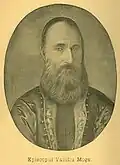
November 19 – Vasile Moga, Romanian orthodox bishop of Sibiu (d. 1845)
January 5 – Charles-Guillaume Étienne, French writer (d. 1845)
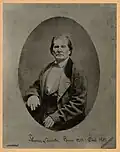
Thomas Lincoln
January 6 – Thomas Lincoln, Farmer, Carpenter (d. 1851)
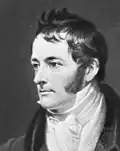
January 7 – Anthony Todd Thomson, British dermatologist (d. 1849)
January 9 – Thomas Brown, Scottish metaphysician (d. 1820)
January 10 – Teodoro Sánchez de Bustamante, Argentine politician (d. 1851)
January 11 – Agathon Jean François Fain, French historian (d. 1837)
January 12 – William Herbert, British politician (d. 1847)
January 13 – Sir Isaac Goldsmid, 1st Baronet, British financier and one of the leading figures in the Jewish emancipation in the United Kingdom (d. 1859)
January 15 – Joseph Adamy, Nassauian politician (d. 1849)
Hugh Hornby Birley, leading Manchester Tory, reputed to have led the fatal charge of the Manchester and Salford Yeomanry, at the Peterloo Massacre (d. 1845)
Philip Willem van Heusde, Dutch philosopher (d. 1839)
Gregory Blaxland, English pioneer farmer, explorer in Australia (d. 1852)
June 19 – Robert Allen, Tennessee politician (d. 1844)
June 20 – Jean Baptiste Gay, vicomte de Martignac, moderate royalist French statesman, during the Bourbon Restoration (1814–30) under King Charles X (d. 1832)
June 22 – George Percy, 5th Duke of Northumberland, British politician (d. 1867)
June 23 – Richard W. Meade, American merchant and art collector (d. 1828)
June 26 – Mariya Svistunova, lady-in-waiting at the Russian Court (d. 1866)
June 27 – Sir John Astley, 1st Baronet, British politician (d. 1842)
December 25 – John Gabriel Jones, colonial American pioneer and politician (b. 1752)
date unknown – Muhammad al-Warghi, Tunisian writer and poet (b. c. 1713)
1777
Enrichetta d'EstePierre-Herman DosquetCornelia SchlosserConsort ShuInfante Philip, Duke of CalabriaCharles Antoine de La Roche-AymonSir Charles Knowles, 1st Baronet
^Mathes, W. Michael (1985). "The Camino Real: California's Mission Trail". Pioneer Trails West. Caxton Press. p. 82.
^"The Revenue Administration of Bengal, 1765-86", by R. B. Ramsbotham, in The Cambridge History of the British Empire, H. H. Dodwell, ed. (Cambridge University Press Archive, 1929) p. 413
^Samuel Fallows, Samuel Adams: A Character Sketch, with Anecdotes, Characteristics and Chronology (The University Association, 1898) p. 110
^Jaswant Lal Mehta, Advanced Study in the History of Modern India 1707-1813 (Sterling Publishers, 2005) p. 510
^Lewis L. Laska, The Tennessee State Constitution: A Reference Guide (Greenwood Publishing Group, 1990) p. 1
^Persen, William (1955). "The Russian occupations of Beirut, 1772–74". Journal of the Royal Central Asian Society. 42 (3–4): 275–286. doi:10.1080/03068375508731555.
^Price, A. Grenfell, ed. (1971). The Explorations of Captain James Cook in the Pacific, as Told by Selections of His Own Journals, 1768-1779. Courier Corporation. p. 107.
^John T. Alexander, Catherine the Great: Life and Legend (Oxford University Press, 1989) p159
^"Anders Sparrman, 1748—1820", in Oceanographic History: The Pacific and Beyond, ed. by Keith R. Benson and Philip F. Rehbock (University of Washington Press, 2002) p230
^Penguin Pocket On This Day. Penguin Reference Library. 2006. ISBN 0-14-102715-0.
^Burke, Edmund, ed. (1774). The Annual Register, or a View of the History, Politics and Literature for the Year 1773. J. Dodsley. p. 25.
^Cook, James (1821). The Three Voyages of Captain James Cook round the World. Vol. III: Being the First of the Second Voyage. London: Longman, Hurst and Rees. pp. 122–128.
^Corman, Brian (2013). The Broadview Anthology of Restoration and Eighteenth-Century Comedy. Broadview Press. p. 359.
^du Quenoy, Paul (2014). "Arabs under Tsarist Rule: The Russian Occupation of Beirut, 1773–1774". Russian History. 41 (2): 128–141. doi:10.1163/18763316-04102002.
^Keith R. Dawson, Caroline Princess of Wales & Other Forgotten People of History (Strategic Book Publishing, 2010) p67
^Woody Holton, Forced Founders: Indians, Debtors, Slaves, and the Making of the American Revolution in Virginia (University of North Carolina Press Books, 2011) p32
^"Beaumarchais", in The Cornhill Magazine (August 1884) p142
^"Fire News of the Week", in Fire and Water Engineering (December 9, 1905) p337
^Clifford Kenyon Shipton, New England Life in the Eighteenth Century: Representative Biographies from Sibley's Harvard Graduates (Harvard University Press, 1995) p324
^ abcdefghiGordon Carruth, ed., The Encyclopedia of American Facts and Dates 3rd Edition (Thomas Y. Crowell, 1962) pp80-82
^Robert K. Massie, Catherine the Great: Portrait of a Woman (Random House, 2011) p406
^Ann Fairfax Withington, Toward a More Perfect Union: Virtue and the Formation of American Republics (Oxford University Press, 1996) p197
^"Giacomo Casanova", by Mattia Begali, in Encyclopedia of Italian Literary Studies (Taylor & Francis, 2007) p402
^Robert Morgan, Boone: A Biography (Algonquin Books, 2008) p152
^Charles R. Steinwedel, Threads of Empire: Loyalty and Tsarist Authority in Bashkiria, 1552–1917 (Indiana University Press, 2016) p73
^Joe Jackson, A World on Fire: A Heretic, an Aristocrat, and the Race to Discover Oxygen (Penguin, 2007) p114
^Robert W. Kirk, Paradise Past: The Transformation of the South Pacific, 1520-1920 (McFarland, 2012) p27
^William Edward Hartpole Lecky, A History of England in the Eighteenth Century, Volume 3 (D. Appleton and Company, 1891) p456
^Richard R. Beeman, Our Lives, Our Fortunes and Our Sacred Honor: The Forging of American Independence, 1774-1776 (Basic Books, 2013) p xi
^Spencer Tucker, Almanac of American Military History (ABC-CLIO, 2013) p211
^James B. Collins and Karen L. Taylor, Early Modern Europe: Issues and Interpretations (John Wiley & Sons, 2008) p57
^Karen Racine, Francisco de Miranda, a Transatlantic Life in the Age of Revolution (Rowman & Littlefield, 2003) p13
^Jennifer J. Davis, Defining Culinary Authority: The Transformation of Cooking in France, 1650-1830 (LSU Press, 2013)
^Warren, James Francis (1981). The Sulu Zone, 1768-1898: The Dynamics of External Trade, Slavery, and Ethnicity in the Transformation of a Southeast Asian Maritime State. Singapore: NUS Press. p. 36.
^ abde Madriaga, Isabel (January 1974). "Catherine II and the Serfs: A Reconsideration of Some Problems". The Slavonic and East European Review. 52 (126): 34–62. JSTOR 4206834.
^"Battles of Lexington and Concord", Britannica Student Encyclopedia, 2006, p. 454, The American Revolution began on April 19, 1775, with the Battles of Lexington and Concord.
^Scherer, F. M. (1965). "Invention and Innovation in the Watt-Boulton Steam-Engine Venture". Technology and Culture. 6 (2): 165–87. doi:10.2307/3101072. JSTOR 3101072. S2CID 112618665.
^ abHarper's Encyclopaedia of United States History from 458 A. D. to 1909, ed. by Benson John Lossing and, Woodrow Wilson (Harper & Brothers, 1910) p166
^Hulse David K (1999): "The early development of the steam engine"; TEE Publishing, Leamington Spa, U.K., ISBN, 85761 107 1 p. 127 et seq.
^R. L. Hills, James Watt: II The Years of Toil, 1775–1785 (Landmark, Ashbourne, 2005), 58–65.
^ abcdLossing, Benson John; Wilson, Woodrow, eds. (1910). Harper's Encyclopaedia of United States History from 458 A.D. to 1909. Harper & Brothers. p. 166.
^Harris, Michael (2014). Brandywine: A Military History of the Battle that Lost Philadelphia but Saved America, September 11, 1777. El Dorado Hills, CA: Savas Beatiuùuù hie. p. 55. ISBN 978-1-61121-162-7.
^ abcdHarper's Encyclopaedia of United States History from 458 A. D. to 1909, ed. by Benson John Lossing and, Woodrow Wilson (Harper & Brothers, 1910) p166
^"Pitt, William (The Elder; Earl of Chatham)", by Philip Woodfine, in British Political Leaders: A Biographical Dictionary, ed. by Keith Laybourn (ABC-CLIO, 2001) p264
^Barry Alan Shain, The Declaration of Independence in Historical Context (Yale University Press, 2014) p657
^Raymond C. Houghton, A Revolutionary War Road Trip on US Route 9 (Cyber Haus, 2003) pp37-38
^Harrison Wick; Luzerne Country Historical Society (2011). Luzerne County. Arcadia Publishing. p. 101. ISBN 978-0-7385-7378-6.
^Kozina, N. I. (1995). "З історії переселення греків з Криму на Маріупольщину: Митрополит Ігнатій (Газадінов)" [From the history of the relocation of the Greeks from the Crimea to the Mariupol region: Metropolitan Ignatius (Gazadinov)]. Регіональне і загальне в історії: Тези міжнародної наукової конференції, присвяченої 140-річчю від дня народження Д.І.Яворницького та 90-літтю XIII Археологічного з'їзду (9 листопада 1995 р.) [Regional and general in history: Abstracts from the international scientific conference dedicated to the 140th anniversary of the birth of D.I. Yavornytsky and the 90th anniversary of the XIII Archaeological Congress (9 November 1995)]. By Beketov, V. M. (in Ukrainian). Dnipro: Institute of History of Ukraine. pp. 262–264. ISBN 5-7707-8671-X. Archived from the original on March 13, 2023. Retrieved 13 March 2023 – via Dmytro Yavornytsky National Historical Museum of Dnipropetrovsk.
^Wilcox, George W. (May 1993). "Profile of an Irish Lady: Bridget Day Beatty". Lower Cape Fear Historical Society, Inc. Bulletin. XXXVIII (3). Wilmington, North Carolina.
^Carvill, James (1981). Famous names in engineering. London Boston: Butterworths. p. 1. ISBN 9780408005401.
^George Holbert Tucker (1995). Jane Austen the Woman: Some Biographical Insights. St. Martin's Griffin. p. 6.
^Archivo Diplomático Peruano (in Spanish). Vol. VI. Lima: Ministerio de Relaciones Exteriores del Perú. 1957. pp. VII.
^Ivan Katchanovski; Zenon E. Kohut; Bohdan Y. Nebesio; Myroslav Yurkevich (11 July 2013). Historical Dictionary of Ukraine. Scarecrow Press. p. 298. ISBN 978-0-8108-7847-1.
^Pardo de Guevara y Valdés, Eduardo (23 October 2002). "Fr. Martín Sarmiento (1695-1772)"(PDF). DSpace Home (in Spanish). Universidade da Coruña: 99. Retrieved 24 May 2019.
^Jón Espólín: Íslands Árbækur í sögu-formi. X. deild, prentað á kostnað ens íslenzka Bókmenntafélags, Kaupmannahöfn 1848. Blaðsíða 34. (Ljósprentuð 2. útgáfa 1947.)
^"Johan Augustin Mannerheim" (in Swedish). Gotlands Försvarshistoria och Gotlands Trupper. Archived from the original on November 15, 2023. Retrieved 23 October 2024.


.svg.png)





_by_Winterhalter.jpg)
.jpg)
.jpg)


.jpg)
.jpg)
.jpg)



.jpg)



.jpg)
.jpg)
.jpg)
_(cropped).jpg)



.jpg)

.jpg)
.jpg)





.jpg)

.jpg)


.jpg)
_by_Maurice_Quentin_de_La_Tour.jpg)


_edited_2.jpg)



.jpg)
.jpg)
_-_SK-A-4155_-_Rijksmuseum.jpg)

.jpg)

_by_James_Millar.jpeg)

._Graveur_Rijksmuseum_SK-A-2671.jpeg)
.jpg)










_-_Museo_Campano.jpg)

_-001.jpg)
.jpg)