1337
| Years |
|---|
| Millennium |
| 2nd millennium |
| Centuries |
| Decades |
| Years |
| 1337 by topic |
|---|
| Leaders |
|
| Birth and death categories |
| Births – Deaths |
| Establishments and disestablishments categories |
| Establishments – Disestablishments |
| Art and literature |
| 1337 in poetry |
| Gregorian calendar | 1337 MCCCXXXVII |
| Ab urbe condita | 2090 |
| Armenian calendar | 786 ԹՎ ՉՁԶ |
| Assyrian calendar | 6087 |
| Balinese saka calendar | 1258–1259 |
| Bengali calendar | 743–744 |
| Berber calendar | 2287 |
| English Regnal year | 10 Edw. 3 – 11 Edw. 3 |
| Buddhist calendar | 1881 |
| Burmese calendar | 699 |
| Byzantine calendar | 6845–6846 |
| Chinese calendar | 丙子年 (Fire Rat) 4034 or 3827 — to — 丁丑年 (Fire Ox) 4035 or 3828 |
| Coptic calendar | 1053–1054 |
| Discordian calendar | 2503 |
| Ethiopian calendar | 1329–1330 |
| Hebrew calendar | 5097–5098 |
| Hindu calendars | |
| - Vikram Samvat | 1393–1394 |
| - Shaka Samvat | 1258–1259 |
| - Kali Yuga | 4437–4438 |
| Holocene calendar | 11337 |
| Igbo calendar | 337–338 |
| Iranian calendar | 715–716 |
| Islamic calendar | 737–738 |
| Japanese calendar | Shōkei 6 (正慶6年) |
| Javanese calendar | 1249–1250 |
| Julian calendar | 1337 MCCCXXXVII |
| Korean calendar | 3670 |
| Minguo calendar | 575 before ROC 民前575年 |
| Nanakshahi calendar | −131 |
| Thai solar calendar | 1879–1880 |
| Tibetan calendar | མེ་ཕོ་བྱི་བ་ལོ་ (male Fire-Rat) 1463 or 1082 or 310 — to — མེ་མོ་གླང་ལོ་ (female Fire-Ox) 1464 or 1083 or 311 |
Year 1337 (MCCCXXXVII) was a common year starting on Wednesday of the Julian calendar.
Events
January–December
- March 16 – Edward, the Black Prince establishes the Duchy of Cornwall, becoming the first English Duke.[1]
- May 24 – Philip VI of France confiscates Gascony from English control.[2]
- August – Second War of Scottish Independence: English forces relieve Stirling Castle, ending Edward III of England's last campaign in Scotland.[2]
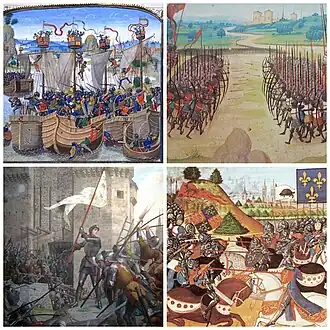
- October – Hundred Years' War: Edward III of England formally rejects Philip VI's claim to the French throne, initiating hostilities between France and England.[2][3]
- November – Battle of Cadzand: English troops raid the Flemish island of Cadzand.
Date unknown
- Bisham Priory is founded in England.
- The Scaligeri Family loses control of Padua; Alberto della Scala, patron of the music of the Trecento, moves to Verona.
- Petrarch, "father" of Renaissance humanism, first visits Rome to wander its mysterious ruins, with an eye for aesthetics as well as for history, exciting a renewed interest in Classical civilisation.
- The Sofia Psalter is produced in Bulgaria.
- The Despotate of Epirus is conquered by the Byzantine Empire.
- The famine in China, which had lasted since 1332 and killed 6,000,000, comes to an end.
- Siege of Nicomedia: After its foundation by Osman I in about 1299, the Ottoman Empire expanded across Bithynia in north-west Anatolia by capturing territory from the Byzantine Empire.
Births
- February 25 – Wenceslaus I, Duke of Luxembourg, Czech Duke of Luxembourg (d. 1383)
- date unknown
Deaths
- January 8 – Giotto di Bondone, Italian painter (b. 1267)
- June 7 – William I, Count of Hainaut (b. 1286)
- June 15 – Angelo da Clareno, Italian Franciscan and leader of a group of Fraticelli (b. 1247)
- June 25 – Frederick III of Sicily (b. 1272)
- June 30 – Eleanor de Clare, politically active English noble (b. 1290)
- date unknown
References
- ^ Penguin Pocket On This Day. Penguin Reference Library. 2006. ISBN 0-14-102715-0.
- ^ a b c Palmer, Alan; Palmer, Veronica (1992). The Chronology of British History. London: Century Ltd. pp. 100–102. ISBN 0-7126-5616-2.
- ^ Williams, Hywel (2005). Cassell's Chronology of World History. London: Weidenfeld & Nicolson. pp. 159–161. ISBN 0-304-35730-8.