1512
| Years |
|---|
| Millennium |
| 2nd millennium |
| Centuries |
| Decades |
| Years |
.JPG)
| 1512 by topic |
|---|
| Arts and science |
|
| Leaders |
|
| Birth and death categories |
| Births – Deaths |
| Establishments and disestablishments categories |
| Establishments – Disestablishments |
| Works category |
|
| Gregorian calendar | 1512 MDXII |
| Ab urbe condita | 2265 |
| Armenian calendar | 961 ԹՎ ՋԿԱ |
| Assyrian calendar | 6262 |
| Balinese saka calendar | 1433–1434 |
| Bengali calendar | 918–919 |
| Berber calendar | 2462 |
| English Regnal year | 3 Hen. 8 – 4 Hen. 8 |
| Buddhist calendar | 2056 |
| Burmese calendar | 874 |
| Byzantine calendar | 7020–7021 |
| Chinese calendar | 辛未年 (Metal Goat) 4209 or 4002 — to — 壬申年 (Water Monkey) 4210 or 4003 |
| Coptic calendar | 1228–1229 |
| Discordian calendar | 2678 |
| Ethiopian calendar | 1504–1505 |
| Hebrew calendar | 5272–5273 |
| Hindu calendars | |
| - Vikram Samvat | 1568–1569 |
| - Shaka Samvat | 1433–1434 |
| - Kali Yuga | 4612–4613 |
| Holocene calendar | 11512 |
| Igbo calendar | 512–513 |
| Iranian calendar | 890–891 |
| Islamic calendar | 917–918 |
| Japanese calendar | Eishō 9 (永正9年) |
| Javanese calendar | 1429–1430 |
| Julian calendar | 1512 MDXII |
| Korean calendar | 3845 |
| Minguo calendar | 400 before ROC 民前400年 |
| Nanakshahi calendar | 44 |
| Thai solar calendar | 2054–2055 |
| Tibetan calendar | ལྕགས་མོ་ལུག་ལོ་ (female Iron-Sheep) 1638 or 1257 or 485 — to — ཆུ་ཕོ་སྤྲེ་ལོ་ (male Water-Monkey) 1639 or 1258 or 486 |
Year 1512 (MDXII) was a leap year starting on Thursday of the Julian calendar.
Events
January–March
- January 2 – Svante Nilsson, regent of Sweden since 1504, dies at the age of 51. Eric Trolle is subsequently elected as the new Regent, but will be ousted after only six months.[1]
- January 23 – Neagoe Basarab becomes the new Prince of Wallachia at the capital, Târgoviște, after Prince Prince Vlad V is captured at battle in Bucharest and then decapitated.[2]
- February 18 – War of the League of Cambrai: The French carry out the Sack of Brescia.
- March 12 – Pope Julius II issues the papal bull Dilecte fili, declaring King Louis XII deposed and directing that the French throne be given to King Henry VIII of England.
- March 23 – Donyo Dorje, ruler of the Kingdom of Ü-Tsang and most of Tibet, dies after a reign of more than 30 years and is succeeded by his brother, Ngawang Namgyal.[3]
April–June
- April 6 – A truce was concluded in Rome, between the emperor Maximilian I and the Republic of Venice. It was ratified on 20 May by the emperor, thus ending imperial participation in the League of Cambrai.[4]
- April 11 – War of the League of Cambrai – Battle of Ravenna:[5] French troops under Gaston of Foix, Duke of Nemours, assisted by the Duchy of Ferrara, defeat the Spanish and Papal States troops led by Ramón de Cardona. Gaston is killed in the pursuit as the Spanish retreat, and at least 3,000 of his troops are killed. More than 9,000 Spanish and Papal troops are killed, and 17,000 civilians in and around the city of Ravenna are massacred.[6]
- May 3 – The Fifth Council of the Lateran begins.
- May 12 – Thomas Howard, 2nd Duke of Norfolk, leads an English expedition into France and burns the port city of Brest.[7]
- May 26 – Selim I succeeds Bayezid II, as Sultan of the Ottoman Empire.
- June 15 – Al-Ashraf Qansuh al-Ghuri, ruler of the Mamluk Sultanate that controls Egypt and what is now Egypt, Israel, Lebanon and parts of Syria, receives an envoy from King George II of Kakheti (now located in the Republic of Georgia) and decides to reopen the Church of the Holy Sepulchre in Jerusalem.[8]
- June 16 – Massimiliano Sforza is installed as the new Duke of Milan by the Holy League, to force out King Louis XII of France.
- June 24 – Captain-Major Simão de Miranda de Azevedo took office as the new Portuguese Governor of Mozambique after being replaced by King Manuel I to replace António de Saldanha.
- June 29 – Giano II di Campofregoso was elected as the Doge of the Republic of Genoa in Italy after the withdrawal of French occupation troops, filling a vacancy that had existed since 1507.
July–September
- July 10 – King Ferdinand II of Aragon sends Don Fadrique de Toledo, to complete the Spanish conquest of Iberian Navarre.[9]
- July 12 – The Treaty of Blois is signed in France between representatives of the Spanish Kingdom of Navarre and of the Kingdom of France guaranteeing French intervention to keep Navarre neutral and to prevent an attack by the "Holy League" alliance of Pope Julius II and Spain's King Ferdinand II of Aragon and Castile.[10]
- July 23 – Sten Sture the Younger is elected new Regent of Sweden, replacing Eric Trolle.[1]
- August 10 – War of the League of Cambrai – Battle of Saint-Mathieu: The English navy defeats the French-Breton fleet. Both navies use ships firing cannons through ports, and each loses its principal ship — Regent and Marie-la-Cordelière — through a large explosion aboard the latter.
- September 1 – After being dispatched by Pope Julius II with command of a Spanish Army, General Giovanni di Lorenzo de' Medici recaptures the city of Florence (Firenze), capital of the Florentine Republic in Italy and ousts Piero Soderini as the ruling Gonfaloniere. The success at Florence spares the city of Rome from a French invasion. Within a year, Medici becomes leader of the Roman Catholic Church and the Papal States as Pope Leo X.
- September 10 – Portuguese Admiral Afonso de Albuquerque departs from the Indian city of Cochin with 14 ships and 1,700 troops to retake the fortress of Goa, capital of Portuguese India, from Bijapur's General Rasul Khan. A day before a planned Portuguese attack on Bihar's army, Rasul Khan and his occupying forces depart from Goa.[11]
October–December
- October 19 – Martin Luther becomes a doctor of theology (Doctor in Biblia).[12]
- October 21 – Martin Luther joins the theological faculty of the University of Wittenberg.[12]
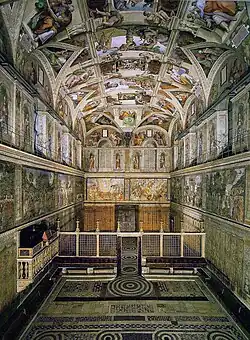
- November 1 – The ceiling of the Sistine Chapel, painted by Michelangelo, is exhibited to the public for the first time.
- November 10 – Pope Julius II proposes the conclusion of a comprehensive peace treaty between the emperor and the Venetians, that would resolve various political conflicts by favoring Maximilian's interests and suppressing the French influence in Italy.[13]
- December 23 – Finding the Pope's peace proposals too favorable towards the emperor, Venetian government decides to initiate peace negotiations with the king of France.[14]
- December 27 – The Spanish Crown issues the Laws of Burgos, governing the conduct of settlers with regard to native Indians in the New World.
Date unknown
- António de Abreu discovers Timor Island, and reaches the Banda Islands, Ambon Island and Seram.
- Francisco Serrão reaches the Moluccas.
- Francisco Serrao and other shipwreck sailors with permission from the Ternate Sultanate build Fort Tolukko. It is one of the earliest, if not the first European style fortress in southeast Asia.
- Juan Ponce de León discovers the Turks and Caicos Islands.[15]
- Pedro Mascarenhas discovers Diego Garcia, and reaches Mauritius in the Mascarene Islands.
- Moldavia becomes a vassal of the Ottoman Empire, on the same conditions as Wallachia: the voivode will be designated by the Turks, but will be Eastern Orthodox Christians. Also, the Turks are not allowed to build mosques, to be buried, to own land or to settle in the country.
- The Florentine Republic begins to be dismantled, and the Medici Family comes back into power.[16]
- The word masque is first used to denote a poetic drama.
- Nicolaus Copernicus begins to write Commentariolus, an abstract of what will eventually become De revolutionibus orbium coelestium; he sends it to other scientists interested in the matter by 1514.[17][18][19]
Births
.jpg)
- January 13 – Gaspar de Quiroga y Vela, General Inquisitor of Spain (d. 1594)
- January 17 – Sibylle of Cleves, electress consort of Saxony (d. 1554)
- January 31 – Henry, King of Portugal and Cardinal (d. 1580)[20]
- February 3 – John Hamilton, archbishop of St Andrews (d. 1571)
- February 22 – Pedro Agustín, Spanish Catholic bishop (d. 1572)
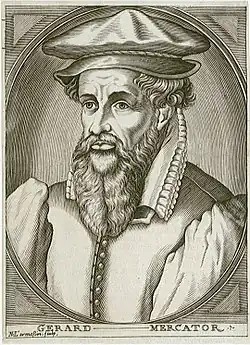
- March 5 – Gerardus Mercator, Flemish cartographer (d. 1594)
- April 10 – James V, King of Scots (d. 1542)[21]
- April 23 – Henry FitzAlan, 19th Earl of Arundel, Chancellor of the University of Oxford (d. 1580)
- April 30 – George II, Duke of Münsterberg-Oels, Count of Glatz (d. 1553)
- July 5 – Cristoforo Madruzzo, Italian Catholic cardinal (d. 1578)
- July 25 – Diego de Covarrubias y Leyva, Spanish jurist, Roman Catholic prelate, Archbishop of Cuenca (d. 1577)
- August ? – Catherine Parr, English queen consort (d. 1548)[22]
- August 27 – Friedrich Staphylus, German theologian (d. 1564)
- November 4 – Hu Zongxian, Chinese general (d. 1565)
- November 9 – Jon Simonssøn, Norwegian humanist (d. 1575)
- November 11 – Marcin Kromer, Prince-Bishop of Warmia (d. 1589)
- December 21 – Boniface IV, Marquess of Montferrat, Italian nobleman (d. 1530)
- date unknown
Deaths

- January 2 – Svante Nilsson, regent of Sweden since 1504 (b. 1460)[1]
- January 30 – Reinhard IV, Count of Hanau-Münzenberg (1500–1512) (b. 1473)
- February 2 – Hatuey, Puerto Rican Taíno chief
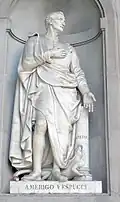
- February 22 – Amerigo Vespucci, Italian merchant and cartographer, after whom the Americas are named (b. 1451)
- March 29 – Lucas Watzenrode, Prince-Bishop of Warmia (b. 1447)
- April 11
- May 21 – Pandolfo Petrucci, ruler of Siena (b. 1452)
- May 26 – Bayezid II, Ottoman Sultan (b. 1447)
- June 20 – Goto Yujo, Japanese swordsman and artisan (b. 1440)
- August 2 – Alessandro Achillini, Italian philosopher (b. 1463)
- August 15 – Imperia Cognati, Italian courtesan (b. 1486)
- September 15 – John Stewart, 1st Earl of Atholl, Scottish peer (b. 1440)
- September 29 – Johannes Engel, German doctor, astronomer and astrologer (b. 1453)[24]
- October 5 – Sophia Jagiellon, Margravine of Brandenburg-Ansbach, Polish princess (b. 1464)
- October 31 – Anna of Saxony, Electress of Brandenburg (b. 1437)
References
- ^ a b c Carl Georg STARBÄCK (1864). Öfversigt af riksföreståndarskapet i Sverige under unionstiden, etc. pp. 22–23.
- ^ Giurescu, Constantin C. (2007). The History of Romanians. Vol. II. București: BIC ALL. pp. 107–108. ISBN 978-9-7357-1709-4.
- Academia Romana (2012). A History of Romanians. Vol. IV (2nd ed.). Bucuresti: Editura Enciclopedica. ISBN 978-9-7345-0652-1.
- ^ Tsepon W.D. Shakabpa, Tibet. A Political History, (Yale University Press, 1967) p. 87
- ^ Setton, Kenneth M. (1984). The Papacy and the Levant (1204-1571). Vol. 3. Philadelphia: American Philosophical Society. p. 116, 125.
- ^ Augustiniana. Augustijns Historisch Instituut. 1977. p. 202.
- ^ Bowd, Stephen D. (2018). Renaissance Mass Murder: Civilians and Soldiers during the Italian Wars. Oxford University Press. p. 6.
- ^ "Fires, Great", in The Insurance Cyclopeadia: Being an Historical Treasury of Events and Circumstances Connected with the Origin and Progress of Insurance, Cornelius Walford, ed. (C. and E. Layton, 1876) p28
- ^ Viaggio di Domenico Trevisan, ambasciatore veneto al gran Sultano del Cairo nell’anno 1512, descritto da Zaccaria Pagani di Belluno, ed. N. Barozzi (Venice, 1875)
- ^ Bustillo Kastrexana, Joxerra (2012). Guía de la conquista de Navarra en 12 escenarios. Donostia: Txertoa Argitaletxea. p. 81. ISBN 978-84-71484819.
- ^ Gregorio Monreal and Roldan Jimeno, Conquista e Incorporación de Navarra a Castilla (Pamplona-Iruña: Prensa Pamiela, 2012)
- ^ Robert Sewell, A Forgotten Empire (Vijayanagar). A Contribution to the History of India, Adamant Media Corporation, p. 351, ISBN 0543925889
- ^ a b Eric W. Gritsch (May 1, 2009). Martin - God's Court Jester: Luther in Retrospect. Wipf and Stock Publishers. p. 10. ISBN 978-1-72522-571-8.
- ^ Setton, Kenneth M. (1984). The Papacy and the Levant (1204-1571). Vol. 3. Philadelphia: American Philosophical Society. p. 134.
- ^ Setton, Kenneth M. (1984). The Papacy and the Levant (1204-1571). Vol. 3. Philadelphia: American Philosophical Society. p. 135.
- ^ Turks & Caicos Islands: Report for the Years ... H.M. Stationery Office. 1961. p. 45.
- ^ Quentin Skinner (November 30, 1978). The Foundations of Modern Political Thought: Volume 1, The Renaissance. Cambridge University Press. p. 153. ISBN 978-0-521-29337-2.
- ^ Grun, Bernard (1991). The Timetables of History (3rd ed.). New York: Simon & Schuster. p. 229. ISBN 0-671-74919-6.
- ^ Gingerich, Owen (2004). The Book Nobody Read: Chasing the Revolutions of Nicolaus Copernicus. New York: Walker. ISBN 0-8027-1415-3.
- ^ Koyré, Alexandre (1973). The Astronomical Revolution: Copernicus – Kepler – Borelli. Ithaca, NY: Cornell University Press. ISBN 0-8014-0504-1.
- ^ Thomas Spencer Baynes (1880). The Encyclopedia Britannica: A Dictionary of Arts, Sciences, and General Literature. Samuel L. Hall. p. 671.
- ^ Lynch, Michael, ed. (February 24, 2011). The Oxford companion to Scottish history. Oxford University Press. p. 353. ISBN 9780199693054.
- ^ Queen Catharine Parr (June 30, 2011). Katherine Parr: Complete Works and Correspondence. University of Chicago Press. p. 5. ISBN 978-0-226-64724-1.
- ^ Gareth Ffowc Roberts (February 15, 2016). Count Us In: How to Make Maths Real for All of Us. University of Wales Press. p. 22. ISBN 978-1-78316-797-5.
- ^ Trimble, Virginia; Williams, Thomas R.; Bracher, Katherine; Jarrell, Richard; Marché, Jordan D.; Ragep, F. Jamil (September 18, 2007). Biographical Encyclopedia of Astronomers. Springer Science & Business Media. p. 339. ISBN 978-0-387-30400-7.