January 2 – King Amangkurat II of Mataram (located on the island of Java, part of modern-day Indonesia), invites Trunajaya, who had led a failed rebellion against him until his surrender on December 26, for a ceremonial visit to the royal palace. After Trunajaya arrives, King Amangkurat stabs his guest to death.
January 24 – William Harris, one of the four English Puritans who established the Plymouth Colony and then the Providence Plantations at Rhode Island in 1636, is captured by Algerian pirates, when his ship is boarded while he is making a voyage back to England. After being sold into slavery on February 23, he remains a slave until ransom is paid. He dies in 1681, three days after his return to England.
February 12 – The Marquis de Croissy, Charles Colbert, becomes France's Minister of Foreign Affairs and serves for 16 years until his death, when he is succeeded as Foreign Minister by his son Jean-Baptiste Colbert.
February 16 – Rev. Ralph Davenant's will provides for foundation of the Davenant Foundation School for poor boys in Whitechapel, in the East End of London.[1]
February 22 – Catherine Deshayes Monvoisin, a fortune teller in France who organized a ring of killers in what became known as the "Affair of the Poisons" that killed at least 1,000 people, is burned at the stake after being convicted of witchcraft. In all, 36 people are executed for their role in the poisoning.
February 24 – The German Duchy of Saxe-Coburg is divided by treaty among the sons of the late Ernest I, Duke of Saxe-Gotha, who had died in 1675. The oldest son, Frederick, receives Saxe-Gotha-Altenburg. The rest is divided among Albert (Duke of Saxe-Coburg); Bernhard (Saxe-Meiningen); Henry (Saxe-Römhild); Christian (Saxe-Eisenberg); Ernest (Saxe-Hildburghausen); and John Ernest (Saxe-Coburg-Saalfeld).
March 24 – The Earl of Shaftesbury informs the Privy Council of England that the Roman Catholics of Ireland were about to launch a rebellion, backed by France. The investigation leads to the arrest and ultimate execution of the Roman Catholic Archbishop of Armagh, Oliver Plunkett.
March 25 – Troops sent by the Sultan of Morocco, Ismail Ibn Sharif, begin a blockade of the port of Tangier, occupied by the English and located on the North African coast. Palmes Fairborne is dispatched to defend Tangier as the colonial governor and commander-in-chief of English forces.
March 27 – The London Penny Post delivery service begins operations after being created by Robert Murray and William Dockwra, with a policy of delivering letters to any part of London or its suburbs for the price of one English penny.
March 30 – A total eclipse of the Sun takes place and is visible over central Africa, with totality over the Opala Territory in the modern-day Democratic Republic of the Congo.
April–June
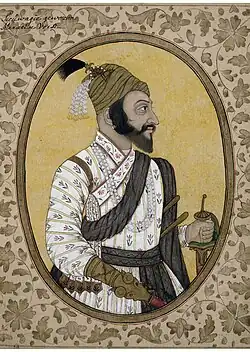
April 21 – Prince Rajaram Bhosle, the 10-year-old son of the Shivaji, the Chhatrapati (Emperor) of the Maratha Empire in India, is installed on the throne as the new Emperor, less than three weeks after the death of his father. Sambhaji Bhosle, the eldest son of Shivaji, learns the news while imprisoned at Panhala and makes plans to escape prison and take over the throne.
April 27 – Prince Sambhaji and fellow prisoners kill the commander of the Panhala prison and take control of the fort, as he makes plans to become ruler of the Maratha Empire.
April 30 – The first FrenchHuguenots in the New World arrive at Charleston, South Carolina, as 45 of the religious exiles arrive at Oyster Point on the ship Richmond, after being sent there by King Charles II of England.[2]
May 6 – King Charles XI of Sweden marries Princess Elonora, daughter of the late King Frederick III of Denmark-Norway and sister of King Christian V.
May – The volcano Krakatoa erupts, probably on a relatively small scale.
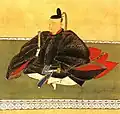
June 4 – Tokugawa Tsunayoshi becomes the new Shōgun of Japan upon the death of his older brother, Tokugawa Ietsuna, who had been shōgun for 29 years.
June 10 – England and Spain sign a mutual defense treaty.[3]
June 11 – Elizabeth Cellier, an English Catholic midwife, is tried and acquitted of treason for pamphleting against the government.
June 16 – Sambhaji Bhosle and his troops capture Raigad, the capital of the Maratha Empire and Sambhaji becomes the new Chhatrapati or Emperor. Sambhaji deposes his younger brother Rajaram I and places Rajaram and Rajaram's mother under house arrest.
June 22 – The Sanquhar Declaration, written by Richard Cameron, leader of the Covenanters who oppose the control of religion in Scotland by King Charles, is read aloud by Richard's brother Michael Cameron at the public square in the village of Sanquhar in Dumfriesshire.
August 10 – A Pueblo medicine man named Popé begins an attack by the Puebloans and their Apache allies on Spanish outposts throughout what is the modern-day U.S. state of New Mexico, choosing the campaign to begin before a supply caravan can reach the Spaniards.[4]
August 20 (August 10 Old Style) – The settlement of Karlskrona in Sweden is founded,[5] as the Royal Swedish Navy relocates there.
August 21 – In the Pueblo Revolt, the native Pueblo people capture Santa Fe (now in New Mexico) from the Spanish colonists.
August 24 – Comédie-Française is founded by decree of Louis XIV as La maison de Molière in Paris.
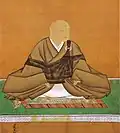
September 11 – Emperor Go-Mizunoo spent his later years in relative seclusion as a retired emperor, continuing to participate in courtly and cultural activities until his passing away.
A four month truce between England and Morocco expires and the Alcaid Omar, Viceroy of Morocco, begins a bombardment of the English fort at Tangier.[6]
A treaty is concluded between the Dutch Republic and the Ottoman Empire for Ottoman Sultan Mehmed IV and his subjects to apply Dutch law to Dutch visitors to Ottoman territory.[7]
September 21 – Spanish troops make a counterattack on Santa Fe in the modern-day U.S. state of New Mexico, allowing the remaining Spanish troops in the besieged city to flee to El Paso (now in Texas).[4]
October 29 – At the request of King Charles XI of Sweden, the Riksdag in Sweden enacts the Great Reduction, returning fiefs which had been granted to the Swedish nobility to the Crown. The nation becomes an absolute monarchy under the rule of Charles.[10]
November 14 – The Great Comet of 1680 is first sighted by Gottfried Kirch, the first comet discovered by telescope.[11]
November 17 – The Green Ribbon Club, a predecessor of the British Whigs, organizes a procession to burn an effigy of the Pope in London for the second year running.[12]
December 17 (December 7 O.S.) – The trial for treason of William Howard, 1st Viscount Stafford before his fellow members of the House of Lords having concluded after seven days, the Lords vote on whether to convict him of the articles of impeachment. The Lords vote, 55 to 31 to convict him and to impose the death sentence [13] and Lord Stafford is beheaded on 29 December (8 January 1681 N.S.)
Date unknown
Chambers of Reunion (French courts under Louis XIV) decide on the complete annexation of Alsace.
January 1 – Prince Muhammad Akbar, son of the Mughal Emperor Aurangzeb, initiates a civil war in India. With the support of troops from the Rajput states, Akbar declares himself the new Mughal Emperor and prepares to fight his father, but is ultimately defeated.
January 18 – The "Exclusion Bill Parliament", summoned by King Charles II of England in October, is dissolved after three months, with directions that new elections be held, and that a new parliament be convened in March in Oxford.
February 2 – In India, the Mughal Empire city of Burhanpur (now in the Indian state of Madhya Pradesh) is sacked and looted by troops of the Maratha Empire on orders of the Maratha emperor, the Chhatrapati Sambhaji. General Hambirrao Mohite began the pillaging three days earlier.
March 21 – The "Oxford Parliament" is summoned in England by King Charles II and meets in Oxford rather than in Westminster, but is dissolved seven days later. No further sessions of parliament are held until after the death of Charles in 1685.
April–June
April 11 – Following the death of its last count, the Palatinate-Landsberg passes to the King of Sweden.
May 15 – The Canal du Midi in France is opened officially, as the Canal Royal de Languedoc.[15]
June 23 – The Church of the East, an Eastern Orthodox rite in Mesopotamia (now Iraq), already split between two patriarchs in the Eliya line and the Shimun line, is split along a third line by the Roman Catholic Church when Mar Yousip of the Archdiocese of Amid (now Diyarbakır in Turkey) is proclaimed by Pope Innocent XI as Joseph I, "Patriarch of the Chaldean nation deprived of its patriarch", creating the "Josephite line" of the Chaldean Catholic Church.
July–September
July 1 – Oliver Plunkett, Roman Catholic Archbishop of Armagh and Primate of All Ireland, falsely convicted in June of treason, is hanged, drawn and quartered at Tyburn, London, the last Catholic martyr to die in England;[16] he is canonised in 1975.
July 23 – The Bombardment of Chios during the French-Tripolitania War (1681-1685) is part of a wider campaign by France against the Barbary Pirates in the 1680s.
August 10 – English sea captain Robert Knox of the East India Company publishes his book An Historical Relation of the Island Ceylon, about his adventures, 20-years imprisonment and escape from Ceylon.[17]
August 12 – Ahom King Gadadhar Singha (or Gadapani), who takes the Tai name Supaatphaa, ascends the throne.
August 31 – English perjurer Titus Oates is told to leave his state apartments in Whitehall; his fame begins to wane, and he is soon arrested and imprisoned for sedition.
October 27 – Sir John Child of England becomes the new Governor of Bombay province and, unofficially, Governor-General of all of the settlements of the East India Company in India. With the exception of a rebellion by Captain Richard Keigwin during the year 1684, Child expands British control until involving the British in a war with the Mughal Empire.
November 20 – Don Melchor de Navarra, Duke of Palata arrives in Lima after a voyage of almost 10 months from Spain and becomes the new Viceroy of Peru, succeeding the Archbishop of Lima, Melchor Liñán y Cisneros, who had administered the area since 1678.
November 25 – Cornelis Speelman of the Netherlands becomes the new Governor-General of the Dutch East Indies (now Indonesia) and concludes an alliance with the Sultan Amangkurat II of the Mataram Sultanate on the island of Java, then uses the Dutch Army to suppress the rebellion started by the Sultan's half-brother, Prince Puger. Puger surrenders on November 28 to the ranking Dutch officer, Jacob Couper.
November 29 – A storm strikes the Isthmus of Panama and overwhelms the Spanish Navy's Flota de Tierra Firma, sinking the ship Nuestra Señora de Encarnación in the Chagres River. The Encarnación wreckage is not found until almost 340 years later, in 2011, mostly intact and still loaded with most of its cargo.
December 3 – Another ship in the Flota de Terra Firma, Nuestra Señora de la Soledad, sinks in the Chagres River with the loss of its 280 crew.
December 7 – Wu Shifan, grandson of Chinese general Wu Sangui, commits suicide at Kunming in Yunnan province, ending the 8-year Revolt of the Three Feudatories against the Kangxi Emperor and the Qing dynasty in China. [18]
December 22 – King Charles II of England signs a warrant for the building of the Royal Hospital Chelsea in London for wounded and retired soldiers.
Date unknown
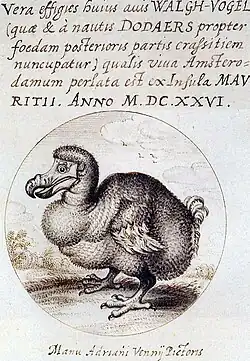
Savery sketch of three dodos from c. 1626, Crocker Art Gallery
Collections are made in England for needy French refugees.
Havertown and Bryn Mawr are founded in Pennsylvania by Welsh Quakers.
January 7 – The Republic of Genoa forbids the unauthorized printing of newspapers and all handwritten newssheets; the ban is lifted after three months.
January 12 – Scottish minister James Renwick, one of the Covenanters resisting the Scottish government's suppression of alternate religious views, publishes the Declaration of Lanark.
January 21 – The Ottoman Empire army is mobilized in preparation for a war against Austria that culminates with the 1683 Battle of Vienna.
January 24 – The first public theater in Brussels, the Opéra du Quai au Foin, is opened.
February 5 – In Japan, on the 28th day of the 12th month in the year Tenna 1, a major fire sweeps through Edo (now Tokyo).
February 9 – Thomas Otway's classic play Venice Preserv'd or A Plot Discover'd is given its first performance, premiering at the Duke's Theatre.
March 11 – Work begins on construction of the Royal Hospital Chelsea for old soldiers in London, England.[19]
April 9 – At the mouth of the Mississippi River, near modern Venice, Louisiana, Robert de La Salle buries an engraved plate and a cross, claiming the territory as La Louisiane for France.
May 7 (April 27 O.S.) – Upon the death of the Tsar Feodor III of Russia, Feodor's younger brother, 15-year-old Ivan is passed over in favor of a half-brother, 10-year-old Peter.
May 11 – The Moscow uprising of 1682 occurs when a mob, outraged by the rejection of Prince Ivan and upset over rumors that Ivan has been strangled, invades the Kremlin and lynches the leading boyars and military commanders. Ivan V and Peter I are named co-rulers of Russia as a result of a compromise between Peter's mother Natalya Naryshkina and Ivan's mother Maria Miloslavskaya and both are crowned a month later.
June 8 – The English trading freighter Johanna is wrecked off of the coast of South Africa with the loss of 10 of her 114 crew, becoming the first of Britain's East India Company fleet to be lost.
June 17 – The Indonesian city of Bandar Lampung is founded on the island of Sumatra.
June 25 (June 15 O.S.) – Ivan V and Peter I are crowned as joint Tsars of Russia at the Cathedral of the Dormition in Moscow, with actual power exercised by their older sister, Sophia Alekseyevna for the next seven years.
August 6 – The Ottoman Empire declares war on the Holy Roman Empire and makes plans to attack Vienna.
August 12 – Vesuvius begins a period of volcanic activity lasting for 10 days.
August 23 – A comet that will later become known as Comet Halley, is observed from several locations on Earth after reaching magnitude 2 and becoming visible to the naked eye. Arthur Storer sees it from the North American colony of Maryland, while German astronomer Johannes Hevelius measures it from Danzig (now Gdansk in Poland). [20]Edmond Halley successfully predicts that it will return in 1758.
August 25 – Following the Bideford witch trial, three women (probably) become the penultimate known to be hanged for witchcraft in England, at Exeter.[21]
September 24 – Trịnh Căn becomes the new ruler of Tonkin (located in the northern part of Vietnam as far south as the Hà Tĩnh province upon the death of his father, Trịnh Tạc, and begins a program of reforms.
November 22 – Nearly 1,000 houses in Wapping, London are destroyed in a fire.[22]
December 11 – William Penn meets with Charles Calvert, 3rd Baron Baltimore for the first discussion of the boundary between the colonies of Pennsylvania and Maryland, fixed at 40 degrees north. Recognizing that 40° north would remove Pennsylvania's access to the sea, Penn proposes a purchase of some of Maryland's territory.
December 27 – Colonists from the German electorate of Brandenburg arrive at Akwidaa on the Brandenburger Gold Coast at what is now Ghana and, five days later, begin building a fort at what is now Princes Town.
Date unknown
Celia Fiennes, noblewoman and traveller, begins her journeys across Britain, in a venture that will prove to be her life's work. Her aim is to chronicle the towns, cities and great houses of the country. Her travels continue until at least 1712, and will take her to every county in England, though the main body of her journal is not written until the year 1702.
The Richard Wall House, believed to be the longest continuously inhabited residence in the US, is built in Pennsylvania.
1683
January–March
January 5 – The Brandenburger-African Company, of the German state of Brandenburg, signs a treaty with representatives of the Ahanta tribe (in modern-day Ghana), to establish the fort and settlement of Groß Friedrichsburg, in honor of Frederick William, Elector of Brandenburg. The location is later renamed Princes Town, also called Pokesu.
January 27 – Gove's Rebellion breaks out in the Province of New Hampshire in North America as a revolt against the Royal Governor, Edward Cranfield. Most of the participants, and their leader Edward Gove, are arrested. Gove is convicted of treason but pardoned three years later.
March 14 – Ageng Tirtayasa, Sultan of Banten on the island of Java (part of modern-day Indonesia), is captured by soldiers hired by the Dutch East India Company.
March 17 – In a battle at Kalyan (near Bombay) between the Maratha Empire and the Mughal Empire in India, Maratha General Hambirrao Mohite defeats the local Mughal official, Ranamast Khan.
March 22 – Great fire in Newmarket, Suffolk, England, consuming half the houses and forcing King Charles II (who is in residence) to flee the town.[23]
May 24 – The Ashmolean Museum opens in Oxford (England), as the world's second university museum, after the establishment of the Kunstmuseum Basel in 1661 by the University of Basel.
July 8 – Admiral Shi Lang of Qing dynasty China leads 300 ships with 20,000 troops out of Tongshan, Fujian, and sails towards the Kingdom of Tungning, in modern-day Taiwan and Penghu, in order to quell the kingdom in the name of the Qing.
July 14 – A 173,000-man Ottoman force arrives at Vienna, and starts to besiege the city.
July 16–17 – Battle of Penghu: Qing Chinese admiral Shi Lang defeats the naval forces of Zheng Keshuang decisively.
July 21 – The gruesome execution of Lord Russell, for his role in the 1683 Rye House Plot to assassinate King Charles II of England, is carried out by the royal executioner Jack Ketch, who wields his axe in a manner requiring multiple blows to make Russell suffer as much as possible during the beheading. [25]
August 4 – Turhan, in the powerful role of the Valide sultan of the Ottoman Empire since 1648 as the mother of Sultan Mehmed IV, dies at the age of 56, bringing an end to the era in Ottoman history known as the "Sultanate of Women". Upon the overthrow of Mehmed IV four years later, the role of the mother of the Ottoman Sultan is less powerful.
August 20 – Bahadur, son of the Emperor Aurangzeb of the Mughal Empire in India, is dispatched along with other Mughal nobles on an invasion of Konkan, the area on the southwestern Indian coast under the control of the Maratha Empire.
August 25 – The Earl of Limerick, Irishman Thomas Dongan, takes office as the new British Colonial Governor of the Province of New York and makes major reforms to restore public order and rescue the province from bankruptcy.
September 5 – Qing Chinese admiral Shi Lang receives the formal surrender of Zheng Keshuang, ushering in the collapse of the Kingdom of Tungning, which is then incorporated into the Qing Empire.
Battle of Vienna: The Ottoman siege of the city is broken with the arrival of a force of 70,000 Poles, Austrians and Germans under Polish–Lithuanian king Jan III Sobieski, whose cavalry turns their flank. The victory marks a turning point in the Ottoman Empire's fortunes and the end of the Turkish attempt to expand its control into Western Europe. [26]
Pedro II becomes the King of Portugal after having served as regent since 1668 for his older brother Afonso VI.
October 6 – Germantown, Philadelphia is founded as the first permanent German settlement in North America (in 1983 U.S. President Ronald Reagan declares a 300th Year Celebration, and in 1987, it becomes an annual holiday, German-American Day).
December 7 – Algernon Sidney, opponent of King Charles II of England and author of the rebel tract Discourses Concerning Government is beheaded after having been arrested on June 25 and found guilty on November 7.
Kara Mustafa Pasha, Grand Vizier of the Ottoman Empire since 1676, is executed on orders of Sultan Mehmed IV after being blamed for the Ottoman loss of the Battle of Vienna on September 12. The execution is carried out in Belgrade as Kara Mustafa is strangled with a silk cord. The Sultan appoints Bayburtlu Kara Ibrahim Pasha as the new Grand Vizier.
George Ducas, the Prince of Moldavia installed by the Ottomans in 1678, is arrested by Polish authorities while on his way back to Bucharest from the defeat by Poland in the Battle of Vienna. Ducas is replaced by Ștefan Petriceicu.
December 27 – Richard Keigwin leads a rebellion against the East India Company to take over as Governor of Bombay and most of the British territory in India, driving out Governor Sir John Child and arresting the Deputy Governor, Charles Ward. Keigwin surrenders the office less than a year later.
December – The River Thames in England freezes, allowing a frost fair to be held.
King Charles II of England gives the title Duke of St Albans to Charles Beauclerk, his illegitimate son by Nell Gwyn.
The earliest form of what is now the University of Tokyo (formally chartered in 1877), the Tenmongata, is established in Japan.[29][30]
January 15 (January 5 O.S.) – To demonstrate that the River Thames, frozen solid during the Great Frost that started in December, is safe to walk upon, "a Coach and six horses drove over the Thames for a wager" and within three days "whole streets of Booths are built on the Thames and thousands of people are continually walking thereon." Sir Richard Newdigate, 2nd Baronet, records the events in his diary.[31]
January 26 – Marcantonio Giustinian is elected Doge of Venice.[32]
January – Edmond Halley, Christopher Wren and Robert Hooke have a conversation in which Hooke later claimed not only to have derived the inverse-square law, but also all the laws of planetary motion attributed to Sir Isaac Newton.[33] Hooke's claim is that in a letter to Newton on 6 January 1680, he first stated the inverse-square law.[34]
February 7 – Morocco retakes control of the city of Tangier from England, which had controlled the North African port since 1661.[35] During the five months prior to evacuation of the English from the city, the Governor, Lord Dartmouth had ordered the destruction of the wall around the city, its fortifications and port facilities that had been built by the English during the occupation.
February 8 – Prince Dumitrașcu Cantacuzino returns to the throne of the principality of Moldavia for a third reign but is overthrown 14 months later on June 25. In 1859, Moldavia will unite with neighboring Wallachia to form the Kingdom of Romania.
February 15 (February 5 O.S.) – The Great Frost in Britain, during which the River Thames was frozen in London and the sea as far as 2 miles (3.2 km) out from land and which started the previous December, ends as the Thames begins to thaw. William Maitland later writes that the Frost, which started in December 1683, "congealed the river Thames to that degree that another city, as it were, was erected thereon; where by the great number of streets and shops, with their rich furniture, it represented a great fair, with a variety of carriages, and diversions of all sorts."[36] During the freeze, there had been great loss of beast and of wildlife, especially birds, and similar reports from across Northern Europe.[37] The Chipperfield's Circus dynasty began during the freeze, with James Chipperfield introducing performing animals to the country at the Frost Fair on the Thames in London.
February 24 – A treaty is signed between European German colonists in Brandenburg-Prussia, and the African chiefs in what is now Ghana to permit the German colonists to build a second fort on the Brandenburger Gold Coast, and the fortress of Dorotheenschanze is built. The area is now the Ghanaian city of Akwida.[38]
March 19 – In Japan, the Tenna era ends on the 21st day of the 2nd month of the Chinese calendar of the 4th year of the Tenna era and the Jōkyō era begins as Japan's royal astronomer, Shibukawa Shunkai institutes the Jōkyō calendar to replace Chinese calendar which had been used in Japan since 859 AD, after calculating that the length of the solar year is 365.2417 days.[40]
May 18 – The French Navy begins a 10-day bombardment of the Italian city of Genoa in the course of the War of the Reunions between France and the Republic of Genoa. During the fight, the French fleet, commanded by Abraham Duquesne, fires almost 13,000 cannonballs, pausing only during a cease-fire on May 21 and May 22, and uses the new technology of explosive bombs. When the bombardment ends on May 28, two-thirds of the city has been destroyed or damaged.[41]
June 7 – After a siege of six weeks that began on April 27, Luxembourg City is taken by the French Army from control by Spain, and the Grand Duchy of Luxembourg, previously part of the Spanish Netherlands (now Belgium) is acquired by France.
June 27 – Francisco de Távora, the Viceroy of Portuguese India, a small colony located in southwestern India at Goa, issues an order prohibiting indigenous residents from speaking their native language, Konkani, and directs them to learn Portuguese within the next three years.[42]
October 7 – Japanese Chief Minister Hotta Masatoshi is assassinated, leaving Shōgun Tokugawa Tsunayoshi without any adequate advisors, leading him to issue impractical edicts and create hardships for the Japanese people.
November 8 – James Renwick, a Scottish minister and one of the "Covenanters" challenging the attempt by Kings James VI and Charles I to take over churches in Scotland, posts his "Apologetical Declaration" on church doors and market crosses in and around Cambusnethan, Lanarkshire.[47]
November 19 – Richard Keigwin, who had arrested the East India Company's Governor of Bombay in 1683, Josiah Child and had taken over as the unauthorized administrator of Bombay, turns control back to the company and its envoy, Sir Thomas Grantham, receiving a general pardon.[48][49]
December 17 – The Tibet–Ladakh–Mughal War, which had been going on since 1679, ends with the signing of the Treaty at Tingmosgang between the 5th Dalai Lama (Desi Sangye Gyatso) and King Delek Namgyal of Ladakh. The Ladakh kingdom agrees to not invite foreign armies into the area (now part of the Indian union territory of Jammu and Kashmir) in return for a respect for its sovereignty.
Date unknown
Japanese poet Ihara Saikaku composes 23,500 verses in 24 hours at the Sumiyoshi-taisha (shrine) at Osaka; the scribes cannot keep pace with his dictation and just count the verses.[51]
The British East India Company receives Chinese permission to build a trading station at Canton.[52]Tea sells in Europe for less than a shilling a pound, but the import duty of 5 shillings makes it too expensive for most English people to afford; hence smuggled tea is drunk much more than legally imported tea.
January 6 – American-born British citizen Elihu Yale, for whom Yale University in the U.S. is named, completes his term as the first leader of the Madras Presidency in India, administering the colony on behalf of the East India Company, and is succeeded by William Gyfford.
January 8 – Almost 200 people are arrested in Coventry by English authorities for gathering to hear readings of the sermons of the non-conformist Protestant minister Obadiah Grew
February 4 – A treaty is signed between Brandenburg-Prussia and the indigenous chiefs at Takoradi in what is now Ghana to permit the German colonists to build a third fort on the Brandenburger Gold Coast.[54]
February 6 – Catholic James Stuart, Duke of York, becomes King James II of England and Ireland, and King James VII of Scotland, in succession to his brother Charles II (1660–1685), King of England, Scotland, and Ireland since 1660. James II and VII reigns until deposed, in 1688.
February–March – Morean War (part of the Great Turkish War): The Ottomanserasker Halil Pasha invades the Mani Peninsula, and forces it to surrender hostages.
March 28 – An attack on a Mughal Empire envoy, Khwajah Abdur Rahim, outside of the Maratha fortress at the Bijapur Fort in India leads to a siege of the city by the forces of Mughal Emperor Aurangzeb. The siege lasts for 15 months before Bijapur surrenders.
March – Louis XIV passes the Code Noir, allowing the full use of slaves in the French colonies.
April–June
April 16 – Wara Dhammaraza becomes the new King of Arakan on the western coast of Burma upon the death of his brother, Thiri Thuriya.
June 16 – A lunar eclipse is observed in the evening by François-Timoléon de Choisy, amongst others, onboard his ship in the vicinity of Madagascar. The ship was at a latitude of 37 degrees 40 minutes, and the eclipse was not visible from Europe.[58]
June 20 – Monmouth Rebellion: James, Duke of Monmouth declares himself at Taunton to be King, and heir to his father's Kingdoms as James II of England and Ireland, and James VII of Scotland.[57]
August 11 – Morean War: The 49-day Siege of Coron ends with the surrender and massacre of its garrison by the Venetians.[59]
August 25 – The Bloody Assizes begin in Winchester: Lord Chief Justice of England George Jeffreys tries over 1000 of Monmouth's rebels and condemns them to death or transportation.
September 29 – The first organised street lighting is introduced by the city of London in England, as Edward Hemming begins carrying out his contract to be paid for lighting an oil lamp "at every tenth house on main streets between 6 PM and midnight between September 29 and March 25" on nights in the autumn and winter without adequate moonlight.[60]
October–December
October 22 – Louis XIV of France issues the Edict of Fontainebleau, which revokes the Edict of Nantes and declares Protestantism illegal, thereby depriving Huguenots of civil rights. Their Temple de Charenton-le-Pont is immediately demolished and many flee to England, Prussia and elsewhere.
November 8 (October 29 O.S.) – The Edict of Potsdam is issued by Frederick William, Elector of Brandenburg in response to France's Edict of Fontainebleau, welcoming the Protestant Huguenots of France to resettle in eastern Germany in Brandenburg. The French Colony of Magdeburg is established on December 1 in Saxony as a community separate from Magdeburg.
December 3 – King Charles XI of Sweden issues an order banning Jews from settling in Sweden, particularly in the capital at Stockholm "on account of the danger of the eventual influence of the Jewish religion on the pure evangelical faith." [61]
December 10 – In what is now Thailand, King Narai of Ayutthaya signs a treaty with representatives of France at Lopburi, allowing Roman Catholic missionaries to preach the Gospel and exempting Thai Catholics from work on Sunday, as well as appointing a special court to settle disputes between Thai Christians and non-Christians.
Adam Baldridge founds a pirate base at Île Sainte-Marie, Madagascar.
Alice Molland becomes the last known person in England to be sentenced to death for witchcraft, in Exeter.[63]
The Old Dutch Church of Sleepy Hollow in the State of New York is constructed by the original Dutch settlers (later to become famous as the site of the rampage of the "Headless Horseman" spirit in the novel The Legend of Sleepy Hollow).
1686
January–March
January 3 – In Madras (now Chennai) in India, local residents employed by the East India Company threaten to boycott their jobs after corporate administrator William Gyfford imposes a house tax on residences within the city walls. Gyfford places security forces at all entrances to the city and threatens to banish anyone who fails to pay their taxes, as well as to confiscate the goods of merchants who refuse to make sales.[64] A compromise is reached the next day on the amount of the taxes.[65]
January 17 – King Louis XIV of France reports the success of the Edict of Fontainebleau, issued on October 22 against the Protestant Huguenots, and reports that after less than three months, the vast majority of the Huguenot population had left the country.[66]
January 29 – In Guatemala, Spanish Army Captain Melchor Rodríguez Mazariegos leads a campaign to conquer the indigenous Maya people in the rain forests of Lacandona, departing from Huehuetenango to rendezvous with the colonial governor at San Mateo Ixtatán.
January 31 – In the wake of the success of France's campaign against Protestantism, Victor Amadeus II, the Duke of Savoy, issues an edict against the Valdesi, the Duchy's Protestant minority, setting a 15-day deadline for members of the Valdesi to publicly renounce their beliefs as erroneous, or face banishment or death.[67] The February 15 deadline is ignored.
February 15 – After the Valdesi in the Duchy of Savoy decline to obey the edict to convert to Catholicism, Duke Victor Amadeus dispatches a force of 9,000 French and Piedmontese soldiers to enforce the edict.
February 22 – Sweden's Council of State endorses the reforms proposed by King Charles XI for the Swedish Church Law 1686, after having debated it in three sessions on February 18, 19 and 20.[68] The law confirms and describes the rights of the Lutheran Church and confirms Sweden as a Lutheran state; all non-Lutherans are banned from immigration unless they convert to Lutheranism; the Romani people are to be incorporated to the Lutheran Church; the poor care law is regulated; and all parishes are forced by law to teach the children within them to read and write, in order to learn the scripture, which closely eradicates illiteracy in Sweden.[69]
February 27 – Gabriel Milan, the controversial Governor of the Danish West Indies since 1684, is removed from office by order of King Frederick III and placed under arrest for treason. Three years later, after being found guilty in a trial after being brought back to Copenhagen, Milan is beheaded on March 26, 1689.[70]
March 3 – A group of 107 French Canadian soldiers, under the command of Pierre de Troyes, begins the Hudson Bay expedition, departing from Montreal on an 800-mile (1,300 km) journey to take control of the properties of British North American settlers of the Hudson's Bay Company.[71] The group marches for 82 days and arrives at the first Hudson's Bay fort, at Moose Factory on June 19.[72]
April–June
April 9 – As the Valdesi rebellion continues, the Duke of Savoy issues a second edict, giving the Protestant Valdesi eight days to lay down their arms and allows safe passage into exile for those who agree.
April 22 – In the wake of Savoy's newest repression of the Protestant Valdesi, a third war breaks out and Protestant pastor Henri Arnaud leads the resistance with 3,000 rebel soldiers against 8,500 Savoyard soldiers and mercenaries. The Valdesi are overwhelmed within one month.
May 6 – The Treaty of Perpetual Peace (1686) is signed between the Tsardom of Russia and the Polish–Lithuanian Commonwealth, recognizing the former's possession of Left-bank Ukraine and the city of Kiev, as agreed upon in the earlier Treaty of Andrusovo in 1667.[74] The treaty also brings the Tsardom of Russia into the Great Turkish War, on the side of the Holy League of 1684.[75]
May 14 – Joseph Dudley formally begins his tenure, as President of the Council of the newly formed Dominion of New England.[76]
May 25 – The third war against the Protestant Valdesi ends. Soon afterward, 2,000 of the Valdesi are massacred, 8,500 taken prisoner and about 3,000 surviving civilians forcibly resettled and converted to Catholicism.
June 20 – French Canadian soldiers on the Hudson Bay expedition capture the first of the British Hudson's Bay Company outposts, with the surrender the unarmed inhabitants of the fortress at Moose Factory, Ontario.[77]
July 17 – King James II of England appoints four Roman Catholics to the Privy Council of England,[80] in defiance of the Test Acts, which bar Catholics from public office. Suspicions about James's intentions lead to a group of conspirators meeting at Charborough House in Dorset, to plan his overthrow and replacement with the Protestant Dutch Stadtholder, William III of Orange-Nassau (James's son-in-law).
July 18 – An army of 3,000 Chinese troops demand Russian surrender of a Russian Empire fortress at Albazino on the Amur River. The fortress is manned by only 736 Russian soldiers and militia but is armed with cannons. Over the next several weeks, the Chinese troops are joined by another 3,000 men in supply boats, but the Russians hold off the attacks for the next five months. By December, only 24 Russians remain, and Albazino is ceded to China in 1689.
August 4 – Portuguese soldiers hired by the East India Company mutiny rather than follow orders to join the war in Bengal. The ringleaders are quickly arrested and executed, and the mutiny ends.
August 15 – Christina, who had ruled as the monarch of Sweden until her abdication in 1654 in favor of her cousin Charles, responds to the revocation in France of the Edict of Nantz and declares that Jews within Sweden will be under her protection.
August 16 – King James VII of Scotland dismisses the Parliament of Scotland after the members refuse to remove restrictions on Roman Catholics and on Protestants outside of the Church of Scotland and the Church of England. The Parliament does not meet again for more than two and a half years.
August 17 – Spanish troops attack and plunder the Scottish colony of Stuarts Town in the Province of Carolina (now Port Royal, South Carolina) and plunder the city.[82] After three days, the Spaniards begin a march of over 75 miles (121 km) toward the larger port city of Charles Town.
September 30 – The Ottoman fortress of Sinj in Dalmatia falls to the army of the Republic of Venice.[85]
October–December
October 17 – As the Savoyard–Waldensian wars, draw to a close, the Duke of Savoy announces that the Protestant Valdisi defenders will be granted safe passage to Switzerland, and that children taken during the war will be allowed to return to their families.[86] By January, a little more than 2,500 Valdisi take the offer.
October 22 – In the Great Turkish War, the Siege of Pécs ends when the Ottoman-held city, located across the Danube River from the recent liberated Buda, surrenders[87] to Austrian troops of the Holy League, continuing the Austrian assumption of control of Hungary.[88] Buda and Pécs are later combined to form the Hungarian city (and now capital) of Budapest.
October 31 – Anglurah Agung, the virtual leader of the island of Bali as king of the paramount state of Gelgel, is killed in battle fighting Batu Lepang (who also dies in the fighting), ending the unification of the island (now part of Indonesia) and causing Bali to split into several principalities.
November 26 – The Treaty of Whitehall, more formerly the Treaty of Neutrality for America, is signed at the Palace of Whitehall in Westminster between representatives of King Louis XIV of France and King James II of England, with both sides pledging that "though the two Countries might be at war in Europe their Colonies in America should continue in peace and Neutrality".[90] The treaty is broken less than two years later when King William's War breaks out in what is now the U.S. state of Maine.
November 30 – Melchor Portocarrero, 3rd Count of Monclova becomes the new Viceroy of New Spain (encompassing what is now Mexico and much of the southwestern United States) as he arrives in Mexico City to take over at the end of the term of Tomás de la Cerda, 3rd Marquess of la Laguna.[91]
December 20 – Edmund Andros arrives in Boston to become the British Governor of the newly created Dominion of New England, which includes most of the what are now the U.S. states of Connecticut, Maine, Massachusetts, New Hampshire, New Jersey, Rhode Island, Vermont and much of the eastern portion of New York.[92] The unpopular Andros, who reigns as a dictator after being appointed by King James II, is driven out of office in 1689 after the overthrow of James, and the Dominion of New England is broken up into its constituent colonies.
English historian and naturalist Robert Plot publishes The Natural History of Staffordshire, a collection of illustrations and texts detailing the history of the county.[93] It is the first document known to mention crop circles[94] and a double sunset.[95]
The Café Procope, which remains in business in the 21st century, is opened in Paris by Procopio Cutò, as a coffeehouse.[96]
1687
January–March
January 3 – With the end of latest of the Savoyard–Waldensian wars in the Duchy of Savoy between the Savoyard government and Protestant Italians known as the Waldensians, Victor Amadeus III, Duke of Savoy, carries out the release of 3,847 surviving prisoners and their families, who had forcibly been converted to Catholicism, and permits the group to emigrate to Switzerland.
January 8 – Richard Talbot, 1st Earl of Tyrconnell, is appointed as the last Lord Deputy of Ireland by the English crown, and begins efforts to include more Roman Catholic Irishmen in the administration. Upon the removal of King James II in England and Scotland, the Earl of Tyrconnell loses his job and is replaced by James, who reigns briefly as King of Ireland until William III establishes his rule over the isle.
January 27 – In one of the most sensational cases in England in the 17th century, midwife Mary Hobry murders her abusive husband, Denis Hobry, after he beats her up for the last time. Mary then dismembers his body and scatters the remains in a dunghill and in several outhouses (or privies) in the area. Despite a defense of justifiable homicide, Mary is convicted of murder and burned at the stake.
February 7 – The Arjeplog blasphemy trial begins for Erik Eskilsson and Amund Thorsson, two practitioners of the Sami religion who had resisted Sweden's efforts at their conversion to Christianity. Eskilsson and Thorsson are acquitted of the charges after agreeing to convert to Christianity.
February 11 – In India, troops under the command of Job Charnock of the East India Company, preparing to go to war against the Nawab of Bengal, Shaista Khan of the Mughal empire, destroy his fortresses located at Thana. [97]
February 12 – The Declaration of Indulgence is issued in Scotland by King James VII as one of the first steps in establishing freedom of religion in the British Isles, eliminating enforcement of criminal penalties against persons who failed to conform with Anglicanism. As King James II of England, he issues a similar declaration on April 4.
April 4 – King James II of England issues the Declaration of Indulgence (or Declaration for the Liberty of Conscience), suspending laws against Roman Catholics and nonconformists.[98]
April 26 – The Spanish city of Guayaquil (now part of Ecuador) is attacked and looted by English and French pirates under the command of George Hout (English) and Pierre Le Picard and Francois Groniet (French). [101] Of more than 260 pirates, 35 are killed and 46 were wounded; 75 defenders of the city died and more than 100 are wounded.
May 6 – Emperor Higashiyama succeeds Emperor Reigen, on the throne of Japan.
June 14 – In one of the few actions on land in the Anglo-Siamese War, English sailors on the coast of Mergui in Burma (now Myeik, Myanmar) are massacred by Siamese troops.
July 24 – Morean War: Battle of Patras – The Republic of Venice defeats the Ottomans, which flee in panic, allowing the Venetians to capture the fortresses of Patras, Rio, Antirrio, and Lepanto unopposed.
August 12 – Great Turkish War: Battle of Mohács – The Habsburg imperial army, and allies under Charles V, Duke of Lorraine, defeat the OttomanTurks, and enable Austria to conquer most of Ottoman-occupied Hungary.
September 22 – The Siege of Golconda, ordered by Emperor Aurangzeb of India's Mughal Empire against the capital of the Golconda sultanate, ends after nine months when a traitor inside the walled city, Sarandaz Khan, opens the first of several entrances into the fortress. The Sultan Abul Hasan Qutb Shah is taken prisoner by General Mir Shahab ud-Din, and Golconda (now part of Hyderabad in the Telangana state).
September 26 – Half of the Parthenon is destroyed in Athens after mortar shells are fired by Republic of Venice forces under the command of Francesco Morosini in a battle against the Ottoman Empire for control of the city. The strike ignites a stock of gunpowder that the Ottomans had stored inside the 2,200-year-old temple, which had been completed in 438 BC as a shrine to the goddess Athena. During the fighting September 23 and September 29 for control of the Acropolis in the Morean War, the Temple of Athena Nike is demolished and the Propylaea suffers damage.
October–December
October 20 – An estimated 8.7 magnitude earthquake strikes 50 kilometres (31 mi) off of the coast of Peru and kills at least 5,000 people, primarily from a tsunami that washes away the city of Pisco and causes severe damage to the Spanish colonial cities of Lima, Callao and Ica. [102]
October 31 – The legend of the Charter Oak begins as a successful attempt to hide the 1662 Royal Charter of the British colony (and now a U.S. state) of Connecticut after Edmund Andros, the Governor of the Dominion of New England, makes a mission of attempting to confiscate the founding documents for the seven colonies that make up the new administrative area. After Governor Andros arrives in Hartford and comes to the tavern of Zachariah Sanford to demand the Connecticut Colony charter, Captain Joseph Wadsworth spirits the parchment away from the and hides the Charter in a hollowed out portion of a white oak tree on Wyllys Hyll until Andros is recalled to London. [103]
December 31 – In response to the revocation of the Edict of Nantes in 1685, a group of Huguenots set sail from France, and settle in the recently established Dutch colony at the Cape of Good Hope, where, using their native skills, they establish the first South African vineyards.
1688
January–March
January 2 – Fleeing from the Spanish Navy, French pirate Raveneau de Lussan and his 70 men arrive on the west coast of Nicaragua, sink their boats, and make a difficult 10 day march to the city of Ocotal.[104]
January 5 – Pirates Charles Swan and William Dampier and the crew of the privateer Cygnet become the first Englishmen to set foot on the continent of Australia.[105]
January 11 – The Patta Fort and the Avandha Fort, located in what is now India's Maharashtra state near Ahmednagar, are captured from the Maratha clan by Mughul Army commander Matabar Khan. The Mughal Empire rules the area 73 years.
January 17 – Ilona Zrínyi, who has defended the Palanok Castle in Hungary from Austrian Imperial forces since 1685, is forced to surrender to General Antonio Caraffa.
January 29 – Madame Jeanne Guyon, French mystic, is arrested in France and imprisoned for seven months.[106]
January 30 (January 20, 1687 old style) – King James II of England and Scotland issues a proclamation offering amnesty to pirates in the West Indies who surrender to Sir Robert Holmes.[107]
February 7 – Six French Jesuit scientists, Joachim Bouvet, Jean-François Gerbillon, Louis-Daniel Lecomte, Guy Tachard, Claude de Visdelou and the leader, Jean de Fontaney, arrive in Beijing and are welcomed by the Emperor of China, Kangxi.[108]
February 17 – James Renwick, the last of the Covenanters in Scotland to be martyred for opposing the authority of King Charles II, is publicly hanged at Grassmarket square in Edinburgh.
February 23 – Abaza Siyavuş Pasha, the Grand Vizier of the Ottoman Empire, is assassinated by the Janissaries, the Turkish troops who had placed him in power in September, after the new Sultan fails to make payment of an expected bonus.
March – William Dampier makes the first recorded visit to Christmas Island, now a territory of Australia, located south of the island of Java (now part of Indonesia).
April–June
April 3 – Francesco Morosini becomes Doge of Venice.[111]: 346 [112]
April 9 – Morean War: The Venetian forces under Francesco Morosini evacuate Athens[113] and Piraeus.
April 18 (Julian calendar) – The Germantown Quaker Protest Against Slavery is drafted by four Germantown Quakers.[114]
May 10 – King Narai of Ayutthaya nominates Princess Sudawadi as his successor, with Constantine Phaulkon, Mom Pi and Phetracha acting as joint regents.[117]: 444 [118]
May 17 – The arrest of King Narai of Ayutthaya launches a coup d'état.
A 7.0 magnitude earthquake[119] strikes southern Italy at 6:30 in the evening and kills at least 10,000 people in the Kingdom of Naples in what is now the province of Benevento.
Constantine Phaulkon is beheaded after having been arrested in May.[120]
June 10 – The birth of James Francis Edward Stuart (later known as the Old Pretender), son and heir to James II of England and his Catholic wife Mary of Modena, at St James's Palace in London, increases public disquiet about a Catholic dynasty, particularly when the baby is baptised into the Catholic faith. Rumours about his true maternity swiftly begin to circulate.
June 24 – French forces under Chevalier de Beauregard abandon their garrison at Mergui, following repeated Siamese attacks; this ultimately leads to their withdrawal from the country.[121]
September 6 – Great Turkish War: The Habsburg army captures Belgrade.[126]
September 24 – Louis XIV publishes his manifesto Memoire de raisons, which lists his grievances and demands. He cites three major things as grievances: Wilhelm Egon von Fürstenberg, who had been earlier elected to be the coadjutor-archbishop of Cologne with support of Louis being vetoed by the pope, the continued aggressions and forming of alliances against France and providing an alternative to Fürstenberg in the Cologne election by the Holy Roman Empire, and Philip William becoming Elector Palatine and seizing the territory, which he believed belonged to Elizabeth Charlotte.[127]
November 15 (November 5 OS) – The Glorious Revolution begins: William of Orange lands at Torbay, England with a multinational force of 20,000 soldiers.[132] He makes no claim to the British Crown, saying only that he has come to save Protestantism and to maintain English liberty, and begins a march on London.
November 19 (November 9 OS) – William of Orange captures Exeter, after the magistrates flee the city.[133]
November 20 (November 10 OS) – The Wincanton Skirmish between forces loyal to James II led by Patrick Sarsfield and a party of Dutch troops is one of the few armed clashes in England during the Glorious Revolution.[134]
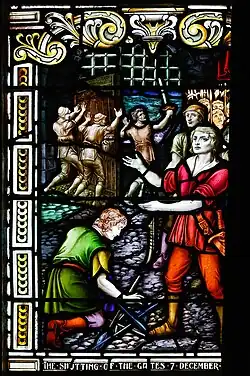
December 7 – December 7: The shutting of the gates in Derry in a stained glass window of the Guildhall[136] The gates of Derry are shut in front of the Jacobite Earl of Antrim and his "redshanks".[137] This initiates the siege of Derry, which is the first major event in the Williamite War in Ireland.
December 9 – The Battle of Reading takes place in Reading, Berkshire. It is the only substantial military action in England during the Glorious Revolution and ends in a decisive victory for forces loyal to William of Orange.
January 30 – The first performance of the opera Henrico Leone composed by Agostino Steffani takes place in Hannover to inaugurate the new royal theatre in the Leineschloss.
March 22 (March 12 O.S.) – Start of the Williamite War in Ireland: The deposed James II of England lands with 6,000 French soldiers in Ireland, where there is a Catholic majority, hoping to use it as the base for a counter-coup.[143] However, many Irish Catholics see him as an agent of Louis XIV, and refuse to support him.
March 27 – Japanese haiku master Bashō sets out on his last great voyage, which will result in the prose and verse classic Oku no Hosomichi ("Narrow Road to the Interior").
Boston revolt: Unpopular New England Governor Sir Edmund Andros and other officials are overthrown by a "mob" of Bostonians. Andros, an appointee of James II of England, is disliked for his support of the Church of England and revocation of various colonial charters.
The Siege of Derry begins in Ireland as former King James II arrives at the gates of Derry and asks for its surrender during the Williamite War in Ireland. The Protestant defenders refuse and the siege lasts until August 1 when it is abandoned. .[145]
The Battle of Bantry Bay begins during the Williamite War in Ireland as the French fleet under the Marquis de Châteaurenault is able to protect its transports, unloading supplies for James II, from the English Royal Navy under the Earl of Torrington, and withdraws unpursued.[146]
William and Mary accept the Scottish throne a month after the Scottish Parliament votes to depose King James VII
May 12 – Nine Years' War: With England and the Netherlands now both ruled by William III, they join the Grand Alliance (League of Augsburg), thus escalating the conflict, which continues until 1697. This is also the effective beginning of King William's War, the first of four North American Wars (until 1763) between English and French colonists, both sides allied to Native American tribes. The nature of the fighting is a series of raids on each other's settlements, across the Canadian and New England borders.
May 24 – The Act of Toleration, drawn up by the Convention Parliament of England to protect Protestants but with Roman Catholics intentionally excluded, is passed; this effectively concludes the Glorious Revolution.
May 25 – The last hearth tax is collected in England and Wales.
May 31 – Leisler's Rebellion: Calvinist Jacob Leisler deposes lieutenant governor Francis Nicholson and assumes control of the Province of New York.
June 5 – The Convention of Estates adjourns in Scotland after 11 weeks and its members form a new Scottish parliament.
June 14 – The Duke of Gordon, a Scottish peer and Jacobite supporter, surrenders Edinburgh Castle to Protestant attackers after holding out for 20 days following the Glorious Revolution.
July–September
July 25 – The Council of Wales and the Marches is abolished.
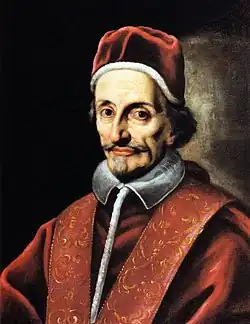
August 12 – Pope Innocent XI (Benedetto Odescalchi, b. 1611), Pope since 1676, dies. He played a major part in founding both the League of Augsburg, against Louis XIV, and the Holy League, against the Ottoman Empire.
August 20 – A large Williamite force under Marshal Schomberg begins the siege of Carrickfergus in the north of Ireland, which surrenders on August 27.
August 21 – First Jacobite rising: Battle of Dunkeld – Covenanters defeat the Jacobites in Scotland.[149]
Roman Catholic cardinals convene in Rome for a papal conclave to elect a successor to Pope Innocent XI. The conclave lasts until October 6.
Gravely ill, the Empress Xiaoyiren is proclaimed empress by her husband, China's Kangxi Emperor, after having been Imperial Noble Consort since 1682. She dies the next day.
September 3–12 – Messengers from over 100 Baptist churches assembled in the City of London to discuss and endorse the 1677 document that would become known as the 1689 Baptist Confession of Faith.[150]
September 8 – The Siege of Mainz (in the modern-day Rheinland-Pfalz state of Germany), which had started on June 1, ends after almost three months, as French General Nicolas Chalon du Blé surrenders the walled city to the armies of Austria and the Dutch Republic.
September 9 – King William brings England into a military alliance with the Holy Roman Empire in a fight against France in the Nine Years War.
September 24 – The Holy Roman Empire wins the Battle of Niš, fought against the Ottoman Empire during the Great Turkish War in modern-day Serbia.
October 6 – The papal conclave in Rome unanimously elects Pietro Vito Ottoboni as the new Pope. Ottoboni takes the name Alexander VIII and succeeds Pope Innocent XI, to become the 241st pope, the first Venetian to hold the office in over 200 years.
October 26 – Skopje fire of 1689 occurs, lasting for two days and burning much of the city.
November 11 – The Siege of Larache in Morocco ends when the Spanish troops surrender to Mawlay Ismail and the Moroccan forces.
December 10 – A great comet is visible from Pekin and sightings continue until December 24th, including many from Dutch ships near the equator.[152]
December 16 – The Bill of Rights (An Act Declaring the Rights and Liberties of the Subject and Settling the Succession of the Crown), drawn up by the Convention Parliament of England to establish constitutional monarchy in England, but with Roman Catholics barred from the throne, receives royal assent; it will remain substantially in force into the 21st century.
Valvasor's The Glory of the Duchy of Carniola is printed in Nuremberg.
The first documented performance of the opera Dido and Aeneas by Henry Purcell takes place at Josias Priest's girls' school in Chelsea, London, with a libretto based on Virgil's Aeneid.[156]
Felipe Fernandez de Pardo, Roman Catholic prelate, Archbishop of Manila (b. 1611)
Gilbert de Choiseul Duplessis Praslin, Roman Catholic bishop (b. 1613)
Anders Sinclair, Scottish soldier who joined Swedish service during the Thirty Years' War (b. 1614)
References
^James Peller Malcolm, Londinium Redivivum, or, An Ancient History and Modern Description of London (J. Nichols, 1807) p. 433
^Edward G. Lilly, ed., Historic Churches of Charleston, South Carolina (Legerton Publishing, 1966) p. 29
^"William III, Brandenburg, and the anti-French coalition", by Wouter Troost, in The Anglo-Dutch Moment: Essays on the Glorious Revolution and Its World Impact, ed. by Jonathan I. Israel (Cambridge University Press, 2003) p. 315
^ ab"Pueblo Revolt", by Amy Meschke, in Encyclopedia of Leadership (Sage Publications, 2004) p. 1277
^John Childs, General Percy Kirke and the Later Stuart Army (Bloomsbury Publishing, 2014) p. 35
^"The peace treaties of the Ottoman Empire with European Christian powers", by Karl-Heinz Ziegler, in Peace Treaties and International Law in European History: From the Late Middle Ages to World War One, ed. by Randall Lesaffer (Cambridge University Press, 2004) p. 349
^N.C. Datta, The Story of Chemistry (Universities Press, 2005) p. 74
^Frederic E. Wakeman, The Great Enterprise: The Manchu Reconstruction of Imperial Order in Seventeenth-century China (University of California Press, 1985) p. 1120
^ abPenguin Pocket On This Day. Penguin Reference Library. 2006. ISBN 0-14-102715-0.
^"Comet Halley 1682", in Atlas of Great Comets, by Ronald Stoyan (Cambridge University Press, 2015) p. 90
^Gent, Frank J. (1982). The Trial of the Bideford Witches. Bideford.{{cite book}}: CS1 maint: location missing publisher (link) Another woman was sentenced to be hanged for witchcraft in Exeter in 1685 although there is no surviving confirmation that the sentence was carried out. "The Devon "Witches"". Exeter Civic Society. Retrieved 2022-07-27.
^Walford, Cornelius, ed. (1876). "Fires, Great". The Insurance Cyclopeadia: Being an Historical Treasury of Events and Circumstances Connected with the Origin and Progress of Insurance. C. & E. Layton. p. 44.
^Walford, Cornelius, ed. (1876). "Fires, Great". The Insurance Cyclopeadia: Being an Historical Treasury of Events and Circumstances Connected with the Origin and Progress of Insurance. C. & E. Layton. p. 44.
^ abEverett, Jason M., ed. (2006). "1683". The People's Chronology. Thomson Gale.
^Juré Fiorillo, Great Bastards of History: True and Riveting Accounts of the Most Famous Illegitimate Children Who Went on to Achieve Greatness (Fair Winds Press, 2010) p. 82
^Anne Emily Garnier Newdigate-Newdegate, ed., Cavalier and Puritan in the Days of the Stuarts: Compiled from the Private Papers and Diary of Sir Richard Newdigate, Second Baronet, with Extracts from Ms. News-letters Addressed to Him Between 1675 and 1689 (Smith, Elder, & Co., 1901) p. 234
^William Andrews, Famous Frosts and Frost Fairs in Great Britain: Chronicled from the Earliest to the Present Time (G. Redway, 1887) pp. 17-18
^Stratton, J. M. (1969). Agricultural Records. John Baker. ISBN 0-212-97022-4.
^Ulrich van der Heyden, Rote Adler an Afrikas Küste: Die Brandenburgisch-preussische Kolonie Grossfriedrichsburg in Westafrika ("Red eagles on the African coast: the Brandenburg-Prussian colony of Grossfriedrichsburg in West Africa") (Selignow, 2001) p. 31
^Ulrich van der Heyden, Rote Adler an Afrikas Küste: Die Brandenburgisch-preussische Kolonie Grossfriedrichsburg in Westafrika ("Red eagles on the African coast: the Brandenburg-Prussian colony of Grossfriedrichsburg in West Africa") (Selignow, 2001) p. 32
^de Choisy, Abbé (1993). Journal of a Voyage to Siam: 1685-1686 (Translated and Introduced by Michael Smithies). Kuala Lumpur: Oxford University Press. p. 89. ISBN 967-65-3026-3.
^Armbruster, Caroline (2016). "Alice Molland (d.1685)". In Levin, Carole; et al. (eds.). A Biographical Encyclopedia of Early Modern Englishwomen: Exemplary Lives: 1500–1650. Routledge. p. 334. OCLC949870073.
^Worth, John E. (February 4, 2007). The Struggle for the Georgia Coast. University of Alabama Press. p. 164. ISBN 978-0-8173-5411-4. Retrieved May 13, 2023.
^Vance A. Myers, Storm Tide Frequencies on the South Carolina Coast, NOAA Technical Report NWS-16 (National Weather Service Office of Hydrology, June 1975) p. 15
^Lieutenant Colonel D. G. Crawford, A Brief History of the Hughli District (Bengal Secretariat Press, 1902) p. 18
^Palmer, Alan; Palmer, Veronica (1992). The Chronology of British History. London: Century Ltd. pp. 196–197. ISBN 0-7126-5616-2.
^Barsoum, Ephrem (2009). History of the Syriac Dioceses. Vol. 1. Translated by Matti Moosa. Gorgias Press. p. 1.
^Kiraz, George A. (2011). "Giwargis II, Ignatius". In Sebastian P. Brock; Aaron M. Butts; George A. Kiraz; Lucas Van Rompay (eds.). Gorgias Encyclopedic Dictionary of the Syriac Heritage: Electronic Edition. Gorgias Press. p. 178. Retrieved 17 September 2020.
^"Intercolonial Friction (1660—1700)", in Wars of the Americas: A Chronology of Armed Conflict in the Western Hemisphere (ABC-CLIO, 2008) p. 308
^Kelly, Billy (2009). "THE GUILDHALL: Derry's Museum in Glass". History Ireland. 17 (6): 66–69. JSTOR 40588462.
^Reid, James Seaton; Killen, William Dool; Alexander, Samuel Davies (1860). History of the Presbyterian Church in Ireland. New York: Robert Charter & Brothers. p. 232. Retrieved 10 June 2023.
^Sell, Alan P. F. (28 November 2017). "The Life and Thought of Henry Grove". Testimony and Tradition: Studies in Reformed and Dissenting Thought. Routledge. ISBN 978-1-351-14810-8. Retrieved 5 April 2023.
^Babuscio, Jack; Dunn, Richard (1984). European political facts, 1648-1789. New York, NY: Facts on File. p. 12. ISBN 978-0-87196-992-7. Retrieved 10 April 2023.
^Sedgwick, Romney (1970). The House of Commons, 1715-1754. London: History of Parliament Trust. p. 282. ISBN 978-0-11-880098-3. Retrieved 13 April 2023.
^Mirza, Umair (1 March 1911). Encyclopedia Britannica. Vol. 25. The Encyclopedia Britannica Company. p. 749. Retrieved 13 April 2023.
^Aubert de La Chesnaye-Desbois, François-Alexandre (1770). Dictionnaire de la noblesse (in French). Paris: La veuve Duchesne. p. 236. Retrieved 17 April 2023.
^Music in Spain During the Eighteenth Century Malcolm Boyd, Juan José Carreras - 2006 "D. Jayme de la Te y Sagau, impressor da Musica na Corte de Lisboa, imprimiu estas Décadas, porém quando sahi de Portugal creyo que não estava ..."
^Hayton, David; Cruickshanks, Eveline (2002). The House of Commons, 1690-1715. Cambridge University Press. p. 567. ISBN 978-0-521-77221-1. Retrieved June 2, 2023.
^Herbermann, Charles George; Pace, Edward A.; Shahan, Thomas J.; Pallen, Conde B.; Wynne, John J. (1910). The Catholic Encyclopedia: Laprade-Mass. Vol. 9. New York: Appleton. p. 3. Retrieved June 2, 2023.
^Половцова, А. А. (1905). Русский биографический словарь (in Russian). Санкт-Петербургское Императорское Русское историческое общество. p. 405. Retrieved June 2, 2023.
^The Americana. Vol. 23. The Encyclopedia Americana Corporation. 1923. p. 205. Retrieved May 24, 2023.
^MACARÉ, A.C. "MACARÉ". hogenda.nl (in Dutch). p. 13. Retrieved June 2, 2023.
^Herbermann, Charles George; Pace, Edward A.; Shahan, Thomas J.; Pallen, Conde B.; Wynne, John J. (1910). Catholic Encyclopedia. Vol. 8. New York: Appleton. p. 569. Retrieved June 2, 2023.
^Sedgwick, Romney (1970). The House of Commons, 1715-1754. London: History of Parliament Trust. p. 109. ISBN 978-0-11-880098-3. Retrieved June 2, 2023.
^Edney, Matthew H.; Pedley, Mary Sponberg (15 May 2020). The History of Cartography. Vol. 4. University of Chicago Press. p. 342. ISBN 978-0-226-33922-1.
^Biographie, Deutsche (1876). Allgemeine Deutsche Biographie (in German). Historical Commission of the Bavarian Academy of Science. Retrieved 11 June 2023.
^Setton, Kenneth Meyer (1991). Venice, Austria, and the Turks in the seventeenth century. Memoirs of the American philosophical society. Philadelphia (Pa.): the American philosophical society. p. 358. ISBN 978-0-87169-192-7.

.png)
_The_painter_Antoine_Watteau_by_Rosalba_Carriera_-_Museo_civico_di_Santa_Caterina.jpg)
%252C_Holy_Roman_Emperor.jpg)



.jpg)

.jpg)

.png)
.jpg)
%252C_by_Jacob_Houbraken.jpg)
%252C_wife_of_Sir_Richard_Fanshawe.jpeg)










.jpg)

.jpg)


.jpg)





%252C_Lady_Fisher_from_NPG.jpg)